This is the content of the pop-over!

Praxis PLT: Grades 5-9 (5623) Practice Tests & Test Prep by Exam Edge


Praxis Principles of Learning and Teaching Grades 5-9  product image
(5.0)
Based on 17 Reviews

  • Real Exam Simulation: Timed questions and matching content build comfort for your Praxis PLT: Grades 5-9 test day.
  • Instant, 24/7 Access: Web-based Praxis Principles of Learning and Teaching Grades 5-9 practice exams with no software needed.
  • Clear Explanations: Step-by-step answers and explanations for your Praxis exam to strengthen understanding.
  • Boosted Confidence: Reduces anxiety and improves test-taking skills to ace your Praxis Principles of Learning and Teaching Grades 5-9 (5623).

Featured on

Praxis Principles of Learning and Teaching Grades 5-9 Online Practice Test Bundles

BEST VALUE
15 practice tests

$149.25

$599.25

SAVE $450

Only $9.95 per test!

  • 100% Pass Guarantee
  • 15 online practice tests
  • 70 questions + 4 essays per test
  • Bonus: 100 Flash Cards + Study Guide
  • Instant access
  • Detailed Explanations
  • Practice tests never expire
  • Timed, untimed, or study guide mode
MOST POPULAR
10 practice tests

$99.50

$399.50

SAVE $300

Only $9.95 per test!

  • 10 online practice tests
  • 70 questions + 4 essays per test
  • Bonus: 100 Flash Cards + Study Guide
  • Instant access
  • Detailed Explanations
  • Practice tests never expire
  • Timed, untimed, or study guide mode
5 practice tests

$69.75

$199.75

SAVE $130

Only $13.95 per test!

  • 5 online practice tests
  • 70 questions + 4 essays per test
  • Bonus: 100 Flash Cards
  • Instant access
  • Detailed Explanations
  • Practice tests never expire
  • Timed, untimed, or study guide mode
1 practice test

$39.95

  • 1 online practice test
  • 70 questions + 4 essays per test
  • Instant access
  • Detailed Explanations
  • Practice tests never expire
  • Timed, untimed, or study guide mode
Quick Select
Tap to choose a bundle

** All Prices are in US Dollars (USD) **


Praxis PLT: Grades 5-9 (5623) Resources

Jump to the section you need most.

Understanding the exact breakdown of the Praxis Principles of Learning and Teaching Grades 5-9 test will help you know what to expect and how to most effectively prepare. The Praxis Principles of Learning and Teaching Grades 5-9 has 70 multiple-choice questions and 4 essay questions. The exam will be broken down into the sections below:

Praxis Principles of Learning and Teaching Grades 5-9 Exam Blueprint
Domain Name % Number of
Questions
Students as Learners 22.5% 16
Instruction and Process 22.5% 16
Assessment 15% 11
Professional Development - Leadership and Community 15% 11
Analysis of Instructional 25% 18
     Students as Learners  
     Instructional Process  
     Assessment  
     Professional Development - Leadership and Community  

Praxis Principles of Learning and Teaching Grades 5-9 Study Tips by Domain

  • Identify how physical, social, emotional, and cognitive development typically looks in grades 5–9; red flag: treating early adolescence as “mini adults” rather than expecting variability in maturity and self-regulation.
  • Apply major learning theories (behaviorism, social learning, information processing, constructivism) to classroom scenarios; common trap: choosing a theory buzzword instead of matching the theory to the evidence in the vignette (e.g., modeling → social learning).
  • Use motivation principles (intrinsic vs. extrinsic, goal orientation, self-efficacy) to explain engagement; priority rule: reinforce effort/strategy and growth, not fixed ability labels, to avoid undermining persistence.
  • Interpret individual differences and diverse learners (ELLs, IEP/504, cultural/linguistic background, gifted) in terms of access and supports; red flag: confusing accommodation (how) with modification (what) when selecting an appropriate response.
  • Recognize factors affecting learning such as prior knowledge, misconceptions, attention, and memory limits; practical cue: pre-assess before introducing new content when student errors suggest a misconception rather than simple skill gaps.
  • Promote safe, inclusive learning conditions that reduce barriers (belonging, trauma awareness, bias prevention); contraindication: public comparisons, sarcasm, or shaming—they often escalate behavior and reduce academic risk-taking in this age group.
  • Set measurable objectives aligned to a standard and an end-of-lesson check (e.g., exit ticket)—red flag: activities that are fun but don’t map to the stated learning target.
  • Use a gradual release sequence (I do–We do–You do) with purposeful modeling and guided practice—common trap: moving to independent work before students can demonstrate success during guided practice.
  • Differentiate by content, process, and product (scaffolds, tiered tasks, choice) while keeping the same core goal—priority rule: accommodations change access, not the learning expectation.
  • Maintain momentum and time-on-task with clear routines, transitions, and proximity—red flag: frequent downtime or unclear directions that create behavior issues.
  • Use questioning strategies that include adequate wait time and require evidence-based responses—common trap: calling on the first hand up repeatedly, which hides misconceptions and reduces equity.
  • Teach and reinforce academic language and literacy strategies within the content (vocabulary, text structures, discourse norms)—priority rule: don’t assume students can “read to learn” without explicit supports.
  • Use formative assessment during instruction to adjust pacing and supports; red flag: collecting exit tickets but not changing instruction based on the data.
  • Align every item and task to the intended learning target and level of rigor; common trap: assessing recall when the objective requires analysis or application.
  • Prioritize validity and reliability in classroom measures (clear criteria, consistent scoring); red flag: vague rubrics that produce different scores for the same work.
  • Provide timely, specific feedback tied to criteria and next steps; common trap: grades-only feedback that doesn’t tell students what to improve.
  • Interpret assessment results using multiple data points and look for patterns across groups; red flag: making high-stakes decisions from a single quiz or one outlier score.
  • Ensure fairness and accessibility with appropriate accommodations and language supports while keeping the construct intact; contraindication: modifying the skill being measured (e.g., reading the reading test aloud when decoding is the construct).
  • Follow ethical practice and test security rules—red flag: discussing specific test items or student records in public spaces or on social media violates confidentiality.
  • Use collaboration structures (e.g., PLCs, co-planning) with clear roles and norms—common trap: meetings that focus on opinions instead of student evidence and agreed next steps.
  • Communicate with families using accessible, jargon-free language and multiple modalities—priority rule: document outreach attempts, especially when concerns involve safety, attendance, or failing performance.
  • Know mandatory reporting and school protocols for suspected abuse, self-harm, or threats—contraindication: do not investigate yourself; report immediately to the designated personnel per policy.
  • Use professional learning goals tied to measurable student outcomes and reflect on impact—common trap: logging PD hours without implementing, collecting evidence, and adjusting practice.
  • Promote equitable, culturally responsive school-community partnerships—red flag: “one-size-fits-all” events that exclude families due to language, scheduling, transportation, or disability access barriers.
  • Use evidence (student work, observation notes, exit tickets) to judge whether lesson objectives were met; red flag: praising engagement when the stated standard/target wasn’t assessed.
  • Analyze patterns by subgroup and misconception (not just overall averages) to decide next steps; common trap: reteaching everything instead of targeting the specific error trend.
  • Check alignment among objective, task, and assessment; priority rule: if the assessment doesn’t measure the objective, your conclusions about effectiveness are invalid.
  • Evaluate pacing and cognitive demand for grades 5–9; red flag: students finish quickly with high accuracy because the task is too low-level, not because mastery is deep.
  • Review classroom management and routines as they affect learning time; common trap: interpreting off-task behavior as “lack of motivation” when expectations, transitions, or directions were unclear.
  • Select actionable instructional adjustments (scaffold, model, regroup, re-sequence, enrichment) and match them to the diagnosed issue; contraindication: giving more practice without changing instruction when misunderstanding is conceptual.
  • Connect early adolescent development to instruction—use concrete-to-abstract scaffolds and allow peer interaction, but watch the red flag of assuming all 11–14-year-olds are at the same cognitive stage.
  • Plan for motivation and engagement by supporting autonomy, competence, and relevance; a common trap is overusing extrinsic rewards that reduce persistence once the reward is removed.
  • Differentiate for readiness, interest, and learning needs (e.g., tiered tasks, flexible grouping); red flag: confusing “more work” with appropriate challenge for advanced learners.
  • Use culturally responsive practices (multiple perspectives, inclusive materials, community funds of knowledge); avoid the trap of tokenism—adding a single cultural example without changing participation norms or expectations.
  • Support students with disabilities and multilingual learners through accommodations and language supports (sentence frames, visuals, extended time); priority rule: accommodations change access, not the learning target or scoring criteria.
  • Address classroom climate and behavior through proactive routines, clear expectations, and restorative responses; red flag: escalating to punitive consequences without identifying the function of behavior (attention, escape, sensory, tangible).
  • Plan lessons with clear, measurable objectives aligned to standards and checks for understanding; red flag: activities that are engaging but not tied to an outcome you can assess.
  • Use research-based strategies (e.g., modeling, guided practice, gradual release) and explicitly teach the “why” and “how”; common trap: skipping modeling and expecting independent work to succeed.
  • Differentiate content/process/product using readiness, interest, and learning profile; priority rule: provide equitable access without lowering rigor (avoid “more of the same” as differentiation).
  • Manage time, transitions, and routines to maximize learning minutes; red flag: unclear procedures that cause repeated off-task behavior during group work or movement.
  • Use questioning and discussion techniques that move from recall to analysis (wait time, probing, cold call with support); common trap: calling only on volunteers and accepting one-word answers.
  • Integrate technology and instructional materials purposefully with clear expectations and monitoring; contraindication: using tech as a reward or filler instead of to meet an instructional goal.
  • Use formative checks (e.g., exit tickets, quick writes) to adjust instruction in the moment; red flag: treating formative results as grades rather than feedback for next steps.
  • Match assessment type to purpose (diagnostic at start, formative during, summative at end); common trap: using a unit test to identify prerequisite gaps after instruction has already moved on.
  • Write aligned items that measure the target (standard/objective) at the intended rigor; red flag: vocabulary-heavy wording that turns a content assessment into a reading test.
  • Interpret results with basic measurement principles (validity, reliability, bias) in mind; priority rule: if an assessment isn’t valid for the learning target, higher “reliability” doesn’t fix it.
  • Use clear criteria (rubrics, exemplars) for constructed responses and performance tasks; common trap: scoring on neatness/effort when those aren’t in the rubric.
  • Ensure ethical/legal assessment practices (accommodations vs. modifications, confidentiality); red flag: changing what is being measured (modification) when only access supports (accommodations) are permitted.
  • Follow legal/ethical duties — FERPA confidentiality and mandated reporting for suspected abuse/neglect; red flag: promising a student “I won’t tell anyone” or discussing grades/IEPs in public areas.
  • Use data-driven reflection (formative + summative) to set a measurable growth goal; common trap: choosing a PD goal not tied to student evidence (e.g., “use more tech” without a baseline and progress check).
  • Collaborate in PLCs/teams with clear norms (agenda, roles, action items) and bring student work to calibrate expectations; red flag: meetings that stay at “sharing activities” without analyzing learning outcomes.
  • Partner with families using culturally responsive, two-way communication (interpretation as needed, multiple channels); priority rule: contact home early for positives — not only when behavior/grades become crises.
  • Support inclusive services by implementing IEP/504 accommodations as written and documenting attempts; common trap: modifying curriculum/grading without team approval or failing to provide listed accommodations during assessments.
  • Contribute to school/community climate through professional conduct (social media, boundaries, equity); red flag: posting student images/work without consent or engaging in biased/discriminatory language that undermines trust.


Built to Fit Into Your Busy Life

Everything you need to prepare with confidence—without wasting a minute.

Three Study Modes

Timed, No Time Limit, or Explanation mode.

Actionable Analytics

Heatmaps and scaled scores highlight weak areas.

High-Yield Rationales

Concise explanations emphasize key concepts.

Realistic Interface

Matches the feel of the actual exam environment.

Accessible by Design

Clean layout reduces cognitive load.

Anytime, Anywhere

Web-based access 24/7 on any device.
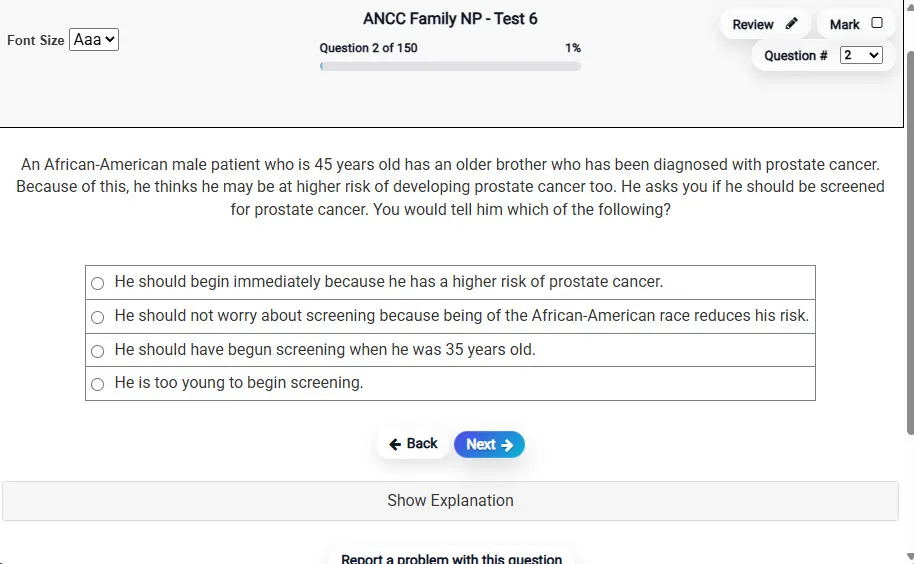
Answering a Question screen – Multiple-choice item view with navigation controls and progress tracker.
Answering a Question Multiple-choice item view with navigation controls and progress tracker.

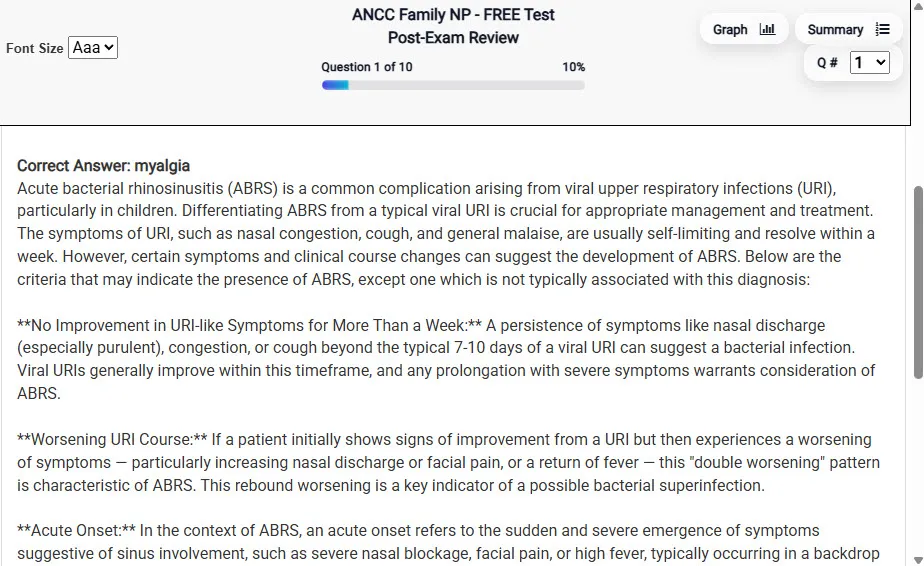
                           Detailed Explanation screen – 
                         Review mode showing chosen answer and rationale and references.
Detailed Explanation Review mode showing chosen answer and rationale and references.

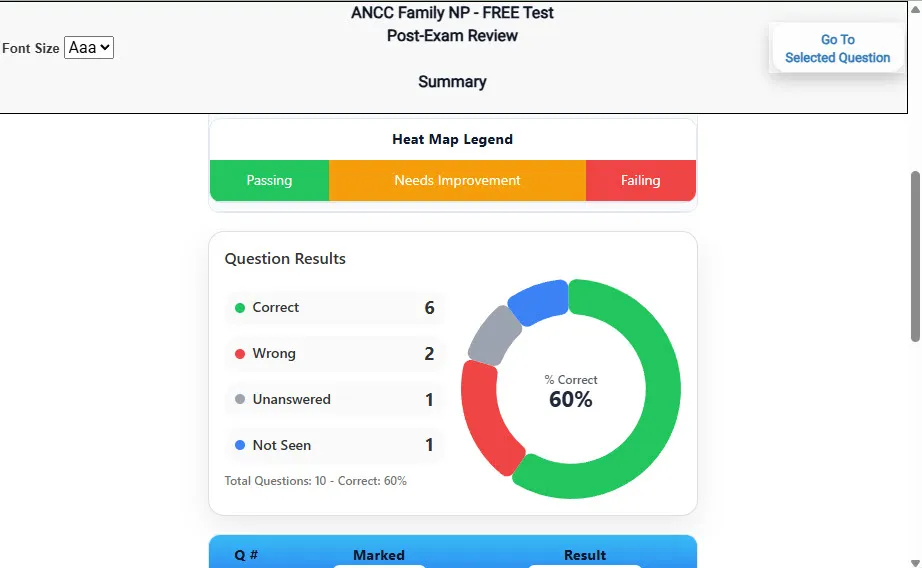
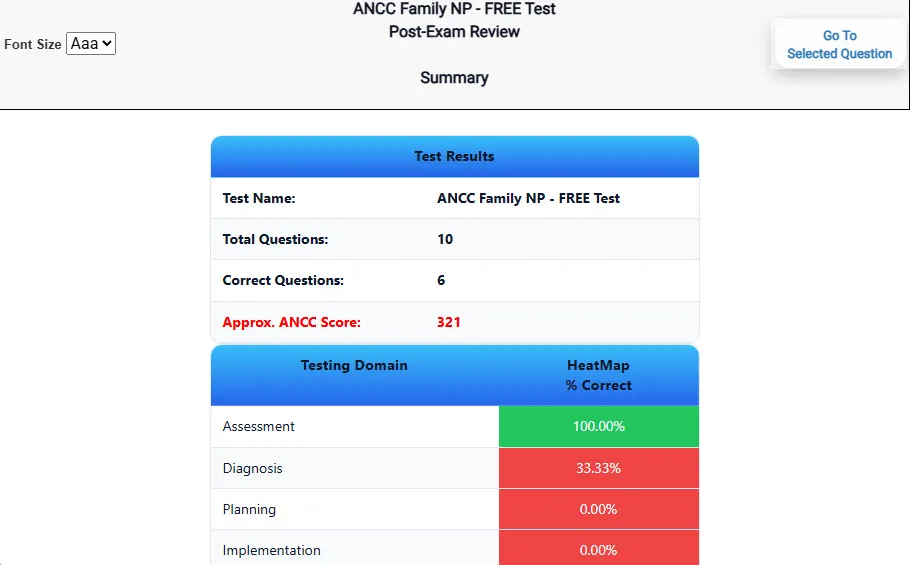
                           Review Summary 1 screen – 
                         Summary with counts for correct/wrong/unanswered and not seen items.
Review Summary 1 Summary with counts for correct/wrong/unanswered and not seen items.

                           Review Summary 2 screen – 
                         Advanced summary with category/domain breakdown and performance insights.
Review Summary 2 Advanced summary with category/domain breakdown and performance insights.

What Each Screen Shows

Answer Question Screen

  • Clean multiple-choice interface with progress bar.
  • Mark for review feature.
  • Matches real test pacing.

Detailed Explanation

  • Correct answer plus rationale.
  • Key concepts and guidelines highlighted.
  • Move between questions to fill knowledge gaps.

Review Summary 1

  • Overall results with total questions and scaled score.
  • Domain heatmap shows strengths and weaknesses.
  • Quick visual feedback on study priorities.

Review Summary 2

  • Chart of correct, wrong, unanswered, not seen.
  • Color-coded results for easy review.
  • Links back to missed items.

Top 10 Reasons to Use Exam Edge for your Praxis Principles of Learning and Teaching Grades 5-9 Exam Prep

  1. Focused on the Praxis Principles of Learning and Teaching Grades 5-9 Exam

    Our practice tests are built specifically for the Praxis PLT: Grades 5-9 exam — every question mirrors the real topics, format, and difficulty so you're studying exactly what matters.

  2. Real Exam Simulation

    We match the per-question time limits and pressure of the actual Praxis exam, so test day feels familiar and stress-free.

  3. 15 Full Practice Tests & 1,110 Unique Questions

    You'll have more than enough material to master every Praxis PLT: Grades 5-9 concept — no repeats, no fluff.

  4. Lower Cost Than a Retake

    Ordering 5 practice exams costs less than retaking the Praxis Principles of Learning and Teaching Grades 5-9 exam after a failure. One low fee could save you both time and money.

  5. Flexible Testing

    Need to step away mid-exam? Pick up right where you left off — with your remaining time intact.

  6. Instant Scoring & Feedback

    See your raw score and an estimated Praxis Principles of Learning and Teaching Grades 5-9 score immediately after finishing each practice test.

  7. Detailed Explanations for Every Question

    Review correct and incorrect answers with clear, step-by-step explanations so you truly understand each topic.

  8. Trusted & Accredited

    We're fully accredited by the Better Business Bureau and uphold the highest standards of trust and transparency.

  9. Web-Based & Always Available

    No software to install. Access your Praxis PLT: Grades 5-9 practice exams 24/7 from any computer or mobile device.

  10. Expert Support When You Need It

    Need extra help? Our specialized tutors are highly qualified and ready to support your Praxis exam prep.


Pass the Praxis Principles of Learning and Teaching Grades 5-9 Exam with Realistic Practice Tests from Exam Edge

Preparing for your upcoming Praxis Principles of Learning and Teaching Grades 5-9 (5623) Certification Exam can feel overwhelming — but the right practice makes all the difference. Exam Edge gives you the tools, structure, and confidence to pass on your first try. Our online practice exams are built to match the real Praxis PLT: Grades 5-9 exam in content, format, and difficulty.

  • 📝 15 Praxis Principles of Learning and Teaching Grades 5-9 Practice Tests: Access 15 full-length exams with 74 questions each, covering every major Praxis Principles of Learning and Teaching Grades 5-9 topic in depth.
  • Instant Online Access: Start practicing right away — no software, no waiting.
  • 🧠 Step-by-Step Explanations: Understand the reasoning behind every correct answer so you can master Praxis PLT: Grades 5-9 exam concepts.
  • 🔄 Retake Each Exam Up to 4 Times: Build knowledge through repetition and track your improvement over time.
  • 🌐 Web-Based & Available 24/7: Study anywhere, anytime, on any device.
  • 🧘 Boost Your Test-Day Confidence: Familiarity with the Praxis format reduces anxiety and helps you perform under pressure.

These Praxis Principles of Learning and Teaching Grades 5-9 practice exams are designed to simulate the real testing experience by matching question types, timing, and difficulty level. This approach helps you get comfortable not just with the exam content, but also with the testing environment, so you walk into your exam day focused and confident.


Exam Edge Praxis Reviews


I failed the Praxis Math test five times before I found your site. After taking all your practice tests, on my next attempt I passed by five points! I can honestly say this site is the reason I passed. Thank you!!!

Nikki P, Tennessee

Just wanted to say thanks for helping me pass the Praxis I Reading! Your practice tests and especially your explanations are great. They gave me the confidence I needed! Now I can student teach this fall. I'm so glad I found PraxisReading.com!

Denise C, Florida

Thank you so much. I just received my results in the mail. I scored a 179 and passed the Praxis I Writing! I'll never have to worry about retaking this test again! PraxisWriting.com is great. I told all my friends about this site.

Susan K, Virginia

I failed the Parapro test four times before I found your site. After taking all your practice tests, on my next attempt I passed by seven points! I can honestly say that this site is the reason I passed. Thank you!!!

Rebecca S, Texas

Hi! Just returned from taking my Praxis computerized and am happy to say that I passed with a 175. The last time I took the test I missed by 1 point. Your tests definitely made the difference for me! The set up was so similar to the test and the types of questions were also similar that I felt ve ...
Read More
Brad Y, Pennsylvania

I have taken the math praxis 3 times and wanted to give up. I ordered the bundle of math tests and I passed the math praxis today. Thank you for all the help.

Jacob D, South Carolina


Praxis Principles of Learning and Teaching Grades 5-9 Aliases Test Name

Here is a list of alternative names used for this exam.

  • Praxis Principles of Learning and Teaching Grades 5-9
  • Praxis Principles of Learning and Teaching Grades 5-9 test
  • Praxis Principles of Learning and Teaching Grades 5-9 Certification Test
  • Praxis PLT: Grades 5-9 test
  • Praxis
  • Praxis 5623
  • 5623 test
  • Praxis Principles of Learning and Teaching Grades 5-9 (5623)
  • Principles of Learning and Teaching Grades 5-9 certification