This is the content of the pop-over!

Praxis Physics (5265) Practice Tests & Test Prep by Exam Edge


Praxis Physics Content Knowledge product image
(5.0)
Based on 28 Reviews

  • Real Exam Simulation: Timed questions and matching content build comfort for your Praxis Physics Content test day.
  • Instant, 24/7 Access: Web-based Praxis Physics Content Knowledge practice exams with no software needed.
  • Clear Explanations: Step-by-step answers and explanations for your Praxis exam to strengthen understanding.
  • Boosted Confidence: Reduces anxiety and improves test-taking skills to ace your Praxis Physics Content Knowledge (5265).

Featured on

Praxis Physics Content Knowledge Online Practice Test Bundles

BEST VALUE
15 practice tests

$149.25

$599.25

SAVE $450

Only $9.95 per test!

  • 100% Pass Guarantee
  • 15 online practice tests
  • 100 questions per test
  • Bonus: 100 Flash Cards + Study Guide
  • Instant access
  • Detailed Explanations
  • Practice tests never expire
  • Timed, untimed, or study guide mode
MOST POPULAR
10 practice tests

$99.50

$399.50

SAVE $300

Only $9.95 per test!

  • 10 online practice tests
  • 100 questions per test
  • Bonus: 100 Flash Cards + Study Guide
  • Instant access
  • Detailed Explanations
  • Practice tests never expire
  • Timed, untimed, or study guide mode
5 practice tests

$69.75

$199.75

SAVE $130

Only $13.95 per test!

  • 5 online practice tests
  • 100 questions per test
  • Bonus: 100 Flash Cards
  • Instant access
  • Detailed Explanations
  • Practice tests never expire
  • Timed, untimed, or study guide mode
1 practice test

$39.95

  • 1 online practice test
  • 100 questions per test
  • Instant access
  • Detailed Explanations
  • Practice tests never expire
  • Timed, untimed, or study guide mode
Quick Select
Tap to choose a bundle

** All Prices are in US Dollars (USD) **


Praxis Physics Content (5265) Resources

Jump to the section you need most.

Understanding the exact breakdown of the Praxis Physics Content Knowledge test will help you know what to expect and how to most effectively prepare. The Praxis Physics Content Knowledge has 125 multiple-choice questions . The exam will be broken down into the sections below:

Praxis Physics Content Knowledge Exam Blueprint
Domain Name % Number of
Questions
Mechanics 32% 40
Electricity and Magnetism 19% 24
Optics and Waves 13% 16
Heat - Energy and Thermodynamics 12% 15
Modern Physics - Atomic
Nuclear Structure
12% 15
History and Nature of Science
Science Technology Social
Perspectives (STS)
12% 15

Praxis Physics Content Knowledge Study Tips by Domain

  • Use free-body diagrams first and choose a sign convention; red flag: mixing axes after writing equations often flips friction or tension signs.
  • Apply kinematics only when acceleration is constant and distinguish displacement from distance; common trap: using average speed formulas for vector motion.
  • For Newton’s laws, check action–reaction pairs act on different objects; priority rule: do not cancel third-law forces within the same free-body diagram.
  • Use work–energy and conservation of mechanical energy when forces are conservative; contraindication: if kinetic friction or external work is present, energy is not conserved without adding nonconservative work terms.
  • For momentum and impulse, conserve momentum only in an isolated system; threshold: during collisions, external impulses must be negligible compared to internal forces.
  • In circular/rotational motion, centripetal acceleration is radial (not a new force) and torque is measured about a chosen pivot; common trap: forgetting the perpendicular lever arm or using I values about the wrong axis.
  • Apply Coulomb’s law and superposition for multiple point charges; red flag: forgetting that force is a vector and mis-handling sign/direction when charges are negative.
  • Use electric field and potential relations (e.g., E = −∇V and for uniform fields ΔV = −Ed); common trap: treating potential as a vector or mixing up units (V vs N/C).
  • Gauss’s law is a shortcut only with high symmetry (spherical, cylindrical, planar); priority rule: choose a Gaussian surface where E is constant and parallel/perpendicular to dA or you won’t simplify the flux integral.
  • Circuits: combine resistors correctly and use Kirchhoff’s rules with consistent sign conventions; red flag: swapping series/parallel logic or ignoring internal resistance when the problem states a non-ideal battery.
  • Magnetic forces and motion: use F = qvB sinθ and F = ILB sinθ plus right-hand rules; common trap: assuming magnetic force does work or forgetting that only the perpendicular velocity component curves.
  • Induction and EM waves basics: Faraday’s law (emf = −dΦB/dt) with Lenz’s law for direction; red flag: missing the negative sign conceptually or confusing changing flux with just changing B.
  • Use the wave relation v = fλ and keep units consistent; red flag: mixing Hz with rpm or using nm with m without converting.
  • Apply Snell’s law n1sinθ1 = n2sinθ2 and remember the critical angle only exists for n1 > n2; common trap: claiming total internal reflection from low to high index.
  • For thin lenses/mirrors use 1/f = 1/do + 1/di and magnification m = −di/do; priority rule: a negative di indicates a virtual image on the object side.
  • In interference/diffraction, distinguish maxima conditions (double-slit: d sinθ = mλ; single-slit minima: a sinθ = mλ)—trap: using the same formula for both patterns.
  • For standing waves on strings and open/closed pipes, enforce boundary conditions; red flag: including even harmonics in a closed–open pipe where only odd harmonics occur.
  • Use the Doppler effect with sign conventions (approaching increases observed frequency) and the small-angle approximation only when θ is in radians; common trap: plugging degrees into sinθ ≈ θ.
  • Convert temperatures correctly: use Kelvin for gas laws and thermodynamics (K = °C + 273.15) — red flag if you see a ratio like T2/T1 done in °C.
  • Apply the first law with consistent sign convention (e.g., ΔU = Q − W, where W is work done by the system) — common trap is flipping signs when switching between “work on” vs “work by.”
  • Use PV work for quasi-static processes: W = ∫P dV, and for isobaric W = PΔV — red flag if a problem implies free expansion (then W = 0) but a student computes PΔV anyway.
  • Know which ideal-gas process makes which quantity zero: isothermal ΔU = 0, isochoric W = 0, adiabatic Q = 0 — common trap is assuming Q = 0 whenever T is constant.
  • For calorimetry, include all energy terms: Q = mcΔT plus phase change Q = mL, and set heat lost + heat gained = 0 in an isolated system — red flag when the temperature crosses 0°C or a boiling point but latent heat is ignored.
  • Second-law reasoning: heat engines obey W = QH − QC and η = W/QH ≤ 1 − TC/TH (Carnot, temperatures in K) — red flag if an efficiency exceeds the Carnot limit or if Celsius is used in TC/TH.
  • Use photon energy relations accurately: E = hf = hc/λ and p = h/λ; red flag—mixing nm and m (convert first) can shift results by 109.
  • Apply atomic energy-level transitions with ΔE = Ei − Ef and emitted photon frequency f = ΔE/h; common trap—sign errors (emission means Ei > Ef).
  • For the photoelectric effect, use Kmax = hf − φ threshold frequency f0 = φ/h; priority rule—increasing intensity raises current, not electron Kmax.
  • For radioactive decay, use N = N0e−λt and t1/2 = ln2/λ; common trap—confusing activity A = λN with the number of nuclei remaining.
  • Balance nuclear reactions by conserving mass number A and charge Z (e.g., α is 42He, β increases Z by 1, β+/electron capture decreases Z by 1); red flag—forgetting the neutrino/&antineutrino in β decay when checking conservation laws.
  • Use mass–energy equivalence for binding energy: B = (Δm)c2 where Δm = Zmp + Nmn − mnucleus; priority cue—fusion releases energy for light nuclei and fission for very heavy nuclei because binding energy per nucleon peaks near iron.
  • Distinguish observation vs inference vs theory vs law—red flag: statements like “theory becomes a law” are incorrect because theories explain and laws describe patterns.
  • Apply the scientific method as iterative (question, model, test, revise) rather than linear—common trap: treating a single experiment as “proving” a hypothesis instead of supporting or refuting it.
  • Evaluate claims using reliability, validity, and sources of bias—priority rule: check for controlled variables, repeatability, and appropriate sample size before accepting a conclusion.
  • Understand how models and idealizations (e.g., frictionless surfaces, point masses) function in science—red flag: conclusions that ignore stated assumptions or apply a model outside its domain of validity.
  • Connect science, technology, and society (STS) through tradeoffs and unintended consequences—common trap: assuming technological progress is value-neutral without considering ethical, environmental, or equity impacts.
  • Interpret risk and uncertainty in public-facing science issues (energy choices, radiation, climate) using quantitative comparisons when possible—priority rule: distinguish correlation from causation and watch for misuse of averages or scales.


Built to Fit Into Your Busy Life

Everything you need to prepare with confidence—without wasting a minute.

Three Study Modes

Timed, No Time Limit, or Explanation mode.

Actionable Analytics

Heatmaps and scaled scores highlight weak areas.

High-Yield Rationales

Concise explanations emphasize key concepts.

Realistic Interface

Matches the feel of the actual exam environment.

Accessible by Design

Clean layout reduces cognitive load.

Anytime, Anywhere

Web-based access 24/7 on any device.
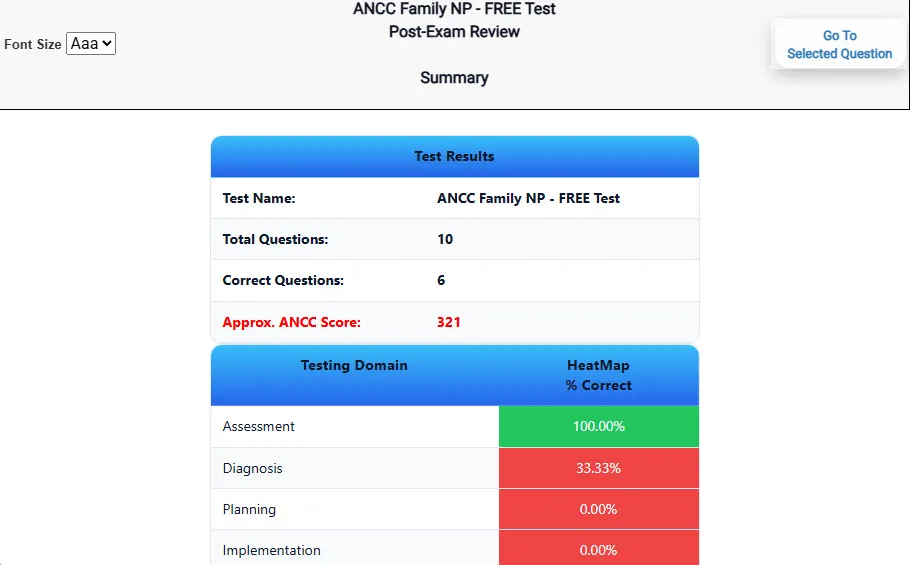
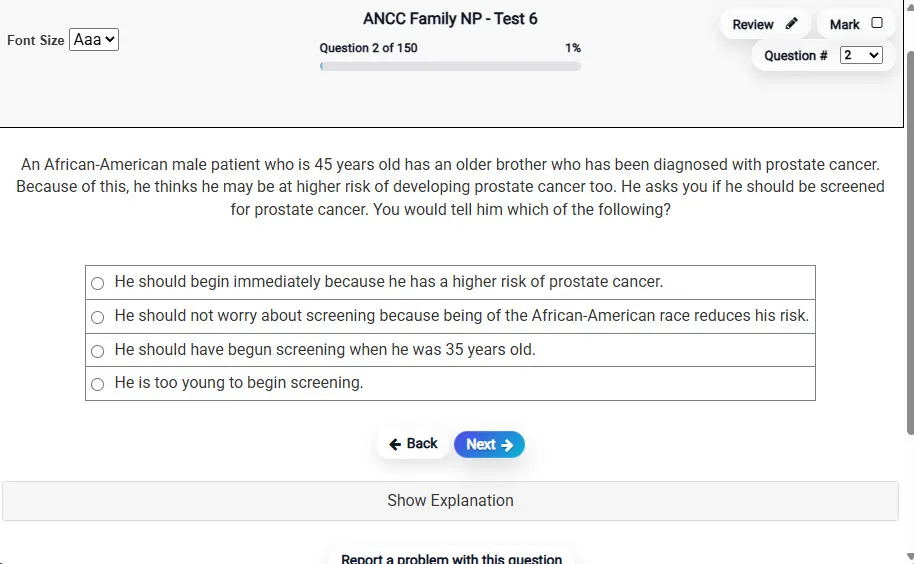
Answering a Question screen – Multiple-choice item view with navigation controls and progress tracker.
Answering a Question Multiple-choice item view with navigation controls and progress tracker.

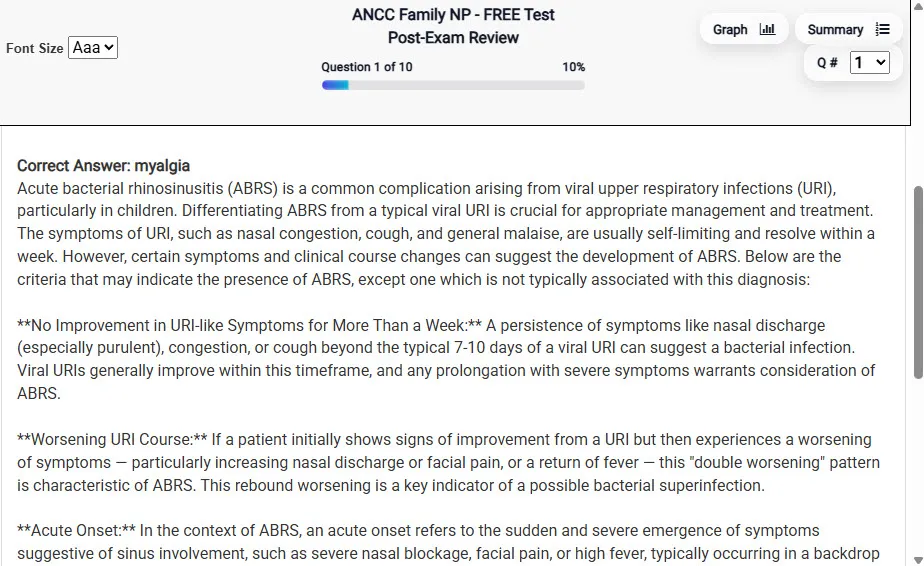
                           Detailed Explanation screen – 
                         Review mode showing chosen answer and rationale and references.
Detailed Explanation Review mode showing chosen answer and rationale and references.

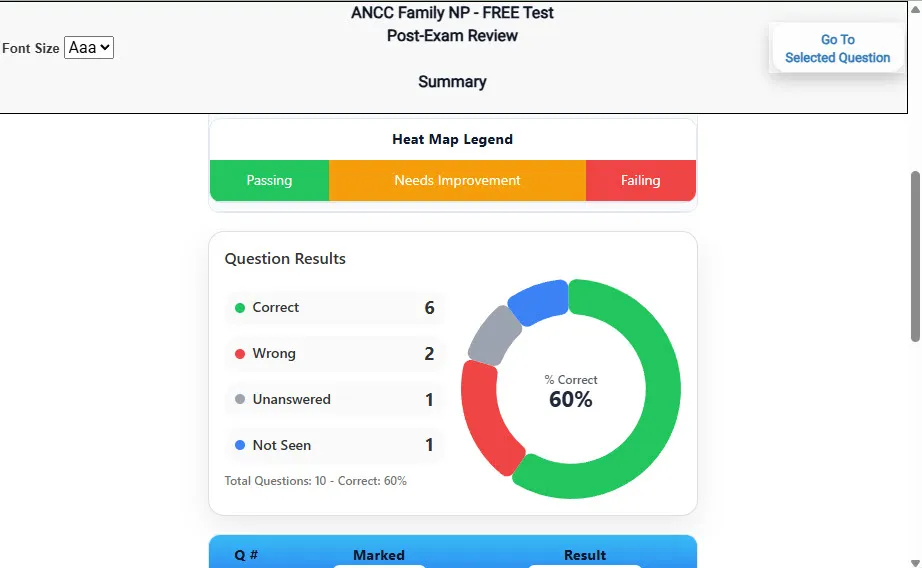
                           Review Summary 1 screen – 
                         Summary with counts for correct/wrong/unanswered and not seen items.
Review Summary 1 Summary with counts for correct/wrong/unanswered and not seen items.

                           Review Summary 2 screen – 
                         Advanced summary with category/domain breakdown and performance insights.
Review Summary 2 Advanced summary with category/domain breakdown and performance insights.

What Each Screen Shows

Answer Question Screen

  • Clean multiple-choice interface with progress bar.
  • Mark for review feature.
  • Matches real test pacing.

Detailed Explanation

  • Correct answer plus rationale.
  • Key concepts and guidelines highlighted.
  • Move between questions to fill knowledge gaps.

Review Summary 1

  • Overall results with total questions and scaled score.
  • Domain heatmap shows strengths and weaknesses.
  • Quick visual feedback on study priorities.

Review Summary 2

  • Chart of correct, wrong, unanswered, not seen.
  • Color-coded results for easy review.
  • Links back to missed items.

Top 10 Reasons to Use Exam Edge for your Praxis Physics Content Knowledge Exam Prep

  1. Focused on the Praxis Physics Content Knowledge Exam

    Our practice tests are built specifically for the Praxis Physics Content exam — every question mirrors the real topics, format, and difficulty so you're studying exactly what matters.

  2. Real Exam Simulation

    We match the per-question time limits and pressure of the actual Praxis exam, so test day feels familiar and stress-free.

  3. 15 Full Practice Tests & 1,500 Unique Questions

    You'll have more than enough material to master every Praxis Physics Content concept — no repeats, no fluff.

  4. Lower Cost Than a Retake

    Ordering 5 practice exams costs less than retaking the Praxis Physics Content Knowledge exam after a failure. One low fee could save you both time and money.

  5. Flexible Testing

    Need to step away mid-exam? Pick up right where you left off — with your remaining time intact.

  6. Instant Scoring & Feedback

    See your raw score and an estimated Praxis Physics Content Knowledge score immediately after finishing each practice test.

  7. Detailed Explanations for Every Question

    Review correct and incorrect answers with clear, step-by-step explanations so you truly understand each topic.

  8. Trusted & Accredited

    We're fully accredited by the Better Business Bureau and uphold the highest standards of trust and transparency.

  9. Web-Based & Always Available

    No software to install. Access your Praxis Physics Content practice exams 24/7 from any computer or mobile device.

  10. Expert Support When You Need It

    Need extra help? Our specialized tutors are highly qualified and ready to support your Praxis exam prep.


Pass the Praxis Physics Content Knowledge Exam with Realistic Practice Tests from Exam Edge

Preparing for your upcoming Praxis Physics Content Knowledge (5265) Certification Exam can feel overwhelming — but the right practice makes all the difference. Exam Edge gives you the tools, structure, and confidence to pass on your first try. Our online practice exams are built to match the real Praxis Physics Content exam in content, format, and difficulty.

  • 📝 15 Praxis Physics Content Knowledge Practice Tests: Access 15 full-length exams with 100 questions each, covering every major Praxis Physics Content Knowledge topic in depth.
  • Instant Online Access: Start practicing right away — no software, no waiting.
  • 🧠 Step-by-Step Explanations: Understand the reasoning behind every correct answer so you can master Praxis Physics Content exam concepts.
  • 🔄 Retake Each Exam Up to 4 Times: Build knowledge through repetition and track your improvement over time.
  • 🌐 Web-Based & Available 24/7: Study anywhere, anytime, on any device.
  • 🧘 Boost Your Test-Day Confidence: Familiarity with the Praxis format reduces anxiety and helps you perform under pressure.

These Praxis Physics Content Knowledge practice exams are designed to simulate the real testing experience by matching question types, timing, and difficulty level. This approach helps you get comfortable not just with the exam content, but also with the testing environment, so you walk into your exam day focused and confident.


Exam Edge Praxis Reviews


I failed the Praxis Math test five times before I found your site. After taking all your practice tests, on my next attempt I passed by five points! I can honestly say this site is the reason I passed. Thank you!!!

Nikki P, Tennessee

Just wanted to say thanks for helping me pass the Praxis I Reading! Your practice tests and especially your explanations are great. They gave me the confidence I needed! Now I can student teach this fall. I'm so glad I found PraxisReading.com!

Denise C, Florida

Thank you so much. I just received my results in the mail. I scored a 179 and passed the Praxis I Writing! I'll never have to worry about retaking this test again! PraxisWriting.com is great. I told all my friends about this site.

Susan K, Virginia

I failed the Parapro test four times before I found your site. After taking all your practice tests, on my next attempt I passed by seven points! I can honestly say that this site is the reason I passed. Thank you!!!

Rebecca S, Texas

Hi! Just returned from taking my Praxis computerized and am happy to say that I passed with a 175. The last time I took the test I missed by 1 point. Your tests definitely made the difference for me! The set up was so similar to the test and the types of questions were also similar that I felt ve ...
Read More
Brad Y, Pennsylvania

I have taken the math praxis 3 times and wanted to give up. I ordered the bundle of math tests and I passed the math praxis today. Thank you for all the help.

Jacob D, South Carolina


Praxis Physics Content Knowledge Aliases Test Name

Here is a list of alternative names used for this exam.

  • Praxis Physics Content Knowledge
  • Praxis Physics Content Knowledge test
  • Praxis Physics Content Knowledge Certification Test
  • Praxis Physics Content test
  • Praxis
  • Praxis 5265
  • 5265 test
  • Praxis Physics Content Knowledge (5265)
  • Physics Content Knowledge certification