This is the content of the pop-over!

Praxis Penn 4-8 Social Studies (5157) Practice Tests & Test Prep by Exam Edge


Praxis Pennsylvania Grades 4-8 Subject Concentration Social Studies  product image
(5.0)
Based on 20 Reviews

  • Real Exam Simulation: Timed questions and matching content build comfort for your Praxis Penn 4-8 Social Studies test day.
  • Instant, 24/7 Access: Web-based Praxis Pennsylvania Grades 4-8 Subject Concentration Social Studies practice exams with no software needed.
  • Clear Explanations: Step-by-step answers and explanations for your Praxis exam to strengthen understanding.
  • Boosted Confidence: Reduces anxiety and improves test-taking skills to ace your Praxis Pennsylvania Grades 4-8 Subject Concentration Social Studies (5157).

Featured on

Praxis Pennsylvania Grades 4-8 Subject Concentration Social Studies Online Practice Test Bundles

BEST VALUE
20 practice tests

$174.00

$799.00

SAVE $625

Only $8.70 per test!

  • 100% Pass Guarantee
  • 20 online practice tests
  • 90 questions per test
  • Bonus: 100 Flash Cards + Study Guide
  • Instant access
  • Detailed Explanations
  • Practice tests never expire
  • Timed, untimed, or study guide mode
MOST POPULAR
10 practice tests

$99.50

$399.50

SAVE $300

Only $9.95 per test!

  • 10 online practice tests
  • 90 questions per test
  • Bonus: 100 Flash Cards + Study Guide
  • Instant access
  • Detailed Explanations
  • Practice tests never expire
  • Timed, untimed, or study guide mode
5 practice tests

$69.75

$199.75

SAVE $130

Only $13.95 per test!

  • 5 online practice tests
  • 90 questions per test
  • Bonus: 100 Flash Cards
  • Instant access
  • Detailed Explanations
  • Practice tests never expire
  • Timed, untimed, or study guide mode
1 practice test

$39.95

  • 1 online practice test
  • 90 questions per test
  • Instant access
  • Detailed Explanations
  • Practice tests never expire
  • Timed, untimed, or study guide mode
Quick Select
Tap to choose a bundle

** All Prices are in US Dollars (USD) **


Praxis Penn 4-8 Social Studies (5157) Resources

Jump to the section you need most.

Understanding the exact breakdown of the Praxis Pennsylvania Grades 4-8 Subject Concentration Social Studies test will help you know what to expect and how to most effectively prepare. The Praxis Pennsylvania Grades 4-8 Subject Concentration Social Studies has 90 multiple-choice questions . The exam will be broken down into the sections below:

Praxis Pennsylvania Grades 4-8 Subject Concentration Social Studies Exam Blueprint
Domain Name % Number of
Questions
United States History 25% 23
World History 20% 18
Government/Political Science 18% 16
Economics 17% 15
Geography 20% 18

Praxis Pennsylvania Grades 4-8 Subject Concentration Social Studies Study Tips by Domain

  • Reconstruct the sequence and significance of major eras (Colonization & Revolution, Early Republic, Civil War/Reconstruction, Industrialization, Progressive Era, WWI/WWII, Cold War, Post–Cold War) and anchor answers with approximate dates; red flag: confusing Reconstruction goals (13th–15th Amendments) with Jim Crow outcomes.
  • Analyze founding documents and debates (Declaration, Articles, Constitution, Federalist/Anti-Federalist) by linking principles to structure; common trap: mixing up enumerated powers with reserved powers under the 10th Amendment.
  • Connect sectionalism and slavery to political compromises and conflict (Missouri Compromise, Compromise of 1850, Kansas–Nebraska, Dred Scott) and explain cause-and-effect; red flag: treating the Civil War as solely “states’ rights” without the central issue of slavery’s expansion.
  • Evaluate economic and social change (market revolution, westward expansion, immigration, industrialization, labor) using evidence like technology, demographics, and policy; priority rule: when asked about “push/pull” migration causes, name at least one of each.
  • Trace reform and rights movements (abolition, women’s suffrage, Populism/Progressivism, civil rights) to specific strategies and outcomes; common trap: assuming Progressive reforms were uniform—some expanded democracy (initiative/referendum) while others reinforced exclusion.
  • Interpret U.S. foreign policy shifts (Monroe Doctrine, imperialism, WWI neutrality/intervention, WWII, containment in the Cold War) by matching doctrines to examples; red flag: confusing the Truman Doctrine (aid/containment) with the Marshall Plan (European economic recovery).
  • Use a clear chronology to connect major eras (ancient → classical → post-classical → early modern → modern) and justify periodization with evidence—red flag: mixing causes from one era with effects from another without a transition point.
  • When analyzing change over time, separate political, economic, social, and cultural factors; common trap: attributing complex developments (e.g., industrialization) to a single “great leader” instead of multiple drivers.
  • Track belief systems (Hinduism, Buddhism, Judaism, Christianity, Islam, major philosophies) by core ideas and diffusion routes—priority rule: identify how trade, conquest, and missionary activity spread ideas before naming local outcomes.
  • For global exchange networks (Silk Roads, Indian Ocean, Trans-Saharan, Columbian Exchange), always name a good/technology, a disease/demographic impact, and a power shift—red flag: listing items exchanged but skipping consequences.
  • Compare empires and state-building (Rome, Han, Islamic caliphates, Mongols, Ottoman, European colonial states) using a consistent lens (administration, military, taxation, legitimacy)—common trap: treating “empire” as only territorial size rather than governance methods.
  • For modern revolutions and conflicts (Atlantic revolutions, imperialism, World Wars, Cold War, decolonization), distinguish long-term causes, immediate triggers, and outcomes; red flag: confusing nationalism as a universal unifier when it can also fuel separatism and ethnic conflict.
  • Know the constitutional structure (separation of powers, checks and balances, federalism) and be able to match powers to the correct branch/level—red flag: confusing reserved (state) powers with delegated (federal) powers.
  • Understand the Bill of Rights and key amendments (e.g., 1st, 4th, 14th) in classroom-scale scenarios; common trap: assuming rights are absolute (time, place, and manner limits; due process standards matter).
  • Distinguish civil liberties (protections from government) from civil rights (equal treatment) and connect to incorporation via the 14th Amendment—priority rule: if a question mentions states restricting speech/search, think incorporation.
  • Compare electoral systems (primary vs general, Electoral College basics, redistricting) and voter behavior; red flag: mixing up gerrymandering (district manipulation) with malapportionment (unequal representation).
  • Identify how a bill becomes law, how budgets/appropriations work, and the role of committees; common trap: thinking a presidential veto is final (Congress can override with a 2/3 vote in both chambers).
  • Explain major political ideologies and the role of parties, interest groups, and media in shaping policy; practical cue: when asked about lobbying/issue ads, prioritize how they influence agenda-setting rather than directly “passing laws.”
  • Use scarcity and opportunity cost to explain choices—red flag: treating opportunity cost as only money instead of the next-best alternative forgone.
  • Distinguish production possibilities curve shifts vs. movements along the curve—trap: labeling unemployment or underuse of resources as a “shift” rather than an interior point.
  • Apply supply-and-demand to price/quantity changes with clear ceteris paribus assumptions—priority rule: decide whether a change is a shift (nonprice factor) or a movement (price change).
  • Compare market structures (perfect competition, monopoly, oligopoly, monopolistic competition) using number of firms, barriers, and price power—red flag: calling any large firm a monopoly without barriers to entry.
  • Explain fiscal vs. monetary policy tools and likely effects on inflation/unemployment—common trap: mixing up the Federal Reserve’s role (monetary) with Congress/executive budgeting/taxes (fiscal).
  • Interpret comparative advantage and trade-offs in specialization—threshold cue: if one party has absolute advantage in both goods, trade can still benefit when opportunity costs differ.
  • Know the five themes (location, place, human–environment interaction, movement, region) and be ready to match an example to the correct theme; red flag: calling anything with a map “location” when it’s really “region” or “place.”
  • Use map elements correctly (scale, legend, direction, latitude/longitude, contour lines) and estimate distance with the scale; common trap: confusing latitude (E/W lines, measures N/S) with longitude (N/S lines, measures E/W).
  • Interpret physical geography processes (plate tectonics, weathering/erosion/deposition, watersheds, climate patterns) and connect cause to landform or hazard; cue: if the question mentions subduction, think volcanic arcs and deep-ocean trenches.
  • Distinguish climate vs. weather and read basic climate graphs (temperature and precipitation) to infer biome or human activity; red flag: using a single storm event to justify a climate conclusion.
  • Analyze human geography patterns (population density, migration push/pull, urbanization, cultural diffusion) and tie them to spatial outcomes; priority rule: migration explanations should include at least one clear push AND one pull factor.
  • Apply geographic reasoning to Pennsylvania and the U.S. (physiographic regions, river systems, resource distribution, settlement/transport corridors) and recognize how waterways shape trade and cities; common trap: mixing up the Appalachian Plateau with the Ridge and Valley when describing landforms and land use.


Built to Fit Into Your Busy Life

Everything you need to prepare with confidence—without wasting a minute.

Three Study Modes

Timed, No Time Limit, or Explanation mode.

Actionable Analytics

Heatmaps and scaled scores highlight weak areas.

High-Yield Rationales

Concise explanations emphasize key concepts.

Realistic Interface

Matches the feel of the actual exam environment.

Accessible by Design

Clean layout reduces cognitive load.

Anytime, Anywhere

Web-based access 24/7 on any device.
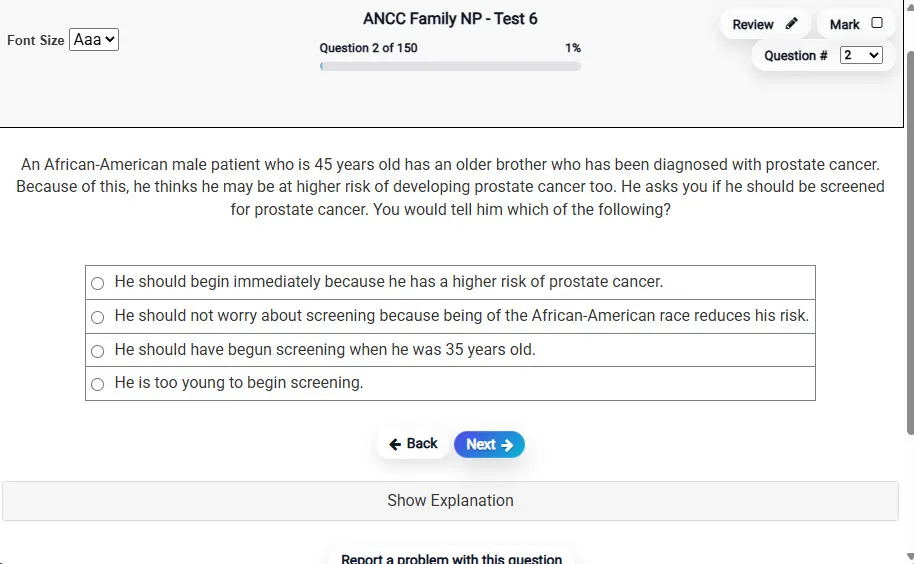
Answering a Question screen – Multiple-choice item view with navigation controls and progress tracker.
Answering a Question Multiple-choice item view with navigation controls and progress tracker.

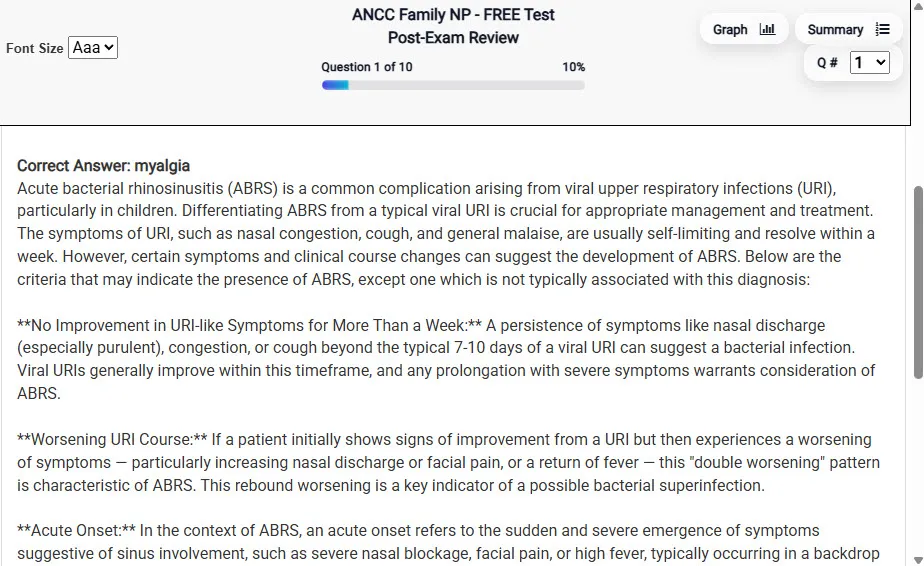
                           Detailed Explanation screen – 
                         Review mode showing chosen answer and rationale and references.
Detailed Explanation Review mode showing chosen answer and rationale and references.

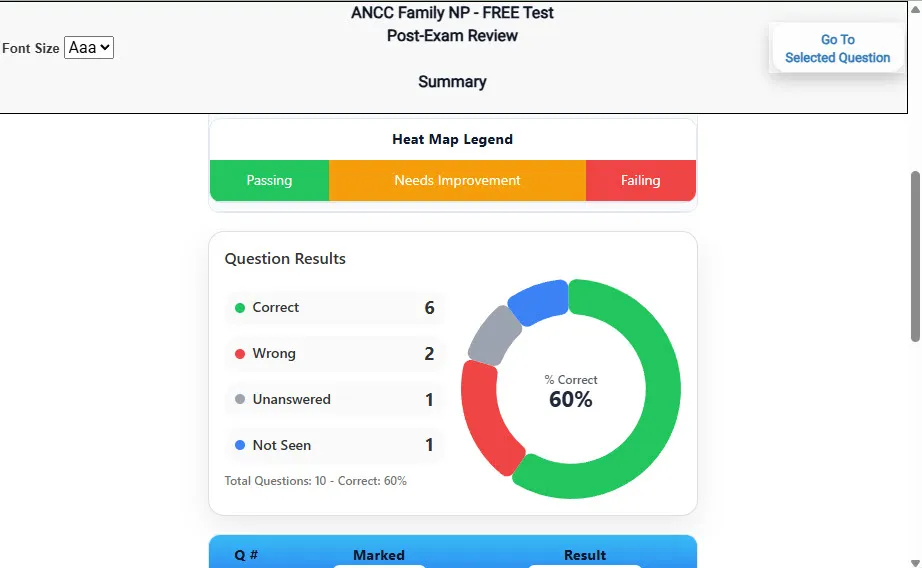
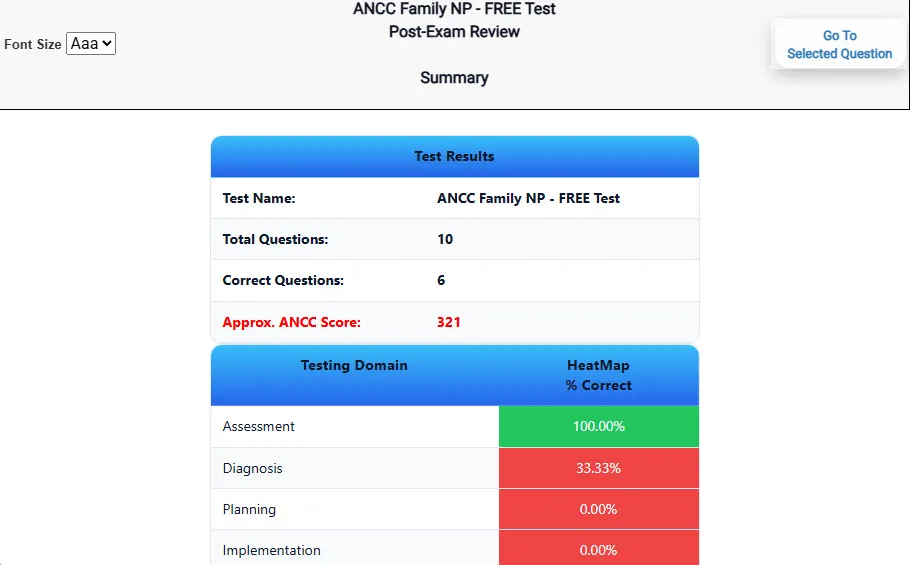
                           Review Summary 1 screen – 
                         Summary with counts for correct/wrong/unanswered and not seen items.
Review Summary 1 Summary with counts for correct/wrong/unanswered and not seen items.

                           Review Summary 2 screen – 
                         Advanced summary with category/domain breakdown and performance insights.
Review Summary 2 Advanced summary with category/domain breakdown and performance insights.

What Each Screen Shows

Answer Question Screen

  • Clean multiple-choice interface with progress bar.
  • Mark for review feature.
  • Matches real test pacing.

Detailed Explanation

  • Correct answer plus rationale.
  • Key concepts and guidelines highlighted.
  • Move between questions to fill knowledge gaps.

Review Summary 1

  • Overall results with total questions and scaled score.
  • Domain heatmap shows strengths and weaknesses.
  • Quick visual feedback on study priorities.

Review Summary 2

  • Chart of correct, wrong, unanswered, not seen.
  • Color-coded results for easy review.
  • Links back to missed items.

Top 10 Reasons to Use Exam Edge for your Praxis Pennsylvania Grades 4-8 Subject Concentration Social Studies Exam Prep

  1. Focused on the Praxis Pennsylvania Grades 4-8 Subject Concentration Social Studies Exam

    Our practice tests are built specifically for the Praxis Penn 4-8 Social Studies exam — every question mirrors the real topics, format, and difficulty so you're studying exactly what matters.

  2. Real Exam Simulation

    We match the per-question time limits and pressure of the actual Praxis exam, so test day feels familiar and stress-free.

  3. 20 Full Practice Tests & 1,800 Unique Questions

    You'll have more than enough material to master every Praxis Penn 4-8 Social Studies concept — no repeats, no fluff.

  4. Lower Cost Than a Retake

    Ordering 5 practice exams costs less than retaking the Praxis Pennsylvania Grades 4-8 Subject Concentration Social Studies exam after a failure. One low fee could save you both time and money.

  5. Flexible Testing

    Need to step away mid-exam? Pick up right where you left off — with your remaining time intact.

  6. Instant Scoring & Feedback

    See your raw score and an estimated Praxis Pennsylvania Grades 4-8 Subject Concentration Social Studies score immediately after finishing each practice test.

  7. Detailed Explanations for Every Question

    Review correct and incorrect answers with clear, step-by-step explanations so you truly understand each topic.

  8. Trusted & Accredited

    We're fully accredited by the Better Business Bureau and uphold the highest standards of trust and transparency.

  9. Web-Based & Always Available

    No software to install. Access your Praxis Penn 4-8 Social Studies practice exams 24/7 from any computer or mobile device.

  10. Expert Support When You Need It

    Need extra help? Our specialized tutors are highly qualified and ready to support your Praxis exam prep.


Pass the Praxis Pennsylvania Grades 4-8 Subject Concentration Social Studies Exam with Realistic Practice Tests from Exam Edge

Preparing for your upcoming Praxis Pennsylvania Grades 4-8 Subject Concentration Social Studies (5157) Certification Exam can feel overwhelming — but the right practice makes all the difference. Exam Edge gives you the tools, structure, and confidence to pass on your first try. Our online practice exams are built to match the real Praxis Penn 4-8 Social Studies exam in content, format, and difficulty.

  • 📝 20 Praxis Pennsylvania Grades 4-8 Subject Concentration Social Studies Practice Tests: Access 20 full-length exams with 90 questions each, covering every major Praxis Pennsylvania Grades 4-8 Subject Concentration Social Studies topic in depth.
  • Instant Online Access: Start practicing right away — no software, no waiting.
  • 🧠 Step-by-Step Explanations: Understand the reasoning behind every correct answer so you can master Praxis Penn 4-8 Social Studies exam concepts.
  • 🔄 Retake Each Exam Up to 4 Times: Build knowledge through repetition and track your improvement over time.
  • 🌐 Web-Based & Available 24/7: Study anywhere, anytime, on any device.
  • 🧘 Boost Your Test-Day Confidence: Familiarity with the Praxis format reduces anxiety and helps you perform under pressure.

These Praxis Pennsylvania Grades 4-8 Subject Concentration Social Studies practice exams are designed to simulate the real testing experience by matching question types, timing, and difficulty level. This approach helps you get comfortable not just with the exam content, but also with the testing environment, so you walk into your exam day focused and confident.


Exam Edge Praxis Reviews


I failed the Praxis Math test five times before I found your site. After taking all your practice tests, on my next attempt I passed by five points! I can honestly say this site is the reason I passed. Thank you!!!

Nikki P, Tennessee

Just wanted to say thanks for helping me pass the Praxis I Reading! Your practice tests and especially your explanations are great. They gave me the confidence I needed! Now I can student teach this fall. I'm so glad I found PraxisReading.com!

Denise C, Florida

Thank you so much. I just received my results in the mail. I scored a 179 and passed the Praxis I Writing! I'll never have to worry about retaking this test again! PraxisWriting.com is great. I told all my friends about this site.

Susan K, Virginia

I failed the Parapro test four times before I found your site. After taking all your practice tests, on my next attempt I passed by seven points! I can honestly say that this site is the reason I passed. Thank you!!!

Rebecca S, Texas

Hi! Just returned from taking my Praxis computerized and am happy to say that I passed with a 175. The last time I took the test I missed by 1 point. Your tests definitely made the difference for me! The set up was so similar to the test and the types of questions were also similar that I felt ve ...
Read More
Brad Y, Pennsylvania

I have taken the math praxis 3 times and wanted to give up. I ordered the bundle of math tests and I passed the math praxis today. Thank you for all the help.

Jacob D, South Carolina


Praxis Pennsylvania Grades 4-8 Subject Concentration Social Studies Aliases Test Name

Here is a list of alternative names used for this exam.

  • Praxis Pennsylvania Grades 4-8 Subject Concentration Social Studies
  • Praxis Pennsylvania Grades 4-8 Subject Concentration Social Studies test
  • Praxis Pennsylvania Grades 4-8 Subject Concentration Social Studies Certification Test
  • Praxis Penn 4-8 Social Studies test
  • Praxis
  • Praxis 5157
  • 5157 test
  • Praxis Pennsylvania Grades 4-8 Subject Concentration Social Studies (5157)
  • Pennsylvania Grades 4-8 Subject Concentration Social Studies certification