This is the content of the pop-over!

Praxis Middle School Social Studies (5089) Practice Tests & Test Prep by Exam Edge


Praxis Middle School Social Studies  product image
(5.0)
Based on 28 Reviews

  • Real Exam Simulation: Timed questions and matching content build comfort for your Praxis Middle School Social Studies test day.
  • Instant, 24/7 Access: Web-based Praxis Middle School Social Studies practice exams with no software needed.
  • Clear Explanations: Step-by-step answers and explanations for your Praxis exam to strengthen understanding.
  • Boosted Confidence: Reduces anxiety and improves test-taking skills to ace your Praxis Middle School Social Studies (5089).

Featured on

Praxis Middle School Social Studies Online Practice Test Bundles

BEST VALUE
20 practice tests

$174.00

$799.00

SAVE $625

Only $8.70 per test!

  • 100% Pass Guarantee
  • 20 online practice tests
  • 90 questions + 3 essays per test
  • Bonus: 100 Flash Cards + Study Guide
  • Instant access
  • Detailed Explanations
  • Practice tests never expire
  • Timed, untimed, or study guide mode
MOST POPULAR
10 practice tests

$99.50

$399.50

SAVE $300

Only $9.95 per test!

  • 10 online practice tests
  • 90 questions + 3 essays per test
  • Bonus: 100 Flash Cards + Study Guide
  • Instant access
  • Detailed Explanations
  • Practice tests never expire
  • Timed, untimed, or study guide mode
5 practice tests

$69.75

$199.75

SAVE $130

Only $13.95 per test!

  • 5 online practice tests
  • 90 questions + 3 essays per test
  • Bonus: 100 Flash Cards
  • Instant access
  • Detailed Explanations
  • Practice tests never expire
  • Timed, untimed, or study guide mode
1 practice test

$39.95

  • 1 online practice test
  • 90 questions + 3 essays per test
  • Instant access
  • Detailed Explanations
  • Practice tests never expire
  • Timed, untimed, or study guide mode
Quick Select
Tap to choose a bundle

** All Prices are in US Dollars (USD) **


Praxis Middle School Social Studies (5089) Resources

Jump to the section you need most.

Understanding the exact breakdown of the Praxis Middle School Social Studies test will help you know what to expect and how to most effectively prepare. The Praxis Middle School Social Studies has 90 multiple-choice questions and 3 essay questions. The exam will be broken down into the sections below:

Praxis Middle School Social Studies Exam Blueprint
Domain Name % Number of
Questions
United States History 19% 17
World History 15% 14
Government/Civics 14% 13
Geography 14% 13
Economics 13% 12
Short Content Essays 25% 23
     1. United States History - related to Government/Civics  
     2. World History - related to Geography  
     3. U.S. History - related to Economics or Geography
OR
World History - related to Economics or Government/Civics
 

Praxis Middle School Social Studies Study Tips by Domain

  • Track continuity vs. change in U.S. History by linking a policy to its long-term effects (e.g., Reconstruction amendments to later civil rights)—red flag: answers that only restate events without causation.
  • Know founding-era documents and debates (Declaration, Articles, Constitution, Federalists/Anti-Federalists) and what problem each tried to solve—common trap: confusing Articles-era weaknesses with Constitutional-era features.
  • Connect major conflicts to turning points (Revolution, Civil War, World Wars, Cold War) and be ready to name a clear catalyst, key shift, and outcome—priority rule: pick the option that best explains why the war changed power or policy.
  • Interpret primary sources by sourcing (author, audience, purpose, context) before using the content—red flag: treating a partisan pamphlet or political cartoon as neutral fact.
  • Use timelines to place reform and social movements (abolition, suffrage, labor, civil rights) in the correct century and region—common trap: mixing Progressive Era reforms with New Deal programs.
  • Be able to match Supreme Court cases to their constitutional principles (e.g., Marbury, Dred Scott, Brown, Miranda) and historical impact—contraindication: choosing an answer that states the holding but ignores how it altered federal vs. state power or individual rights.
  • Build a tight chronology by era (classical, post-classical, early modern, modern) and anchor each with 2–3 turning points; red flag: mixing up causes vs. effects (e.g., industrialization as a cause of imperialism vs. a result).
  • Compare major belief systems (Buddhism, Christianity, Islam, Hinduism, Confucianism) by origin, diffusion routes, and political role; common trap: treating religions as static and ignoring syncretism.
  • Track state-building patterns (bureaucracy, legitimacy, military tech, taxation) across empires; priority rule: when multiple factors are present, identify the “enabling” factor (often administration or revenue) before the “trigger.”
  • Use evidence of interaction—trade, conquest, migration, and disease—to explain continuity/change; red flag: naming a trade route (Silk Roads, Trans-Saharan, Indian Ocean) without stating what moved and what changed locally.
  • For revolutions and reforms (French, Haitian, Latin American independence, Meiji, Russian, Chinese), connect ideology to social groups and outcomes; common trap: assuming all revolutions yield immediate democracy or equal rights.
  • In 20th-century conflicts (World Wars, Cold War, decolonization), distinguish long-term tensions from immediate sparks; threshold cue: if a prompt asks “most significant,” pick one driver and justify with specific examples rather than listing many.
  • Know constitutional structure (separation of powers, checks and balances, federalism) and use concrete examples (e.g., veto/override, judicial review)—red flag: confusing delegated powers with reserved or concurrent powers.
  • Differentiate civil rights vs. civil liberties and connect them to amendments/court cases—common trap: treating the Bill of Rights as applying directly to states without incorporation via the 14th Amendment.
  • Track the policy-making process (agenda setting → committee → floor → conference → president) and where bills most often die—priority rule: committee gatekeeping is a major bottleneck.
  • Compare major political ideologies and party coalitions in U.S. politics and link to policy preferences—red flag: assuming parties are ideologically uniform across regions and time periods.
  • Understand elections and participation (primaries, general elections, Electoral College, turnout factors) and how representation works—common trap: conflating plurality, majority, and proportional systems.
  • Identify citizens’ civic duties/responsibilities (jury duty, taxes, voting, informed engagement) and limits on government action—contraindication: rights are not absolute (e.g., time/place/manner restrictions for speech).
  • Use the five themes of geography (location, place, human–environment interaction, movement, region) as an organizer; red flag: confusing absolute location (latitude/longitude) with relative location (“near/between”).
  • Read maps by checking scale, projection, and legend first; common trap: assuming Mercator preserves area—it preserves direction but distorts size toward the poles.
  • Interpret latitude/longitude quickly: latitude is N/S of the Equator and longitude is E/W of the Prime Meridian; threshold cue: coordinates are written (lat, long) and swapping them often points to the wrong continent.
  • Connect physical processes to landforms and hazards (plate boundaries, erosion, weathering, water cycle); priority rule: convergent boundaries are linked to mountain building and subduction—not mid-ocean ridges.
  • Apply population and migration tools (population pyramids, push/pull factors, urbanization); red flag: assuming high birth rates always mean rapid growth—look for high death rates or out-migration too.
  • Link human systems to environment (resources, climate, sustainability) using cause-and-effect; common trap: treating climate (long-term patterns) as the same as weather (short-term conditions).
  • Explain scarcity and opportunity cost using a production possibilities curve; red flag: shifting along the curve (reallocation) is not the same as an outward shift (growth from resources/technology).
  • Distinguish supply vs. demand shifters and predict price/quantity changes; common trap: a price change causes movement along a curve, not a shift of the curve.
  • Use elasticity (price, income, cross-price) to predict revenue and substitution; cue: with inelastic demand, price increases raise total revenue, but only if demand doesn’t become elastic over the relevant range.
  • Connect market failures to policy tools (externalities, public goods, asymmetric information); priority rule: match the fix to the failure (e.g., a tax targets negative externalities, not public goods underprovision).
  • Compare fiscal vs. monetary policy and their limits; red flag: monetary policy affects interest rates and money supply (Fed), while fiscal policy changes spending/taxes (Congress/President).
  • Interpret basic macro indicators (GDP, inflation/CPI, unemployment) and business cycles; common trap: nominal GDP can rise from inflation alone, so use real GDP when judging growth.
  • Answer the exact prompt first with a defensible thesis in the first 1–2 sentences; red flag: writing a topic summary without taking a position or addressing every part of the question.
  • Use 2–3 specific pieces of evidence (dates, laws, events, cases, policies, regions) and explain how each proves the thesis; common trap: name-dropping facts without linking them to the claim.
  • Organize with a clear structure (e.g., claim → evidence → reasoning, or chronological/cause-and-effect) and keep paragraphs focused; priority rule: one main idea per paragraph.
  • Define or clarify key terms as you use them (e.g., “federalism,” “industrialization,” “mercantilism”) to avoid ambiguity; red flag: using vocabulary incorrectly or inconsistently.
  • Address complexity with one counterpoint or limitation (e.g., regional variation, competing motives, short-term vs. long-term effects) and then resolve it; common trap: presenting one-sided causation when multiple factors are obvious.
  • Manage time by outlining in ~1 minute and leaving ~1 minute to proofread for factual errors and missing prompt elements; red flag: perfecting prose while leaving out required evidence or analysis.


Built to Fit Into Your Busy Life

Everything you need to prepare with confidence—without wasting a minute.

Three Study Modes

Timed, No Time Limit, or Explanation mode.

Actionable Analytics

Heatmaps and scaled scores highlight weak areas.

High-Yield Rationales

Concise explanations emphasize key concepts.

Realistic Interface

Matches the feel of the actual exam environment.

Accessible by Design

Clean layout reduces cognitive load.

Anytime, Anywhere

Web-based access 24/7 on any device.
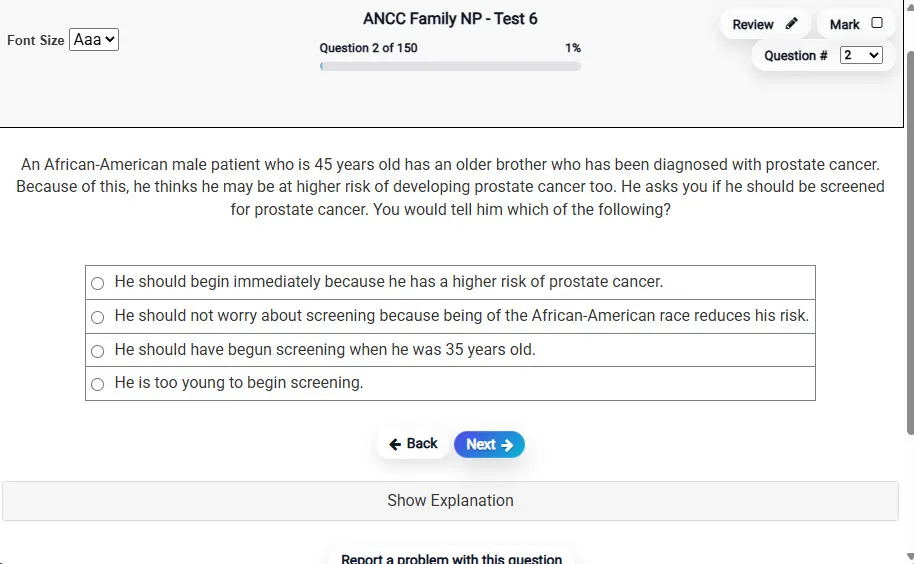
Answering a Question screen – Multiple-choice item view with navigation controls and progress tracker.
Answering a Question Multiple-choice item view with navigation controls and progress tracker.

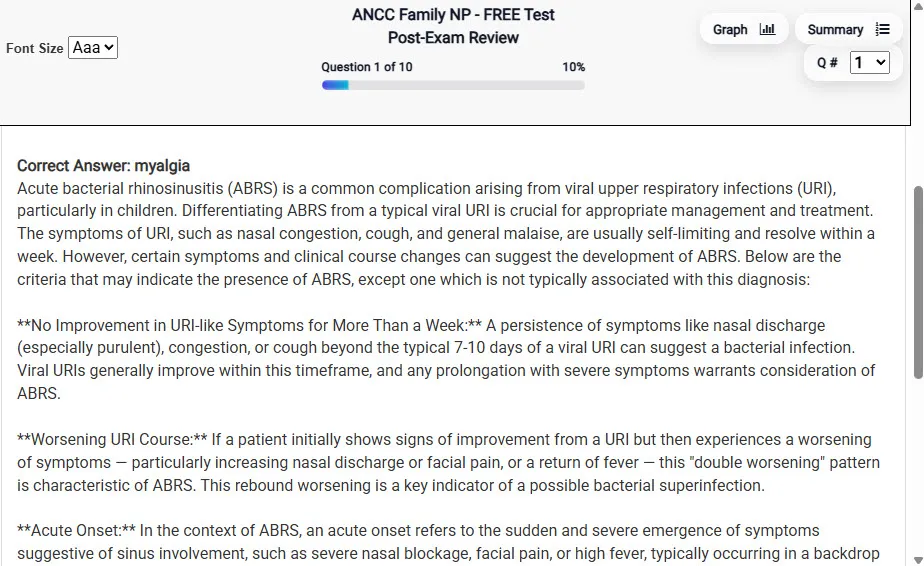
                           Detailed Explanation screen – 
                         Review mode showing chosen answer and rationale and references.
Detailed Explanation Review mode showing chosen answer and rationale and references.

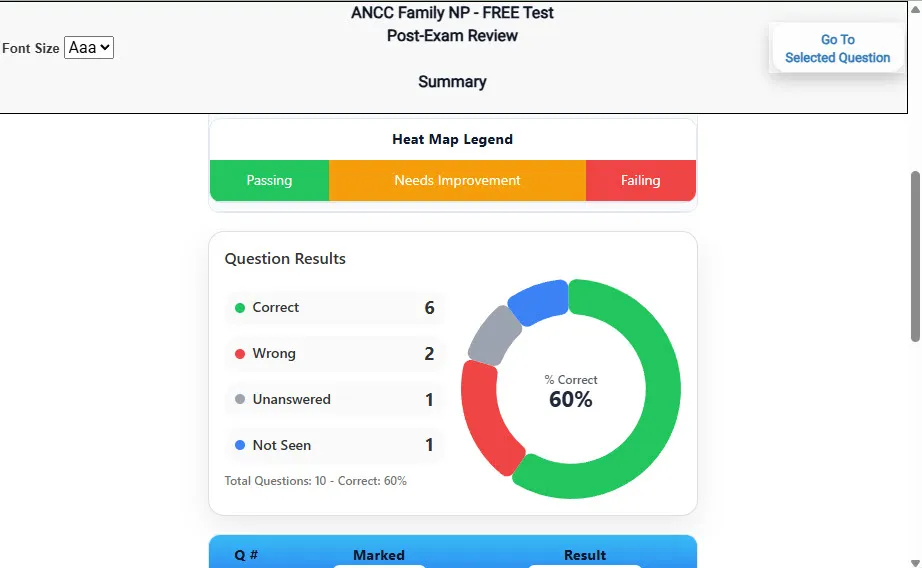
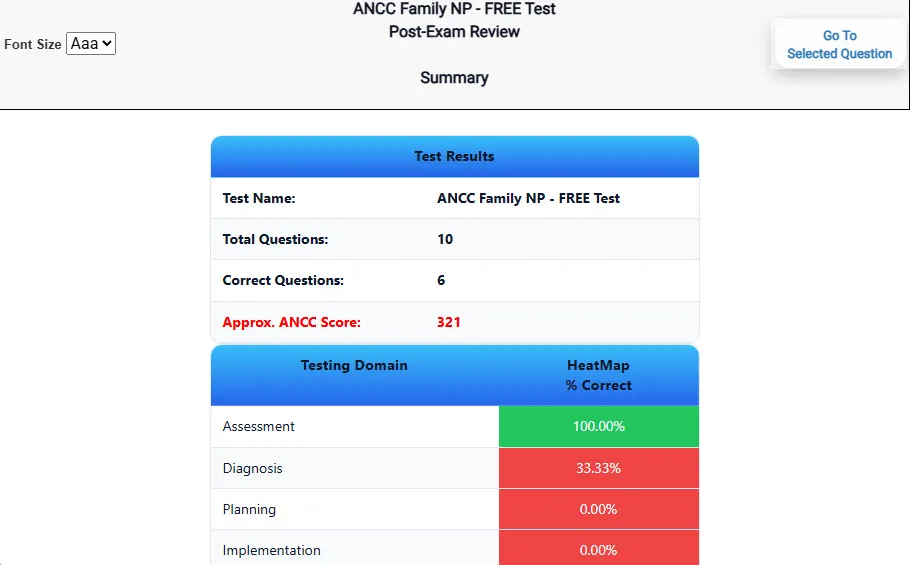
                           Review Summary 1 screen – 
                         Summary with counts for correct/wrong/unanswered and not seen items.
Review Summary 1 Summary with counts for correct/wrong/unanswered and not seen items.

                           Review Summary 2 screen – 
                         Advanced summary with category/domain breakdown and performance insights.
Review Summary 2 Advanced summary with category/domain breakdown and performance insights.

What Each Screen Shows

Answer Question Screen

  • Clean multiple-choice interface with progress bar.
  • Mark for review feature.
  • Matches real test pacing.

Detailed Explanation

  • Correct answer plus rationale.
  • Key concepts and guidelines highlighted.
  • Move between questions to fill knowledge gaps.

Review Summary 1

  • Overall results with total questions and scaled score.
  • Domain heatmap shows strengths and weaknesses.
  • Quick visual feedback on study priorities.

Review Summary 2

  • Chart of correct, wrong, unanswered, not seen.
  • Color-coded results for easy review.
  • Links back to missed items.

Top 10 Reasons to Use Exam Edge for your Praxis Middle School Social Studies Exam Prep

  1. Focused on the Praxis Middle School Social Studies Exam

    Our practice tests are built specifically for the Praxis Middle School Social Studies exam — every question mirrors the real topics, format, and difficulty so you're studying exactly what matters.

  2. Real Exam Simulation

    We match the per-question time limits and pressure of the actual Praxis exam, so test day feels familiar and stress-free.

  3. 20 Full Practice Tests & 1,860 Unique Questions

    You'll have more than enough material to master every Praxis Middle School Social Studies concept — no repeats, no fluff.

  4. Lower Cost Than a Retake

    Ordering 5 practice exams costs less than retaking the Praxis Middle School Social Studies exam after a failure. One low fee could save you both time and money.

  5. Flexible Testing

    Need to step away mid-exam? Pick up right where you left off — with your remaining time intact.

  6. Instant Scoring & Feedback

    See your raw score and an estimated Praxis Middle School Social Studies score immediately after finishing each practice test.

  7. Detailed Explanations for Every Question

    Review correct and incorrect answers with clear, step-by-step explanations so you truly understand each topic.

  8. Trusted & Accredited

    We're fully accredited by the Better Business Bureau and uphold the highest standards of trust and transparency.

  9. Web-Based & Always Available

    No software to install. Access your Praxis Middle School Social Studies practice exams 24/7 from any computer or mobile device.

  10. Expert Support When You Need It

    Need extra help? Our specialized tutors are highly qualified and ready to support your Praxis exam prep.


Pass the Praxis Middle School Social Studies Exam with Realistic Practice Tests from Exam Edge

Preparing for your upcoming Praxis Middle School Social Studies (5089) Certification Exam can feel overwhelming — but the right practice makes all the difference. Exam Edge gives you the tools, structure, and confidence to pass on your first try. Our online practice exams are built to match the real Praxis Middle School Social Studies exam in content, format, and difficulty.

  • 📝 20 Praxis Middle School Social Studies Practice Tests: Access 20 full-length exams with 93 questions each, covering every major Praxis Middle School Social Studies topic in depth.
  • Instant Online Access: Start practicing right away — no software, no waiting.
  • 🧠 Step-by-Step Explanations: Understand the reasoning behind every correct answer so you can master Praxis Middle School Social Studies exam concepts.
  • 🔄 Retake Each Exam Up to 4 Times: Build knowledge through repetition and track your improvement over time.
  • 🌐 Web-Based & Available 24/7: Study anywhere, anytime, on any device.
  • 🧘 Boost Your Test-Day Confidence: Familiarity with the Praxis format reduces anxiety and helps you perform under pressure.

These Praxis Middle School Social Studies practice exams are designed to simulate the real testing experience by matching question types, timing, and difficulty level. This approach helps you get comfortable not just with the exam content, but also with the testing environment, so you walk into your exam day focused and confident.


Exam Edge Praxis Reviews


Your practice social studies questions were exactly what I needed to pass the Praxis Middle School Social Studies test. I'm glad I found your website before I took the real test.

Tim B.,

I failed the Praxis Math test five times before I found your site. After taking all your practice tests, on my next attempt I passed by five points! I can honestly say this site is the reason I passed. Thank you!!!

Nikki P, Tennessee

Just wanted to say thanks for helping me pass the Praxis I Reading! Your practice tests and especially your explanations are great. They gave me the confidence I needed! Now I can student teach this fall. I'm so glad I found PraxisReading.com!

Denise C, Florida

Thank you so much. I just received my results in the mail. I scored a 179 and passed the Praxis I Writing! I'll never have to worry about retaking this test again! PraxisWriting.com is great. I told all my friends about this site.

Susan K, Virginia

I failed the Parapro test four times before I found your site. After taking all your practice tests, on my next attempt I passed by seven points! I can honestly say that this site is the reason I passed. Thank you!!!

Rebecca S, Texas

Hi! Just returned from taking my Praxis computerized and am happy to say that I passed with a 175. The last time I took the test I missed by 1 point. Your tests definitely made the difference for me! The set up was so similar to the test and the types of questions were also similar that I felt ve ...
Read More
Brad Y, Pennsylvania


Praxis Middle School Social Studies Aliases Test Name

Here is a list of alternative names used for this exam.

  • Praxis Middle School Social Studies
  • Praxis Middle School Social Studies test
  • Praxis Middle School Social Studies Certification Test
  • Praxis
  • Praxis 5089
  • 5089 test
  • Praxis Middle School Social Studies (5089)
  • Middle School Social Studies certification