This is the content of the pop-over!

Praxis Health and Physical Education (5857) Practice Tests & Test Prep by Exam Edge


Praxis Health and Physical Education  product image
(5.0)
Based on 34 Reviews

  • Real Exam Simulation: Timed questions and matching content build comfort for your Praxis Health and Physical Education test day.
  • Instant, 24/7 Access: Web-based Praxis Health and Physical Education practice exams with no software needed.
  • Clear Explanations: Step-by-step answers and explanations for your Praxis exam to strengthen understanding.
  • Boosted Confidence: Reduces anxiety and improves test-taking skills to ace your Praxis Health and Physical Education (5857).

Featured on

Praxis Health and Physical Education Online Practice Test Bundles

BEST VALUE
20 practice tests

$174.00

$799.00

SAVE $625

Only $8.70 per test!

  • 100% Pass Guarantee
  • 20 online practice tests
  • 130 questions per test
  • Bonus: 100 Flash Cards + Study Guide
  • Instant access
  • Detailed Explanations
  • Practice tests never expire
  • Timed, untimed, or study guide mode
MOST POPULAR
10 practice tests

$99.50

$399.50

SAVE $300

Only $9.95 per test!

  • 10 online practice tests
  • 130 questions per test
  • Bonus: 100 Flash Cards + Study Guide
  • Instant access
  • Detailed Explanations
  • Practice tests never expire
  • Timed, untimed, or study guide mode
5 practice tests

$69.75

$199.75

SAVE $130

Only $13.95 per test!

  • 5 online practice tests
  • 130 questions per test
  • Bonus: 100 Flash Cards
  • Instant access
  • Detailed Explanations
  • Practice tests never expire
  • Timed, untimed, or study guide mode
1 practice test

$39.95

  • 1 online practice test
  • 130 questions per test
  • Instant access
  • Detailed Explanations
  • Practice tests never expire
  • Timed, untimed, or study guide mode
Quick Select
Tap to choose a bundle

** All Prices are in US Dollars (USD) **


Praxis Health and Physical Education (5857) Resources

Jump to the section you need most.

Understanding the exact breakdown of the Praxis Health and Physical Education test will help you know what to expect and how to most effectively prepare. The Praxis Health and Physical Education has 130 multiple-choice questions . The exam will be broken down into the sections below:

Praxis Health and Physical Education Exam Blueprint
Domain Name % Number of
Questions
Health Education  
     Health Education as a Discipline/Health Instruction 20% 26
     Health Education Content 25% 33
Physical Education  
     Content Knowledge and Student Growth and Development 17% 22
     Management - Motivation Communication/Collaboration - Reflection Technology 22% 29
     Planning - Instruction Student Assessment 16% 21

Praxis Health and Physical Education Study Tips by Domain

  • Use a coordinated school health (or WSCC) lens to connect policy, environment, and services to student outcomes; red flag: planning only classroom lessons while ignoring schoolwide supports that drive behavior change.
  • Apply a public-health prevention model (primary/secondary/tertiary) to prioritize interventions; common trap: treating screening or treatment as “prevention” without addressing upstream risk factors.
  • Interpret basic epidemiology (incidence vs prevalence, risk vs rate, correlation vs causation) when reviewing health data; red flag: making causal claims from correlational survey results.
  • Follow confidentiality and mandatory reporting rules for minors (e.g., suspected abuse, self-harm threats, certain communicable diseases) while maintaining student trust; priority rule: safety overrides confidentiality.
  • Implement evidence-based health behavior theories (e.g., HBM, SCT, TTM) to select strategies; common trap: relying on fear appeals without self-efficacy and actionable skills practice.
  • Align health education with standards and community resources, ensuring inclusivity and cultural responsiveness; red flag: using biased materials or assuming a one-size-fits-all approach to sensitive topics.
  • Differentiate health education’s role (skill-building for health literacy) from health services and policy; red flag: lessons that only deliver facts without practicing decision-making, communication, or advocacy skills.
  • Use behavior-change and learning theories (e.g., Social Cognitive Theory, Theory of Planned Behavior) to select strategies; common trap: assuming knowledge automatically changes behavior without addressing self-efficacy, norms, and environmental supports.
  • Apply the National Health Education Standards (NHES) and performance indicators to align objectives and assessment; priority rule: write measurable skill-based objectives (e.g., demonstrate refusal skills), not vague goals like “understand risks.”
  • Deliver instruction using interactive, culturally responsive methods (role-play, peer teaching, guided practice); contraindication: using fear appeals, shaming, or stigma-based messaging, which can backfire and reduce help-seeking.
  • Teach sensitive topics with a safe, trauma-informed approach and clear boundaries; red flag: asking students to disclose personal behaviors/experiences or collecting identifiable health information without a legitimate educational need.
  • Evaluate instruction with valid, developmentally appropriate assessments (rubrics for skills practice, scenario-based items) and use results to reteach; common trap: grading based on personal values, participation alone, or self-reported behavior change.
  • Prioritize accurate body systems and disease processes (e.g., cardiovascular, respiratory, immune) and use correct transmission routes; red flag: confusing infection vs. disease or claiming antibiotics treat viral illnesses.
  • Apply nutrition fundamentals (macros, micronutrients, hydration, energy balance) and interpret food labels; common trap: equating “low-fat” or “natural” with healthy without checking added sugars/sodium.
  • Address substance use content with current categories and effects (depressants, stimulants, opioids, vaping/nicotine, alcohol) and emphasize impairment risk; priority rule: never present abstinence and harm-reduction as mutually exclusive in classroom safety messaging.
  • Teach sexual and reproductive health with medically accurate anatomy, consent, STI prevention, and pregnancy prevention options; red flag: using fear-based claims or implying any method is 100% effective aside from abstinence.
  • Integrate mental/emotional health content (stress, coping skills, warning signs, help-seeking) and recognize when referral is required; contraindication: do not attempt to diagnose or provide therapy—follow mandated reporting and school protocols.
  • Cover injury prevention and safety (first aid basics, CPR/AED awareness, concussion signs, environmental safety) with clear response steps; threshold cue: suspected concussion or heat illness requires immediate removal from activity and prompt evaluation.
  • Apply biomechanical principles (force, leverage, balance, center of gravity) to skill correction; red flag: giving cues that contradict the skill’s critical elements (e.g., telling a jumper to “lean back” on takeoff).
  • Match instruction to motor development and learning stages (cognitive–associative–autonomous) with appropriate practice type; common trap: using complex open-skill game play before students can perform the closed-skill fundamentals.
  • Ensure safety and risk management with equipment, space, spotting, and emergency procedures; priority rule: stop activity immediately for unsafe conditions (wet floors, damaged equipment, improper spotting) rather than “playing through.”
  • Design inclusive, legally defensible adaptations for diverse learners (UDL, IEP/504 accommodations) while maintaining learning targets; contraindication: removing a student from activity instead of modifying task, equipment, or rules.
  • Use fitness concepts (FITT, overload, specificity, progression) and valid field assessments to guide programs; red flag: interpreting BMI or a single test score as the sole indicator of health or grading students on raw performance.
  • Teach and assess rules, strategies, and sportsmanship across individual, dual, and team activities; common trap: letting full games dominate class time instead of using small-sided tasks that maximize MVPA and skill touches.
  • Use major growth theories (Piaget, Erikson, Kohlberg) to align expectations to age/stage; red flag: assigning abstract reasoning or complex moral dilemmas to students not developmentally ready.
  • Distinguish motor development patterns (cephalocaudal/proximodistal, fundamental motor skills → specialized skills) when selecting activities; common trap: treating chronological age as the only readiness indicator.
  • Apply knowledge of physical maturation (puberty timing, growth spurts, peak height velocity) to adjust load, intensity, and skill demands; priority rule: reduce high-impact/overuse risk during rapid growth phases.
  • Recognize cognitive and social-emotional factors that affect learning (attention, self-efficacy, peer influence) and plan supports; red flag: interpreting avoidance or disruption solely as “lack of motivation” instead of a developmental or contextual barrier.
  • Account for individual differences and exceptionalities (IEP/504, ELL, cultural norms, trauma impacts) in learning and performance; common trap: providing the same accommodation to all students rather than matching need and documentation.
  • Use valid indicators of student growth (baseline → progress monitoring → outcomes) while considering normal developmental variability; red flag: attributing short-term performance dips to instruction failure without checking fatigue, illness, or maturation changes.
  • Establish clear routines for entry/exit, equipment distribution, and transitions to maximize activity time; red flag: more than 1–2 minutes of idle time per transition signals weak management.
  • Use proactive supervision (scan, move, and position yourself to see all students) and enforce safety rules consistently; common trap: correcting behavior only after an injury-risk situation occurs.
  • Build motivation with specific, mastery-focused feedback (effort, technique, improvement) and student choice; priority rule: avoid public comparisons or ranking that can reduce participation and increase off-task behavior.
  • Communicate expectations with concise cues and confirm understanding (e.g., “show me” checks) before starting activity; red flag: giving multi-step directions while students are holding equipment invites misbehavior.
  • Collaborate appropriately with families, nurses/counselors, and special education staff around accommodations and health plans; contraindication: sharing student health information beyond those with a legitimate educational interest.
  • Use technology purposefully (timers, skill video feedback, heart-rate/step data, or learning platforms) and reflect using evidence (participation data, behavior logs, exit tickets) to adjust instruction; common trap: using tech that increases screen time without improving learning or safety.
  • Write measurable objectives aligned to standards using an observable verb and criterion (e.g., “perform 8/10 correct passes”); red flag: goals like “understand” with no performance evidence.
  • Sequence lessons from simple to complex with adequate practice and feedback cycles; common trap: adding competition too early, which hides skill deficits and increases safety risk.
  • Differentiate tasks by modifying space, equipment, rules, or cues to ensure access for all learners; priority rule: adjust the task first before removing the student from participation.
  • Use formative assessment (checklists, exit slips, peer/self-assessment with clear criteria) to adjust instruction in real time; red flag: grading effort/participation as a substitute for skill or knowledge evidence.
  • Design summative assessments with rubrics tied to critical elements and administer them under consistent conditions; common trap: changing scoring criteria mid-assessment or using a single trial for high-stakes evaluation.
  • Protect student data and fairness in assessment (secure records, consistent accommodations, and unbiased feedback); contraindication: posting scores publicly or using assessments that systematically disadvantage a subgroup.


Built to Fit Into Your Busy Life

Everything you need to prepare with confidence—without wasting a minute.

Three Study Modes

Timed, No Time Limit, or Explanation mode.

Actionable Analytics

Heatmaps and scaled scores highlight weak areas.

High-Yield Rationales

Concise explanations emphasize key concepts.

Realistic Interface

Matches the feel of the actual exam environment.

Accessible by Design

Clean layout reduces cognitive load.

Anytime, Anywhere

Web-based access 24/7 on any device.
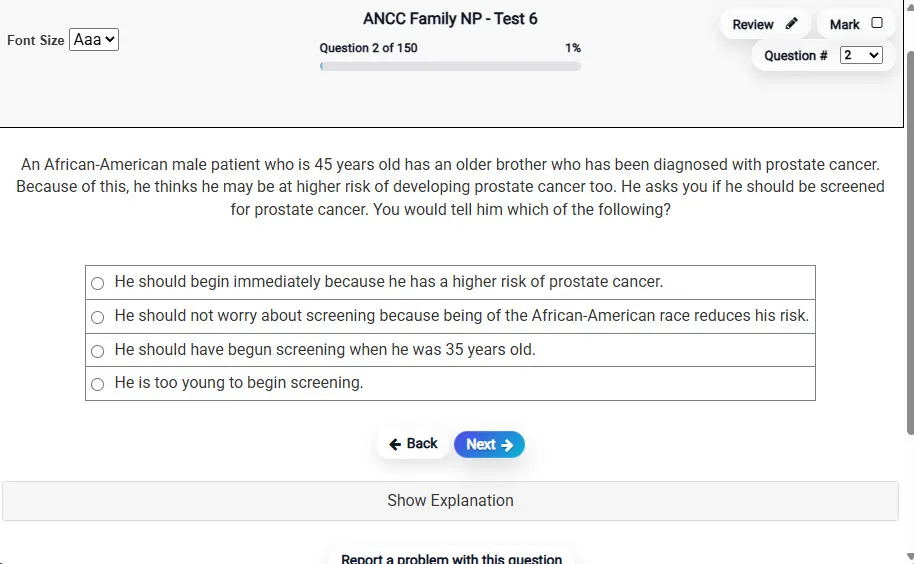
Answering a Question screen – Multiple-choice item view with navigation controls and progress tracker.
Answering a Question Multiple-choice item view with navigation controls and progress tracker.

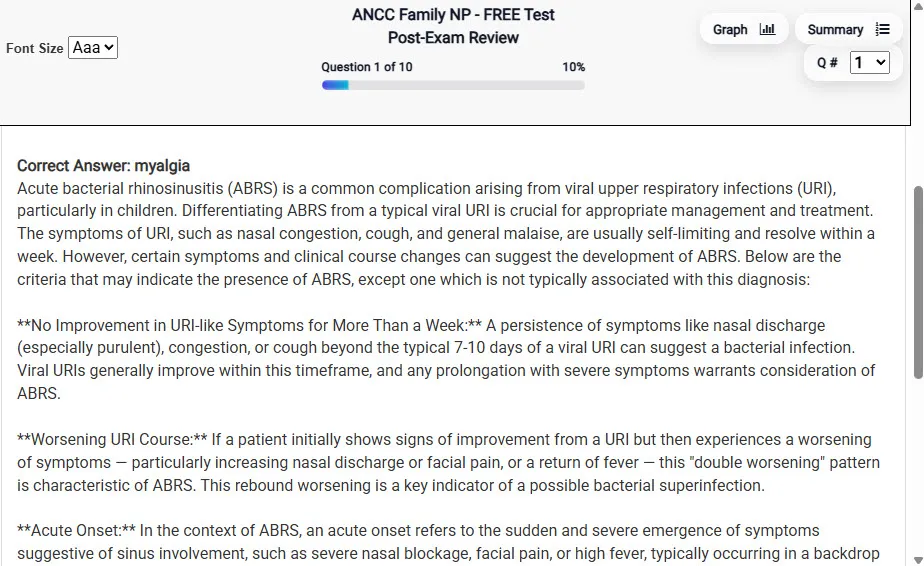
                           Detailed Explanation screen – 
                         Review mode showing chosen answer and rationale and references.
Detailed Explanation Review mode showing chosen answer and rationale and references.

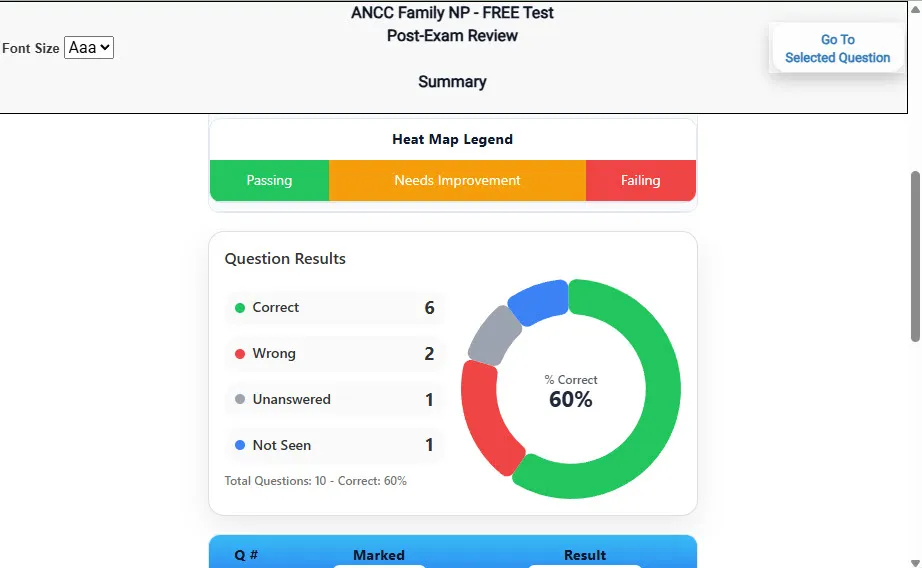
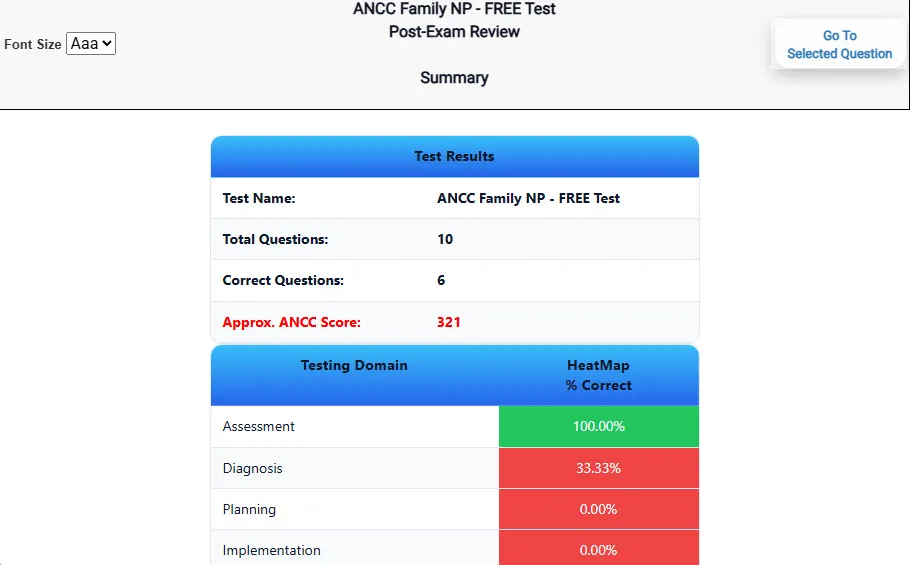
                           Review Summary 1 screen – 
                         Summary with counts for correct/wrong/unanswered and not seen items.
Review Summary 1 Summary with counts for correct/wrong/unanswered and not seen items.

                           Review Summary 2 screen – 
                         Advanced summary with category/domain breakdown and performance insights.
Review Summary 2 Advanced summary with category/domain breakdown and performance insights.

What Each Screen Shows

Answer Question Screen

  • Clean multiple-choice interface with progress bar.
  • Mark for review feature.
  • Matches real test pacing.

Detailed Explanation

  • Correct answer plus rationale.
  • Key concepts and guidelines highlighted.
  • Move between questions to fill knowledge gaps.

Review Summary 1

  • Overall results with total questions and scaled score.
  • Domain heatmap shows strengths and weaknesses.
  • Quick visual feedback on study priorities.

Review Summary 2

  • Chart of correct, wrong, unanswered, not seen.
  • Color-coded results for easy review.
  • Links back to missed items.

Top 10 Reasons to Use Exam Edge for your Praxis Health and Physical Education Exam Prep

  1. Focused on the Praxis Health and Physical Education Exam

    Our practice tests are built specifically for the Praxis Health and Physical Education exam — every question mirrors the real topics, format, and difficulty so you're studying exactly what matters.

  2. Real Exam Simulation

    We match the per-question time limits and pressure of the actual Praxis exam, so test day feels familiar and stress-free.

  3. 20 Full Practice Tests & 2,600 Unique Questions

    You'll have more than enough material to master every Praxis Health and Physical Education concept — no repeats, no fluff.

  4. Lower Cost Than a Retake

    Ordering 5 practice exams costs less than retaking the Praxis Health and Physical Education exam after a failure. One low fee could save you both time and money.

  5. Flexible Testing

    Need to step away mid-exam? Pick up right where you left off — with your remaining time intact.

  6. Instant Scoring & Feedback

    See your raw score and an estimated Praxis Health and Physical Education score immediately after finishing each practice test.

  7. Detailed Explanations for Every Question

    Review correct and incorrect answers with clear, step-by-step explanations so you truly understand each topic.

  8. Trusted & Accredited

    We're fully accredited by the Better Business Bureau and uphold the highest standards of trust and transparency.

  9. Web-Based & Always Available

    No software to install. Access your Praxis Health and Physical Education practice exams 24/7 from any computer or mobile device.

  10. Expert Support When You Need It

    Need extra help? Our specialized tutors are highly qualified and ready to support your Praxis exam prep.


Pass the Praxis Health and Physical Education Exam with Realistic Practice Tests from Exam Edge

Preparing for your upcoming Praxis Health and Physical Education (5857) Certification Exam can feel overwhelming — but the right practice makes all the difference. Exam Edge gives you the tools, structure, and confidence to pass on your first try. Our online practice exams are built to match the real Praxis Health and Physical Education exam in content, format, and difficulty.

  • 📝 20 Praxis Health and Physical Education Practice Tests: Access 20 full-length exams with 130 questions each, covering every major Praxis Health and Physical Education topic in depth.
  • Instant Online Access: Start practicing right away — no software, no waiting.
  • 🧠 Step-by-Step Explanations: Understand the reasoning behind every correct answer so you can master Praxis Health and Physical Education exam concepts.
  • 🔄 Retake Each Exam Up to 4 Times: Build knowledge through repetition and track your improvement over time.
  • 🌐 Web-Based & Available 24/7: Study anywhere, anytime, on any device.
  • 🧘 Boost Your Test-Day Confidence: Familiarity with the Praxis format reduces anxiety and helps you perform under pressure.

These Praxis Health and Physical Education practice exams are designed to simulate the real testing experience by matching question types, timing, and difficulty level. This approach helps you get comfortable not just with the exam content, but also with the testing environment, so you walk into your exam day focused and confident.


Exam Edge Praxis Reviews


I failed the Praxis Math test five times before I found your site. After taking all your practice tests, on my next attempt I passed by five points! I can honestly say this site is the reason I passed. Thank you!!!

Nikki P, Tennessee

Just wanted to say thanks for helping me pass the Praxis I Reading! Your practice tests and especially your explanations are great. They gave me the confidence I needed! Now I can student teach this fall. I'm so glad I found PraxisReading.com!

Denise C, Florida

Thank you so much. I just received my results in the mail. I scored a 179 and passed the Praxis I Writing! I'll never have to worry about retaking this test again! PraxisWriting.com is great. I told all my friends about this site.

Susan K, Virginia

I failed the Parapro test four times before I found your site. After taking all your practice tests, on my next attempt I passed by seven points! I can honestly say that this site is the reason I passed. Thank you!!!

Rebecca S, Texas

Hi! Just returned from taking my Praxis computerized and am happy to say that I passed with a 175. The last time I took the test I missed by 1 point. Your tests definitely made the difference for me! The set up was so similar to the test and the types of questions were also similar that I felt ve ...
Read More
Brad Y, Pennsylvania

I have taken the math praxis 3 times and wanted to give up. I ordered the bundle of math tests and I passed the math praxis today. Thank you for all the help.

Jacob D, South Carolina


Praxis Health and Physical Education Aliases Test Name

Here is a list of alternative names used for this exam.

  • Praxis Health and Physical Education
  • Praxis Health and Physical Education test
  • Praxis Health and Physical Education Certification Test
  • Praxis
  • Praxis 5857
  • 5857 test
  • Praxis Health and Physical Education (5857)
  • Health and Physical Education certification