This is the content of the pop-over!

Praxis Government/Political Science (5931) Practice Tests & Test Prep by Exam Edge


Praxis Government/Political Science   product image
(5.0)
Based on 20 Reviews

  • Real Exam Simulation: Timed questions and matching content build comfort for your Praxis Government/Political Science test day.
  • Instant, 24/7 Access: Web-based Praxis Government/Political Science practice exams with no software needed.
  • Clear Explanations: Step-by-step answers and explanations for your Praxis exam to strengthen understanding.
  • Boosted Confidence: Reduces anxiety and improves test-taking skills to ace your Praxis Government/Political Science (5931).

Featured on

Praxis Government/Political Science Online Practice Test Bundles

BEST VALUE
5 practice tests

$69.75

$199.75

SAVE $130

Only $13.95 per test!

  • 100% Pass Guarantee
  • 5 online practice tests
  • 120 questions per test
  • Bonus: 100 Flash Cards + Study Guide
  • Instant access
  • Detailed Explanations
  • Practice tests never expire
  • Timed, untimed, or study guide mode
1 practice test

$39.95

  • 1 online practice test
  • 120 questions per test
  • Instant access
  • Detailed Explanations
  • Practice tests never expire
  • Timed, untimed, or study guide mode
Quick Select
Tap to choose a bundle

** All Prices are in US Dollars (USD) **


Praxis Government/Political Science (5931) Resources

Jump to the section you need most.

Understanding the exact breakdown of the Praxis Government/Political Science test will help you know what to expect and how to most effectively prepare. The Praxis Government/Political Science has 120 multiple-choice questions . The exam will be broken down into the sections below:

Praxis Government/Political Science Exam Blueprint
Domain Name % Number of
Questions
United States Constitution 22% 26
United States Government: Federal - State Local Institutions 28% 34
Civil Rights and Civil Liberties 16% 19
United States Politics 20% 24
Comparative Politics and International Relations 14% 17

Praxis Government/Political Science Study Tips by Domain

  • Trace core constitutional principles—popular sovereignty, limited government, separation of powers, checks and balances, federalism—and use the text to justify them; red flag: confusing separation of powers (between branches) with federalism (between national and state governments).
  • Know the amendment process (Article V) and how it balances rigidity and change; common trap: thinking amendments can be proposed only by Congress or ratified only by state legislatures (conventions are an alternate route).
  • Identify major Supreme Court interpretive approaches (textualism, originalism, living Constitution, precedent) and apply them to a fact pattern; priority rule: start with the constitutional provision (Article, Section, Clause) before case holdings.
  • Distinguish enumerated, implied (Necessary and Proper), and inherent powers and link them to limits (Tenth Amendment, specific prohibitions); red flag: treating the Tenth Amendment as an independent grant of power rather than a rule about reserved powers.
  • Explain federalism doctrines (supremacy, preemption, commerce power, spending power, intergovernmental immunity) in concrete scenarios; common trap: missing that federal preemption can be express, field, or conflict-based.
  • Connect structural provisions to individual rights protections (Bill of Rights, Reconstruction Amendments, incorporation via Fourteenth Amendment); threshold cue: when a question involves rights limits, first ask whether there is “state action” before applying constitutional constraints.
  • Differentiate enumerated, reserved, and concurrent powers and apply supremacy & preemption correctly—red flag: assuming states can ignore a valid federal statute in an area where Congress is acting within its powers.
  • Track federalism models (dual, cooperative, new) and the role of grants-in-aid—common trap: mixing up categorical grants (tight rules) with block grants (broad discretion) when predicting state/local behavior.
  • Know the core functions and constraints of Congress, the presidency, and the federal bureaucracy—priority rule: if asked who implements policy day-to-day, the best answer is typically executive agencies under delegated authority.
  • Identify state government structures (legislature, governor, courts) and key policy levers like police powers—red flag: attributing general police power to the federal government rather than to states.
  • Explain local government authority (counties, municipalities, special districts) and home rule vs. Dillon’s Rule—common trap: assuming localities have inherent sovereignty when many operate only with powers granted by the state.
  • Distinguish election/administration responsibilities across levels (e.g., state-run elections, local administration, federal standards) and recognize intergovernmental mandates—red flag: forgetting that most election logistics are state/local even in federal elections.
  • Distinguish civil rights (equal treatment) from civil liberties (freedom from government interference)—common trap: treating both as the same thing when analyzing a fact pattern.
  • Apply the Equal Protection Clause via the 14th Amendment (and incorporation via the 14th for many liberties)—red flag: assuming the Bill of Rights originally restricted state governments.
  • Know scrutiny levels for equal protection: strict scrutiny (race/national origin, fundamental rights), intermediate (sex), rational basis (most others)—priority rule: if strict scrutiny applies, the law is usually struck down unless narrowly tailored to a compelling interest.
  • Differentiate procedural due process (fair procedures) from substantive due process (certain rights from government intrusion)—common trap: claiming “due process” is only about criminal trials.
  • First Amendment limits: content-based speech restrictions trigger strict scrutiny; time-place-manner rules can stand if content-neutral and narrowly tailored with alternatives—red flag: a rule targeting a viewpoint is almost always unconstitutional.
  • Religious freedom: Establishment Clause vs Free Exercise Clause—common trap: assuming any burden on religion is unconstitutional; generally applicable, religion-neutral laws are usually upheld absent targeting.
  • Distinguish linkage institutions (parties, interest groups, media) from government institutions—a common trap is treating PACs as part of the formal government rather than as election-influence mechanisms.
  • Know party systems and polarization effects (responsible party model vs. candidate-centered politics)—red flag: assuming parties are constitutionally mandated or uniformly “strong” across U.S. history.
  • Track voter behavior patterns (party identification, retrospective voting, issue voting, turnout differentials)—priority rule: turnout is systematically lower in midterms and primaries than in presidential general elections.
  • Understand campaign rules and incentives (incumbency advantage, gerrymandering, money and mobilization)—common trap: confusing “soft money” party spending with regulated candidate “hard money” contributions.
  • Use accurate public opinion concepts (sampling, margin of error, question wording, salience)—threshold cue: small subgroup polls with tiny n are a reliability red flag even if the overall poll looks precise.
  • Connect media and agenda-setting (framing, priming, horse-race coverage) to political outcomes—contraindication: treating a single viral event as proof of long-term opinion change without longitudinal evidence.
  • Compare regime types by institutional features (democracy, authoritarian, hybrid) and watch the red flag that “elections” alone do not equal democracy without competitive parties, civil liberties, and rule of law.
  • Use electoral systems (plurality/majoritarian vs proportional representation vs mixed) to predict party systems; common trap: assuming PR always produces stability—it often increases coalition bargaining and fragmentation.
  • Differentiate unitary vs federal states and parliamentary vs presidential systems; priority rule: in parliamentary systems, executive survival hinges on legislative confidence (no-confidence votes are a key threshold event).
  • Apply core IR theories (realism, liberalism, constructivism) to explain state behavior; red flag: confusing realist “relative gains/security dilemma” logic with liberal emphasis on institutions, interdependence, and absolute gains.
  • Identify major international organizations and legal tools (UN, NATO, WTO, IMF/World Bank, treaties, customary law); common trap: assuming UN Security Council actions work without P5 consensus—veto power is the practical constraint.
  • Track globalization and development indicators (GDP per capita, HDI, Gini, demographic transition) and note the cue that correlation is not causation—resource wealth can coincide with weak institutions (the “resource curse”).


Built to Fit Into Your Busy Life

Everything you need to prepare with confidence—without wasting a minute.

Three Study Modes

Timed, No Time Limit, or Explanation mode.

Actionable Analytics

Heatmaps and scaled scores highlight weak areas.

High-Yield Rationales

Concise explanations emphasize key concepts.

Realistic Interface

Matches the feel of the actual exam environment.

Accessible by Design

Clean layout reduces cognitive load.

Anytime, Anywhere

Web-based access 24/7 on any device.
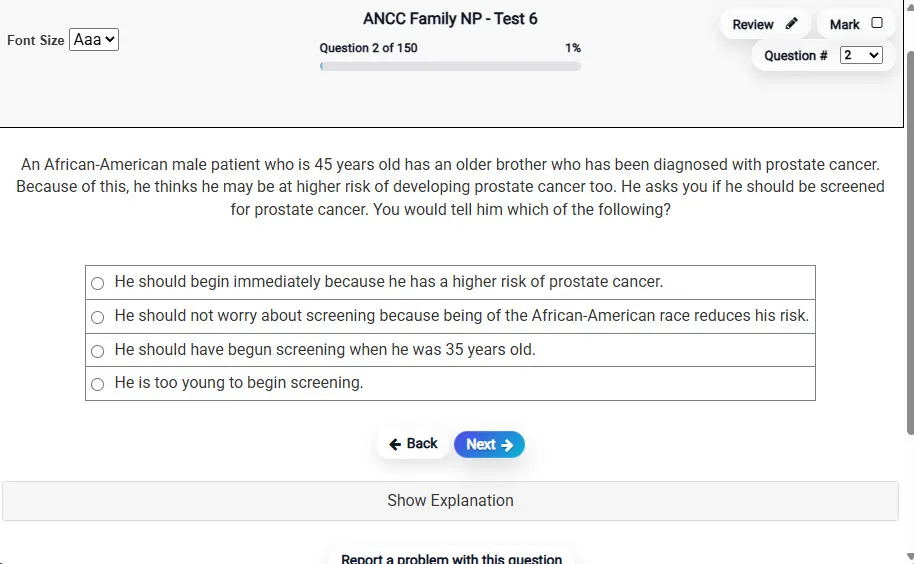
Answering a Question screen – Multiple-choice item view with navigation controls and progress tracker.
Answering a Question Multiple-choice item view with navigation controls and progress tracker.

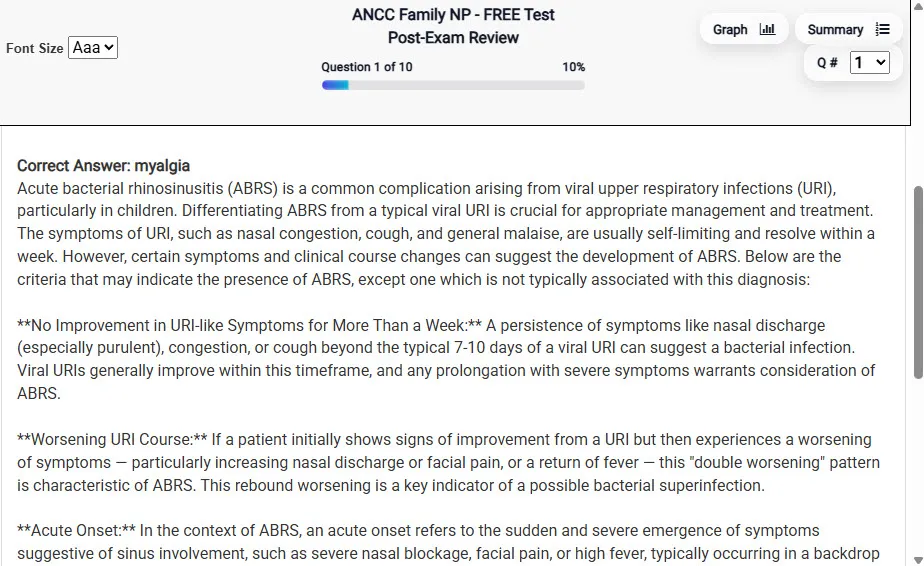
                           Detailed Explanation screen – 
                         Review mode showing chosen answer and rationale and references.
Detailed Explanation Review mode showing chosen answer and rationale and references.

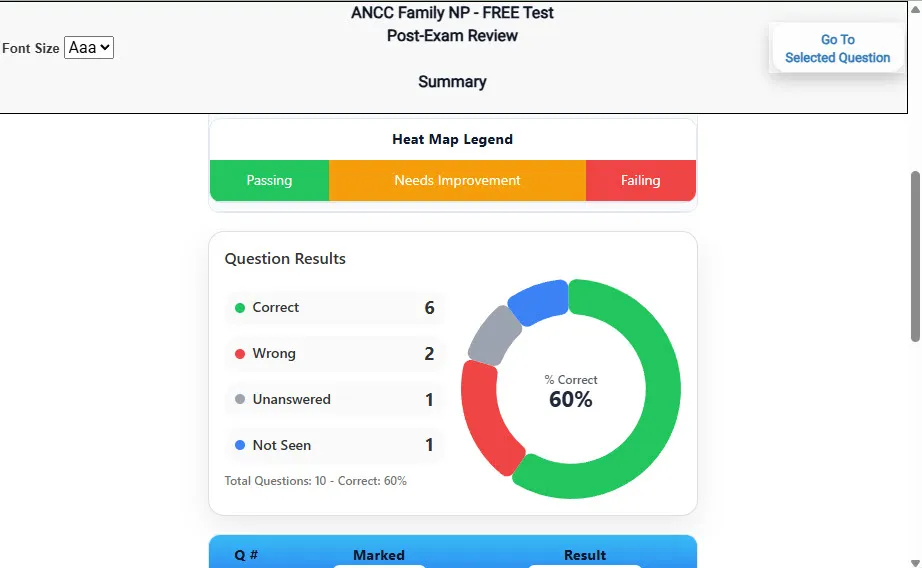
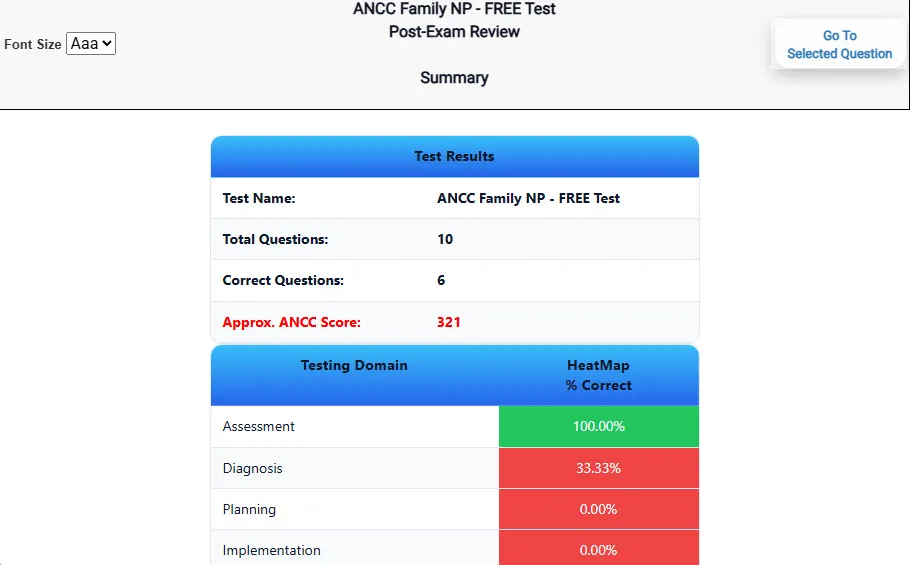
                           Review Summary 1 screen – 
                         Summary with counts for correct/wrong/unanswered and not seen items.
Review Summary 1 Summary with counts for correct/wrong/unanswered and not seen items.

                           Review Summary 2 screen – 
                         Advanced summary with category/domain breakdown and performance insights.
Review Summary 2 Advanced summary with category/domain breakdown and performance insights.

What Each Screen Shows

Answer Question Screen

  • Clean multiple-choice interface with progress bar.
  • Mark for review feature.
  • Matches real test pacing.

Detailed Explanation

  • Correct answer plus rationale.
  • Key concepts and guidelines highlighted.
  • Move between questions to fill knowledge gaps.

Review Summary 1

  • Overall results with total questions and scaled score.
  • Domain heatmap shows strengths and weaknesses.
  • Quick visual feedback on study priorities.

Review Summary 2

  • Chart of correct, wrong, unanswered, not seen.
  • Color-coded results for easy review.
  • Links back to missed items.

Top 10 Reasons to Use Exam Edge for your Praxis Government/Political Science Exam Prep

  1. Focused on the Praxis Government/Political Science Exam

    Our practice tests are built specifically for the Praxis Government/Political Science exam — every question mirrors the real topics, format, and difficulty so you're studying exactly what matters.

  2. Real Exam Simulation

    We match the per-question time limits and pressure of the actual Praxis exam, so test day feels familiar and stress-free.

  3. 5 Full Practice Tests & 600 Unique Questions

    You'll have more than enough material to master every Praxis Government/Political Science concept — no repeats, no fluff.

  4. Lower Cost Than a Retake

    Ordering 5 practice exams costs less than retaking the Praxis Government/Political Science exam after a failure. One low fee could save you both time and money.

  5. Flexible Testing

    Need to step away mid-exam? Pick up right where you left off — with your remaining time intact.

  6. Instant Scoring & Feedback

    See your raw score and an estimated Praxis Government/Political Science score immediately after finishing each practice test.

  7. Detailed Explanations for Every Question

    Review correct and incorrect answers with clear, step-by-step explanations so you truly understand each topic.

  8. Trusted & Accredited

    We're fully accredited by the Better Business Bureau and uphold the highest standards of trust and transparency.

  9. Web-Based & Always Available

    No software to install. Access your Praxis Government/Political Science practice exams 24/7 from any computer or mobile device.

  10. Expert Support When You Need It

    Need extra help? Our specialized tutors are highly qualified and ready to support your Praxis exam prep.


Pass the Praxis Government/Political Science Exam with Realistic Practice Tests from Exam Edge

Preparing for your upcoming Praxis Government/Political Science (5931) Certification Exam can feel overwhelming — but the right practice makes all the difference. Exam Edge gives you the tools, structure, and confidence to pass on your first try. Our online practice exams are built to match the real Praxis Government/Political Science exam in content, format, and difficulty.

  • 📝 5 Praxis Government/Political Science Practice Tests: Access 5 full-length exams with 120 questions each, covering every major Praxis Government/Political Science topic in depth.
  • Instant Online Access: Start practicing right away — no software, no waiting.
  • 🧠 Step-by-Step Explanations: Understand the reasoning behind every correct answer so you can master Praxis Government/Political Science exam concepts.
  • 🔄 Retake Each Exam Up to 4 Times: Build knowledge through repetition and track your improvement over time.
  • 🌐 Web-Based & Available 24/7: Study anywhere, anytime, on any device.
  • 🧘 Boost Your Test-Day Confidence: Familiarity with the Praxis format reduces anxiety and helps you perform under pressure.

These Praxis Government/Political Science practice exams are designed to simulate the real testing experience by matching question types, timing, and difficulty level. This approach helps you get comfortable not just with the exam content, but also with the testing environment, so you walk into your exam day focused and confident.


Exam Edge Praxis Reviews


I would like to provide you with an additional update concerning your product.  Seldom do I rate an item/app, etc.  Yet today I took the Praxis ii Government/Political Science exam and while I scored around the 150 mark with your exams I made a 173 on the actual ETS test.  I find your ...
Read More
Nik , TN

Great test materials to help one pass the praxis test. Praxis test 5931.

Daryl , Memphis, TN

I failed the Praxis Math test five times before I found your site. After taking all your practice tests, on my next attempt I passed by five points! I can honestly say this site is the reason I passed. Thank you!!!

Nikki P, Tennessee

Just wanted to say thanks for helping me pass the Praxis I Reading! Your practice tests and especially your explanations are great. They gave me the confidence I needed! Now I can student teach this fall. I'm so glad I found PraxisReading.com!

Denise C, Florida

Thank you so much. I just received my results in the mail. I scored a 179 and passed the Praxis I Writing! I'll never have to worry about retaking this test again! PraxisWriting.com is great. I told all my friends about this site.

Susan K, Virginia

I failed the Parapro test four times before I found your site. After taking all your practice tests, on my next attempt I passed by seven points! I can honestly say that this site is the reason I passed. Thank you!!!

Rebecca S, Texas


Praxis Government/Political Science Aliases Test Name

Here is a list of alternative names used for this exam.

  • Praxis Government/Political Science
  • Praxis Government/Political Science test
  • Praxis Government/Political Science Certification Test
  • Praxis
  • Praxis 5931
  • 5931 test
  • Praxis Government/Political Science (5931)
  • Government/Political Science certification