This is the content of the pop-over!

Praxis Gifted Education (5358) Practice Tests & Test Prep by Exam Edge


Praxis Gifted Education  product image
(5.0)
Based on 29 Reviews

  • Real Exam Simulation: Timed questions and matching content build comfort for your Praxis Gifted Education test day.
  • Instant, 24/7 Access: Web-based Praxis Gifted Education practice exams with no software needed.
  • Clear Explanations: Step-by-step answers and explanations for your Praxis exam to strengthen understanding.
  • Boosted Confidence: Reduces anxiety and improves test-taking skills to ace your Praxis Gifted Education (5358).

Featured on

Praxis Gifted Education Online Practice Test Bundles

BEST VALUE
10 practice tests

$99.50

$399.50

SAVE $300

Only $9.95 per test!

  • 100% Pass Guarantee
  • 10 online practice tests
  • 120 questions per test
  • Bonus: 100 Flash Cards + Study Guide
  • Instant access
  • Detailed Explanations
  • Practice tests never expire
  • Timed, untimed, or study guide mode
5 practice tests

$69.75

$199.75

SAVE $130

Only $13.95 per test!

  • 5 online practice tests
  • 120 questions per test
  • Bonus: 100 Flash Cards + Study Guide
  • Instant access
  • Detailed Explanations
  • Practice tests never expire
  • Timed, untimed, or study guide mode
1 practice test

$39.95

  • 1 online practice test
  • 120 questions per test
  • Instant access
  • Detailed Explanations
  • Practice tests never expire
  • Timed, untimed, or study guide mode
Quick Select
Tap to choose a bundle

** All Prices are in US Dollars (USD) **


Praxis Gifted Education (5358) Resources

Jump to the section you need most.

Understanding the exact breakdown of the Praxis Gifted Education test will help you know what to expect and how to most effectively prepare. The Praxis Gifted Education has 120 multiple-choice questions . The exam will be broken down into the sections below:

Praxis Gifted Education Exam Blueprint
Domain Name % Number of
Questions
Development and Characteristics of Gifted Students 21% 25
Learning Environment for Gifted Students 19% 23
Instruction of Gifted Students 28% 34
Identification and Assessment of Gifted Students 18% 22
Professionalism 14% 17

Praxis Gifted Education Study Tips by Domain

  • Know asynchronous development (advanced cognition with age-typical or lagging social/emotional skills); red flag: assuming high IQ means mature self-regulation and peer skills.
  • Recognize overexcitabilities and heightened sensitivity (intellectual, emotional, sensory, psychomotor) that can look like behavior problems; common trap: mislabeling intensity as defiance.
  • Understand twice-exceptionality (e.g., gifted with ADHD, ASD, dyslexia) where strengths can mask needs or needs can mask strengths; priority rule: look for uneven profiles and unexpected underachievement.
  • Differentiate giftedness from high achievement by focusing on rapid learning, complexity, and novel problem solving; red flag: equating giftedness solely with grades and compliance.
  • Account for cultural/linguistic and socioeconomic factors affecting how gifted traits present (e.g., code-switching, limited opportunities to show talent); common trap: interpreting quietness or limited background knowledge as low ability.
  • Know common affective characteristics (perfectionism, impostor feelings, risk avoidance, moral concern) and their classroom impact; contraindication: using public ranking or “gifted labels” as motivation when it increases anxiety.
  • Establish a classroom culture that normalizes advanced thinking without status hierarchies—use norms that value curiosity, evidence, and respectful critique; red flag: praising “smartness” over process can increase perfectionism and risk-avoidance.
  • Design flexible grouping (interest/skill/choice) with planned rotation and clear purposes; common trap: leaving gifted learners in permanent “helper” roles that reduce their access to challenge.
  • Proactively address social-emotional needs common in gifted learners (asynchronous development, intensity, perfectionism) with explicit coping and goal-setting routines; contraindication: assuming high ability means low need for SEL supports.
  • Maintain psychologically safe discourse structures (think time, norms for disagreement, sentence stems) so students will take intellectual risks; red flag: rapid-fire pacing that rewards speed can silence reflective or twice-exceptional students.
  • Provide access and accommodations for twice-exceptional learners through UDL and individualized supports while keeping the cognitive demand high; common trap: reducing rigor when providing accommodations (e.g., fewer complex tasks instead of alternate ways to show mastery).
  • Use family and community partnerships to support advocacy, mentorships, and culturally responsive belonging; priority rule: communicate with specific evidence (work samples, data, observed behaviors) rather than labels to prevent conflict and misinterpretation.
  • Match service delivery to learner need (e.g., acceleration, enrichment, curriculum compacting) and document the rationale; red flag: giving all “gifted” students the same enrichment regardless of readiness data.
  • Write measurable goals that target advanced outcomes (depth, complexity, and pace) and include progress monitoring; common trap: goals that restate activities (e.g., “will complete a project”) instead of outcomes.
  • Differentiate content, process, and product using preassessment to eliminate mastered material; priority rule: compact first, then replace with appropriately challenging work rather than adding “more of the same.”
  • Use higher-order questioning and inquiry (problem-based learning, Socratic seminar) with explicit criteria for rigor; red flag: “harder” means longer assignments instead of increased abstraction or complexity.
  • Design authentic assessments (rubrics, performance tasks, portfolios) aligned to advanced standards and talent area; common trap: grading creativity or effort without clear, published performance descriptors.
  • Plan for twice-exceptional and culturally/linguistically diverse gifted learners with accommodations that preserve challenge; contraindication: lowering cognitive demand when providing supports (e.g., simplified tasks instead of access tools).
  • Use multiple measures for eligibility (e.g., achievement, aptitude, performance, portfolios, observations) and avoid a single test cutoff as the sole gatekeeper—red flag: overreliance on IQ or one composite score.
  • Interpret scores with appropriate norms (age vs. grade), confidence intervals, and error of measurement; priority rule: treat close-to-cutoff scores as needing corroborating evidence, not automatic denial.
  • Screen and refer with equity safeguards (universal screening, local norms, alternative pathways) to reduce underidentification—common trap: referral-only systems that miss culturally/linguistically diverse and low-SES students.
  • Distinguish giftedness from high achievement and from disability; red flag: “twice-exceptional” patterns (strong reasoning with weak output/processing) being misread as lack of gifted potential.
  • Assess for instructional planning, not just placement: use preassessments to determine mastery and need for acceleration/compacting—priority rule: if pretest shows high mastery, repeating instruction is contraindicated.
  • Ensure ethical, legal, and family communication practices (informed consent where required, confidentiality, clear explanation of results) and document decision rules—common trap: vague criteria that cannot be defended if challenged.
  • Know key laws and ethical expectations affecting gifted services (e.g., IDEA/Section 504, FERPA) and keep student records confidential—red flag: sharing scores or eligibility status with unauthorized staff or other parents.
  • Use formal, bias-aware communication with families and colleagues, documenting decisions and contacts—common trap: relying on informal conversations instead of written meeting notes and agreed-upon next steps.
  • Advocate for equitable access to gifted identification and services, especially for culturally/linguistically diverse and twice-exceptional students—priority rule: challenge referral “gatekeeping” based solely on teacher nomination or behavior/compliance.
  • Collaborate in multidisciplinary teams (general education, special education, counselors, administrators) to align goals, accommodations, and progress monitoring—contraindication: making unilateral placement or acceleration decisions without team input and data.
  • Engage in ongoing professional learning that targets evidence-based gifted practices (differentiation, acceleration, SEL, creativity) and evaluate impact—cue: if training doesn’t change student outcomes, revise the plan rather than repeating the same PD.
  • Practice reflective, data-driven decision making and recognize personal bias in interpreting performance and behavior—common trap: equating high achievement with giftedness or overlooking underachievement due to perfectionism, anxiety, or masking.


Built to Fit Into Your Busy Life

Everything you need to prepare with confidence—without wasting a minute.

Three Study Modes

Timed, No Time Limit, or Explanation mode.

Actionable Analytics

Heatmaps and scaled scores highlight weak areas.

High-Yield Rationales

Concise explanations emphasize key concepts.

Realistic Interface

Matches the feel of the actual exam environment.

Accessible by Design

Clean layout reduces cognitive load.

Anytime, Anywhere

Web-based access 24/7 on any device.
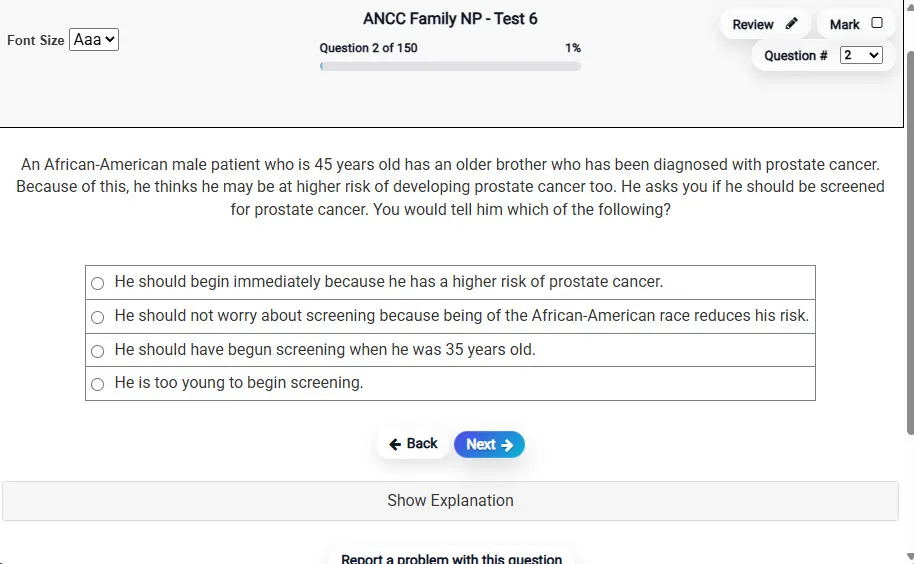
Answering a Question screen – Multiple-choice item view with navigation controls and progress tracker.
Answering a Question Multiple-choice item view with navigation controls and progress tracker.

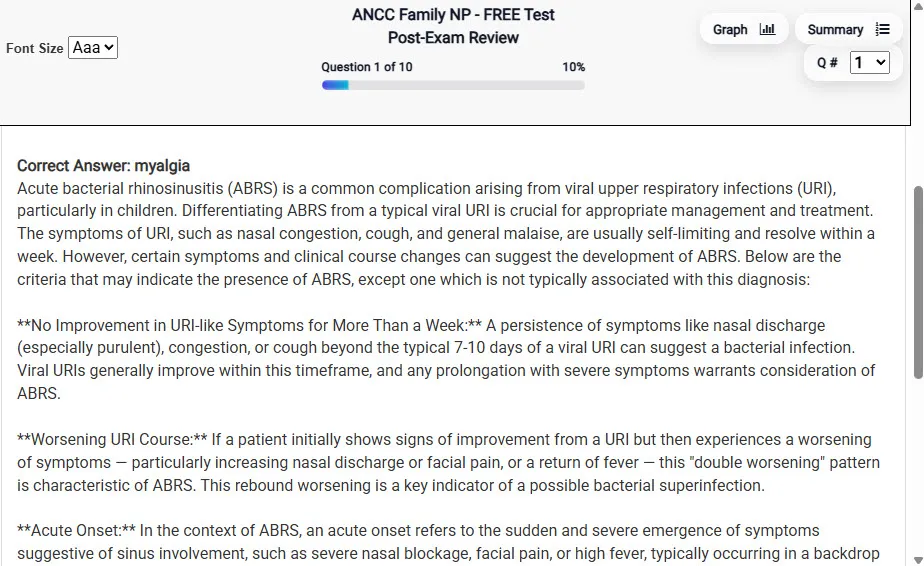
                           Detailed Explanation screen – 
                         Review mode showing chosen answer and rationale and references.
Detailed Explanation Review mode showing chosen answer and rationale and references.

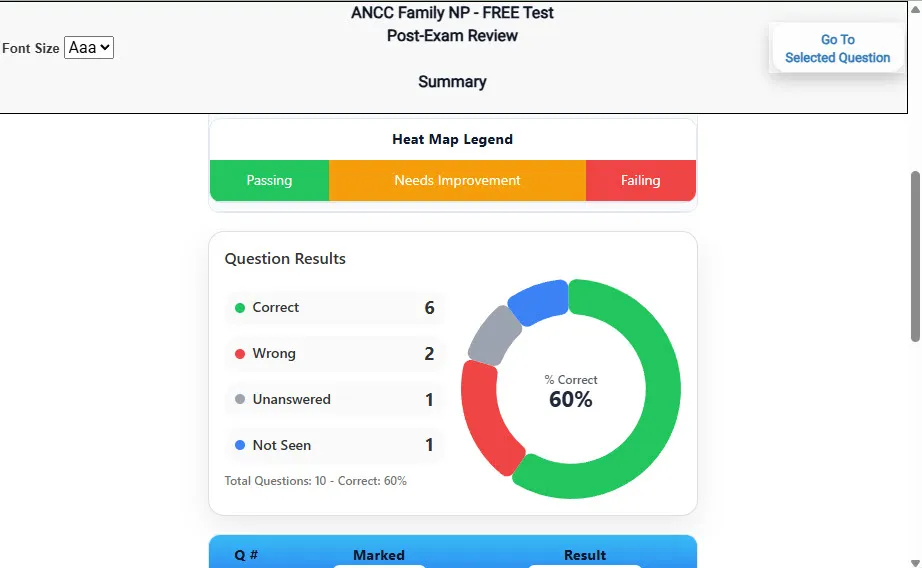
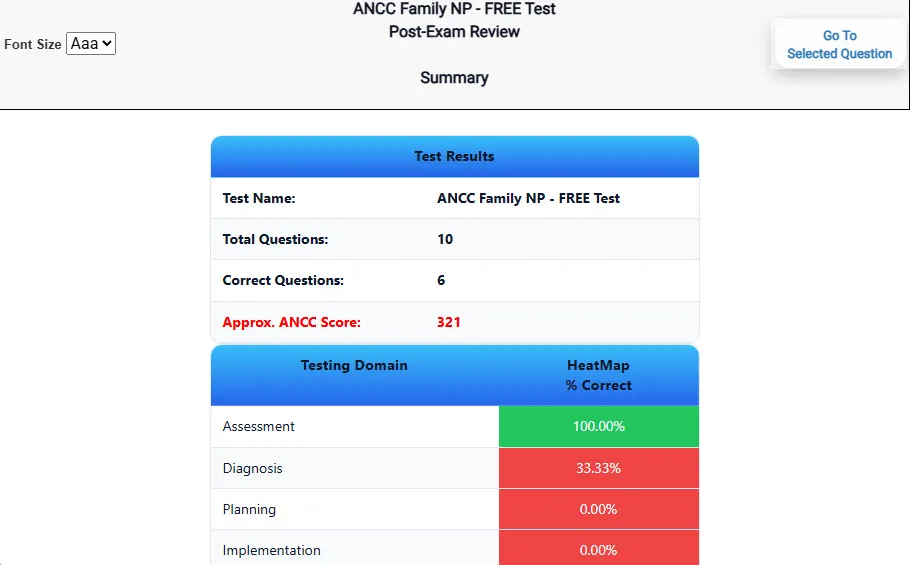
                           Review Summary 1 screen – 
                         Summary with counts for correct/wrong/unanswered and not seen items.
Review Summary 1 Summary with counts for correct/wrong/unanswered and not seen items.

                           Review Summary 2 screen – 
                         Advanced summary with category/domain breakdown and performance insights.
Review Summary 2 Advanced summary with category/domain breakdown and performance insights.

What Each Screen Shows

Answer Question Screen

  • Clean multiple-choice interface with progress bar.
  • Mark for review feature.
  • Matches real test pacing.

Detailed Explanation

  • Correct answer plus rationale.
  • Key concepts and guidelines highlighted.
  • Move between questions to fill knowledge gaps.

Review Summary 1

  • Overall results with total questions and scaled score.
  • Domain heatmap shows strengths and weaknesses.
  • Quick visual feedback on study priorities.

Review Summary 2

  • Chart of correct, wrong, unanswered, not seen.
  • Color-coded results for easy review.
  • Links back to missed items.

Top 10 Reasons to Use Exam Edge for your Praxis Gifted Education Exam Prep

  1. Focused on the Praxis Gifted Education Exam

    Our practice tests are built specifically for the Praxis Gifted Education exam — every question mirrors the real topics, format, and difficulty so you're studying exactly what matters.

  2. Real Exam Simulation

    We match the per-question time limits and pressure of the actual Praxis exam, so test day feels familiar and stress-free.

  3. 10 Full Practice Tests & 1,200 Unique Questions

    You'll have more than enough material to master every Praxis Gifted Education concept — no repeats, no fluff.

  4. Lower Cost Than a Retake

    Ordering 5 practice exams costs less than retaking the Praxis Gifted Education exam after a failure. One low fee could save you both time and money.

  5. Flexible Testing

    Need to step away mid-exam? Pick up right where you left off — with your remaining time intact.

  6. Instant Scoring & Feedback

    See your raw score and an estimated Praxis Gifted Education score immediately after finishing each practice test.

  7. Detailed Explanations for Every Question

    Review correct and incorrect answers with clear, step-by-step explanations so you truly understand each topic.

  8. Trusted & Accredited

    We're fully accredited by the Better Business Bureau and uphold the highest standards of trust and transparency.

  9. Web-Based & Always Available

    No software to install. Access your Praxis Gifted Education practice exams 24/7 from any computer or mobile device.

  10. Expert Support When You Need It

    Need extra help? Our specialized tutors are highly qualified and ready to support your Praxis exam prep.


Pass the Praxis Gifted Education Exam with Realistic Practice Tests from Exam Edge

Preparing for your upcoming Praxis Gifted Education (5358) Certification Exam can feel overwhelming — but the right practice makes all the difference. Exam Edge gives you the tools, structure, and confidence to pass on your first try. Our online practice exams are built to match the real Praxis Gifted Education exam in content, format, and difficulty.

  • 📝 10 Praxis Gifted Education Practice Tests: Access 10 full-length exams with 120 questions each, covering every major Praxis Gifted Education topic in depth.
  • Instant Online Access: Start practicing right away — no software, no waiting.
  • 🧠 Step-by-Step Explanations: Understand the reasoning behind every correct answer so you can master Praxis Gifted Education exam concepts.
  • 🔄 Retake Each Exam Up to 4 Times: Build knowledge through repetition and track your improvement over time.
  • 🌐 Web-Based & Available 24/7: Study anywhere, anytime, on any device.
  • 🧘 Boost Your Test-Day Confidence: Familiarity with the Praxis format reduces anxiety and helps you perform under pressure.

These Praxis Gifted Education practice exams are designed to simulate the real testing experience by matching question types, timing, and difficulty level. This approach helps you get comfortable not just with the exam content, but also with the testing environment, so you walk into your exam day focused and confident.


Exam Edge Praxis Reviews


I failed the Praxis Math test five times before I found your site. After taking all your practice tests, on my next attempt I passed by five points! I can honestly say this site is the reason I passed. Thank you!!!

Nikki P, Tennessee

Just wanted to say thanks for helping me pass the Praxis I Reading! Your practice tests and especially your explanations are great. They gave me the confidence I needed! Now I can student teach this fall. I'm so glad I found PraxisReading.com!

Denise C, Florida

Thank you so much. I just received my results in the mail. I scored a 179 and passed the Praxis I Writing! I'll never have to worry about retaking this test again! PraxisWriting.com is great. I told all my friends about this site.

Susan K, Virginia

I failed the Parapro test four times before I found your site. After taking all your practice tests, on my next attempt I passed by seven points! I can honestly say that this site is the reason I passed. Thank you!!!

Rebecca S, Texas

Hi! Just returned from taking my Praxis computerized and am happy to say that I passed with a 175. The last time I took the test I missed by 1 point. Your tests definitely made the difference for me! The set up was so similar to the test and the types of questions were also similar that I felt ve ...
Read More
Brad Y, Pennsylvania

I have taken the math praxis 3 times and wanted to give up. I ordered the bundle of math tests and I passed the math praxis today. Thank you for all the help.

Jacob D, South Carolina


Praxis Gifted Education Aliases Test Name

Here is a list of alternative names used for this exam.

  • Praxis Gifted Education
  • Praxis Gifted Education test
  • Praxis Gifted Education Certification Test
  • Praxis
  • Praxis 5358
  • 5358 test
  • Praxis Gifted Education (5358)
  • Gifted Education certification