This is the content of the pop-over!

Praxis Family and Consumer Sciences 5121 (5121) Practice Tests & Test Prep by Exam Edge


Praxis Family and Consumer Sciences 5121  product image
(5.0)
Based on 20 Reviews

  • Real Exam Simulation: Timed questions and matching content build comfort for your Praxis Family and Consumer Sciences 5121 test day.
  • Instant, 24/7 Access: Web-based Praxis Family and Consumer Sciences 5121 practice exams with no software needed.
  • Clear Explanations: Step-by-step answers and explanations for your Praxis exam to strengthen understanding.
  • Boosted Confidence: Reduces anxiety and improves test-taking skills to ace your Praxis Family and Consumer Sciences 5121 (5121).

Featured on

Praxis Family and Consumer Sciences 5121 Online Practice Test Bundles

BEST VALUE
5 practice tests

$69.75

$199.75

SAVE $130

Only $13.95 per test!

  • 100% Pass Guarantee
  • 5 online practice tests
  • 120 questions per test
  • Bonus: 100 Flash Cards + Study Guide
  • Instant access
  • Detailed Explanations
  • Practice tests never expire
  • Timed, untimed, or study guide mode
1 practice test

$39.95

  • 1 online practice test
  • 120 questions per test
  • Instant access
  • Detailed Explanations
  • Practice tests never expire
  • Timed, untimed, or study guide mode
Quick Select
Tap to choose a bundle

** All Prices are in US Dollars (USD) **


Praxis Family and Consumer Sciences 5121 (5121) Resources

Jump to the section you need most.

Understanding the exact breakdown of the Praxis Family and Consumer Sciences 5121 test will help you know what to expect and how to most effectively prepare. The Praxis Family and Consumer Sciences 5121 has 120 multiple-choice questions . The exam will be broken down into the sections below:

Praxis Family and Consumer Sciences 5121 Exam Blueprint
Domain Name % Number of
Questions
The Family 15% 18
Human Development Through the Life Span 15% 18
Consumer Economics and Resource Management 13% 16
Nutrition - Food Science Wellness 14% 17
Textiles and Apparel 6% 7
Housing and Living Environments 8% 10
Family and Consumer Sciences Education 19% 23
Career - Community Family Connections 8% 10

Praxis Family and Consumer Sciences 5121 Study Tips by Domain

  • Differentiate family structures (nuclear, single-parent, blended, multigenerational, cohabiting) and note the priority rule: define “family” by function/support roles rather than household composition (common trap: assuming one “normal” model).
  • Apply major family theories (family systems, structural-functional, ecological, social exchange) to predict how change in one subsystem affects others; red flag: treating individual behavior as isolated without feedback loops.
  • Recognize typical stages/tasks in the family life cycle (launching, parenting, empty nest, aging) and plan supports accordingly; common trap: using age-only milestones and ignoring cultural or socioeconomic timing differences.
  • Identify healthy vs. unhealthy communication patterns (I-statements, active listening, triangulation, stonewalling) and choose an appropriate conflict-resolution strategy; contraindication: escalating during high arousal without a time-out plan.
  • Assess indicators of family stress and resilience (pile-up of demands, coping resources, social support) and select community referrals; threshold cue: safety issues (abuse, neglect, IPV) require mandated reporting and immediate safeguarding.
  • Explain how culture, religion, gender roles, and media shape family expectations and power dynamics; red flag: imposing personal values instead of using inclusive, legally compliant language and practices.
  • Know core developmental theories across the life span (Piaget, Erikson, Vygotsky, Kohlberg) and be able to match stages to classroom/family scenarios; red flag: mixing up similar-age stages (e.g., initiative vs. industry).
  • Track physical development milestones (motor, puberty, aging changes) and typical ranges rather than single ages; trap: treating wide-normal variation as pathology without functional impact.
  • Explain cognitive development shifts (executive function, abstract reasoning, information processing) and how they affect learning supports; priority rule: adjust task demands before labeling a learner as “unmotivated.”
  • Address social-emotional development (attachment, temperament, identity, peer influence) using protective factors; contraindication: interventions that ignore caregiver-child relationship quality often backfire.
  • Recognize risk and resilience factors (ACEs, poverty, disability, culture, supportive adults) and how they alter trajectories; common trap: assuming a single risk factor determines outcome (development is probabilistic, not deterministic).
  • Apply ethical and safety considerations when discussing development (privacy, mandated reporting indicators, informed consent when appropriate); threshold: suspected abuse/neglect cues require reporting per policy, not “waiting for proof.”
  • Apply budgeting and cash-flow basics (fixed vs. variable expenses) and prioritize needs before wants—red flag: budgets that ignore irregular/seasonal costs (insurance, gifts) usually fail.
  • Compare credit options (APR, fees, grace period, amortization) and calculate true borrowing cost—common trap: focusing on monthly payment while ignoring total interest paid.
  • Use saving and investing principles (time value of money, risk/return, diversification) to match goals and timelines—priority rule: short-term goals shouldn’t rely on volatile, high-risk assets.
  • Interpret pay information (gross vs. net, FICA, withholding, benefits) and adjust W-4 choices as circumstances change—red flag: large refunds can signal over-withholding and reduced take-home pay.
  • Explain consumer rights and protections (contracts, warranties, identity theft prevention) and keep documentation—common trap: skipping return policies, arbitration clauses, or warranty exclusions in fine print.
  • Manage resources beyond money (time, energy, community supports) using decision-making models—priority rule: choose options that reduce opportunity cost when time constraints are the limiting resource.
  • Use Dietary Reference Intakes correctly—RDA meets needs of ~97–98% of healthy people, while UL flags toxicity risk; red flag: recommending doses near/above UL (e.g., vitamin A, iron) without indication.
  • Interpret Nutrition Facts with serving size math first; common trap: forgetting multiple servings per package and undercounting calories, sodium, or added sugars.
  • Apply food safety controls: keep hot foods ≥135°F and cold foods ≤41°F with minimal time in the 41–135°F danger zone; red flag: leaving cooked foods at room temperature for more than 2 hours (1 hour if hot ambient conditions).
  • Match cooking methods to nutrient retention—steam/microwave to reduce vitamin losses and avoid excessive leaching; common trap: assuming “boiling is healthiest” for vegetables despite water-soluble vitamin loss.
  • Differentiate fats and label claims: prioritize unsaturated fats and limit trans fats; red flag: products listed as “0 g trans fat” but containing “partially hydrogenated oils” in ingredients.
  • Recognize key diet-modification contraindications: carbohydrate consistency for diabetes, low-sodium patterns for hypertension, and strict allergen avoidance for IgE-mediated reactions; red flag: confusing lactose intolerance with milk allergy when planning substitutions.
  • Identify fiber types and performance (e.g., cotton absorbs, polyester resists wrinkles, wool insulates); red flag: assuming “natural” always means easier care or better durability.
  • Differentiate yarn and fabric construction (woven vs. knit, nap, grainline) and predict behavior; common trap: cutting off-grain leads to twisting seams and distorted drape.
  • Use textile testing and labeling (burn test limits, colorfastness, AATCC-style wash tests, FTC fiber content labels); priority rule: don’t rely on burn tests for blends or flame-retardant finishes.
  • Apply correct care methods (laundering symbols, shrinkage control, stain removal, pressing tools); red flag: using heat on protein fibers (wool/silk) or setting protein-based stains with hot water.
  • Understand basic pattern selection and alteration (ease, darts, seams, interfacing, notions) for fit and function; common trap: confusing wearing ease with design ease, producing garments that restrict movement.
  • Address sewing and lab safety (needle/tool handling, machine setup, ergonomic practices) and quality control; threshold cue: stop and re-thread/adjust tension immediately when stitches skip or fabric puckers.
  • Apply space-planning basics (traffic flow, adjacency, and activity zones) so primary pathways stay unobstructed; red flag: placing major circulation through a work zone (e.g., cooking or study area) increases accidents and conflict.
  • Use universal design principles (zero-step entry, lever handles, wider clearances) to support aging-in-place; common trap: confusing “ADA compliance” with universally usable residential design.
  • Prioritize indoor air quality by controlling moisture, ventilation, and pollutant sources; threshold cue: persistent relative humidity above ~60% is a mold risk and requires source control, not just air fresheners.
  • Match lighting type to task (ambient, task, accent) and reduce glare; red flag: relying on a single ceiling fixture for kitchens or workspaces leads to shadowing and safety issues.
  • Interpret basic building safety features (smoke/CO alarms, egress, fire extinguishers) and placement rules; common trap: installing a fire extinguisher where you must reach past the fire to access it.
  • Select materials and furnishings using durability, maintenance, and life-cycle cost, not just price; priority rule: in high-traffic or wet areas, choose slip-resistant and moisture-tolerant finishes to prevent falls and premature failure.
  • Align lesson plans to clear, measurable learning targets (e.g., “Given a budget scenario, students will calculate net pay within ± $1”)—red flag: objectives that only say “understand” or “learn” are hard to assess.
  • Use safety as a first-step routine in labs (food, sewing, child development simulations) with explicit procedures and PPE—common trap: skipping a documented safety briefing increases risk and can invalidate lab outcomes.
  • Choose instructional strategies that fit skill acquisition (model → guided practice → independent practice) and include checks for understanding—priority rule: don’t move to independent work until most students can demonstrate the critical step correctly.
  • Design assessments with rubrics that distinguish process vs. product (e.g., sanitation steps vs. final dish quality)—red flag: grading only the final product can penalize students who followed correct procedures.
  • Differentiate for diverse learners (IEPs/504s, ELLs) using accessible materials and alternative demonstrations of competence—common trap: modifying the task without preserving the same learning target lowers validity.
  • Integrate employability and CTSO/industry practices (team roles, time logs, quality control) while maintaining equity and inclusion—contraindication: assigning “helper” roles repeatedly to the same students limits skill mastery evidence.
  • Differentiate career pathways in FCS (e.g., education, hospitality, human services, apparel) and align them to skills/credentials; cue: don’t confuse “career cluster” with a specific “occupation” on Praxis-style items.
  • Apply job-search and employability skills (networking, résumés, interviewing, workplace professionalism) with attention to legal/ethical limits; red flag: questions that imply an employer can ask about family status, pregnancy, or disability without restrictions.
  • Use goal setting and decision-making models (values, alternatives, consequences) for career planning and family/community choices; common trap: choosing an option that fits short-term wants but violates stated constraints (time, budget, childcare).
  • Explain how community resources (public assistance, childcare, healthcare, housing, elder services) support individuals and families and how to make appropriate referrals; priority rule: match the resource to the stated eligibility/need rather than the most familiar program.
  • Connect family systems and work–life balance concepts (roles, communication, boundaries) to career and community engagement; contraindication: interventions that ignore safety concerns such as coercion, abuse, or unsafe home conditions.
  • Recognize civic engagement and service-learning processes (needs assessment, planning, implementation, evaluation) and how they build career readiness; threshold: include measurable outcomes/evidence of impact, not just participation hours.


Built to Fit Into Your Busy Life

Everything you need to prepare with confidence—without wasting a minute.

Three Study Modes

Timed, No Time Limit, or Explanation mode.

Actionable Analytics

Heatmaps and scaled scores highlight weak areas.

High-Yield Rationales

Concise explanations emphasize key concepts.

Realistic Interface

Matches the feel of the actual exam environment.

Accessible by Design

Clean layout reduces cognitive load.

Anytime, Anywhere

Web-based access 24/7 on any device.
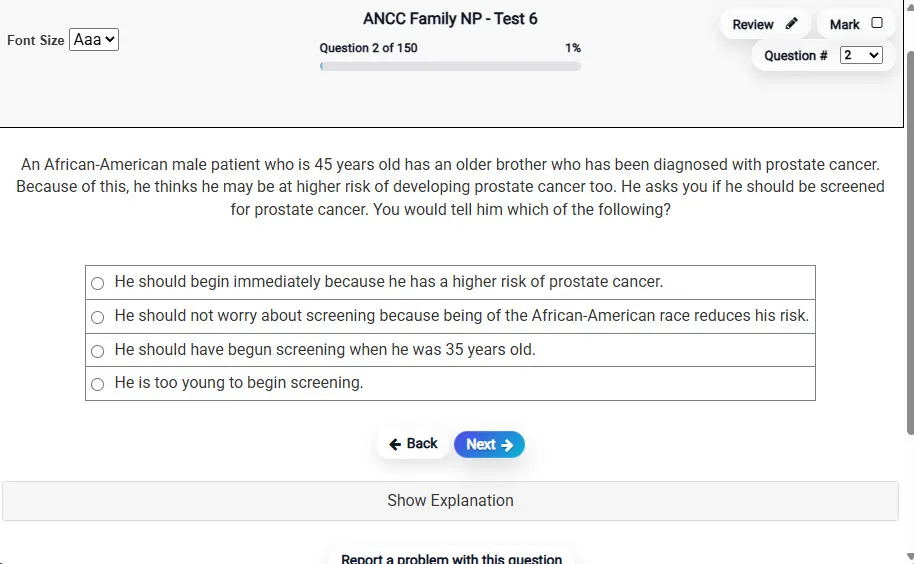
Answering a Question screen – Multiple-choice item view with navigation controls and progress tracker.
Answering a Question Multiple-choice item view with navigation controls and progress tracker.

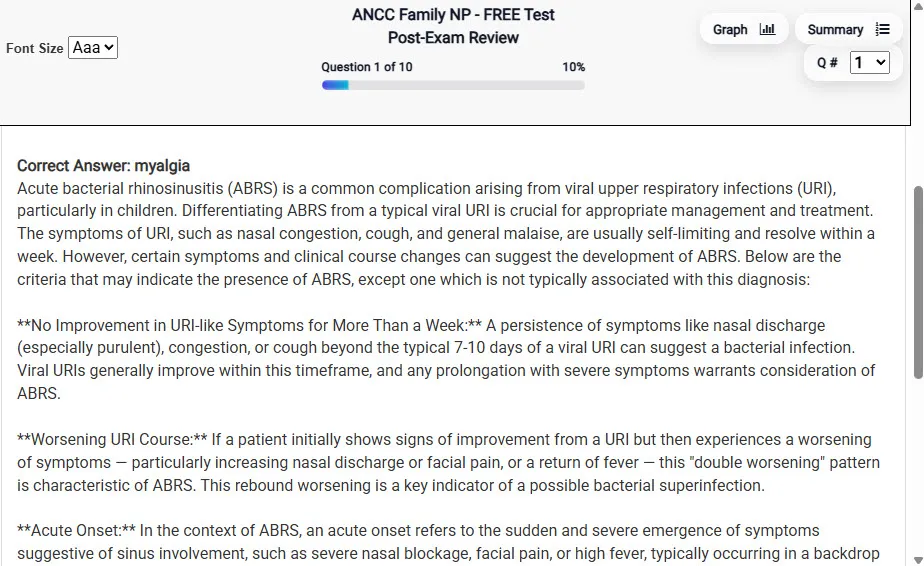
                           Detailed Explanation screen – 
                         Review mode showing chosen answer and rationale and references.
Detailed Explanation Review mode showing chosen answer and rationale and references.

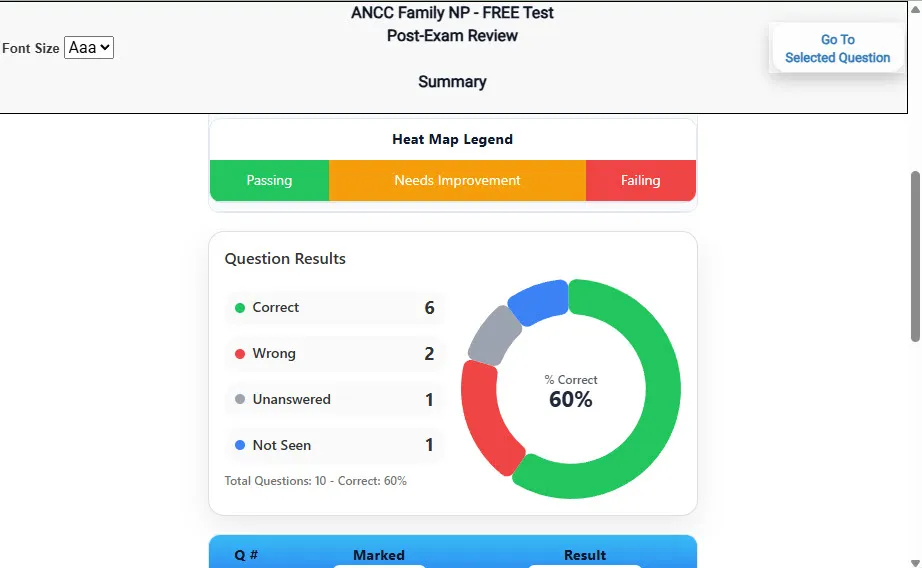
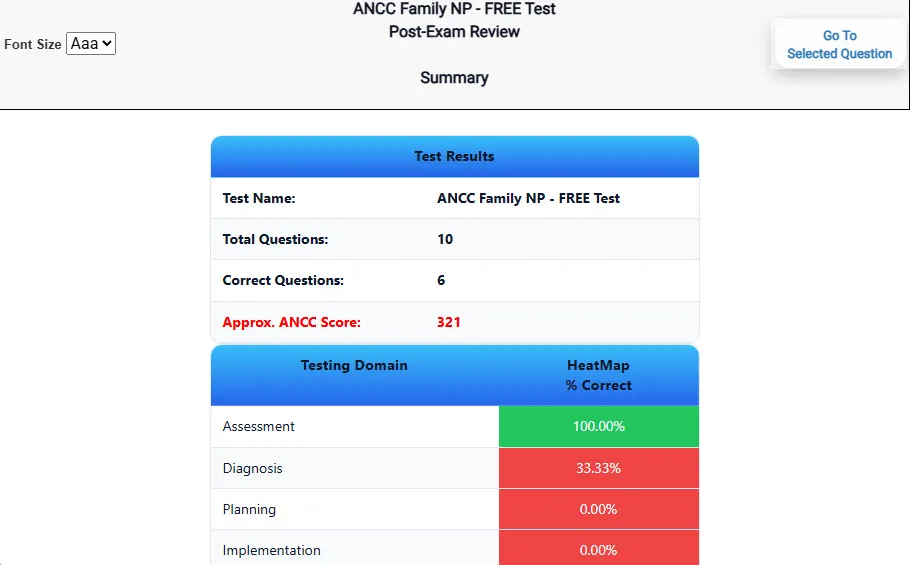
                           Review Summary 1 screen – 
                         Summary with counts for correct/wrong/unanswered and not seen items.
Review Summary 1 Summary with counts for correct/wrong/unanswered and not seen items.

                           Review Summary 2 screen – 
                         Advanced summary with category/domain breakdown and performance insights.
Review Summary 2 Advanced summary with category/domain breakdown and performance insights.

What Each Screen Shows

Answer Question Screen

  • Clean multiple-choice interface with progress bar.
  • Mark for review feature.
  • Matches real test pacing.

Detailed Explanation

  • Correct answer plus rationale.
  • Key concepts and guidelines highlighted.
  • Move between questions to fill knowledge gaps.

Review Summary 1

  • Overall results with total questions and scaled score.
  • Domain heatmap shows strengths and weaknesses.
  • Quick visual feedback on study priorities.

Review Summary 2

  • Chart of correct, wrong, unanswered, not seen.
  • Color-coded results for easy review.
  • Links back to missed items.

Top 10 Reasons to Use Exam Edge for your Praxis Family and Consumer Sciences 5121 Exam Prep

  1. Focused on the Praxis Family and Consumer Sciences 5121 Exam

    Our practice tests are built specifically for the Praxis Family and Consumer Sciences 5121 exam — every question mirrors the real topics, format, and difficulty so you're studying exactly what matters.

  2. Real Exam Simulation

    We match the per-question time limits and pressure of the actual Praxis exam, so test day feels familiar and stress-free.

  3. 5 Full Practice Tests & 600 Unique Questions

    You'll have more than enough material to master every Praxis Family and Consumer Sciences 5121 concept — no repeats, no fluff.

  4. Lower Cost Than a Retake

    Ordering 5 practice exams costs less than retaking the Praxis Family and Consumer Sciences 5121 exam after a failure. One low fee could save you both time and money.

  5. Flexible Testing

    Need to step away mid-exam? Pick up right where you left off — with your remaining time intact.

  6. Instant Scoring & Feedback

    See your raw score and an estimated Praxis Family and Consumer Sciences 5121 score immediately after finishing each practice test.

  7. Detailed Explanations for Every Question

    Review correct and incorrect answers with clear, step-by-step explanations so you truly understand each topic.

  8. Trusted & Accredited

    We're fully accredited by the Better Business Bureau and uphold the highest standards of trust and transparency.

  9. Web-Based & Always Available

    No software to install. Access your Praxis Family and Consumer Sciences 5121 practice exams 24/7 from any computer or mobile device.

  10. Expert Support When You Need It

    Need extra help? Our specialized tutors are highly qualified and ready to support your Praxis exam prep.


Pass the Praxis Family and Consumer Sciences 5121 Exam with Realistic Practice Tests from Exam Edge

Preparing for your upcoming Praxis Family and Consumer Sciences 5121 (5121) Certification Exam can feel overwhelming — but the right practice makes all the difference. Exam Edge gives you the tools, structure, and confidence to pass on your first try. Our online practice exams are built to match the real Praxis Family and Consumer Sciences 5121 exam in content, format, and difficulty.

  • 📝 5 Praxis Family and Consumer Sciences 5121 Practice Tests: Access 5 full-length exams with 120 questions each, covering every major Praxis Family and Consumer Sciences 5121 topic in depth.
  • Instant Online Access: Start practicing right away — no software, no waiting.
  • 🧠 Step-by-Step Explanations: Understand the reasoning behind every correct answer so you can master Praxis Family and Consumer Sciences 5121 exam concepts.
  • 🔄 Retake Each Exam Up to 4 Times: Build knowledge through repetition and track your improvement over time.
  • 🌐 Web-Based & Available 24/7: Study anywhere, anytime, on any device.
  • 🧘 Boost Your Test-Day Confidence: Familiarity with the Praxis format reduces anxiety and helps you perform under pressure.

These Praxis Family and Consumer Sciences 5121 practice exams are designed to simulate the real testing experience by matching question types, timing, and difficulty level. This approach helps you get comfortable not just with the exam content, but also with the testing environment, so you walk into your exam day focused and confident.

Exam Edge Praxis Reviews


I failed the Praxis Math test five times before I found your site. After taking all your practice tests, on my next attempt I passed by five points! I can honestly say this site is the reason I passed. Thank you!!!

Nikki P, Tennessee

Just wanted to say thanks for helping me pass the Praxis I Reading! Your practice tests and especially your explanations are great. They gave me the confidence I needed! Now I can student teach this fall. I'm so glad I found PraxisReading.com!

Denise C, Florida

Thank you so much. I just received my results in the mail. I scored a 179 and passed the Praxis I Writing! I'll never have to worry about retaking this test again! PraxisWriting.com is great. I told all my friends about this site.

Susan K, Virginia

I failed the Parapro test four times before I found your site. After taking all your practice tests, on my next attempt I passed by seven points! I can honestly say that this site is the reason I passed. Thank you!!!

Rebecca S, Texas

Hi! Just returned from taking my Praxis computerized and am happy to say that I passed with a 175. The last time I took the test I missed by 1 point. Your tests definitely made the difference for me! The set up was so similar to the test and the types of questions were also similar that I felt ve ...
Read More
Brad Y, Pennsylvania

I have taken the math praxis 3 times and wanted to give up. I ordered the bundle of math tests and I passed the math praxis today. Thank you for all the help.

Jacob D, South Carolina


Praxis Family and Consumer Sciences 5121 Aliases Test Name

Here is a list of alternative names used for this exam.

  • Praxis Family and Consumer Sciences 5121
  • Praxis Family and Consumer Sciences 5121 test
  • Praxis Family and Consumer Sciences 5121 Certification Test
  • Praxis
  • Praxis 5121
  • 5121 test
  • Praxis Family and Consumer Sciences 5121 (5121)
  • Family and Consumer Sciences 5121 certification