This is the content of the pop-over!

Praxis ESOL (5362) Practice Tests & Test Prep by Exam Edge


Praxis English to Speakers of Other Languages  product image
(5.0)
Based on 28 Reviews

  • Real Exam Simulation: Timed questions and matching content build comfort for your Praxis ESOL test day.
  • Instant, 24/7 Access: Web-based Praxis English to Speakers of Other Languages practice exams with no software needed.
  • Clear Explanations: Step-by-step answers and explanations for your Praxis exam to strengthen understanding.
  • Boosted Confidence: Reduces anxiety and improves test-taking skills to ace your Praxis English to Speakers of Other Languages (5362).

Featured on

Praxis English to Speakers of Other Languages Online Practice Test Bundles

BEST VALUE
10 practice tests

$99.50

$399.50

SAVE $300

Only $9.95 per test!

  • 100% Pass Guarantee
  • 10 online practice tests
  • 120 questions per test
  • Bonus: 100 Flash Cards + Study Guide
  • Instant access
  • Detailed Explanations
  • Practice tests never expire
  • Timed, untimed, or study guide mode
5 practice tests

$69.75

$199.75

SAVE $130

Only $13.95 per test!

  • 5 online practice tests
  • 120 questions per test
  • Bonus: 100 Flash Cards + Study Guide
  • Instant access
  • Detailed Explanations
  • Practice tests never expire
  • Timed, untimed, or study guide mode
1 practice test

$39.95

  • 1 online practice test
  • 120 questions per test
  • Instant access
  • Detailed Explanations
  • Practice tests never expire
  • Timed, untimed, or study guide mode
Quick Select
Tap to choose a bundle

** All Prices are in US Dollars (USD) **


Praxis ESOL (5362) Resources

Jump to the section you need most.

Understanding the exact breakdown of the Praxis English to Speakers of Other Languages test will help you know what to expect and how to most effectively prepare. The Praxis English to Speakers of Other Languages has 120 multiple-choice questions . The exam will be broken down into the sections below:

Praxis English to Speakers of Other Languages Exam Blueprint
Domain Name % Number of
Questions
Foundations of Linguistics 18% 22
Foundations of Language Learning 22% 26
Planning and Implementing Instruction 23% 28
Assessment and Evaluation 15% 18
Culture 11% 13
Professionalism and Advocacy 11% 13

Praxis English to Speakers of Other Languages Study Tips by Domain

  • Distinguish phonemes vs. allophones and use minimal pairs to diagnose meaning-changing contrasts; red flag: correcting an accent feature that doesn’t change meaning in English (e.g., [p] vs. [p?]).
  • Apply phonological rules (assimilation, deletion, epenthesis) to explain learner patterns; common trap: treating predictable connected-speech processes (e.g., “gonna,” flapping) as random errors.
  • Analyze morphology (free/bound morphemes, inflection vs. derivation) to target instruction; priority rule: focus first on inflections with high communicative load (e.g., -ed tense, -s agreement) rather than low-frequency derivations.
  • Use syntax concepts (word order, constituents, phrase structure, clauses) to interpret errors; red flag: mislabeling transfer issues like missing auxiliary in questions (“Why you go?”) as solely vocabulary gaps.
  • Connect semantics and pragmatics (denotation, entailment, implicature, speech acts, politeness) to meaning-in-context; common trap: marking pragmatically odd but grammatically correct responses as simply “wrong.”
  • Recognize discourse features (cohesion via reference/substitution/ellipsis, conjunction, lexical ties) and genre conventions; red flag: over-focusing on sentence-level grammar when breakdowns are due to weak cohesion markers (e.g., unclear pronoun reference).
  • Differentiate language acquisition vs. learning and plan accordingly; red flag: overemphasizing explicit grammar explanations for beginners when comprehensible input is the priority.
  • Apply Krashen’s Monitor, Input, and Affective Filter hypotheses; trap: correcting every error during meaning-focused tasks, which raises anxiety and reduces risk-taking.
  • Use interaction and negotiation of meaning (Long) with structured talk moves; priority rule: build in recasts, clarification requests, and wait time rather than defaulting to teacher re-explaining.
  • Leverage Swain’s Output hypothesis by requiring students to produce language (speaking/writing) with supports; cue: if students only select answers (multiple choice), you’re under-assessing productive control.
  • Plan for developmental sequences and interlanguage, treating errors as evidence of growth; red flag: marking all non-target forms as “wrong” instead of distinguishing global vs. local errors.
  • Support motivation and autonomy with meaningful goals and choice; contraindication: using public error correction or competitive grading structures that can undermine willingness to communicate.
  • Start with standards-based objectives that specify language function + form + content; red flag: objectives that only say “students will understand” with no observable outcome.
  • Plan explicit scaffolds (modeling, sentence frames, visuals, graphic organizers) and then fade support; common trap: keeping the same scaffold indefinitely so students don’t gain independence.
  • Differentiate by proficiency (e.g., WIDA/ACTFL-style levels) using the same topic but adjusted demands; priority rule: never lower cognitive rigor—adjust language load instead.
  • Sequence a lesson with input → guided practice → meaningful output, ensuring students talk/write more than the teacher; red flag: “coverage” lessons with minimal student production.
  • Teach vocabulary in context with multiple exposures (collocations, word families, morphology) and check usage; common trap: isolated word lists without opportunities to apply in speaking/writing.
  • Use grouping strategically (pairs, small groups, structured roles) and set interaction norms; contraindication: unstructured group work that leaves ELs silent or dependent on a fluent peer.
  • Match the assessment type to the decision: use diagnostic for placement/needs, formative for next-step teaching, and summative for grades/program exit—red flag if a single test score is used to make high-stakes decisions without multiple measures.
  • Design language assessments around both content and language objectives (listening/speaking/reading/writing plus academic language)—common trap: assessing content knowledge when the construct is English proficiency.
  • Use clear rubrics with proficiency-level descriptors and anchor samples to improve reliability—priority rule: norm your scoring before grading a class set, especially for writing and speaking.
  • Interpret results with validity and fairness in mind (construct-irrelevant factors, cultural bias, accessibility)—red flag if items depend on U.S.-specific background knowledge rather than language ability.
  • Provide appropriate accommodations vs. modifications (supports that don’t change the construct)—contraindication: reading a reading-comprehension test aloud, which changes what is being measured.
  • Use data to target instruction (error analysis, skill breakdown, progress monitoring) and document growth over time—common trap: reporting only overall scores instead of actionable subskill patterns (e.g., decoding vs. vocabulary vs. syntax).
  • Use culturally responsive practices that validate students’ identities while keeping expectations high—red flag: confusing “respecting culture” with lowering academic rigor.
  • Distinguish surface culture (food, holidays) from deep culture (communication norms, power distance, time orientation)—common trap: planning only “festival” lessons that don’t address interaction patterns affecting classroom performance.
  • Anticipate culture shock/acculturation stress and its impact on behavior and participation—priority rule: treat sudden withdrawal or irritability as a possible adjustment issue before labeling it defiance.
  • Leverage students’ funds of knowledge (home/community expertise) to build background for texts and tasks—cue: if a lesson assumes U.S.-specific schema (e.g., “prom,” “Thanksgiving”), preteach context or offer parallel examples.
  • Teach pragmatics explicitly (turn-taking, eye contact, politeness strategies, disagreement) across contexts—red flag: grading “participation” without clarifying the hidden cultural rules for discussion.
  • Partner with families using interpreters and culturally appropriate communication channels—contraindication: using students as interpreters for sensitive topics (discipline, grades, special education) risks errors and breaches confidentiality.
  • Follow legal/ethical requirements for ELs (e.g., language-access obligations, nondiscrimination, accommodations)—red flag: placing or exiting students based on subjective teacher opinion instead of documented criteria.
  • Maintain confidentiality of student records and immigration-related information—common trap: discussing a student’s proficiency level, test scores, or family status in public spaces or with staff who lack a legitimate educational interest.
  • Use collaborative service delivery (co-planning, co-teaching, shared progress monitoring) with content teachers and specialists—priority rule: define roles and language objectives up front to avoid the “ESOL teacher as aide” misconception.
  • Communicate with families in understandable, culturally responsive ways (interpreters/translated materials as needed)—contraindication: using students or siblings as interpreters for sensitive conferences.
  • Advocate for equitable access to grade-level curriculum and appropriate supports—red flag: ELs being routinely excluded from advanced courses, electives, or enrichment due to language proficiency alone.
  • Engage in ongoing professional learning and reflective practice using data and feedback—common trap: adopting trendy strategies without checking alignment to standards, student proficiency levels, and documented outcomes.


Built to Fit Into Your Busy Life

Everything you need to prepare with confidence—without wasting a minute.

Three Study Modes

Timed, No Time Limit, or Explanation mode.

Actionable Analytics

Heatmaps and scaled scores highlight weak areas.

High-Yield Rationales

Concise explanations emphasize key concepts.

Realistic Interface

Matches the feel of the actual exam environment.

Accessible by Design

Clean layout reduces cognitive load.

Anytime, Anywhere

Web-based access 24/7 on any device.
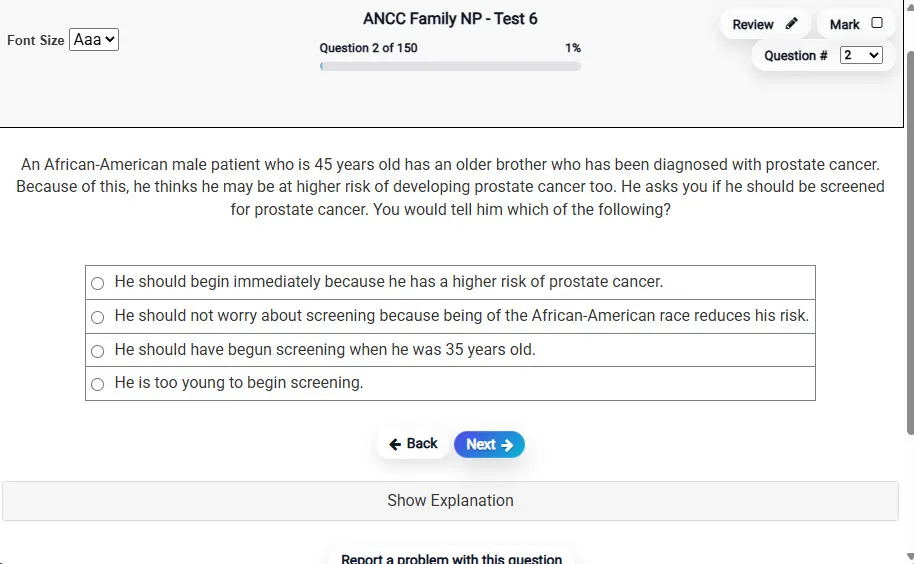
Answering a Question screen – Multiple-choice item view with navigation controls and progress tracker.
Answering a Question Multiple-choice item view with navigation controls and progress tracker.

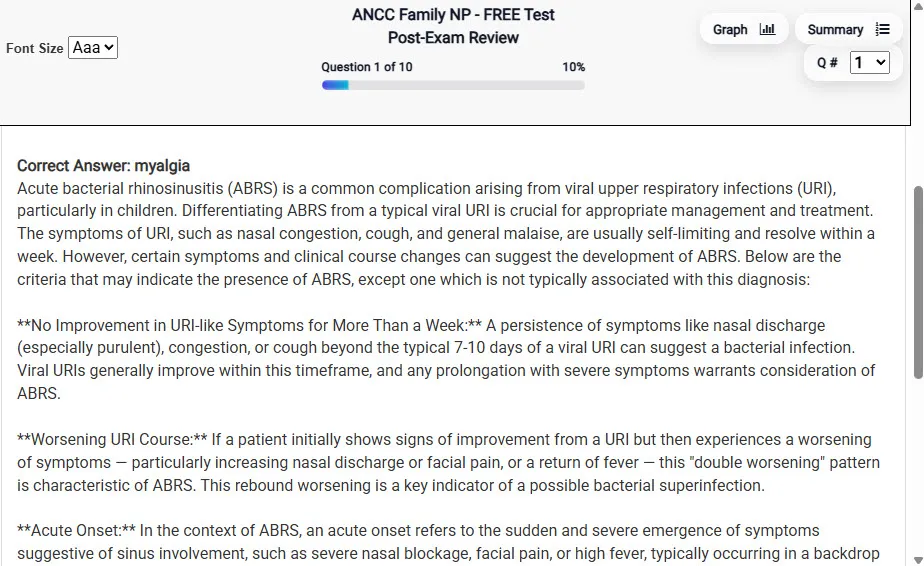
                           Detailed Explanation screen – 
                         Review mode showing chosen answer and rationale and references.
Detailed Explanation Review mode showing chosen answer and rationale and references.

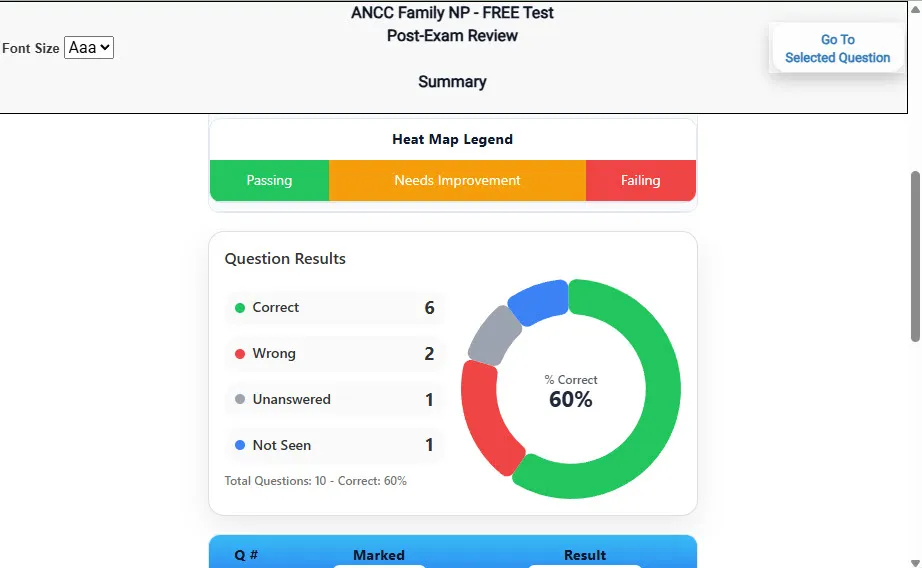
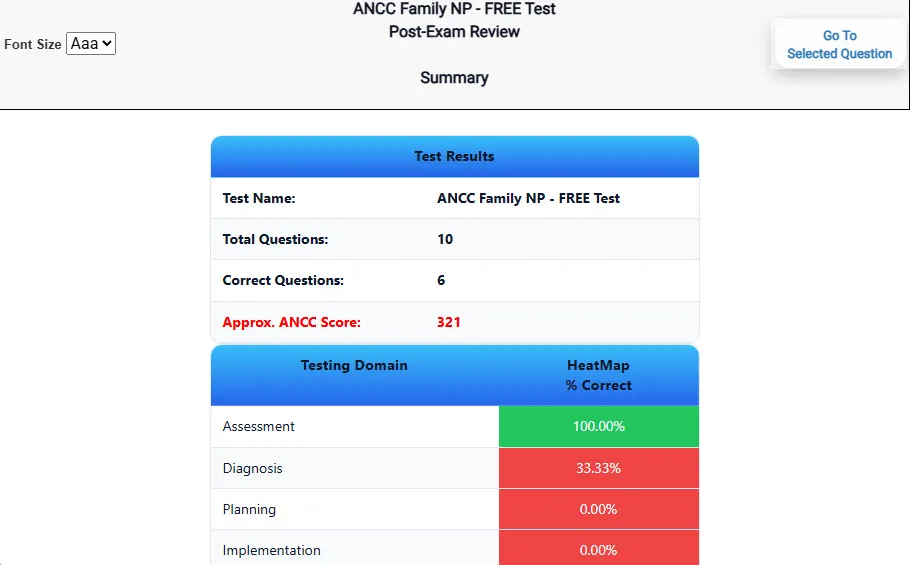
                           Review Summary 1 screen – 
                         Summary with counts for correct/wrong/unanswered and not seen items.
Review Summary 1 Summary with counts for correct/wrong/unanswered and not seen items.

                           Review Summary 2 screen – 
                         Advanced summary with category/domain breakdown and performance insights.
Review Summary 2 Advanced summary with category/domain breakdown and performance insights.

What Each Screen Shows

Answer Question Screen

  • Clean multiple-choice interface with progress bar.
  • Mark for review feature.
  • Matches real test pacing.

Detailed Explanation

  • Correct answer plus rationale.
  • Key concepts and guidelines highlighted.
  • Move between questions to fill knowledge gaps.

Review Summary 1

  • Overall results with total questions and scaled score.
  • Domain heatmap shows strengths and weaknesses.
  • Quick visual feedback on study priorities.

Review Summary 2

  • Chart of correct, wrong, unanswered, not seen.
  • Color-coded results for easy review.
  • Links back to missed items.

Top 10 Reasons to Use Exam Edge for your Praxis English to Speakers of Other Languages Exam Prep

  1. Focused on the Praxis English to Speakers of Other Languages Exam

    Our practice tests are built specifically for the Praxis ESOL exam — every question mirrors the real topics, format, and difficulty so you're studying exactly what matters.

  2. Real Exam Simulation

    We match the per-question time limits and pressure of the actual Praxis exam, so test day feels familiar and stress-free.

  3. 10 Full Practice Tests & 1,200 Unique Questions

    You'll have more than enough material to master every Praxis ESOL concept — no repeats, no fluff.

  4. Lower Cost Than a Retake

    Ordering 5 practice exams costs less than retaking the Praxis English to Speakers of Other Languages exam after a failure. One low fee could save you both time and money.

  5. Flexible Testing

    Need to step away mid-exam? Pick up right where you left off — with your remaining time intact.

  6. Instant Scoring & Feedback

    See your raw score and an estimated Praxis English to Speakers of Other Languages score immediately after finishing each practice test.

  7. Detailed Explanations for Every Question

    Review correct and incorrect answers with clear, step-by-step explanations so you truly understand each topic.

  8. Trusted & Accredited

    We're fully accredited by the Better Business Bureau and uphold the highest standards of trust and transparency.

  9. Web-Based & Always Available

    No software to install. Access your Praxis ESOL practice exams 24/7 from any computer or mobile device.

  10. Expert Support When You Need It

    Need extra help? Our specialized tutors are highly qualified and ready to support your Praxis exam prep.


Pass the Praxis English to Speakers of Other Languages Exam with Realistic Practice Tests from Exam Edge

Preparing for your upcoming Praxis English to Speakers of Other Languages (5362) Certification Exam can feel overwhelming — but the right practice makes all the difference. Exam Edge gives you the tools, structure, and confidence to pass on your first try. Our online practice exams are built to match the real Praxis ESOL exam in content, format, and difficulty.

  • 📝 10 Praxis English to Speakers of Other Languages Practice Tests: Access 10 full-length exams with 120 questions each, covering every major Praxis English to Speakers of Other Languages topic in depth.
  • Instant Online Access: Start practicing right away — no software, no waiting.
  • 🧠 Step-by-Step Explanations: Understand the reasoning behind every correct answer so you can master Praxis ESOL exam concepts.
  • 🔄 Retake Each Exam Up to 4 Times: Build knowledge through repetition and track your improvement over time.
  • 🌐 Web-Based & Available 24/7: Study anywhere, anytime, on any device.
  • 🧘 Boost Your Test-Day Confidence: Familiarity with the Praxis format reduces anxiety and helps you perform under pressure.

These Praxis English to Speakers of Other Languages practice exams are designed to simulate the real testing experience by matching question types, timing, and difficulty level. This approach helps you get comfortable not just with the exam content, but also with the testing environment, so you walk into your exam day focused and confident.


Exam Edge Praxis Reviews


Excellent test prep!

Jannet , Quinton, Virginia

I failed the Praxis Math test five times before I found your site. After taking all your practice tests, on my next attempt I passed by five points! I can honestly say this site is the reason I passed. Thank you!!!

Nikki P, Tennessee

Just wanted to say thanks for helping me pass the Praxis I Reading! Your practice tests and especially your explanations are great. They gave me the confidence I needed! Now I can student teach this fall. I'm so glad I found PraxisReading.com!

Denise C, Florida

Thank you so much. I just received my results in the mail. I scored a 179 and passed the Praxis I Writing! I'll never have to worry about retaking this test again! PraxisWriting.com is great. I told all my friends about this site.

Susan K, Virginia

I failed the Parapro test four times before I found your site. After taking all your practice tests, on my next attempt I passed by seven points! I can honestly say that this site is the reason I passed. Thank you!!!

Rebecca S, Texas

Hi! Just returned from taking my Praxis computerized and am happy to say that I passed with a 175. The last time I took the test I missed by 1 point. Your tests definitely made the difference for me! The set up was so similar to the test and the types of questions were also similar that I felt ve ...
Read More
Brad Y, Pennsylvania


Praxis English to Speakers of Other Languages Aliases Test Name

Here is a list of alternative names used for this exam.

  • Praxis English to Speakers of Other Languages
  • Praxis English to Speakers of Other Languages test
  • Praxis English to Speakers of Other Languages Certification Test
  • Praxis ESOL test
  • Praxis
  • Praxis 5362
  • 5362 test
  • Praxis English to Speakers of Other Languages (5362)
  • English to Speakers of Other Languages certification