This is the content of the pop-over!

Praxis ESOL 5361 (5361) Practice Tests & Test Prep by Exam Edge


Praxis English to Speakers of Other Languages 5361  product image
(5.0)
Based on 22 Reviews

  • Real Exam Simulation: Timed questions and matching content build comfort for your Praxis ESOL 5361 test day.
  • Instant, 24/7 Access: Web-based Praxis English to Speakers of Other Languages 5361 practice exams with no software needed.
  • Clear Explanations: Step-by-step answers and explanations for your Praxis exam to strengthen understanding.
  • Boosted Confidence: Reduces anxiety and improves test-taking skills to ace your Praxis English to Speakers of Other Languages 5361 (5361).

Featured on

Praxis English to Speakers of Other Languages 5361 Online Practice Test Bundles

BEST VALUE
15 practice tests

$149.25

$599.25

SAVE $450

Only $9.95 per test!

  • 100% Pass Guarantee
  • 15 online practice tests
  • 120 questions per test
  • Bonus: 100 Flash Cards + Study Guide
  • Instant access
  • Detailed Explanations
  • Practice tests never expire
  • Timed, untimed, or study guide mode
MOST POPULAR
10 practice tests

$99.50

$399.50

SAVE $300

Only $9.95 per test!

  • 10 online practice tests
  • 120 questions per test
  • Bonus: 100 Flash Cards + Study Guide
  • Instant access
  • Detailed Explanations
  • Practice tests never expire
  • Timed, untimed, or study guide mode
5 practice tests

$69.75

$199.75

SAVE $130

Only $13.95 per test!

  • 5 online practice tests
  • 120 questions per test
  • Bonus: 100 Flash Cards
  • Instant access
  • Detailed Explanations
  • Practice tests never expire
  • Timed, untimed, or study guide mode
1 practice test

$39.95

  • 1 online practice test
  • 120 questions per test
  • Instant access
  • Detailed Explanations
  • Practice tests never expire
  • Timed, untimed, or study guide mode
Quick Select
Tap to choose a bundle

** All Prices are in US Dollars (USD) **


Praxis ESOL 5361 (5361) Resources

Jump to the section you need most.

Understanding the exact breakdown of the Praxis English to Speakers of Other Languages 5361 test will help you know what to expect and how to most effectively prepare. The Praxis English to Speakers of Other Languages 5361 has 120 multiple-choice questions . The exam will be broken down into the sections below:

Praxis English to Speakers of Other Languages 5361 Exam Blueprint
Domain Name % Number of
Questions
Foundations of Linguistics and Language Learning  
     Section 1 (Listening*): 20% 23
     Section 2 20% 23
Planning - Implementing Managing Instruction 30% 34
Assessment 15% 17
Cultural and Professional Aspects of the job 20% 23
Listening*  

Praxis English to Speakers of Other Languages 5361 Study Tips by Domain

  • Distinguish phonetics (physical sounds) from phonology (sound patterns) and apply minimal pairs to diagnose errors; red flag: treating a phonological process (e.g., final consonant devoicing) as a simple articulation problem.
  • Use morpheme analysis (free vs. bound; inflectional vs. derivational) to explain learner errors; common trap: calling “went” an inflection of “go” rather than an irregular form requiring memorization.
  • Link syntax and word order to meaning (SVO, wh-movement, negation) when analyzing interlanguage; priority rule: check for L1 transfer before assuming a developmental sequence error.
  • Apply semantics/pragmatics (denotation vs. connotation, speech acts, implicature, politeness) to classroom communication; red flag: interpreting pragmatic missteps (e.g., direct requests) as disrespect rather than discourse norms.
  • Compare major SLA theories (behaviorism, innatism/UG, interaction, sociocultural, noticing) and match them to instructional implications; common trap: overclaiming a “critical period” as meaning adults can’t reach high proficiency.
  • Explain BICS vs. CALP and common developmental patterns in language learning; threshold cue: don’t equate conversational fluency with academic readiness when making placement or exit decisions.
  • Preview the question first and listen for the specific detail it asks (speaker’s purpose, main idea, inference)—red flag: choosing an answer that is true but not the one the prompt targets.
  • Track discourse markers (“however,” “for example,” “as a result”) to map the talk’s structure—common trap: missing a contrast and selecting the pre-“but” idea.
  • For implied meaning, attend to tone, hedges, and stance words (e.g., “seems,” “might,” “actually”)—priority rule: inference must be supported by what is said, not background assumptions.
  • When speakers mention numbers, dates, or steps, anchor them with quick mental tags (first/next/then)—red flag: mixing up sequence and picking a later step as the initial action.
  • Use elimination against extreme language (“always,” “never,” “only”) unless the audio clearly supports it—common trap: test-taker overgeneralizes from a single example.
  • For classroom/EL contexts, listen for the instructional goal (assessment vs. practice vs. feedback)—priority rule: choose the option aligned to the goal rather than the most familiar ESL buzzword.
  • Know the Section 2 format and pacing—skim questions first to set a listening/reading purpose; red flag: spending too long on one constructed-response prompt and leaving another blank.
  • Support every answer with a specific detail from the stimulus (quote, example, data point); common trap: giving a plausible ESL opinion that isn’t anchored in the provided scenario.
  • When responding to a classroom scenario, prioritize actionable next steps over broad philosophy; priority rule: name a concrete strategy, the target skill, and how you’ll check learning.
  • Use accurate TESOL terminology (e.g., “form-focused instruction,” “scaffolding,” “comprehensible input”) only when it fits the evidence; red flag: jargon without linking it to what the teacher/student actually did.
  • Address equity and access explicitly when the prompt involves multilingual learners (ELD supports, accommodations vs. modifications); common trap: recommending grade-level assessment without stating appropriate linguistic supports.
  • For any assessment-related task in Section 2, align the measure to the objective and proficiency level; threshold cue: state what success looks like (criteria/rubric indicator) rather than just saying “informal assessment.”
  • Write objectives with both language and content targets (e.g., function + form + vocabulary) aligned to standards; red flag: activities listed without measurable outcomes or success criteria.
  • Differentiate by proficiency (WIDA/ACTFL-style can-do) using tiered tasks, sentence frames, and adjusted text complexity; common trap: giving the same product to all students and only “adding time” as support.
  • Plan explicit instruction for academic language (discourse, syntax, and word learning) embedded in the lesson cycle; priority rule: teach key vocabulary in context with multiple encounters, not as isolated lists.
  • Use scaffolding strategically (modeling, visuals, graphic organizers, guided practice) and fade supports as independence grows; red flag: scaffolds that reduce cognitive demand instead of supporting access to grade-level tasks.
  • Manage interaction patterns (pair/group roles, wait time, structured talk moves) to maximize student talk and comprehensible output; common trap: teacher-dominated IRE questioning that limits language production.
  • Monitor learning during instruction with quick checks (thumbs, mini-whiteboards, exit tickets) and adjust immediately; threshold cue: if most students miss a CFU item, reteach before moving on rather than “covering” the next objective.
  • Match assessment type to purpose—diagnostic (before), formative (during), summative (after); red flag: using a unit test to decide placement or services.
  • Use proficiency-aligned rubrics (e.g., speaking/writing) with clear criteria for content, organization, vocabulary, grammar, and pronunciation/fluency; common trap: grading only grammar accuracy and ignoring comprehensibility.
  • Prioritize validity and reliability—ensure tasks sample the target language function/genre and scoring is consistent; cue: if two raters disagree often, calibrate with anchor papers and revise descriptors.
  • Ensure accommodations are appropriate for ELs versus modifications that change the construct; red flag: reading aloud a reading comprehension test item that is intended to measure decoding/reading.
  • Interpret assessment data using multiple measures and growth over time, not a single score; priority rule: triangulate with work samples, observations, and performance tasks before changing placement/exit decisions.
  • Design items and prompts to reduce cultural/linguistic bias (clear directions, accessible contexts, familiar formats); cue: if errors cluster around unclear task language, simplify instructions before reteaching content.
  • Demonstrate cultural competence by using asset-based language and avoiding deficit labels (red flag: attributing learning problems to “lack of motivation” rather than barriers such as interrupted schooling or trauma).
  • Support equitable family engagement with accessible communication (priority rule: provide interpretation/translated notices when needed; common trap: relying on students to interpret for parents in sensitive situations).
  • Apply legal/ethical responsibilities for multilingual learners (red flag: denying access to core content or special programs because a student is an English learner).
  • Collaborate effectively with content teachers using clear, shared language goals (common trap: offering only generic “accommodations” instead of specific language supports tied to the lesson objective).
  • Select culturally responsive materials and classroom practices that validate students’ identities (red flag: using stereotypes, “single story” texts, or token holidays without authentic representation).
  • Maintain professional boundaries and confidentiality while advocating for students (priority rule: follow school protocols for records and disclosures; common trap: sharing student status, test results, or immigration-related information casually).
  • Identify the speaker’s main idea and purpose early; red flag: choosing a detail that sounds familiar but doesn’t answer the “why is the speaker talking?” question.
  • Track discourse markers (e.g., “however,” “in contrast,” “as a result”) to follow organization; common trap: missing a pivot word and selecting the pre-change claim.
  • Use intonation and stress to infer attitude, certainty, or sarcasm; cue: extreme stress on one word often signals emphasis or correction, not a new topic.
  • Distinguish explicit statements from implied meaning; priority rule: if the question asks “implies/suggests,” eliminate options that merely restate what was said verbatim.
  • Listen for referents (pronouns, “this/that,” ellipsis) and connect them to the correct noun; red flag: two plausible antecedents—choose the one most recently and logically foregrounded.
  • Infer meaning of unfamiliar words from context (definitions, examples, restatements); common trap: picking an option based on word sound-alikes rather than surrounding clues.


Built to Fit Into Your Busy Life

Everything you need to prepare with confidence—without wasting a minute.

Three Study Modes

Timed, No Time Limit, or Explanation mode.

Actionable Analytics

Heatmaps and scaled scores highlight weak areas.

High-Yield Rationales

Concise explanations emphasize key concepts.

Realistic Interface

Matches the feel of the actual exam environment.

Accessible by Design

Clean layout reduces cognitive load.

Anytime, Anywhere

Web-based access 24/7 on any device.
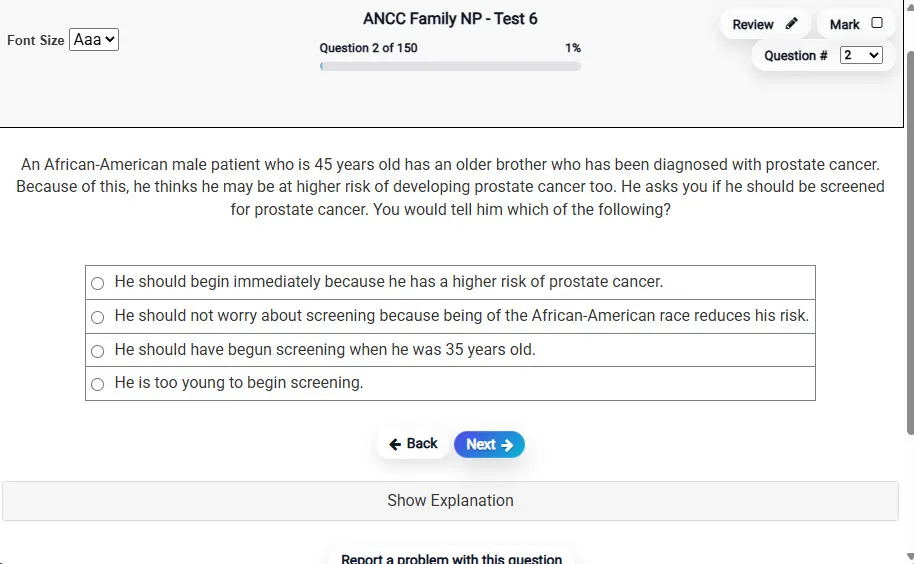
Answering a Question screen – Multiple-choice item view with navigation controls and progress tracker.
Answering a Question Multiple-choice item view with navigation controls and progress tracker.

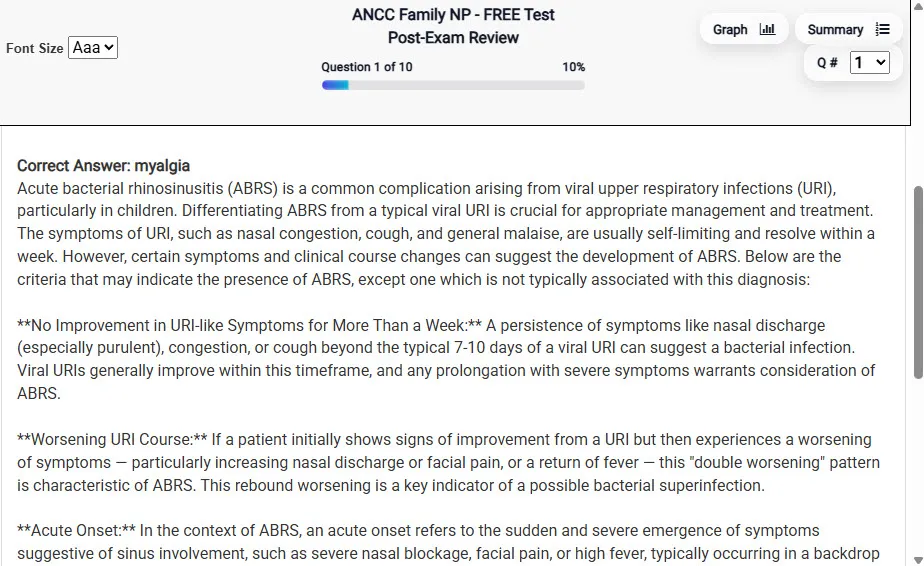
                           Detailed Explanation screen – 
                         Review mode showing chosen answer and rationale and references.
Detailed Explanation Review mode showing chosen answer and rationale and references.

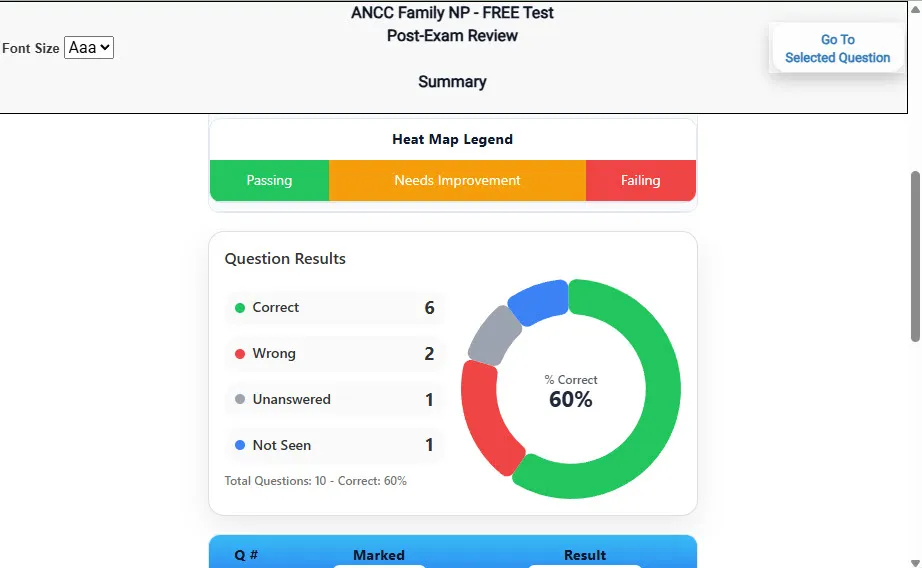
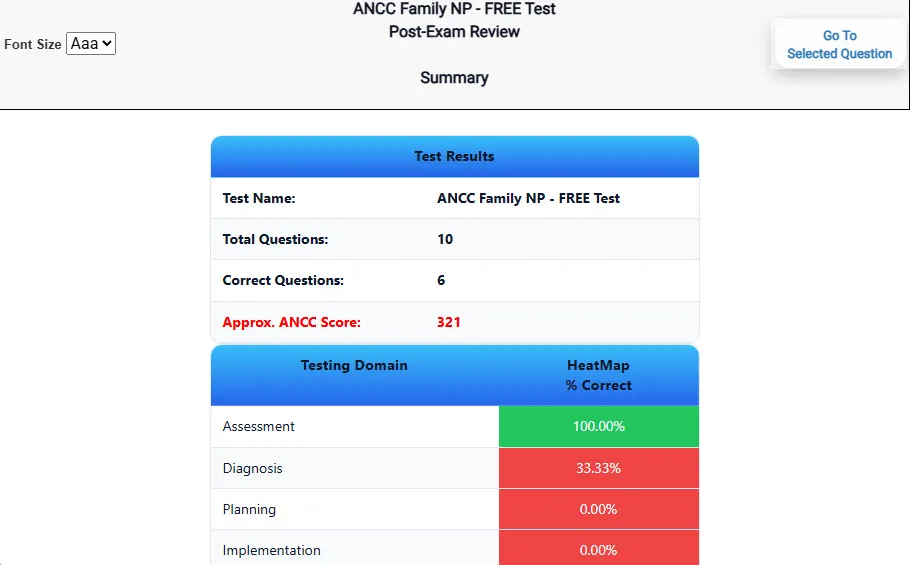
                           Review Summary 1 screen – 
                         Summary with counts for correct/wrong/unanswered and not seen items.
Review Summary 1 Summary with counts for correct/wrong/unanswered and not seen items.

                           Review Summary 2 screen – 
                         Advanced summary with category/domain breakdown and performance insights.
Review Summary 2 Advanced summary with category/domain breakdown and performance insights.

What Each Screen Shows

Answer Question Screen

  • Clean multiple-choice interface with progress bar.
  • Mark for review feature.
  • Matches real test pacing.

Detailed Explanation

  • Correct answer plus rationale.
  • Key concepts and guidelines highlighted.
  • Move between questions to fill knowledge gaps.

Review Summary 1

  • Overall results with total questions and scaled score.
  • Domain heatmap shows strengths and weaknesses.
  • Quick visual feedback on study priorities.

Review Summary 2

  • Chart of correct, wrong, unanswered, not seen.
  • Color-coded results for easy review.
  • Links back to missed items.

Top 10 Reasons to Use Exam Edge for your Praxis English to Speakers of Other Languages 5361 Exam Prep

  1. Focused on the Praxis English to Speakers of Other Languages 5361 Exam

    Our practice tests are built specifically for the Praxis ESOL 5361 exam — every question mirrors the real topics, format, and difficulty so you're studying exactly what matters.

  2. Real Exam Simulation

    We match the per-question time limits and pressure of the actual Praxis exam, so test day feels familiar and stress-free.

  3. 15 Full Practice Tests & 1,800 Unique Questions

    You'll have more than enough material to master every Praxis ESOL 5361 concept — no repeats, no fluff.

  4. Lower Cost Than a Retake

    Ordering 5 practice exams costs less than retaking the Praxis English to Speakers of Other Languages 5361 exam after a failure. One low fee could save you both time and money.

  5. Flexible Testing

    Need to step away mid-exam? Pick up right where you left off — with your remaining time intact.

  6. Instant Scoring & Feedback

    See your raw score and an estimated Praxis English to Speakers of Other Languages 5361 score immediately after finishing each practice test.

  7. Detailed Explanations for Every Question

    Review correct and incorrect answers with clear, step-by-step explanations so you truly understand each topic.

  8. Trusted & Accredited

    We're fully accredited by the Better Business Bureau and uphold the highest standards of trust and transparency.

  9. Web-Based & Always Available

    No software to install. Access your Praxis ESOL 5361 practice exams 24/7 from any computer or mobile device.

  10. Expert Support When You Need It

    Need extra help? Our specialized tutors are highly qualified and ready to support your Praxis exam prep.


Pass the Praxis English to Speakers of Other Languages 5361 Exam with Realistic Practice Tests from Exam Edge

Preparing for your upcoming Praxis English to Speakers of Other Languages 5361 (5361) Certification Exam can feel overwhelming — but the right practice makes all the difference. Exam Edge gives you the tools, structure, and confidence to pass on your first try. Our online practice exams are built to match the real Praxis ESOL 5361 exam in content, format, and difficulty.

  • 📝 15 Praxis English to Speakers of Other Languages 5361 Practice Tests: Access 15 full-length exams with 120 questions each, covering every major Praxis English to Speakers of Other Languages 5361 topic in depth.
  • Instant Online Access: Start practicing right away — no software, no waiting.
  • 🧠 Step-by-Step Explanations: Understand the reasoning behind every correct answer so you can master Praxis ESOL 5361 exam concepts.
  • 🔄 Retake Each Exam Up to 4 Times: Build knowledge through repetition and track your improvement over time.
  • 🌐 Web-Based & Available 24/7: Study anywhere, anytime, on any device.
  • 🧘 Boost Your Test-Day Confidence: Familiarity with the Praxis format reduces anxiety and helps you perform under pressure.

These Praxis English to Speakers of Other Languages 5361 practice exams are designed to simulate the real testing experience by matching question types, timing, and difficulty level. This approach helps you get comfortable not just with the exam content, but also with the testing environment, so you walk into your exam day focused and confident.


Exam Edge Praxis Reviews


I just received a score of 176 on the Praxis 5361 ESOL test which is 35 points above the passing score in my state. Truly, I thank ExamEdge for the excellent study materials, practice tests, that helped me to soar through the exam. I really needed superior materials that would help me obtain licensu ...
Read More
Linda, Wilmington, NC

I failed the Praxis Math test five times before I found your site. After taking all your practice tests, on my next attempt I passed by five points! I can honestly say this site is the reason I passed. Thank you!!!

Nikki P, Tennessee

Just wanted to say thanks for helping me pass the Praxis I Reading! Your practice tests and especially your explanations are great. They gave me the confidence I needed! Now I can student teach this fall. I'm so glad I found PraxisReading.com!

Denise C, Florida

Thank you so much. I just received my results in the mail. I scored a 179 and passed the Praxis I Writing! I'll never have to worry about retaking this test again! PraxisWriting.com is great. I told all my friends about this site.

Susan K, Virginia

I failed the Parapro test four times before I found your site. After taking all your practice tests, on my next attempt I passed by seven points! I can honestly say that this site is the reason I passed. Thank you!!!

Rebecca S, Texas

Hi! Just returned from taking my Praxis computerized and am happy to say that I passed with a 175. The last time I took the test I missed by 1 point. Your tests definitely made the difference for me! The set up was so similar to the test and the types of questions were also similar that I felt ve ...
Read More
Brad Y, Pennsylvania


Praxis English to Speakers of Other Languages 5361 Aliases Test Name

Here is a list of alternative names used for this exam.

  • Praxis English to Speakers of Other Languages 5361
  • Praxis English to Speakers of Other Languages 5361 test
  • Praxis English to Speakers of Other Languages 5361 Certification Test
  • Praxis ESOL 5361 test
  • Praxis
  • Praxis 5361
  • 5361 test
  • Praxis English to Speakers of Other Languages 5361 (5361)
  • English to Speakers of Other Languages 5361 certification