This is the content of the pop-over!

Praxis Elementary Ed Instructional Practice (5019) Practice Tests & Test Prep by Exam Edge


Praxis Elementary Education Instructional Practice and Applications  product image
(5.0)
Based on 22 Reviews

  • Real Exam Simulation: Timed questions and matching content build comfort for your Praxis Elementary Ed Instructional Practice test day.
  • Instant, 24/7 Access: Web-based Praxis Elementary Education Instructional Practice and Applications practice exams with no software needed.
  • Clear Explanations: Step-by-step answers and explanations for your Praxis exam to strengthen understanding.
  • Boosted Confidence: Reduces anxiety and improves test-taking skills to ace your Praxis Elementary Education Instructional Practice and Applications (5019).

Featured on

Praxis Elementary Education Instructional Practice and Applications Online Practice Test Bundles

BEST VALUE
10 practice tests

$99.50

$399.50

SAVE $300

Only $9.95 per test!

  • 100% Pass Guarantee
  • 10 online practice tests
  • 120 questions + 4 essays per test
  • Bonus: 100 Flash Cards + Study Guide
  • Instant access
  • Detailed Explanations
  • Practice tests never expire
  • Timed, untimed, or study guide mode
5 practice tests

$69.75

$199.75

SAVE $130

Only $13.95 per test!

  • 5 online practice tests
  • 120 questions + 4 essays per test
  • Bonus: 100 Flash Cards + Study Guide
  • Instant access
  • Detailed Explanations
  • Practice tests never expire
  • Timed, untimed, or study guide mode
1 practice test

$39.95

  • 1 online practice test
  • 120 questions + 4 essays per test
  • Instant access
  • Detailed Explanations
  • Practice tests never expire
  • Timed, untimed, or study guide mode
Quick Select
Tap to choose a bundle

** All Prices are in US Dollars (USD) **


Praxis Elementary Ed Instructional Practice (5019) Resources

Jump to the section you need most.

Understanding the exact breakdown of the Praxis Elementary Education Instructional Practice and Applications test will help you know what to expect and how to most effectively prepare. The Praxis Elementary Education Instructional Practice and Applications has 120 multiple-choice questions and 4 essay questions. The exam will be broken down into the sections below:

Praxis Elementary Education Instructional Practice and Applications Exam Blueprint
Domain Name % Number of
Questions
Reading/Language Arts 23% 28
Mathematics 19% 23
Science 12% 14
Social Studies 11% 13
Art - Music Physical Education 10% 12
Applications (Constructed Response) 25% 30

Praxis Elementary Education Instructional Practice and Applications Study Tips by Domain

  • Use multiple measures (running record, phonics inventory, spelling analysis, comprehension checks) to identify the primary barrier; red flag: selecting “more reading” as an intervention when errors show a decoding deficit.
  • Teach phonological awareness → phonics/word recognition in an explicit sequence (model, guided practice, cumulative review); common trap: spending most time on worksheets instead of reading connected text with the target pattern.
  • Build fluency with repeated reading and phrase-cued practice while maintaining accuracy and prosody; priority rule: intervene first when accuracy is below ~95% on instructional-level text.
  • Improve comprehension by explicitly teaching strategies (predict, question, clarify, summarize) tied to text evidence; red flag: asking only literal questions and calling it “comprehension instruction.”
  • Teach vocabulary using student-friendly definitions, morphology (prefix/suffix/root), and context within meaningful sentences; common trap: relying on dictionary copying or isolated word lists with no multiple exposures.
  • Strengthen writing by aligning planning, drafting, revising, and editing to purpose and audience, with targeted mini-lessons on conventions; red flag: grading only final drafts without feedback on organization and evidence.
  • Prioritize place value and base-ten reasoning when comparing, rounding, or regrouping multi-digit numbers; red flag: students who treat digits independently (e.g., think 402 > 39 because 4 > 3).
  • Use models (number lines, area/array models, fraction strips) to connect fraction concepts to operations; common trap: adding/subtracting fractions by adding denominators or ignoring the need for common denominators.
  • Teach multiplication/division through equal groups, arrays, and scaling before relying on algorithms; priority rule: check reasonableness with estimation (if 48 × 6 is near 50 × 6 ≈ 300, 2,880 is a red flag).
  • Interpret word problems by identifying the situation type (join/separate/compare, equal groups, multiplicative comparison) and mapping to an equation with a symbol for the unknown; common trap: “keyword” solving (e.g., always subtract when seeing “left”).
  • Emphasize understanding of area, perimeter, and volume with units and formulas; contraindication: applying the area formula to perimeter or forgetting squared/cubed units is a consistent error pattern to watch for.
  • In data and graphing, distinguish between reading values and interpreting the story (trend, center, variability); red flag: students who misread scale intervals or ignore that the y-axis may not start at zero.
  • Plan investigations with a clear, testable question and identified variables; red flag: changing more than one variable at a time makes results uninterpretable.
  • Use measurement tools appropriately (thermometers, balances, graduated cylinders) and record units; common trap: mixing metric units or rounding too early skews conclusions.
  • Interpret data from tables/graphs by describing patterns before inferring causes; priority rule: correlation in a graph does not prove causation.
  • Teach life science with structures-to-function and basic ecology (food chains/webs); red flag: confusing energy flow (one-way) with matter cycling (reused).
  • Cover Earth/space science by connecting weather, water cycle, and observable sky patterns; common trap: seasons are caused by Earth’s tilt, not Earth being closer to the Sun.
  • Address physical science with forces, motion, and simple circuits using evidence-based explanations; contraindication: students often think heavier objects fall faster or that current is “used up” in a circuit.
  • Use timelines and cause-and-effect chains to connect events across local, state, national, and world history; red flag: students listing facts without explaining “because” relationships.
  • Teach geography through map skills (cardinal directions, scale, legend, latitude/longitude) and human-environment interaction; common trap: confusing a map key/legend with a compass rose.
  • Emphasize civics structures (rules vs. laws, rights vs. responsibilities, branches of government, and levels of government); priority rule: when a scenario names a service like policing or schooling, ask “which level usually runs it?” first.
  • Build inquiry with primary/secondary sources by sourcing, corroborating, and identifying point of view; red flag: treating a textbook excerpt or modern summary as a primary source.
  • Cover basic economics (scarcity, opportunity cost, incentives, producers/consumers, supply and demand) using classroom-market examples; threshold cue: if a choice has a “next best alternative,” you must name the opportunity cost.
  • Integrate culturally responsive and accurate representations of communities and histories; common trap: using stereotypes or single-story narratives instead of multiple perspectives and evidence.
  • Art: Plan instruction around elements/principles (line, color, balance, contrast) and require students to justify choices with evidence from their work—common trap is grading only on “neatness” or talent instead of process and criteria.
  • Art: Teach safe and responsible tool/material use (scissors, adhesives, paint, clay dust) and model cleanup routines—red flag is allowing shared materials without hygiene expectations or clear storage/labeling procedures.
  • Music: Assess steady beat, rhythm, pitch, and expressive elements using quick performance checks (echo patterns, singing, recorder/boomwhackers)—priority rule is to measure skill with a rubric rather than participation alone.
  • Music: Build musical literacy (high/low, loud/soft, tempo, simple notation) through short, repeated practice cycles—common trap is expecting notation reading before students can audiate/perform patterns accurately.
  • Physical Education: Prioritize safety and engagement with clear boundaries, equipment rules, and active supervision—red flag is long lines or elimination games that reduce MVPA and increase off-task behavior.
  • Physical Education: Teach fundamental motor skills and inclusive modifications (smaller/lighter balls, reduced distance, peer supports) aligned to learning targets—priority rule is adapt for IEP/504 needs and contraindications rather than “same task for all.”
  • Build every constructed response around the prompt’s exact task (e.g., “analyze” vs. “describe”) and cite specific evidence from the scenario; red flag: writing a generic strategy list with no scenario details.
  • State a clear instructional objective aligned to the content and skill, then explain the next teaching move; common trap: naming an activity (e.g., “do a worksheet”) without the learning target it supports.
  • Include at least one actionable differentiation for an identified need (ELL, IEP/504, advanced learners) tied to the task; priority rule: don’t just say “provide accommodations”—name what and how.
  • Use formative assessment with a specific look-for and decision point (what you’ll check, how, and what you’ll do if students miss it); red flag: only mentioning a summative grade at the end.
  • Justify choices with developmentally appropriate practice and classroom realities (time, materials, behavior supports); common trap: proposing a complex, multi-day plan when the prompt implies a brief lesson segment.
  • When addressing student work or misconceptions, identify the error pattern and give a targeted feedback statement plus reteach step; red flag: correcting the answer without explaining the underlying misconception.


Built to Fit Into Your Busy Life

Everything you need to prepare with confidence—without wasting a minute.

Three Study Modes

Timed, No Time Limit, or Explanation mode.

Actionable Analytics

Heatmaps and scaled scores highlight weak areas.

High-Yield Rationales

Concise explanations emphasize key concepts.

Realistic Interface

Matches the feel of the actual exam environment.

Accessible by Design

Clean layout reduces cognitive load.

Anytime, Anywhere

Web-based access 24/7 on any device.
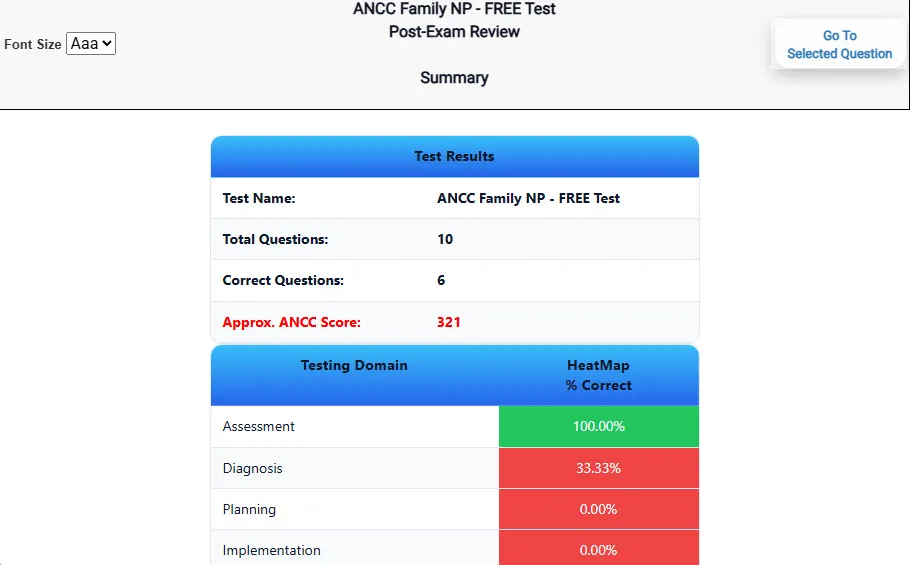
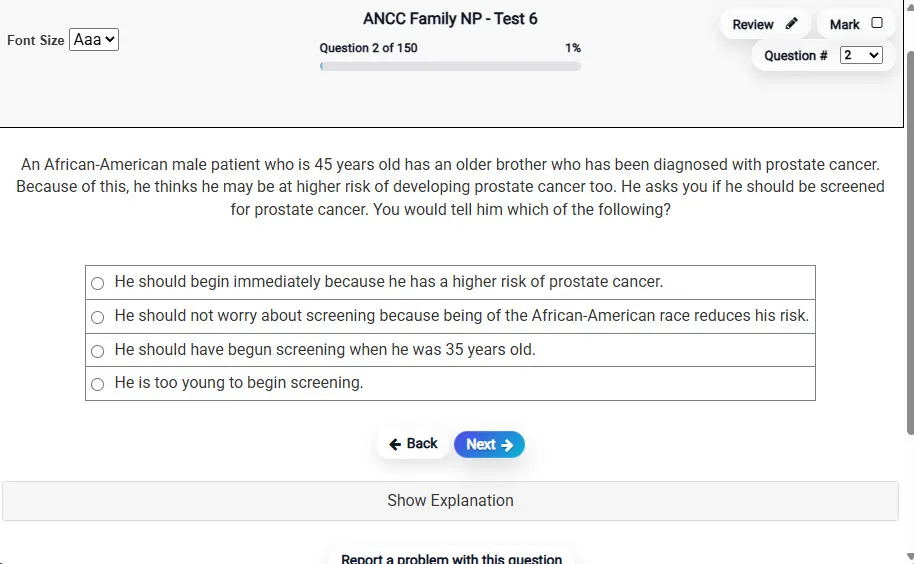
Answering a Question screen – Multiple-choice item view with navigation controls and progress tracker.
Answering a Question Multiple-choice item view with navigation controls and progress tracker.

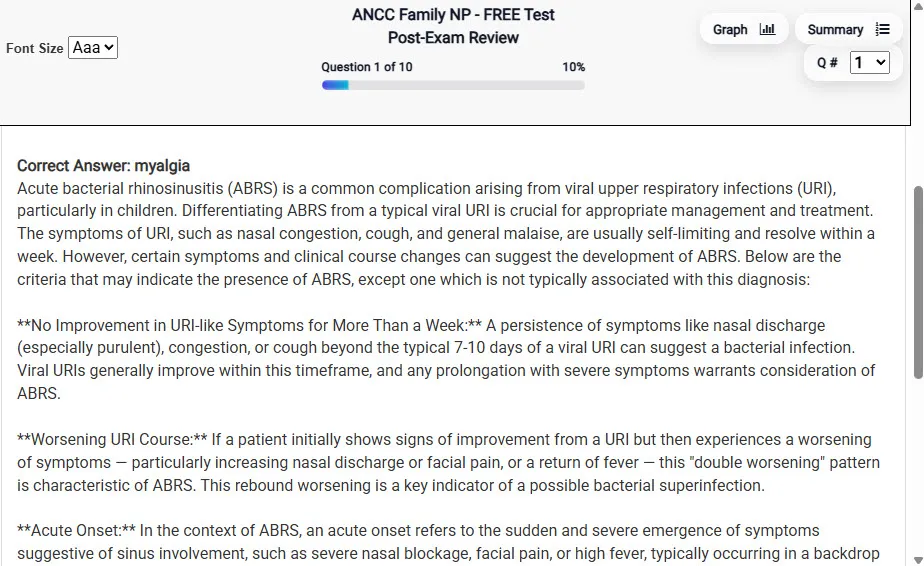
                           Detailed Explanation screen – 
                         Review mode showing chosen answer and rationale and references.
Detailed Explanation Review mode showing chosen answer and rationale and references.

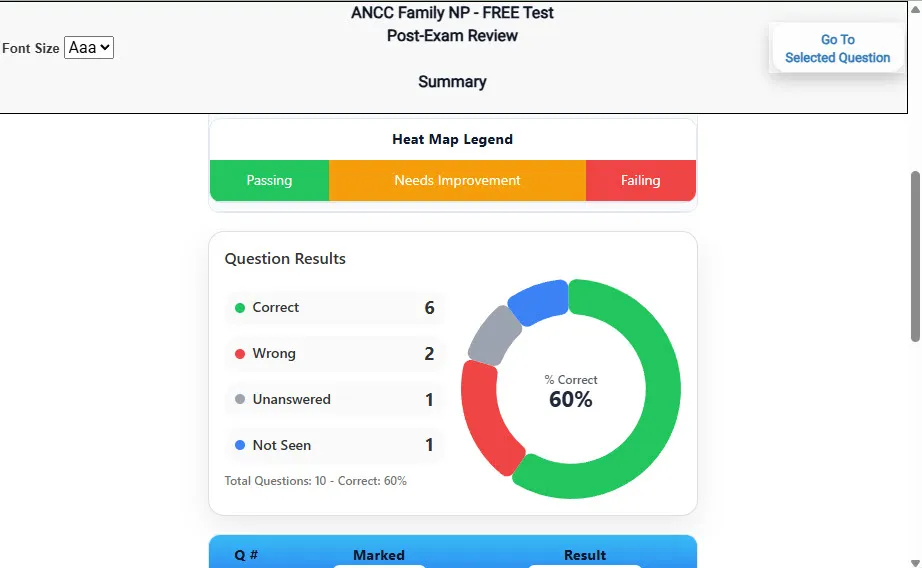
                           Review Summary 1 screen – 
                         Summary with counts for correct/wrong/unanswered and not seen items.
Review Summary 1 Summary with counts for correct/wrong/unanswered and not seen items.

                           Review Summary 2 screen – 
                         Advanced summary with category/domain breakdown and performance insights.
Review Summary 2 Advanced summary with category/domain breakdown and performance insights.

What Each Screen Shows

Answer Question Screen

  • Clean multiple-choice interface with progress bar.
  • Mark for review feature.
  • Matches real test pacing.

Detailed Explanation

  • Correct answer plus rationale.
  • Key concepts and guidelines highlighted.
  • Move between questions to fill knowledge gaps.

Review Summary 1

  • Overall results with total questions and scaled score.
  • Domain heatmap shows strengths and weaknesses.
  • Quick visual feedback on study priorities.

Review Summary 2

  • Chart of correct, wrong, unanswered, not seen.
  • Color-coded results for easy review.
  • Links back to missed items.

Top 10 Reasons to Use Exam Edge for your Praxis Elementary Education Instructional Practice and Applications Exam Prep

  1. Focused on the Praxis Elementary Education Instructional Practice and Applications Exam

    Our practice tests are built specifically for the Praxis Elementary Ed Instructional Practice exam — every question mirrors the real topics, format, and difficulty so you're studying exactly what matters.

  2. Real Exam Simulation

    We match the per-question time limits and pressure of the actual Praxis exam, so test day feels familiar and stress-free.

  3. 10 Full Practice Tests & 1,240 Unique Questions

    You'll have more than enough material to master every Praxis Elementary Ed Instructional Practice concept — no repeats, no fluff.

  4. Lower Cost Than a Retake

    Ordering 5 practice exams costs less than retaking the Praxis Elementary Education Instructional Practice and Applications exam after a failure. One low fee could save you both time and money.

  5. Flexible Testing

    Need to step away mid-exam? Pick up right where you left off — with your remaining time intact.

  6. Instant Scoring & Feedback

    See your raw score and an estimated Praxis Elementary Education Instructional Practice and Applications score immediately after finishing each practice test.

  7. Detailed Explanations for Every Question

    Review correct and incorrect answers with clear, step-by-step explanations so you truly understand each topic.

  8. Trusted & Accredited

    We're fully accredited by the Better Business Bureau and uphold the highest standards of trust and transparency.

  9. Web-Based & Always Available

    No software to install. Access your Praxis Elementary Ed Instructional Practice practice exams 24/7 from any computer or mobile device.

  10. Expert Support When You Need It

    Need extra help? Our specialized tutors are highly qualified and ready to support your Praxis exam prep.


Pass the Praxis Elementary Education Instructional Practice and Applications Exam with Realistic Practice Tests from Exam Edge

Preparing for your upcoming Praxis Elementary Education Instructional Practice and Applications (5019) Certification Exam can feel overwhelming — but the right practice makes all the difference. Exam Edge gives you the tools, structure, and confidence to pass on your first try. Our online practice exams are built to match the real Praxis Elementary Ed Instructional Practice exam in content, format, and difficulty.

  • 📝 10 Praxis Elementary Education Instructional Practice and Applications Practice Tests: Access 10 full-length exams with 124 questions each, covering every major Praxis Elementary Education Instructional Practice and Applications topic in depth.
  • Instant Online Access: Start practicing right away — no software, no waiting.
  • 🧠 Step-by-Step Explanations: Understand the reasoning behind every correct answer so you can master Praxis Elementary Ed Instructional Practice exam concepts.
  • 🔄 Retake Each Exam Up to 4 Times: Build knowledge through repetition and track your improvement over time.
  • 🌐 Web-Based & Available 24/7: Study anywhere, anytime, on any device.
  • 🧘 Boost Your Test-Day Confidence: Familiarity with the Praxis format reduces anxiety and helps you perform under pressure.

These Praxis Elementary Education Instructional Practice and Applications practice exams are designed to simulate the real testing experience by matching question types, timing, and difficulty level. This approach helps you get comfortable not just with the exam content, but also with the testing environment, so you walk into your exam day focused and confident.


Exam Edge Praxis Reviews


I failed the Praxis Math test five times before I found your site. After taking all your practice tests, on my next attempt I passed by five points! I can honestly say this site is the reason I passed. Thank you!!!

Nikki P, Tennessee

Just wanted to say thanks for helping me pass the Praxis I Reading! Your practice tests and especially your explanations are great. They gave me the confidence I needed! Now I can student teach this fall. I'm so glad I found PraxisReading.com!

Denise C, Florida

Thank you so much. I just received my results in the mail. I scored a 179 and passed the Praxis I Writing! I'll never have to worry about retaking this test again! PraxisWriting.com is great. I told all my friends about this site.

Susan K, Virginia

I failed the Parapro test four times before I found your site. After taking all your practice tests, on my next attempt I passed by seven points! I can honestly say that this site is the reason I passed. Thank you!!!

Rebecca S, Texas

Hi! Just returned from taking my Praxis computerized and am happy to say that I passed with a 175. The last time I took the test I missed by 1 point. Your tests definitely made the difference for me! The set up was so similar to the test and the types of questions were also similar that I felt ve ...
Read More
Brad Y, Pennsylvania

I have taken the math praxis 3 times and wanted to give up. I ordered the bundle of math tests and I passed the math praxis today. Thank you for all the help.

Jacob D, South Carolina


Praxis Elementary Education Instructional Practice and Applications Aliases Test Name

Here is a list of alternative names used for this exam.

  • Praxis Elementary Education Instructional Practice and Applications
  • Praxis Elementary Education Instructional Practice and Applications test
  • Praxis Elementary Education Instructional Practice and Applications Certification Test
  • Praxis Elementary Ed Instructional Practice test
  • Praxis
  • Praxis 5019
  • 5019 test
  • Praxis Elementary Education Instructional Practice and Applications (5019)
  • Elementary Education Instructional Practice and Applications certification