This is the content of the pop-over!

Praxis Elem Ed: Multiple Subjects (5001) Practice Tests & Test Prep by Exam Edge


Praxis Elementary Education Multiple Subjects  product image
(5.0)
Based on 25 Reviews

  • Real Exam Simulation: Timed questions and matching content build comfort for your Praxis Elem Ed: Multiple Subjects test day.
  • Instant, 24/7 Access: Web-based Praxis Elementary Education Multiple Subjects practice exams with no software needed.
  • Clear Explanations: Step-by-step answers and explanations for your Praxis exam to strengthen understanding.
  • Boosted Confidence: Reduces anxiety and improves test-taking skills to ace your Praxis Elementary Education Multiple Subjects (5001).

Featured on

Praxis Elementary Education Multiple Subjects Online Practice Test Bundles

BEST VALUE
15 practice tests

$149.25

$599.25

SAVE $450

Only $9.95 per test!

  • 100% Pass Guarantee
  • 15 online practice tests
  • 245 questions per test
  • Bonus: 100 Flash Cards + Study Guide
  • Instant access
  • Detailed Explanations
  • Practice tests never expire
  • Timed, untimed, or study guide mode
MOST POPULAR
10 practice tests

$99.50

$399.50

SAVE $300

Only $9.95 per test!

  • 10 online practice tests
  • 245 questions per test
  • Bonus: 100 Flash Cards + Study Guide
  • Instant access
  • Detailed Explanations
  • Practice tests never expire
  • Timed, untimed, or study guide mode
5 practice tests

$69.75

$199.75

SAVE $130

Only $13.95 per test!

  • 5 online practice tests
  • 245 questions per test
  • Bonus: 100 Flash Cards
  • Instant access
  • Detailed Explanations
  • Practice tests never expire
  • Timed, untimed, or study guide mode
1 practice test

$39.95

  • 1 online practice test
  • 245 questions per test
  • Instant access
  • Detailed Explanations
  • Practice tests never expire
  • Timed, untimed, or study guide mode
Quick Select
Tap to choose a bundle

** All Prices are in US Dollars (USD) **


Praxis Elem Ed: Multiple Subjects (5001) Resources

Jump to the section you need most.

Understanding the exact breakdown of the Praxis Elementary Education Multiple Subjects test will help you know what to expect and how to most effectively prepare. The Praxis Elementary Education Multiple Subjects has 245 multiple-choice questions . The exam will be broken down into the sections below:

Praxis Elementary Education Multiple Subjects Exam Blueprint
Domain Name % Number of
Questions
5002 - Elementary Education: Reading and Language Arts Subtest  
     Reading 47% 29
     Writing - Speaking Listening 53% 32
5003 - Elementary Education: Mathematics Subtest  
     Numbers and Operations 40% 25
     Algebraic Thinking 30% 18
     Geometry and Measurement - Data - Statistics Probability 30% 18
5004 - Elementary Education: Social Studies Subtest  
     United States History - Government Citizenship 45% 28
     Geography - Anthropology Sociology 30% 18
     World History and Economics 25% 15
5005 - Elementary Education: Science Subtest  
     Earth Science 32% 20
     Life Science 34% 21
     Physical Science 34% 21

Praxis Elementary Education Multiple Subjects Study Tips by Domain

  • Explicitly teach foundational skills (phonological awareness, phonics, fluency) and use screening data to target intervention; red flag: relying only on leveled reading without diagnosing specific decoding deficits.
  • Build vocabulary through morphology (prefixes, roots, suffixes), context clues, and word relationships; common trap: treating “guessing from context” as the primary strategy instead of teaching word parts and meaning networks.
  • Teach comprehension with text-dependent questions, main idea/supporting details, and inference using evidence; priority rule: students must cite or paraphrase specific textual evidence rather than personal opinions.
  • Differentiate instruction for English learners and students with disabilities using scaffolds (sentence frames, visuals, structured discussion) while keeping grade-level text goals; red flag: reducing rigor by substituting only below-grade passages.
  • Address writing process and conventions (planning, drafting, revising, editing) with clear purpose and audience; common trap: focusing feedback only on grammar/spelling and skipping organization and development.
  • Integrate speaking and listening standards via accountable talk, presentation skills, and evaluation of information sources; red flag: accepting discussion without norms for turn-taking, claims, and evidence.
  • Teach and test phonemic awareness explicitly (blend, segment, delete, substitute phonemes); red flag: confusing phonemic awareness (sound) with phonics (letters).
  • Prioritize systematic phonics and decoding strategies (e.g., short/long vowels, common digraphs, syllable types); common trap: having students guess words from pictures or context instead of decoding.
  • Use fluency as a bridge to comprehension—monitor accuracy, rate, and prosody with repeated reading; threshold cue: if accuracy is low, focus on decoding before pushing speed.
  • Build vocabulary with both direct instruction (morphology: prefixes/suffixes/roots) and indirect exposure; red flag: teaching only definitions without multiple contexts or word parts.
  • Strengthen comprehension by matching strategies to text structure (story elements vs. main idea/details, cause/effect, compare/contrast); common trap: asking only recall questions instead of inferential and text-evidence questions.
  • Use assessment data to target instruction (running records, miscues, retell, comprehension checks); priority rule: separate decoding errors from language-comprehension issues before choosing an intervention.
  • Use the writing process (plan → draft → revise → edit → publish) and match feedback to the stage—red flag: correcting grammar when the task is to revise ideas/organization.
  • Write to purpose and audience (informative, narrative, opinion/argument) with a clear thesis/claim and relevant support; common trap: listing facts without a controlling idea or using reasons without evidence.
  • Apply conventions strategically (sentence boundaries, agreement, tense consistency, capitalization, punctuation) because run-ons and comma splices are frequent test targets; priority rule: fix sentence structure before polishing word choice.
  • Use cohesive organization (logical paragraphs, transitions, consistent point of view) and avoid abrupt shifts; red flag: pronouns with unclear antecedents or inconsistent verb tense that confuses sequence.
  • Teach speaking and listening norms (turn-taking, asking clarifying questions, summarizing a speaker’s points) and evaluate active listening; common trap: “listening” items often require identifying the best follow-up question, not giving advice.
  • Integrate research and media literacy (quote/paraphrase, basic citation, evaluate source credibility) with attention to plagiarism; threshold cue: paraphrasing must substantially reword and still credit the source.
  • Prioritize place value and base-ten reasoning for whole numbers and decimals; red flag: students who “line up digits” without understanding why are likely to mis-add/mis-subtract decimals.
  • Fractions and ratios must be modeled (number line, area, set) and connected to equivalent forms; common trap: treating the denominator as a second whole number when adding/subtracting fractions.
  • Use properties of operations (commutative, associative, distributive) to justify strategies and mental math; priority rule: explanations matter as much as answers on selected-response items framed around student work.
  • Algebraic thinking focuses on patterns, expressions, and equations with unknowns in any position; red flag: assuming the equal sign means “the answer comes next” rather than “both sides are the same value.”
  • Geometry and measurement require correct units and formulas tied to meaning; common trap: confusing perimeter vs. area or mixing linear vs. square units when converting (e.g., cm to cm²).
  • Data, statistics, and probability emphasize interpreting representations and variability; red flag: using mean when outliers skew results or misreading a graph’s scale/intervals.
  • Fluency with place value (to billions and to thousandths) drives multi-digit operations—red flag if a student can “do the steps” but can’t explain regrouping or estimate reasonableness.
  • Compare and order rational numbers (fractions, decimals, percents) using benchmarks (0, 1/2, 1, 10, 100)—common trap: thinking a longer decimal is always larger (e.g., 0.4 vs 0.35).
  • Understand and generate equivalent fractions/decimals/percents and simplify fractions using factors—priority rule: use greatest common factor and verify equivalence by multiplying/dividing numerator and denominator by the same number.
  • Apply fraction operations with visual models and meaning (part-whole, measurement, number line)—contraindication: “add numerators and denominators” is always wrong unless denominators already match via equivalence.
  • Work with ratios, rates, and proportional reasoning (unit rate, scale, percent)—common trap: mixing part-to-part with part-to-whole or setting up a proportion with mismatched units.
  • Interpret and use number theory ideas (factors, multiples, primes, divisibility) to solve problems—threshold cue: any claim about divisibility should be checked with a quick rule (e.g., 3/9 sum-of-digits, 2/5 last digit) before calculating.
  • Translate word phrases into expressions/equations and define variables explicitly; red flag: reversing relationships (e.g., “5 less than x” is x − 5, not 5 − x).
  • Solve one-step and multi-step linear equations/inequalities using inverse operations while maintaining equivalence; trap: forgetting to flip the inequality when multiplying/dividing by a negative.
  • Use properties of operations (commutative, associative, distributive) to rewrite and simplify expressions; priority rule: distribute across parentheses before combining like terms.
  • Represent and compare relationships with tables, graphs, and rules (input–output); cue: check whether the relationship is proportional—if so, the graph passes through (0,0) and has constant ratio.
  • Identify patterns and write generalizations (including recursive vs explicit rules); trap: giving only the next term instead of a rule that works for term n.
  • Interpret equal sign as “same value” and use it to reason about unknowns in equations; red flag: treating “=” as an instruction to compute only on the left (common in students’ misconceptions).
  • Know area vs. perimeter for rectangles/triangles and when to use each; red flag: choosing perimeter when the prompt asks for “covering” or “tiling” (area) and vice versa for “fencing” (perimeter).
  • Use volume formulas (rectangular prism V = lwh) and reason about unit cubes; common trap: mixing linear units with square/cubic units or forgetting to cube the unit.
  • Convert within measurement systems (e.g., inches–feet, minutes–hours) using multiplicative reasoning; priority rule: write the conversion factor so units cancel to avoid reversing the ratio.
  • Interpret and create scaled graphs (bar/line/pictographs) and read axes carefully; red flag: misreading the scale when tick marks represent 2s, 5s, or 10s rather than 1s.
  • Compute and compare measures of center (mean/median/mode) and understand outliers; common trap: using mean when an extreme value makes median the more representative choice.
  • Apply basic probability with equally likely outcomes (P = favorable/total) and simple compound events; red flag: assuming events are independent when the situation is “without replacement.”
  • Be ready to interpret maps, graphs, and timelines by distinguishing absolute vs. relative location and scale—red flag: confusing direction/distance on different map projections or scales.
  • Know core civics (Constitution, separation of powers, checks and balances, federalism, rights/responsibilities)—common trap: mixing up delegated, reserved, and concurrent powers.
  • Connect U.S. history eras (colonization, Revolution, expansion, Civil War/Reconstruction, industrialization, world wars, civil rights) to cause-and-effect—priority rule: choose answers that name both a cause and a historically plausible consequence.
  • Understand basic economics (scarcity, opportunity cost, supply/demand, incentives, market vs. command systems, trade)—threshold cue: when a prompt mentions “trade-off,” think opportunity cost first.
  • Use cultural and social science lenses (anthropology, sociology, geography) to explain institutions, norms, migration, and cultural diffusion—red flag: treating culture as fixed rather than changing through contact and technology.
  • Apply inquiry skills: evaluate source reliability, bias, and perspective; distinguish primary vs. secondary sources—common trap: assuming a primary source is automatically accurate or unbiased.
  • Use a simple timeline to place major eras (colonization, Revolution, Constitution, Civil War/Reconstruction, industrialization, Great Depression, civil rights) and connect each to a key cause/effect; red flag: mixing up Reconstruction amendments (13th ends slavery, 14th citizenship/equal protection, 15th voting rights for men regardless of race).
  • Distinguish Articles of Confederation vs. Constitution by power location and weaknesses; common trap: attributing “no power to tax” (Articles) to the Constitution, which grants taxing and regulating commerce powers to Congress.
  • Know the three branches and core checks and balances (veto/override, judicial review, advice and consent, impeachment); priority rule: only Congress makes laws, so “executive order creates a law” is a misconception to flag.
  • Separate federalism powers into delegated, reserved, and concurrent and apply to examples; red flag: claiming education is an enumerated federal power—it is primarily reserved to states (10th Amendment), though federal influence occurs through funding and civil rights enforcement.
  • Identify key civil liberties and civil rights in the Bill of Rights and later amendments; common trap: confusing the 1st Amendment (speech, religion, press, assembly, petition) with due process protections (5th/14th).
  • Teach citizenship with civic participation and election fundamentals (voter registration, primaries/general election, local/state/federal offices); threshold cue: naturalization typically requires permanent residency, English/civics knowledge, and an oath—not just being born abroad to U.S. parents (which can confer citizenship by law, not naturalization).
  • Use maps and globes to interpret absolute vs. relative location (latitude/longitude, cardinal directions) and scale; red flag: confusing degrees of latitude with longitude or treating map scale as linear distance without converting units.
  • Explain how physical geography (climate, landforms, natural resources) shapes human settlement and movement; common trap: assuming one factor (e.g., climate) alone determines where people live without considering trade, technology, and policy.
  • Connect human-environment interaction to adaptation and modification (irrigation, dams, urbanization) and their consequences; priority rule: always name both a benefit and a cost (e.g., flood control vs. habitat loss).
  • Differentiate culture components (language, religion, norms, artifacts) from institutions (schools, government, economy); red flag: defining culture only as food/holidays and ignoring shared values and behavior expectations.
  • Apply basic anthropology concepts like cultural relativism vs. ethnocentrism when comparing societies; contraindication: judging a practice by your own cultural standards instead of explaining it within that culture’s context.
  • Use sociology ideas of groups, roles, and socialization (family, peers, media) to explain behavior and social order; common trap: mixing up role (expected behavior) with status (position) or assuming socialization ends in childhood.
  • Know major world eras and turning points (classical, medieval, Renaissance/Reformation, Enlightenment, Industrial Revolution, world wars, decolonization) and be able to place events in correct sequence—trap: confusing the effects of industrialization (urbanization, labor shifts) with causes.
  • Connect key political ideas to historical outcomes (e.g., nationalism, imperialism, communism, fascism) and identify a defining feature—red flag: treating “democracy” as synonymous with “capitalism” on multiple-choice items.
  • Use geography as a driver of history (trade routes, resources, climate, river valleys) and infer how location shaped economies—common trap: assuming cultural diffusion only happens through conquest rather than trade and migration.
  • Understand basic economic systems (traditional, market, command, mixed) and identify who answers “what/how/for whom”—priority rule: when incentives and prices allocate resources, it’s market-based, even with some regulation.
  • Interpret supply-and-demand shifts with real scenarios (technology, tastes, input costs, taxes) and predict price/quantity changes—red flag: mixing up movement along a curve (price change) with a shift of the curve (non-price factor).
  • Explain core macro concepts (GDP, inflation, unemployment, monetary vs. fiscal policy) at a conceptual level—common trap: assuming inflation means “prices rise because supply is high” rather than too much money/demand relative to output.
  • Plan investigations using controls, repeated trials, and fair tests; red flag: changing more than one variable at a time invalidates cause-and-effect claims.
  • Interpret data displays (tables, line graphs, bar graphs) by linking patterns to claims; common trap: confusing correlation with causation or overreading a single outlier.
  • Use measurement correctly in science contexts (SI units, tools, precision); priority rule: match tool to scale (e.g., thermometer range, balance sensitivity) or your results won’t support the conclusion.
  • Apply core physical science ideas (forces/motion, energy transfer, matter properties/changes); red flag: mixing up mass vs. weight or heat vs. temperature when predicting outcomes.
  • Apply life science ideas (cells, heredity, ecosystems, adaptation); common trap: assuming individuals “adapt” within a lifetime rather than populations changing over generations.
  • Apply earth/space science ideas (weather vs. climate, rock cycle, Earth systems, Sun–Earth–Moon patterns); red flag: confusing phases of the Moon with Earth’s shadow (that describes lunar eclipses).
  • Distinguish rocks/minerals and rock cycle processes (igneous, sedimentary, metamorphic)—red flag: calling “rock” a mineral or confusing weathering (breakdown) with erosion (transport).
  • Explain plate tectonics evidence (fossils, seafloor spreading, earthquakes/volcanoes) and boundary types—common trap: mixing up transform boundaries with convergent/divergent and misplacing where volcanism is most likely.
  • Interpret Earth’s layers and what drives convection/mantle dynamics—priority rule: density differences (not “heat rises” alone) explain motion; don’t swap inner/outer core properties.
  • Use the water cycle and watershed concepts to predict runoff, infiltration, and groundwater flow—red flag: assuming groundwater is underground “lakes” rather than water in pore spaces/aquifers.
  • Read weather maps (fronts, pressure, wind) and link uneven heating to atmospheric circulation—common trap: stating wind blows from low to high pressure (it goes from high to low, with Coriolis effects).
  • Connect seasons, Moon phases, and eclipses to relative positions and tilt—contraindication: attributing seasons to Earth being closer to the Sun, or saying Moon phases are caused by Earth’s shadow.
  • Model life processes at the elementary level—cells, tissues, organs, and systems—and flag the trap of teaching that plants “don’t respire” (they do, even though photosynthesis is different).
  • Compare photosynthesis vs. cellular respiration using inputs/outputs (CO2, H2O, O2, glucose) and use the cue that energy flows while matter cycles (don’t say energy “recycles”).
  • Explain heredity with dominant/recessive traits, Punnett squares, and variation, and watch the common trap of claiming “dominant means more common” (dominance is not frequency).
  • Describe ecosystems with producers/consumers/decomposers and food webs, and use the red flag that arrows show energy moving from the organism eaten to the eater (not the other way around).
  • Cover evolution/adaptation at an age-appropriate level (traits that improve survival/reproduction become more common over generations) and avoid the misconception that individuals “evolve because they need to.”
  • Summarize life cycles and reproduction (sexual vs. asexual; metamorphosis; plant pollination/seed dispersal) and cue that asexual reproduction produces genetically identical offspring barring mutation (don’t overstate variability).
  • Differentiate physical vs. chemical changes by evidence (new substance, gas formation, precipitate, energy change)—red flag: phase changes (melting/boiling) are physical, not chemical.
  • Use particle model to explain states of matter, density, and pressure—common trap: heating increases particle motion/spacing but does not change particle size or mass.
  • Apply Newton’s laws with free-body thinking: net force causes acceleration, not motion—priority rule: constant velocity means net force = 0 even if forces are present and balanced.
  • Work/energy relationships: work requires force and displacement; energy is conserved in closed systems—red flag: a force perpendicular to motion (e.g., centripetal) does zero work.
  • Electricity and circuits: distinguish series vs. parallel effects on current/voltage and identify conductors/insulators—common trap: current is the same everywhere in a series circuit, while voltage divides.
  • Waves and optics: relate wavelength, frequency, and speed; compare reflection/refraction and sound vs. light behavior—red flag: amplitude affects loudness/brightness, while frequency affects pitch/color.


Built to Fit Into Your Busy Life

Everything you need to prepare with confidence—without wasting a minute.

Three Study Modes

Timed, No Time Limit, or Explanation mode.

Actionable Analytics

Heatmaps and scaled scores highlight weak areas.

High-Yield Rationales

Concise explanations emphasize key concepts.

Realistic Interface

Matches the feel of the actual exam environment.

Accessible by Design

Clean layout reduces cognitive load.

Anytime, Anywhere

Web-based access 24/7 on any device.
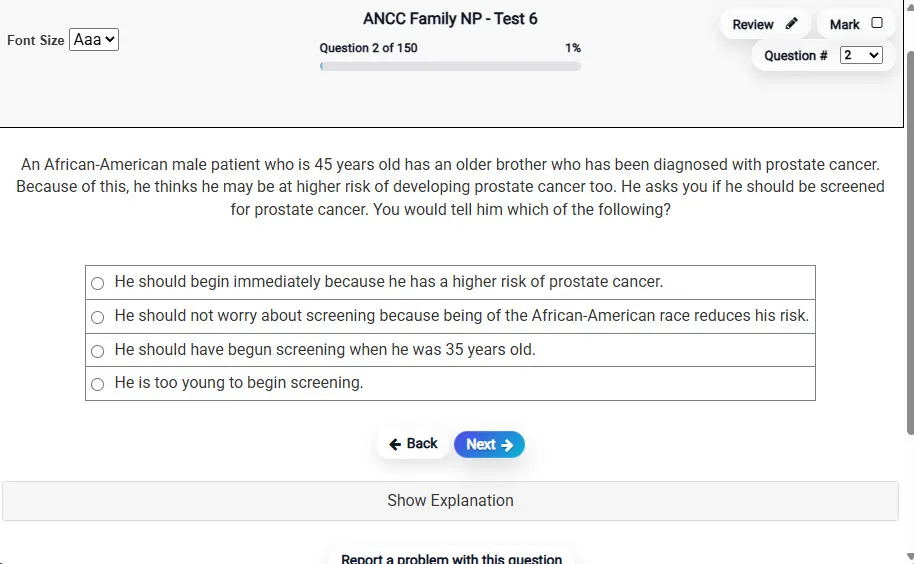
Answering a Question screen – Multiple-choice item view with navigation controls and progress tracker.
Answering a Question Multiple-choice item view with navigation controls and progress tracker.

                           Detailed Explanation screen – 
                         Review mode showing chosen answer and rationale and references.
Detailed Explanation Review mode showing chosen answer and rationale and references.

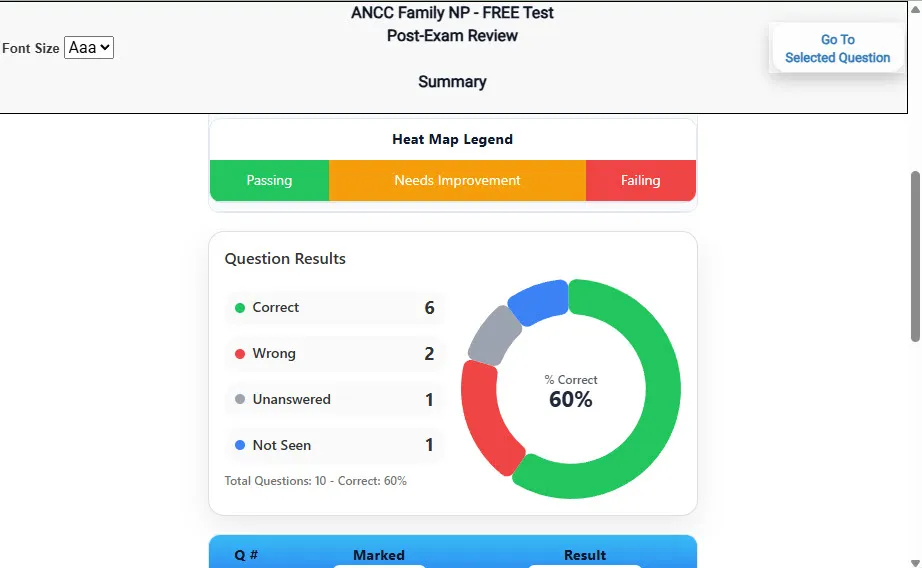
                           Review Summary 1 screen – 
                         Summary with counts for correct/wrong/unanswered and not seen items.
Review Summary 1 Summary with counts for correct/wrong/unanswered and not seen items.

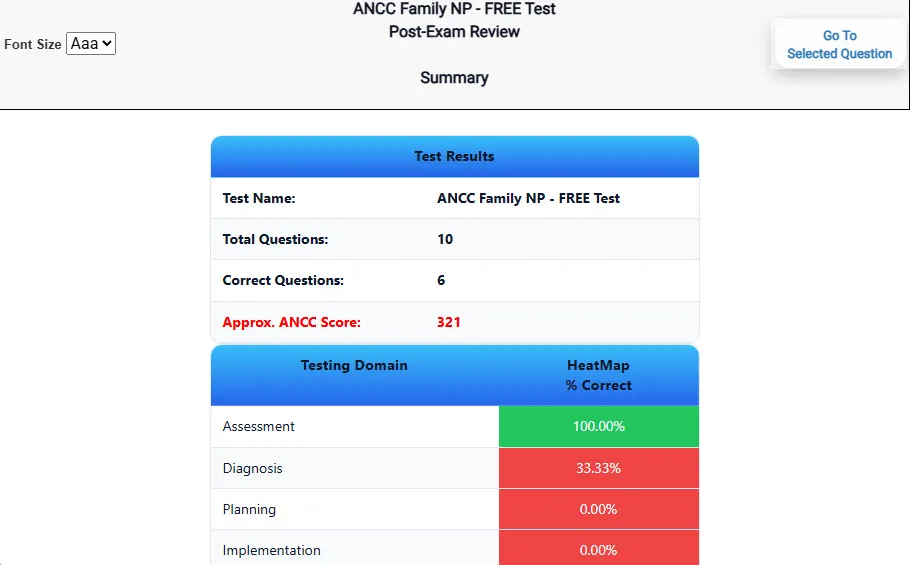
                           Review Summary 2 screen – 
                         Advanced summary with category/domain breakdown and performance insights.
Review Summary 2 Advanced summary with category/domain breakdown and performance insights.

What Each Screen Shows

Answer Question Screen

  • Clean multiple-choice interface with progress bar.
  • Mark for review feature.
  • Matches real test pacing.

Detailed Explanation

  • Correct answer plus rationale.
  • Key concepts and guidelines highlighted.
  • Move between questions to fill knowledge gaps.

Review Summary 1

  • Overall results with total questions and scaled score.
  • Domain heatmap shows strengths and weaknesses.
  • Quick visual feedback on study priorities.

Review Summary 2

  • Chart of correct, wrong, unanswered, not seen.
  • Color-coded results for easy review.
  • Links back to missed items.

Top 10 Reasons to Use Exam Edge for your Praxis Elementary Education Multiple Subjects Exam Prep

  1. Focused on the Praxis Elementary Education Multiple Subjects Exam

    Our practice tests are built specifically for the Praxis Elem Ed: Multiple Subjects exam — every question mirrors the real topics, format, and difficulty so you're studying exactly what matters.

  2. Real Exam Simulation

    We match the per-question time limits and pressure of the actual Praxis exam, so test day feels familiar and stress-free.

  3. 15 Full Practice Tests & 3,675 Unique Questions

    You'll have more than enough material to master every Praxis Elem Ed: Multiple Subjects concept — no repeats, no fluff.

  4. Lower Cost Than a Retake

    Ordering 5 practice exams costs less than retaking the Praxis Elementary Education Multiple Subjects exam after a failure. One low fee could save you both time and money.

  5. Flexible Testing

    Need to step away mid-exam? Pick up right where you left off — with your remaining time intact.

  6. Instant Scoring & Feedback

    See your raw score and an estimated Praxis Elementary Education Multiple Subjects score immediately after finishing each practice test.

  7. Detailed Explanations for Every Question

    Review correct and incorrect answers with clear, step-by-step explanations so you truly understand each topic.

  8. Trusted & Accredited

    We're fully accredited by the Better Business Bureau and uphold the highest standards of trust and transparency.

  9. Web-Based & Always Available

    No software to install. Access your Praxis Elem Ed: Multiple Subjects practice exams 24/7 from any computer or mobile device.

  10. Expert Support When You Need It

    Need extra help? Our specialized tutors are highly qualified and ready to support your Praxis exam prep.


Pass the Praxis Elementary Education Multiple Subjects Exam with Realistic Practice Tests from Exam Edge

Preparing for your upcoming Praxis Elementary Education Multiple Subjects (5001) Certification Exam can feel overwhelming — but the right practice makes all the difference. Exam Edge gives you the tools, structure, and confidence to pass on your first try. Our online practice exams are built to match the real Praxis Elem Ed: Multiple Subjects exam in content, format, and difficulty.

  • 📝 15 Praxis Elementary Education Multiple Subjects Practice Tests: Access 15 full-length exams with 245 questions each, covering every major Praxis Elementary Education Multiple Subjects topic in depth.
  • Instant Online Access: Start practicing right away — no software, no waiting.
  • 🧠 Step-by-Step Explanations: Understand the reasoning behind every correct answer so you can master Praxis Elem Ed: Multiple Subjects exam concepts.
  • 🔄 Retake Each Exam Up to 4 Times: Build knowledge through repetition and track your improvement over time.
  • 🌐 Web-Based & Available 24/7: Study anywhere, anytime, on any device.
  • 🧘 Boost Your Test-Day Confidence: Familiarity with the Praxis format reduces anxiety and helps you perform under pressure.

These Praxis Elementary Education Multiple Subjects practice exams are designed to simulate the real testing experience by matching question types, timing, and difficulty level. This approach helps you get comfortable not just with the exam content, but also with the testing environment, so you walk into your exam day focused and confident.

Exam Edge Praxis Reviews


These tests are the key to getting a passing score! Worth EVERY penny!

Alexis , Silver Spring , MD

I failed the Praxis Math test five times before I found your site. After taking all your practice tests, on my next attempt I passed by five points! I can honestly say this site is the reason I passed. Thank you!!!

Nikki P, Tennessee

Just wanted to say thanks for helping me pass the Praxis I Reading! Your practice tests and especially your explanations are great. They gave me the confidence I needed! Now I can student teach this fall. I'm so glad I found PraxisReading.com!

Denise C, Florida

Thank you so much. I just received my results in the mail. I scored a 179 and passed the Praxis I Writing! I'll never have to worry about retaking this test again! PraxisWriting.com is great. I told all my friends about this site.

Susan K, Virginia

I failed the Parapro test four times before I found your site. After taking all your practice tests, on my next attempt I passed by seven points! I can honestly say that this site is the reason I passed. Thank you!!!

Rebecca S, Texas

Hi! Just returned from taking my Praxis computerized and am happy to say that I passed with a 175. The last time I took the test I missed by 1 point. Your tests definitely made the difference for me! The set up was so similar to the test and the types of questions were also similar that I felt ve ...
Read More
Brad Y, Pennsylvania


Praxis Elementary Education Multiple Subjects Aliases Test Name

Here is a list of alternative names used for this exam.

  • Praxis Elementary Education Multiple Subjects
  • Praxis Elementary Education Multiple Subjects test
  • Praxis Elementary Education Multiple Subjects Certification Test
  • Praxis Elem Ed: Multiple Subjects test
  • Praxis
  • Praxis 5001
  • 5001 test
  • Praxis Elementary Education Multiple Subjects (5001)
  • Elementary Education Multiple Subjects certification