This is the content of the pop-over!

Praxis Elem Ed Curr, Inst, and Assessment 5011 (5011) Practice Tests & Test Prep by Exam Edge


Praxis Elementary Education Curriculum, Instruction, and Assessment 5011  product image
(5.0)
Based on 34 Reviews

  • Real Exam Simulation: Timed questions and matching content build comfort for your Praxis Elem Ed Curr, Inst, and Assessment 5011 test day.
  • Instant, 24/7 Access: Web-based Praxis Elementary Education Curriculum, Instruction, and Assessment 5011 practice exams with no software needed.
  • Clear Explanations: Step-by-step answers and explanations for your Praxis exam to strengthen understanding.
  • Boosted Confidence: Reduces anxiety and improves test-taking skills to ace your Praxis Elementary Education Curriculum, Instruction, and Assessment 5011 (5011).

Featured on

Praxis Elementary Education Curriculum, Instruction, and Assessment 5011 Online Practice Test Bundles

BEST VALUE
10 practice tests

$99.50

$399.50

SAVE $300

Only $9.95 per test!

  • 100% Pass Guarantee
  • 10 online practice tests
  • 110 questions per test
  • Bonus: 100 Flash Cards + Study Guide
  • Instant access
  • Detailed Explanations
  • Practice tests never expire
  • Timed, untimed, or study guide mode
5 practice tests

$69.75

$199.75

SAVE $130

Only $13.95 per test!

  • 5 online practice tests
  • 110 questions per test
  • Bonus: 100 Flash Cards + Study Guide
  • Instant access
  • Detailed Explanations
  • Practice tests never expire
  • Timed, untimed, or study guide mode
1 practice test

$39.95

  • 1 online practice test
  • 110 questions per test
  • Instant access
  • Detailed Explanations
  • Practice tests never expire
  • Timed, untimed, or study guide mode
Quick Select
Tap to choose a bundle

** All Prices are in US Dollars (USD) **


Praxis Elem Ed Curr, Inst, and Assessment 5011 (5011) Resources

Jump to the section you need most.

Understanding the exact breakdown of the Praxis Elementary Education Curriculum, Instruction, and Assessment 5011 test will help you know what to expect and how to most effectively prepare. The Praxis Elementary Education Curriculum, Instruction, and Assessment 5011 has multiple-choice questions . The exam will be broken down into the sections below:

Praxis Elementary Education Curriculum, Instruction, and Assessment 5011 Exam Blueprint
Domain Name % Number of
Questions
Reading and Language Arts
Curriculum - Instruction Assessment
35% 39
Mathematics
Curriculum - Instruction Assessment
20% 22
Science
Curriculum - Instruction Assessment
10% 11
Social Studies
Curriculum - Instruction Assessment
10% 11
Arts and Physical Education
Curriculum - Instruction Assessment
10% 11
General Information about
Curriculum - Instruction Assessment
15% 17

Praxis Elementary Education Curriculum, Instruction, and Assessment 5011 Study Tips by Domain

  • Align reading instruction to a clear purpose (e.g., comprehension vs. fluency) and match texts to students’ independent/instructional levels—red flag: assigning the same complex text without scaffolds and then grading comprehension.
  • Teach phonological awareness (sound manipulation) before or alongside phonics (print-sound mapping)—common trap: giving letter-sound drills when the student cannot segment or blend sounds orally.
  • Use running records or miscue analysis to diagnose errors (meaning/structure/visual) and choose a targeted next step—priority rule: don’t reteach everything; reteach the skill the errors actually show.
  • Build vocabulary with explicit instruction in morphology (prefixes, roots, suffixes) and multiple exposures in context—red flag: relying only on dictionary definitions or isolated word lists.
  • Plan writing using a process approach (prewrite, draft, revise, edit, publish) and separate revision (ideas/organization) from editing (conventions)—common trap: correcting mechanics on a first draft and calling it “revision.”
  • Choose assessments that match the target (e.g., oral reading rate/accuracy for fluency; rubrics for writing traits) and use accommodations without changing the construct—contraindication: reading the entire reading-comprehension passage aloud when decoding is part of what’s being measured.
  • Align objectives, instruction, and assessment to the same mathematics standard and DOK level; red flag: an assessment item that tests a different skill (e.g., procedure-only) than the lesson objective (e.g., conceptual reasoning).
  • Use CRA/progression of representations (concrete → pictorial → abstract) for new concepts; common trap: introducing algorithms (e.g., long division) before students can explain meaning with models.
  • Choose tasks that require mathematical reasoning and multiple strategies, then facilitate discourse with prompts like “How do you know?”; priority rule: value justification over speed, especially when interpreting student work.
  • Diagnose misconceptions using student errors as data and respond with targeted instruction; red flag: recurring place-value errors (e.g., 0.5 > 0.62) indicating weak understanding of decimals, not mere carelessness.
  • Plan measurement and geometry instruction around units, tools, and definitions; common trap: mixing area and perimeter or treating formulas as memorized rules without unit reasoning (square units vs. linear units).
  • Design assessments with clear criteria (rubrics, exemplars) and include both selected-response and constructed-response; threshold cue: if an item allows guessing without showing reasoning, add a prompt requiring explanation or representation.
  • Plan inquiry-based investigations that align a testable question, variables, and evidence-based conclusions; red flag: students collecting data without identifying the independent/dependent variables or a control/comparison.
  • Prioritize safety and ethical classroom practice (PPE, proper disposal, supervision) during labs and demos; common trap: allowing open flames, unknown substances, or unsecured live organisms without explicit safety procedures.
  • Use formative checks (exit tickets, quick writes, concept sketches) to uncover misconceptions before summative assessment; red flag: moving on when students can recite facts but cannot explain cause-and-effect or mechanisms.
  • Teach data literacy—select appropriate graphs, interpret trends, and distinguish correlation from causation; common trap: treating a single outlier or small sample size as definitive evidence.
  • Integrate crosscutting concepts (patterns, systems, energy and matter, structure and function) to connect life, earth/space, and physical science units; priority rule: require students to justify claims using observations/data rather than opinion.
  • Differentiate science instruction with accessible language supports (sentence frames, word banks, visuals) while keeping the cognitive demand of the task; contraindication: simplifying to vocabulary-only worksheets that remove the investigation or reasoning.
  • Plan inquiry-based lessons that move from compelling questions to evidence-based claims; red flag: activities that are “fun” but lack a clear learning target tied to standards and assessment.
  • Teach map/graph/time-line literacy (scale, legend, direction, intervals, change over time) with explicit modeling; common trap: students can read a map but can’t use it to make an inference or comparison.
  • Build civics understanding around rights, responsibilities, and levels/branches of government; priority rule: distinguish checks and balances from separation of powers and assess with real scenarios, not vocabulary-only quizzes.
  • Develop economic reasoning (scarcity, opportunity cost, incentives, supply/demand, trade) using everyday examples; red flag: treating “needs vs. wants” as the only economics concept in a unit.
  • Use multiple perspectives and primary/secondary sources with sourcing and corroboration; common trap: asking students to cite “facts” without evaluating author, purpose, and bias.
  • Design culturally responsive, inclusive social studies instruction and assessments; contraindication: simulations/role-plays that trivialize oppression or require students to reenact trauma without opt-out alternatives.
  • Plan arts/PE lessons with both a content objective and a process objective (e.g., create/perform, critique, reflect)—red flag: activities that are “fun” but have no measurable skill/standard alignment.
  • Use formative checks in performance-based tasks (rubrics, checklists, peer/self-assessment) and give criteria up front—common trap: grading only the final product instead of the technique/process demonstrated.
  • Differentiate for readiness and access (adaptive equipment, modified rules, varied tempos/levels, multiple ways to show learning)—priority rule: maintain the same learning goal while adjusting supports, not lowering expectations.
  • Prioritize safety and classroom management routines in movement settings (space awareness, signals, equipment handling, warm-up/cool-down)—contraindication: skipping a warm-up or using activities with collision risk in limited space.
  • Teach movement concepts and motor skill cues explicitly (balance, locomotor vs. manipulative skills, force, pathways) and provide specific feedback—common trap: overusing “good job” without correcting a single observable element.
  • Integrate arts/PE with other subjects through purposeful connections (rhythm for fractions, movement for vocabulary) without diluting discipline-specific skills—red flag: integration that replaces arts/PE standards with only ELA/math practice.
  • Use backward design: start with standards and measurable outcomes, then align assessments and daily instruction; red flag: activities that are engaging but don’t provide evidence of the stated objective.
  • Write objectives with observable verbs (e.g., explain, compare) and clear criteria; common trap: vague goals like “understand” that can’t be assessed reliably.
  • Match assessment type to purpose—formative to adjust instruction, summative to evaluate mastery; priority rule: don’t grade practice (formative work) as if it were final performance.
  • Ensure validity, reliability, and fairness in classroom assessments; red flag: items that measure reading level or cultural knowledge when the target is a non-language construct.
  • Differentiate using data (readiness, interest, learning profile) while keeping the same essential standard; common trap: lowering rigor instead of adjusting scaffolds, supports, or product options.
  • Provide feedback that is timely, specific, and tied to success criteria; contraindication: feedback that is only evaluative (e.g., “Good job”) without the next-step cue for improvement.


Built to Fit Into Your Busy Life

Everything you need to prepare with confidence—without wasting a minute.

Three Study Modes

Timed, No Time Limit, or Explanation mode.

Actionable Analytics

Heatmaps and scaled scores highlight weak areas.

High-Yield Rationales

Concise explanations emphasize key concepts.

Realistic Interface

Matches the feel of the actual exam environment.

Accessible by Design

Clean layout reduces cognitive load.

Anytime, Anywhere

Web-based access 24/7 on any device.
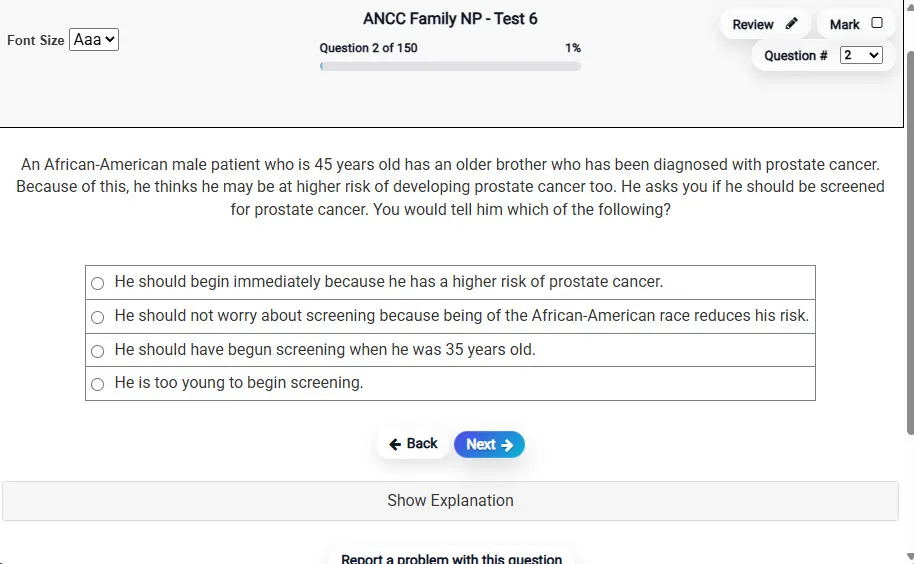
Answering a Question screen – Multiple-choice item view with navigation controls and progress tracker.
Answering a Question Multiple-choice item view with navigation controls and progress tracker.

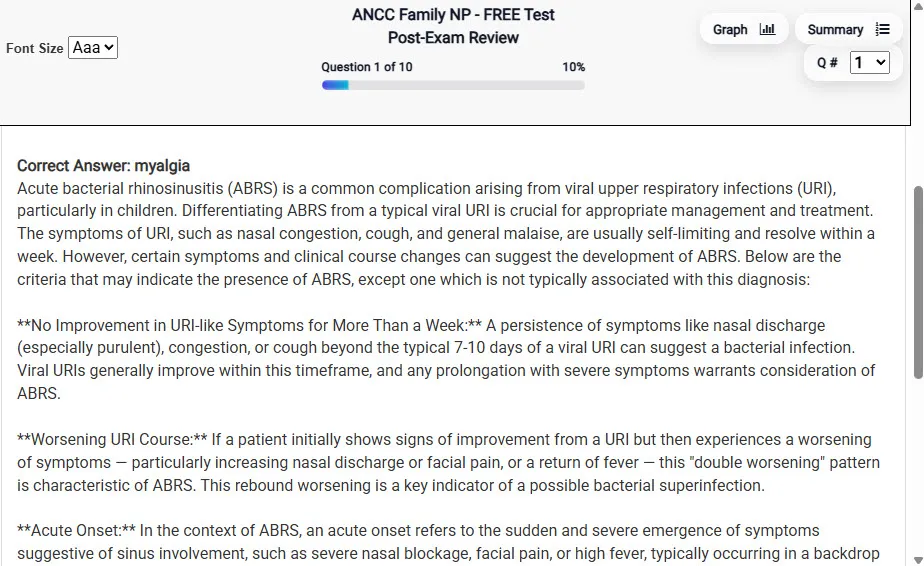
                           Detailed Explanation screen – 
                         Review mode showing chosen answer and rationale and references.
Detailed Explanation Review mode showing chosen answer and rationale and references.

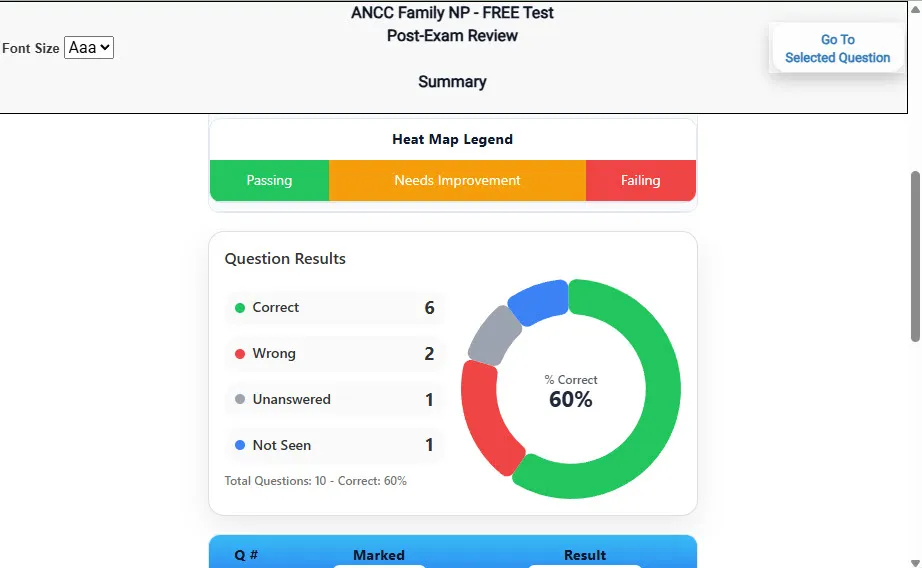
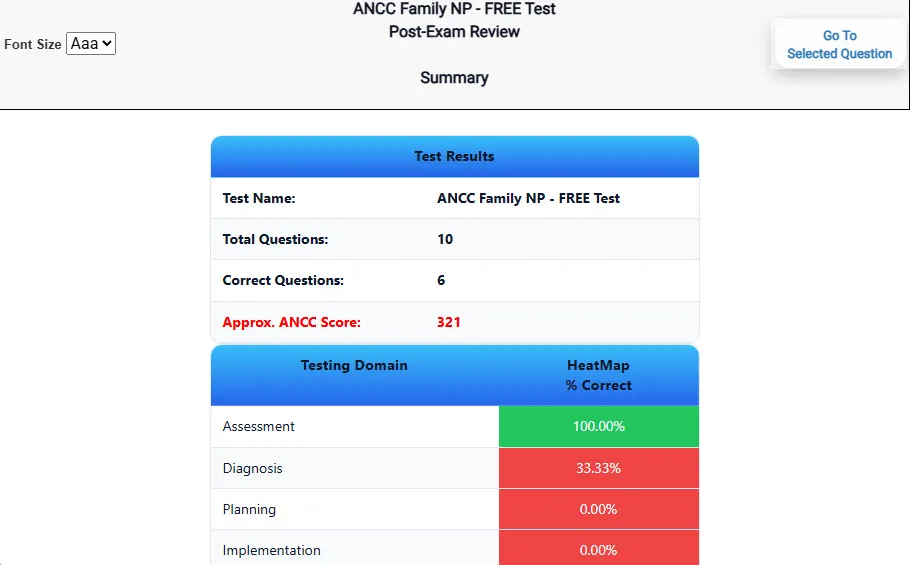
                           Review Summary 1 screen – 
                         Summary with counts for correct/wrong/unanswered and not seen items.
Review Summary 1 Summary with counts for correct/wrong/unanswered and not seen items.

                           Review Summary 2 screen – 
                         Advanced summary with category/domain breakdown and performance insights.
Review Summary 2 Advanced summary with category/domain breakdown and performance insights.

What Each Screen Shows

Answer Question Screen

  • Clean multiple-choice interface with progress bar.
  • Mark for review feature.
  • Matches real test pacing.

Detailed Explanation

  • Correct answer plus rationale.
  • Key concepts and guidelines highlighted.
  • Move between questions to fill knowledge gaps.

Review Summary 1

  • Overall results with total questions and scaled score.
  • Domain heatmap shows strengths and weaknesses.
  • Quick visual feedback on study priorities.

Review Summary 2

  • Chart of correct, wrong, unanswered, not seen.
  • Color-coded results for easy review.
  • Links back to missed items.

Top 10 Reasons to Use Exam Edge for your Praxis Elementary Education Curriculum, Instruction, and Assessment 5011 Exam Prep

  1. Focused on the Praxis Elementary Education Curriculum, Instruction, and Assessment 5011 Exam

    Our practice tests are built specifically for the Praxis Elem Ed Curr, Inst, and Assessment 5011 exam — every question mirrors the real topics, format, and difficulty so you're studying exactly what matters.

  2. Real Exam Simulation

    We match the per-question time limits and pressure of the actual Praxis exam, so test day feels familiar and stress-free.

  3. 10 Full Practice Tests & 1,100 Unique Questions

    You'll have more than enough material to master every Praxis Elem Ed Curr, Inst, and Assessment 5011 concept — no repeats, no fluff.

  4. Lower Cost Than a Retake

    Ordering 5 practice exams costs less than retaking the Praxis Elementary Education Curriculum, Instruction, and Assessment 5011 exam after a failure. One low fee could save you both time and money.

  5. Flexible Testing

    Need to step away mid-exam? Pick up right where you left off — with your remaining time intact.

  6. Instant Scoring & Feedback

    See your raw score and an estimated Praxis Elementary Education Curriculum, Instruction, and Assessment 5011 score immediately after finishing each practice test.

  7. Detailed Explanations for Every Question

    Review correct and incorrect answers with clear, step-by-step explanations so you truly understand each topic.

  8. Trusted & Accredited

    We're fully accredited by the Better Business Bureau and uphold the highest standards of trust and transparency.

  9. Web-Based & Always Available

    No software to install. Access your Praxis Elem Ed Curr, Inst, and Assessment 5011 practice exams 24/7 from any computer or mobile device.

  10. Expert Support When You Need It

    Need extra help? Our specialized tutors are highly qualified and ready to support your Praxis exam prep.


Pass the Praxis Elementary Education Curriculum, Instruction, and Assessment 5011 Exam with Realistic Practice Tests from Exam Edge

Preparing for your upcoming Praxis Elementary Education Curriculum, Instruction, and Assessment 5011 (5011) Certification Exam can feel overwhelming — but the right practice makes all the difference. Exam Edge gives you the tools, structure, and confidence to pass on your first try. Our online practice exams are built to match the real Praxis Elem Ed Curr, Inst, and Assessment 5011 exam in content, format, and difficulty.

  • 📝 10 Praxis Elementary Education Curriculum, Instruction, and Assessment 5011 Practice Tests: Access 10 full-length exams with 110 questions each, covering every major Praxis Elementary Education Curriculum, Instruction, and Assessment 5011 topic in depth.
  • Instant Online Access: Start practicing right away — no software, no waiting.
  • 🧠 Step-by-Step Explanations: Understand the reasoning behind every correct answer so you can master Praxis Elem Ed Curr, Inst, and Assessment 5011 exam concepts.
  • 🔄 Retake Each Exam Up to 4 Times: Build knowledge through repetition and track your improvement over time.
  • 🌐 Web-Based & Available 24/7: Study anywhere, anytime, on any device.
  • 🧘 Boost Your Test-Day Confidence: Familiarity with the Praxis format reduces anxiety and helps you perform under pressure.

These Praxis Elementary Education Curriculum, Instruction, and Assessment 5011 practice exams are designed to simulate the real testing experience by matching question types, timing, and difficulty level. This approach helps you get comfortable not just with the exam content, but also with the testing environment, so you walk into your exam day focused and confident.


Exam Edge Praxis Reviews


I passed my Praxis Elementary Ed (0011) test today!!! Thank you for the wonderful tests. I don't think I would have passed without them. Now I never have to worry about that test again!

Brooke S.,

Hi, I just wanted to say THANK YOU for this website and the practice test! I have to pass the Praxis 5011 by the middle of this next semester. I took the test in June and failed by 4 points. I took some of the practice tests provided here...I took the test again today and brought my score up by 9 po ...
Read More
allie , MS

I failed the Praxis Math test five times before I found your site. After taking all your practice tests, on my next attempt I passed by five points! I can honestly say this site is the reason I passed. Thank you!!!

Nikki P, Tennessee

Just wanted to say thanks for helping me pass the Praxis I Reading! Your practice tests and especially your explanations are great. They gave me the confidence I needed! Now I can student teach this fall. I'm so glad I found PraxisReading.com!

Denise C, Florida

Thank you so much. I just received my results in the mail. I scored a 179 and passed the Praxis I Writing! I'll never have to worry about retaking this test again! PraxisWriting.com is great. I told all my friends about this site.

Susan K, Virginia

I failed the Parapro test four times before I found your site. After taking all your practice tests, on my next attempt I passed by seven points! I can honestly say that this site is the reason I passed. Thank you!!!

Rebecca S, Texas


Praxis Elementary Education Curriculum, Instruction, and Assessment 5011 Aliases Test Name

Here is a list of alternative names used for this exam.

  • Praxis Elementary Education Curriculum, Instruction, and Assessment 5011
  • Praxis Elementary Education Curriculum, Instruction, and Assessment 5011 test
  • Praxis Elementary Education Curriculum, Instruction, and Assessment 5011 Certification Test
  • Praxis Elem Ed Curr, Inst, and Assessment 5011 test
  • Praxis
  • Praxis 5011
  • 5011 test
  • Praxis Elementary Education Curriculum, Instruction, and Assessment 5011 (5011)
  • Elementary Education Curriculum, Instruction, and Assessment 5011 certification