This is the content of the pop-over!

Praxis Earth and Space Sciences (5571) Practice Tests & Test Prep by Exam Edge


Praxis Earth and Space Sciences Content Knowledge  product image
(5.0)
Based on 22 Reviews

  • Real Exam Simulation: Timed questions and matching content build comfort for your Praxis Earth and Space Sciences Content test day.
  • Instant, 24/7 Access: Web-based Praxis Earth and Space Sciences Content Knowledge practice exams with no software needed.
  • Clear Explanations: Step-by-step answers and explanations for your Praxis exam to strengthen understanding.
  • Boosted Confidence: Reduces anxiety and improves test-taking skills to ace your Praxis Earth and Space Sciences Content Knowledge (5571).

Featured on

Praxis Earth and Space Sciences Content Knowledge Online Practice Test Bundles

BEST VALUE
15 practice tests

$149.25

$599.25

SAVE $450

Only $9.95 per test!

  • 100% Pass Guarantee
  • 15 online practice tests
  • 125 questions per test
  • Bonus: 100 Flash Cards + Study Guide
  • Instant access
  • Detailed Explanations
  • Practice tests never expire
  • Timed, untimed, or study guide mode
MOST POPULAR
10 practice tests

$99.50

$399.50

SAVE $300

Only $9.95 per test!

  • 10 online practice tests
  • 125 questions per test
  • Bonus: 100 Flash Cards + Study Guide
  • Instant access
  • Detailed Explanations
  • Practice tests never expire
  • Timed, untimed, or study guide mode
5 practice tests

$69.75

$199.75

SAVE $130

Only $13.95 per test!

  • 5 online practice tests
  • 125 questions per test
  • Bonus: 100 Flash Cards
  • Instant access
  • Detailed Explanations
  • Practice tests never expire
  • Timed, untimed, or study guide mode
1 practice test

$39.95

  • 1 online practice test
  • 125 questions per test
  • Instant access
  • Detailed Explanations
  • Practice tests never expire
  • Timed, untimed, or study guide mode
Quick Select
Tap to choose a bundle

** All Prices are in US Dollars (USD) **


Praxis Earth and Space Sciences Content (5571) Resources

Jump to the section you need most.

Understanding the exact breakdown of the Praxis Earth and Space Sciences Content Knowledge test will help you know what to expect and how to most effectively prepare. The Praxis Earth and Space Sciences Content Knowledge has 125 multiple-choice questions . The exam will be broken down into the sections below:

Praxis Earth and Space Sciences Content Knowledge Exam Blueprint
Domain Name % Number of
Questions
Basic Scientific Principles of Earth and Space Sciences 12% 15
Tectonics and Internal Earth Processes 17% 21
Earth Materials and Surface Processes 23% 29
History of the Earth and its Life-Forms 14% 18
Earth’s Atmosphere and Hydrosphere 19% 24
Astronomy 15% 19

Praxis Earth and Space Sciences Content Knowledge Study Tips by Domain

  • Track units and conversions (SI vs. English) because Praxis items often hinge on dimensional analysis; red flag: answers that don’t match the requested unit (e.g., km vs. m, Pa vs. atm).
  • Apply significant figures and uncertainty rules in lab-style data interpretation; common trap: reporting more precision than the measurement device allows (e.g., reading a ruler to 0.01 cm).
  • Use graph skills (slope, intercept, area under curve) to extract physical meaning; priority rule: always label axes/units before interpreting trends or extrapolating.
  • Differentiate accuracy vs. precision and identify sources of systematic vs. random error; red flag: repeating trials improves precision but does not fix a biased instrument.
  • Invoke conservation laws (energy, mass, momentum) and basic thermodynamics (heat vs. temperature); common trap: assuming temperature changes imply heat gained without considering phase change/latent heat.
  • Evaluate scientific claims using hypothesis testing, controls, and correlation vs. causation; red flag: concluding causation from a single variable trend without a control or mechanism.
  • Differentiate plate boundary types by motion and products: convergent → trenches/volcanic arcs, divergent → mid-ocean ridges/rifts, transform → strike-slip faults; red flag: transform boundaries can have large earthquakes with little to no volcanism.
  • Use earthquake wave behavior to infer Earth’s interior: S-waves don’t travel through liquids and P-wave refraction creates shadow zones; common trap: claiming S-waves pass through the outer core.
  • Link stress to fault type as a priority rule: compression → reverse/thrust, tension → normal, shear → strike-slip; red flag: thrust faults are low-angle reverse faults typical of convergent settings.
  • Explain driving mechanisms with correct density logic: slab pull and ridge push move plates as part of mantle convection; common trap: saying convection is in the lithosphere rather than the asthenosphere/upper mantle.
  • Connect hotspot tracks and seafloor patterns to relative plate motion: island chains get older away from the active hotspot and magnetic stripes are symmetric about ridges; red flag: reversing the age pattern (youngest at the trench or farthest from the ridge).
  • Relate mountain building and metamorphism to tectonic setting: orogenies from collision/subduction produce folding, regional metamorphism, and intrusive igneous bodies; common trap: attributing high-pressure metamorphism (e.g., blueschist) to divergent boundaries.
  • Identify common rocks/minerals using diagnostic properties (hardness, cleavage vs. fracture, streak, reaction to HCl) — red flag: confusing calcite’s acid fizz with quartz (no reaction) or equating color with mineral identity.
  • Relate igneous texture/composition to cooling history (intrusive coarse vs. extrusive fine; mafic vs. felsic) — common trap: assuming basalt is intrusive because it can be dark and dense.
  • Track sediment transport and deposition by energy and grain size (high-energy systems move larger clasts; sorting/rounding increase with transport) — priority rule: use grain size and sorting before interpreting environment.
  • Explain weathering types and controls (mechanical vs. chemical; climate, rock type, surface area) — contraindication: chemical weathering is generally fastest in warm, wet climates, not cold, arid ones.
  • Connect erosion and mass wasting to slope stability (angle, saturation, vegetation, undercutting, earthquakes) — red flag: heavy rain after drought raises landslide risk via pore-water pressure even on familiar slopes.
  • Interpret soils and landscapes (soil horizons, parent material, time, organisms, topography, climate) — common trap: assuming thick, mature soils form fastest; they typically require long time and stable surfaces.
  • Know relative dating rules — superposition, original horizontality, cross-cutting relationships, inclusions, and unconformities; red flag: confusing a disconformity (missing time between parallel layers) with an angular unconformity.
  • Use absolute dating logic — radiometric decay, half-life, and which isotopic systems fit which time scales (e.g., U–Pb for very old rocks, C-14 for recent organic remains); common trap: applying C-14 to dinosaurs or igneous rocks.
  • Track the geologic time scale by eras/periods and hallmark events (Cambrian explosion, Permian–Triassic extinction, K–Pg extinction); test cue: if a question asks for the biggest mass extinction, pick end-Permian, not K–Pg.
  • Interpret fossils as evidence for evolution and environments — index fossils have wide geographic range but short stratigraphic range; priority rule: a “good” index fossil is abundant, easily recognized, and time-restricted.
  • Connect major atmospheric/ocean changes to life (Great Oxidation Event, ozone formation, Snowball Earth hypotheses) and their biological consequences; red flag: assuming early Earth had oxygen-rich air comparable to today.
  • Relate plate tectonics and climate to biodiversity patterns (continental drift, sea-level change, glaciations) including causes of extinction (habitat loss, volcanism, impacts); common trap: treating “climate change” as a single cause without a mechanism or timescale.
  • Apply the ideal gas law and hydrostatic balance to explain why pressure drops roughly exponentially with altitude; red flag: confusing pressure–altitude with temperature–altitude (the latter is not monotonic across layers).
  • Use energy-budget logic (albedo, greenhouse effect, emissivity) to predict temperature responses; common trap: saying the ozone layer “traps heat” as its primary role rather than absorbing UV and shaping the stratospheric temperature inversion.
  • Interpret weather maps with pressure gradients, Coriolis deflection, and friction to infer winds; priority rule: near the surface winds cross isobars toward lower pressure, while aloft geostrophic flow is roughly parallel to isobars.
  • Relate humidity, dew point, and adiabatic cooling to cloud formation and precipitation; red flag: treating relative humidity as “amount of water vapor” instead of a temperature-dependent ratio to saturation.
  • Explain global circulation (Hadley–Ferrel–Polar cells) and jet streams using differential heating and angular momentum; common trap: reversing Coriolis directions (right deflection in the Northern Hemisphere, left in the Southern Hemisphere).
  • Analyze the hydrologic cycle and ocean processes (salinity, density, currents, thermohaline circulation); threshold cue: warm surface water is less dense than cold, so “warm sinks” is usually wrong unless salinity dominates.
  • Use angular size ∝ physical size/distance to compare apparent diameters; red flag: assuming a closer object is always physically larger because it looks bigger.
  • Apply Kepler’s 3rd law (P2 ∝ a3) to orbital comparisons; common trap: mixing units or comparing periods without accounting for semimajor axis.
  • Interpret the H–R diagram by relating luminosity, temperature (color), and stellar evolution; red flag: placing red giants as “cool and dim” instead of cool and very luminous.
  • Connect spectral lines to composition and Doppler shift to radial motion; priority rule: redshift means receding and blueshift means approaching (don’t reverse the sign).
  • Explain Moon phases, eclipses, and tides using Sun–Earth–Moon geometry; common trap: saying phases are caused by Earth’s shadow (that’s an eclipse).
  • Distinguish between refracting vs reflecting telescopes and between resolution vs magnification; red flag: claiming bigger magnification improves detail more than larger aperture (aperture drives resolution and light-gathering).


Built to Fit Into Your Busy Life

Everything you need to prepare with confidence—without wasting a minute.

Three Study Modes

Timed, No Time Limit, or Explanation mode.

Actionable Analytics

Heatmaps and scaled scores highlight weak areas.

High-Yield Rationales

Concise explanations emphasize key concepts.

Realistic Interface

Matches the feel of the actual exam environment.

Accessible by Design

Clean layout reduces cognitive load.

Anytime, Anywhere

Web-based access 24/7 on any device.
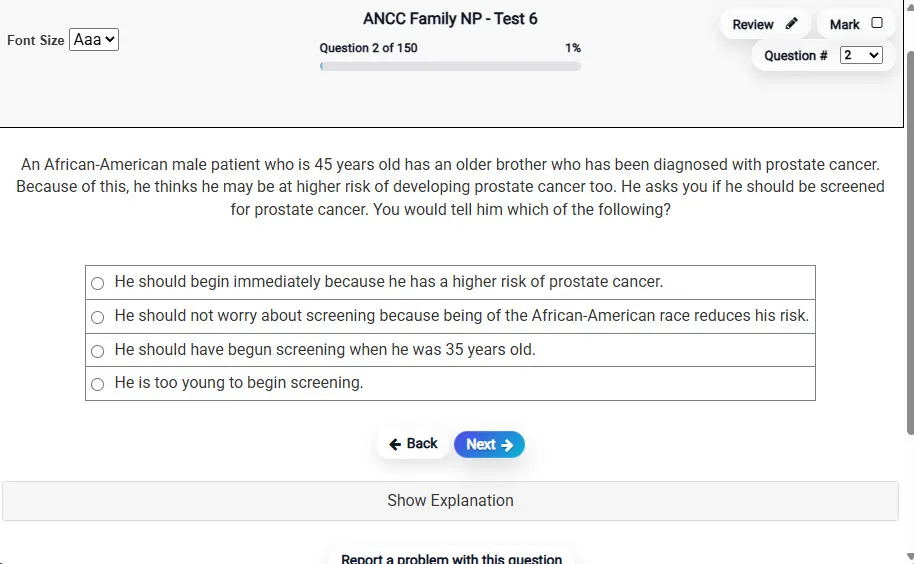
Answering a Question screen – Multiple-choice item view with navigation controls and progress tracker.
Answering a Question Multiple-choice item view with navigation controls and progress tracker.

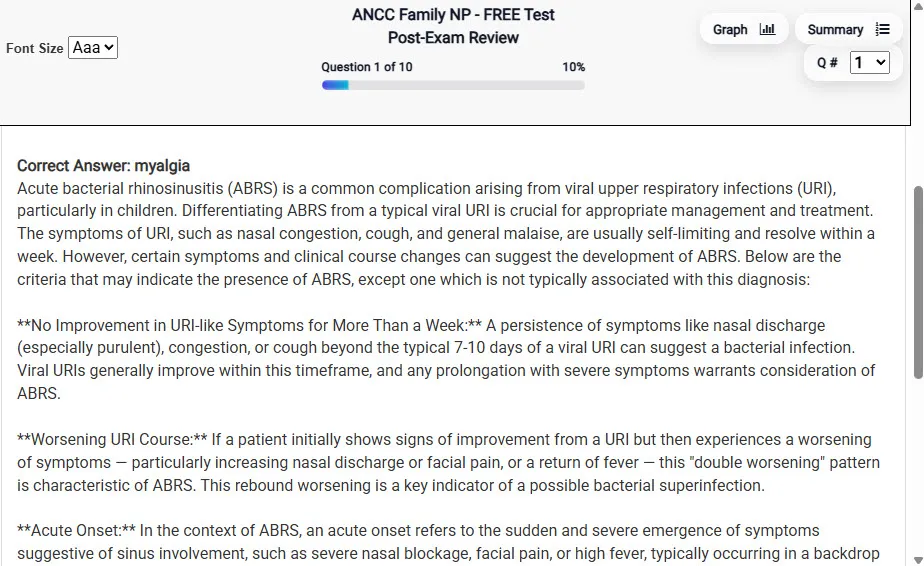
                           Detailed Explanation screen – 
                         Review mode showing chosen answer and rationale and references.
Detailed Explanation Review mode showing chosen answer and rationale and references.

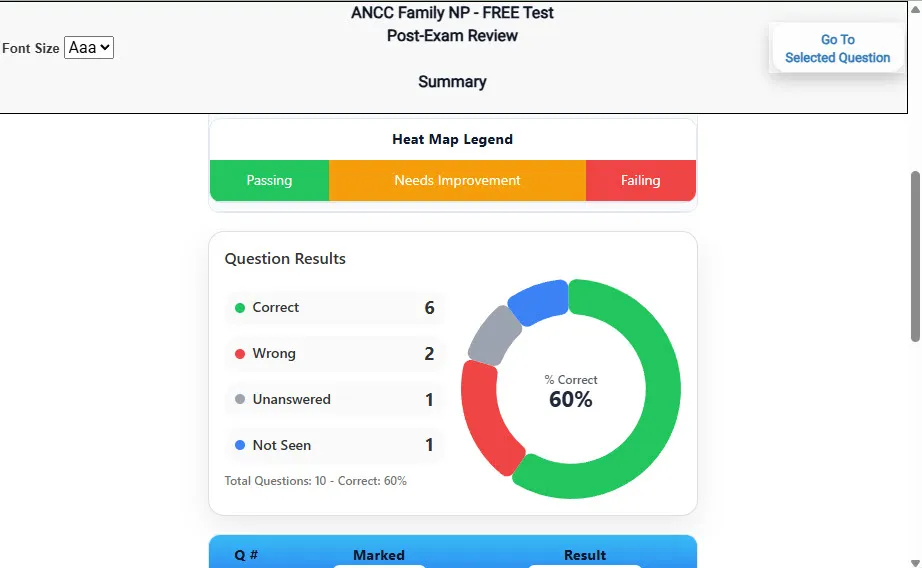
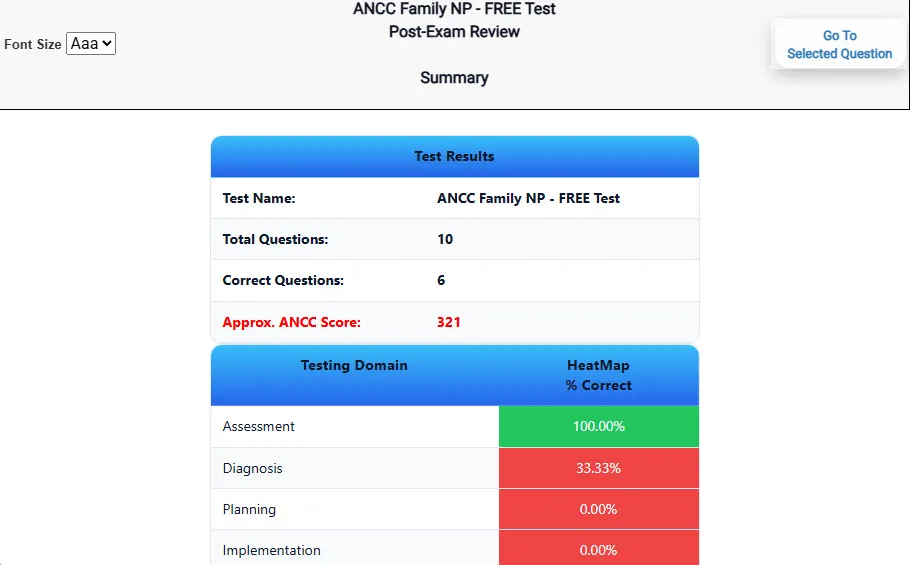
                           Review Summary 1 screen – 
                         Summary with counts for correct/wrong/unanswered and not seen items.
Review Summary 1 Summary with counts for correct/wrong/unanswered and not seen items.

                           Review Summary 2 screen – 
                         Advanced summary with category/domain breakdown and performance insights.
Review Summary 2 Advanced summary with category/domain breakdown and performance insights.

What Each Screen Shows

Answer Question Screen

  • Clean multiple-choice interface with progress bar.
  • Mark for review feature.
  • Matches real test pacing.

Detailed Explanation

  • Correct answer plus rationale.
  • Key concepts and guidelines highlighted.
  • Move between questions to fill knowledge gaps.

Review Summary 1

  • Overall results with total questions and scaled score.
  • Domain heatmap shows strengths and weaknesses.
  • Quick visual feedback on study priorities.

Review Summary 2

  • Chart of correct, wrong, unanswered, not seen.
  • Color-coded results for easy review.
  • Links back to missed items.

Top 10 Reasons to Use Exam Edge for your Praxis Earth and Space Sciences Content Knowledge Exam Prep

  1. Focused on the Praxis Earth and Space Sciences Content Knowledge Exam

    Our practice tests are built specifically for the Praxis Earth and Space Sciences Content exam — every question mirrors the real topics, format, and difficulty so you're studying exactly what matters.

  2. Real Exam Simulation

    We match the per-question time limits and pressure of the actual Praxis exam, so test day feels familiar and stress-free.

  3. 15 Full Practice Tests & 1,875 Unique Questions

    You'll have more than enough material to master every Praxis Earth and Space Sciences Content concept — no repeats, no fluff.

  4. Lower Cost Than a Retake

    Ordering 5 practice exams costs less than retaking the Praxis Earth and Space Sciences Content Knowledge exam after a failure. One low fee could save you both time and money.

  5. Flexible Testing

    Need to step away mid-exam? Pick up right where you left off — with your remaining time intact.

  6. Instant Scoring & Feedback

    See your raw score and an estimated Praxis Earth and Space Sciences Content Knowledge score immediately after finishing each practice test.

  7. Detailed Explanations for Every Question

    Review correct and incorrect answers with clear, step-by-step explanations so you truly understand each topic.

  8. Trusted & Accredited

    We're fully accredited by the Better Business Bureau and uphold the highest standards of trust and transparency.

  9. Web-Based & Always Available

    No software to install. Access your Praxis Earth and Space Sciences Content practice exams 24/7 from any computer or mobile device.

  10. Expert Support When You Need It

    Need extra help? Our specialized tutors are highly qualified and ready to support your Praxis exam prep.


Pass the Praxis Earth and Space Sciences Content Knowledge Exam with Realistic Practice Tests from Exam Edge

Preparing for your upcoming Praxis Earth and Space Sciences Content Knowledge (5571) Certification Exam can feel overwhelming — but the right practice makes all the difference. Exam Edge gives you the tools, structure, and confidence to pass on your first try. Our online practice exams are built to match the real Praxis Earth and Space Sciences Content exam in content, format, and difficulty.

  • 📝 15 Praxis Earth and Space Sciences Content Knowledge Practice Tests: Access 15 full-length exams with 125 questions each, covering every major Praxis Earth and Space Sciences Content Knowledge topic in depth.
  • Instant Online Access: Start practicing right away — no software, no waiting.
  • 🧠 Step-by-Step Explanations: Understand the reasoning behind every correct answer so you can master Praxis Earth and Space Sciences Content exam concepts.
  • 🔄 Retake Each Exam Up to 4 Times: Build knowledge through repetition and track your improvement over time.
  • 🌐 Web-Based & Available 24/7: Study anywhere, anytime, on any device.
  • 🧘 Boost Your Test-Day Confidence: Familiarity with the Praxis format reduces anxiety and helps you perform under pressure.

These Praxis Earth and Space Sciences Content Knowledge practice exams are designed to simulate the real testing experience by matching question types, timing, and difficulty level. This approach helps you get comfortable not just with the exam content, but also with the testing environment, so you walk into your exam day focused and confident.


Exam Edge Praxis Reviews


I am overjoyed and I couldn't have passed the Praxis II Earth Space Science Content Knowledge test on the first try without you. I did see several questions from the practice tests on my test. Thank you so very much!!!

Carol , Virginia

I failed the Praxis Math test five times before I found your site. After taking all your practice tests, on my next attempt I passed by five points! I can honestly say this site is the reason I passed. Thank you!!!

Nikki P, Tennessee

Just wanted to say thanks for helping me pass the Praxis I Reading! Your practice tests and especially your explanations are great. They gave me the confidence I needed! Now I can student teach this fall. I'm so glad I found PraxisReading.com!

Denise C, Florida

Thank you so much. I just received my results in the mail. I scored a 179 and passed the Praxis I Writing! I'll never have to worry about retaking this test again! PraxisWriting.com is great. I told all my friends about this site.

Susan K, Virginia

I failed the Parapro test four times before I found your site. After taking all your practice tests, on my next attempt I passed by seven points! I can honestly say that this site is the reason I passed. Thank you!!!

Rebecca S, Texas

Hi! Just returned from taking my Praxis computerized and am happy to say that I passed with a 175. The last time I took the test I missed by 1 point. Your tests definitely made the difference for me! The set up was so similar to the test and the types of questions were also similar that I felt ve ...
Read More
Brad Y, Pennsylvania


Praxis Earth and Space Sciences Content Knowledge Aliases Test Name

Here is a list of alternative names used for this exam.

  • Praxis Earth and Space Sciences Content Knowledge
  • Praxis Earth and Space Sciences Content Knowledge test
  • Praxis Earth and Space Sciences Content Knowledge Certification Test
  • Praxis Earth and Space Sciences Content test
  • Praxis
  • Praxis 5571
  • 5571 test
  • Praxis Earth and Space Sciences Content Knowledge (5571)
  • Earth and Space Sciences Content Knowledge certification