This is the content of the pop-over!

Praxis Chemistry (5245) Practice Tests & Test Prep by Exam Edge


Praxis Chemistry Content Knowledge product image
(5.0)
Based on 25 Reviews

  • Real Exam Simulation: Timed questions and matching content build comfort for your Praxis Chemistry Content test day.
  • Instant, 24/7 Access: Web-based Praxis Chemistry Content Knowledge practice exams with no software needed.
  • Clear Explanations: Step-by-step answers and explanations for your Praxis exam to strengthen understanding.
  • Boosted Confidence: Reduces anxiety and improves test-taking skills to ace your Praxis Chemistry Content Knowledge (5245).

Featured on

Praxis Chemistry Content Knowledge Online Practice Test Bundles

BEST VALUE
15 practice tests

$149.25

$599.25

SAVE $450

Only $9.95 per test!

  • 100% Pass Guarantee
  • 15 online practice tests
  • 125 questions per test
  • Bonus: 100 Flash Cards + Study Guide
  • Instant access
  • Detailed Explanations
  • Practice tests never expire
  • Timed, untimed, or study guide mode
MOST POPULAR
10 practice tests

$99.50

$399.50

SAVE $300

Only $9.95 per test!

  • 10 online practice tests
  • 125 questions per test
  • Bonus: 100 Flash Cards + Study Guide
  • Instant access
  • Detailed Explanations
  • Practice tests never expire
  • Timed, untimed, or study guide mode
5 practice tests

$69.75

$199.75

SAVE $130

Only $13.95 per test!

  • 5 online practice tests
  • 125 questions per test
  • Bonus: 100 Flash Cards
  • Instant access
  • Detailed Explanations
  • Practice tests never expire
  • Timed, untimed, or study guide mode
1 practice test

$39.95

  • 1 online practice test
  • 125 questions per test
  • Instant access
  • Detailed Explanations
  • Practice tests never expire
  • Timed, untimed, or study guide mode
Quick Select
Tap to choose a bundle

** All Prices are in US Dollars (USD) **


Praxis Chemistry Content (5245) Resources

Jump to the section you need most.

Understanding the exact breakdown of the Praxis Chemistry Content Knowledge test will help you know what to expect and how to most effectively prepare. The Praxis Chemistry Content Knowledge has 125 multiple-choice questions . The exam will be broken down into the sections below:

Praxis Chemistry Content Knowledge Exam Blueprint
Domain Name % Number of
Questions
Basic Principles of Matter and Energy; Thermodynamics 14% 18
Atomic and Nuclear Structure 12% 15
Nomenclature; Chemical Composition; Bonding and Structure 15% 19
Chemical Reactions; Periodicity 20% 25
Solutions and Solubility; Acid-Base Chemistry 15% 19
Scientific Inquiry and Social Perspectives of Science 12% 15
Scientific Procedures and Techniques 12% 15

Praxis Chemistry Content Knowledge Study Tips by Domain

  • Use dimensional analysis relentlessly for unit conversions (J, kJ, cal, L·atm) — red flag: dropping prefixes (m, µ) or mixing per-mole vs per-sample quantities.
  • Identify state functions vs path functions: U, H, S are state functions; q and w depend on path — common trap: treating heat as something a system “has” rather than transfers.
  • Apply the First Law with sign conventions: ΔU = q + w (chemistry convention) and w = −PΔV for PV work — priority rule: expansion work is negative (system does work).
  • Link temperature, kinetic energy, and phase changes: heating within a phase changes T, but phase changes use latent heat at constant T — red flag: trying to use q = mcΔT during melting/boiling.
  • For enthalpy, choose the simplest path (often Hess’s law) and track coefficients: scale ΔH with stoichiometry and reverse sign when reversing reactions — common trap: forgetting to multiply ΔH when multiplying the equation.
  • Use entropy/second-law reasoning: spontaneous processes increase Suniv (or give ΔG < 0 at constant T, P) — contraindication: “spontaneous” does not mean fast (kinetics can be slow).
  • Know subatomic particle charges, relative masses, and locations, and use Z and A to identify protons, neutrons, and electrons—red flag: confusing mass number (A) with average atomic mass from the periodic table.
  • Write and interpret isotope and ion notation (e.g., 146C, Fe3+) and compute neutrons as A − Z—common trap: assuming isotopes differ in electrons rather than neutrons.
  • Apply quantum numbers and electron configurations (Aufbau, Hund’s rule, Pauli) including exceptions like Cr and Cu—priority rule: place 4s before 3d when filling, but remove 4s first when forming transition-metal cations.
  • Relate photon energy to wavelength and frequency (E = hν, c = λν) and connect line spectra to quantized transitions—common trap: thinking electrons emit light when absorbing energy (it’s the reverse).
  • Use nuclear equations to balance mass number and atomic number for alpha, beta (ß+), and gamma processes—red flag: treating gamma emission as changing Z or A (it changes neither).
  • Work half-life and decay-rate problems (N = N0(1/2)t/t1/2) and distinguish fission vs fusion with typical products—threshold cue: after n half-lives, remaining fraction is (1/2)n regardless of starting amount.
  • Apply IUPAC rules precisely: use the longest carbon chain and lowest locants; red flag—misnumbering because you pick the first substituent alphabetically instead of the lowest set of numbers.
  • Write correct ionic formulas by balancing charges to the smallest whole-number ratio; common trap—forgetting parentheses with polyatomic ions (e.g., Ca(NO3)2).
  • Name transition-metal compounds with Roman numerals that match the cation’s oxidation state; priority rule—determine the metal charge from the anion(s) before naming (e.g., FeCl3 is iron(III) chloride).
  • Distinguish ionic vs. molecular naming: ionic compounds do not use prefixes, while molecular compounds do; red flag—using “mono-” on the first element (CO is carbon monoxide, not monocarbon monoxide).
  • Use electron configurations to infer valence electrons, common ions, and bonding patterns; common trap—assigning incorrect charges for main-group ions (e.g., Al is typically +3, not +2).
  • Relate structure to properties by identifying bond type and intermolecular forces; red flag—assuming polar bonds automatically mean a polar molecule (check molecular geometry and dipole cancellation).
  • Balance redox equations by tracking oxidation numbers (or half-reactions) and confirm both mass and charge balance—common trap: balancing atoms but leaving net charge unequal, especially in acidic vs basic media.
  • Use equilibrium concepts (K, Q, Le Châtelier) to predict shift direction; priority rule: compare Q to K before changing conditions, and remember pure solids/liquids are omitted from K expressions.
  • Apply kinetics relationships by identifying rate law from initial-rate data and using integrated rate plots; red flag: assuming stoichiometric coefficients equal reaction orders without experimental evidence.
  • Classify reactions (precipitation, acid-base, gas evolution, combustion) and predict products using solubility and activity rules; common trap: writing incorrect polyatomic ion charges or ignoring spectator ions when forming net ionic equations.
  • Use periodic trends (atomic radius, ionization energy, electronegativity, electron affinity) to justify reactivity patterns; red flag: reversing trends across a period vs down a group, especially for metallic character and oxides.
  • Relate periodicity to electron configuration and common ion formation (e.g., s-, p-, d-block behavior); priority rule: for transition metals, multiple oxidation states are likely—don’t assume a single fixed charge in compounds.
  • Use molarity (M), molality (m), mole fraction (X), and ppm/ppb correctly; red flag: confusing moles of solute with moles of solution when using X or mass percent.
  • Apply solubility rules and Ksp with ICE tables to predict precipitation; common trap: forgetting to include stoichiometric exponents in the ion product Q (e.g., [Al3+][OH]3).
  • Le Châtelier in solubility: common-ion effect decreases solubility, while complex-ion formation can increase it; priority rule: compare Q to Ksp after accounting for added ions/complexes.
  • Acid–base strength: strong acids/bases fully dissociate, weak ones require Ka/Kb; red flag: using Henderson–Hasselbalch when concentrations are not a buffer (both weak acid/base and conjugate present in appreciable amounts).
  • pH calculations: for weak acids/bases, check the 5% approximation (x < 0.05C) and solve quadratic if it fails; common trap: taking log of a negative or using [H+] instead of [OH] after a base calculation.
  • Titrations and indicators: identify equivalence-point pH (strong/weak combinations) and choose an indicator whose transition range brackets the steep region; red flag: at equivalence for a weak acid–strong base titration, pH > 7 due to conjugate-base hydrolysis.
  • Design investigations with explicit hypotheses, controlled variables, and replication; red flag: changing more than one independent variable at a time makes causal claims invalid.
  • Interpret data with appropriate graphs and uncertainty (significant figures, error bars, percent error); common trap: claiming differences are meaningful when values overlap within measurement uncertainty.
  • Differentiate correlation from causation and watch for confounders (e.g., temperature drift, contamination); priority rule: propose at least one alternative explanation before concluding mechanism.
  • Evaluate sources and scientific claims using peer review status, methodology transparency, and reproducibility; red flag: relying on anecdotal evidence or non-peer-reviewed conclusions as definitive.
  • Apply ethical and safety norms in chemistry (proper disposal, minimizing exposure, accurate reporting); contraindication: fabricating, cherry-picking, or omitting data is misconduct even if results “fit” expectations.
  • Connect chemistry to societal contexts (risk-benefit, environmental justice, regulation) using evidence and tradeoffs; common trap: presenting absolute “safe/unsafe” claims without dose, exposure route, and context.
  • Choose measurement tools by required precision and report results with correct significant figures — red flag: adding or rounding sig figs incorrectly after calculations.
  • Convert between units using dimensional analysis and appropriate constants (e.g., 1 atm = 760 mmHg) — common trap: mixing mL and L or forgetting to square/cube unit conversions for area/volume.
  • Interpret and construct graphs (slope, intercept, linearization) tied to chemical meaning — priority rule: label axes with units and use best-fit trends rather than connecting-the-dots.
  • Apply lab safety and chemical hygiene (PPE, SDS/GHS pictograms, waste segregation) — contraindication: never add water to concentrated acid; add acid to water.
  • Use core separation/analysis techniques appropriately (filtration, distillation, chromatography, spectroscopy basics) — red flag: selecting distillation when components have very similar boiling points or ignoring Rf/retention time comparisons.
  • Evaluate data quality via accuracy vs. precision, error types, and calibration — common trap: confusing systematic error (bias, instrument offset) with random error (scatter) when diagnosing results.


Built to Fit Into Your Busy Life

Everything you need to prepare with confidence—without wasting a minute.

Three Study Modes

Timed, No Time Limit, or Explanation mode.

Actionable Analytics

Heatmaps and scaled scores highlight weak areas.

High-Yield Rationales

Concise explanations emphasize key concepts.

Realistic Interface

Matches the feel of the actual exam environment.

Accessible by Design

Clean layout reduces cognitive load.

Anytime, Anywhere

Web-based access 24/7 on any device.
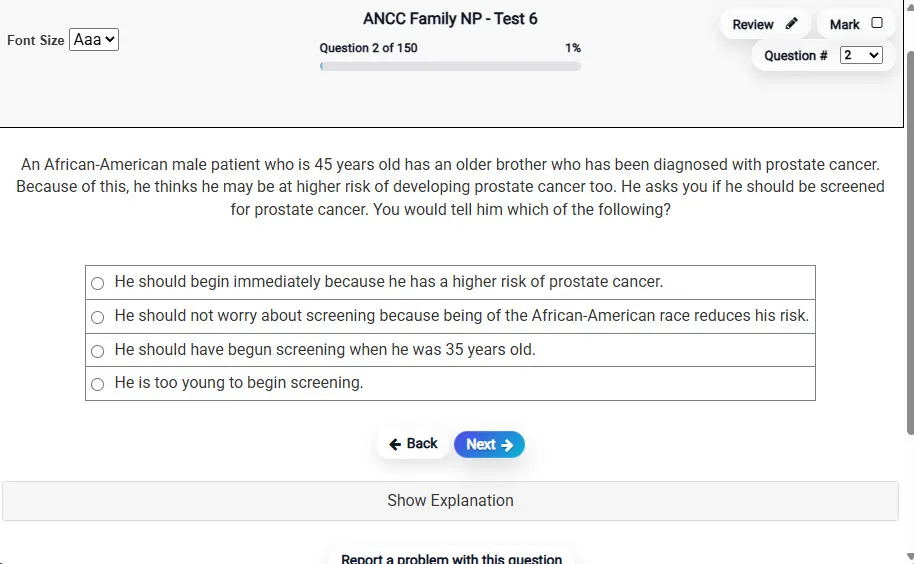
Answering a Question screen – Multiple-choice item view with navigation controls and progress tracker.
Answering a Question Multiple-choice item view with navigation controls and progress tracker.

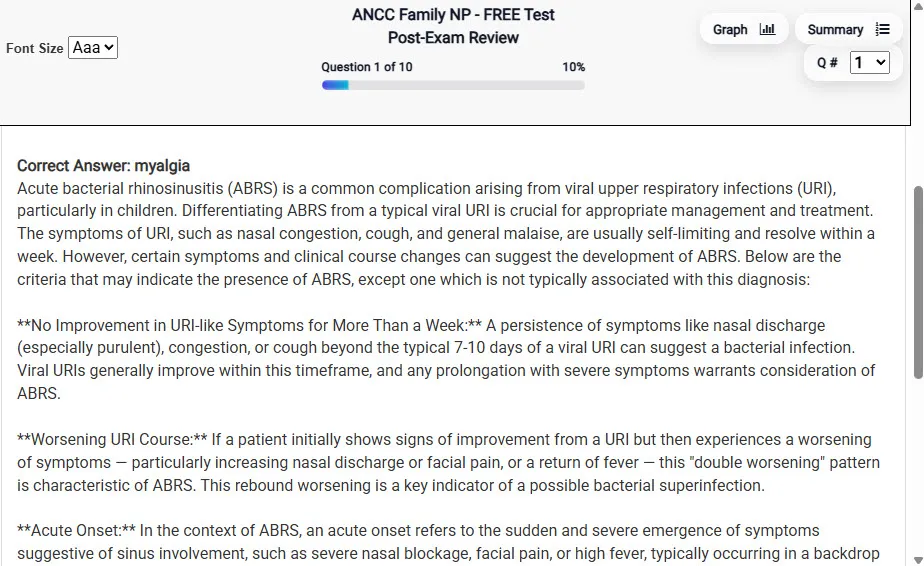
                           Detailed Explanation screen – 
                         Review mode showing chosen answer and rationale and references.
Detailed Explanation Review mode showing chosen answer and rationale and references.

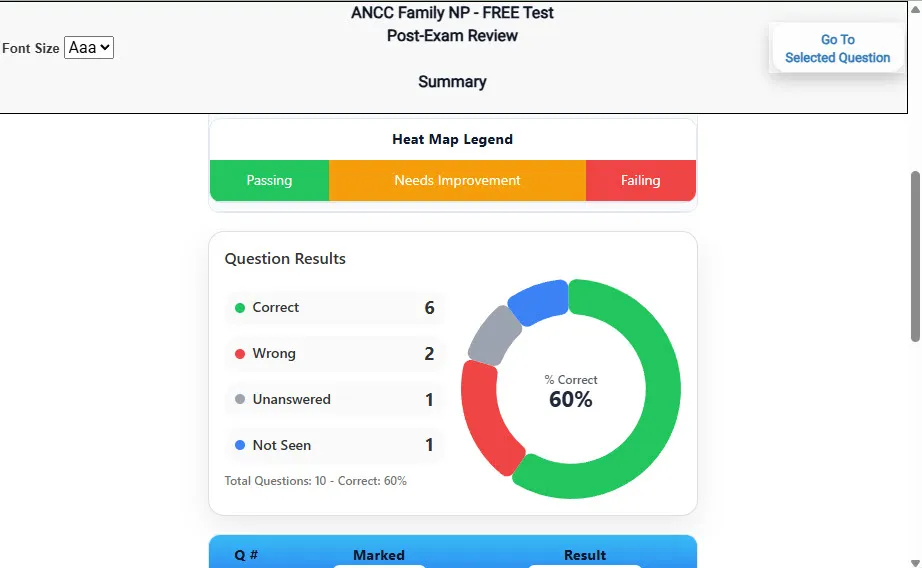
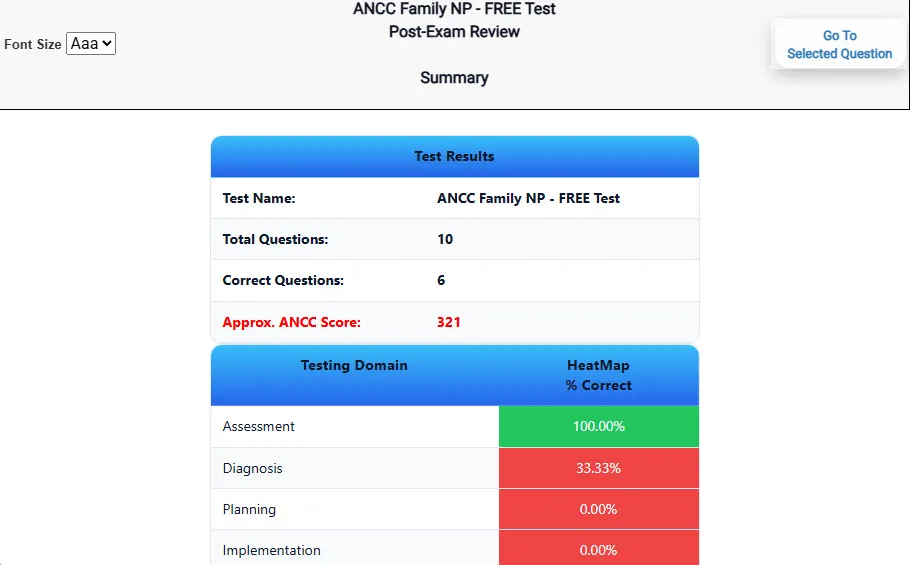
                           Review Summary 1 screen – 
                         Summary with counts for correct/wrong/unanswered and not seen items.
Review Summary 1 Summary with counts for correct/wrong/unanswered and not seen items.

                           Review Summary 2 screen – 
                         Advanced summary with category/domain breakdown and performance insights.
Review Summary 2 Advanced summary with category/domain breakdown and performance insights.

What Each Screen Shows

Answer Question Screen

  • Clean multiple-choice interface with progress bar.
  • Mark for review feature.
  • Matches real test pacing.

Detailed Explanation

  • Correct answer plus rationale.
  • Key concepts and guidelines highlighted.
  • Move between questions to fill knowledge gaps.

Review Summary 1

  • Overall results with total questions and scaled score.
  • Domain heatmap shows strengths and weaknesses.
  • Quick visual feedback on study priorities.

Review Summary 2

  • Chart of correct, wrong, unanswered, not seen.
  • Color-coded results for easy review.
  • Links back to missed items.

Top 10 Reasons to Use Exam Edge for your Praxis Chemistry Content Knowledge Exam Prep

  1. Focused on the Praxis Chemistry Content Knowledge Exam

    Our practice tests are built specifically for the Praxis Chemistry Content exam — every question mirrors the real topics, format, and difficulty so you're studying exactly what matters.

  2. Real Exam Simulation

    We match the per-question time limits and pressure of the actual Praxis exam, so test day feels familiar and stress-free.

  3. 15 Full Practice Tests & 1,875 Unique Questions

    You'll have more than enough material to master every Praxis Chemistry Content concept — no repeats, no fluff.

  4. Lower Cost Than a Retake

    Ordering 5 practice exams costs less than retaking the Praxis Chemistry Content Knowledge exam after a failure. One low fee could save you both time and money.

  5. Flexible Testing

    Need to step away mid-exam? Pick up right where you left off — with your remaining time intact.

  6. Instant Scoring & Feedback

    See your raw score and an estimated Praxis Chemistry Content Knowledge score immediately after finishing each practice test.

  7. Detailed Explanations for Every Question

    Review correct and incorrect answers with clear, step-by-step explanations so you truly understand each topic.

  8. Trusted & Accredited

    We're fully accredited by the Better Business Bureau and uphold the highest standards of trust and transparency.

  9. Web-Based & Always Available

    No software to install. Access your Praxis Chemistry Content practice exams 24/7 from any computer or mobile device.

  10. Expert Support When You Need It

    Need extra help? Our specialized tutors are highly qualified and ready to support your Praxis exam prep.


Pass the Praxis Chemistry Content Knowledge Exam with Realistic Practice Tests from Exam Edge

Preparing for your upcoming Praxis Chemistry Content Knowledge (5245) Certification Exam can feel overwhelming — but the right practice makes all the difference. Exam Edge gives you the tools, structure, and confidence to pass on your first try. Our online practice exams are built to match the real Praxis Chemistry Content exam in content, format, and difficulty.

  • 📝 15 Praxis Chemistry Content Knowledge Practice Tests: Access 15 full-length exams with 125 questions each, covering every major Praxis Chemistry Content Knowledge topic in depth.
  • Instant Online Access: Start practicing right away — no software, no waiting.
  • 🧠 Step-by-Step Explanations: Understand the reasoning behind every correct answer so you can master Praxis Chemistry Content exam concepts.
  • 🔄 Retake Each Exam Up to 4 Times: Build knowledge through repetition and track your improvement over time.
  • 🌐 Web-Based & Available 24/7: Study anywhere, anytime, on any device.
  • 🧘 Boost Your Test-Day Confidence: Familiarity with the Praxis format reduces anxiety and helps you perform under pressure.

These Praxis Chemistry Content Knowledge practice exams are designed to simulate the real testing experience by matching question types, timing, and difficulty level. This approach helps you get comfortable not just with the exam content, but also with the testing environment, so you walk into your exam day focused and confident.


Exam Edge Praxis Reviews


THANK YOU! Using your pretests prepared me so well for my Praxis test in Chemistry, that I passed on the first try! I purposely didn't take all of my Fekula pre-tests, since I thought I was going to have to take the Praxis a 2nd or 3rd time, and I wanted to use those to study. But now I have passed ...
Read More
John, Tennessee

Your practice tests were excellent preparation for the Chemistry content knowledge test. The questions were very similar to those on the test and the explanations for wrong answers very helpful. I aced it on my first try and have been out of college for 20 years! Thank you!

Lora , PA

I failed the Praxis Math test five times before I found your site. After taking all your practice tests, on my next attempt I passed by five points! I can honestly say this site is the reason I passed. Thank you!!!

Nikki P, Tennessee

Just wanted to say thanks for helping me pass the Praxis I Reading! Your practice tests and especially your explanations are great. They gave me the confidence I needed! Now I can student teach this fall. I'm so glad I found PraxisReading.com!

Denise C, Florida

Thank you so much. I just received my results in the mail. I scored a 179 and passed the Praxis I Writing! I'll never have to worry about retaking this test again! PraxisWriting.com is great. I told all my friends about this site.

Susan K, Virginia

I failed the Parapro test four times before I found your site. After taking all your practice tests, on my next attempt I passed by seven points! I can honestly say that this site is the reason I passed. Thank you!!!

Rebecca S, Texas


Praxis Chemistry Content Knowledge Aliases Test Name

Here is a list of alternative names used for this exam.

  • Praxis Chemistry Content Knowledge
  • Praxis Chemistry Content Knowledge test
  • Praxis Chemistry Content Knowledge Certification Test
  • Praxis Chemistry Content test
  • Praxis
  • Praxis 5245
  • 5245 test
  • Praxis Chemistry Content Knowledge (5245)
  • Chemistry Content Knowledge certification