This is the content of the pop-over!

Praxis Business Education (5101) Practice Tests & Test Prep by Exam Edge


Praxis Business Education  product image
(5.0)
Based on 17 Reviews

  • Real Exam Simulation: Timed questions and matching content build comfort for your Praxis Business Education test day.
  • Instant, 24/7 Access: Web-based Praxis Business Education practice exams with no software needed.
  • Clear Explanations: Step-by-step answers and explanations for your Praxis exam to strengthen understanding.
  • Boosted Confidence: Reduces anxiety and improves test-taking skills to ace your Praxis Business Education (5101).

Featured on

Praxis Business Education Online Practice Test Bundles

BEST VALUE
20 practice tests

$174.00

$799.00

SAVE $625

Only $8.70 per test!

  • 100% Pass Guarantee
  • 20 online practice tests
  • 120 questions per test
  • Bonus: 100 Flash Cards + Study Guide
  • Instant access
  • Detailed Explanations
  • Practice tests never expire
  • Timed, untimed, or study guide mode
MOST POPULAR
10 practice tests

$99.50

$399.50

SAVE $300

Only $9.95 per test!

  • 10 online practice tests
  • 120 questions per test
  • Bonus: 100 Flash Cards + Study Guide
  • Instant access
  • Detailed Explanations
  • Practice tests never expire
  • Timed, untimed, or study guide mode
5 practice tests

$69.75

$199.75

SAVE $130

Only $13.95 per test!

  • 5 online practice tests
  • 120 questions per test
  • Bonus: 100 Flash Cards
  • Instant access
  • Detailed Explanations
  • Practice tests never expire
  • Timed, untimed, or study guide mode
1 practice test

$39.95

  • 1 online practice test
  • 120 questions per test
  • Instant access
  • Detailed Explanations
  • Practice tests never expire
  • Timed, untimed, or study guide mode
Quick Select
Tap to choose a bundle

** All Prices are in US Dollars (USD) **


Praxis Business Education (5101) Resources

Jump to the section you need most.

Understanding the exact breakdown of the Praxis Business Education test will help you know what to expect and how to most effectively prepare. The Praxis Business Education has 120 multiple-choice questions . The exam will be broken down into the sections below:

Praxis Business Education Exam Blueprint
Domain Name % Number of
Questions
Accounting and Finance 15% 18
Communication and Career
Development
15% 18
Economics 10% 12
Entrepreneurship 10% 12
Information Technology 15% 18
Law and International Business 15% 18
Marketing and Management 10% 12
Professional Business Education 10% 12

Praxis Business Education Study Tips by Domain

  • Apply the accounting equation (Assets = Liabilities + Equity) to analyze transaction effects; red flag: recording a debit/credit to the right account but on the wrong side flips equity impacts.
  • Distinguish accrual vs. cash basis and correctly adjust with accruals/deferrals; common trap: treating prepaid expenses as immediate expenses or unearned revenue as earned.
  • Interpret financial statements (income statement, balance sheet, statement of cash flows) and key ratios (current ratio, gross margin, ROA); priority rule: compare ratios to industry norms and look for deteriorating liquidity trends.
  • Use time value of money (PV/FV, annuities) for loans and investments; threshold cue: ensure the interest rate and compounding period match (e.g., APR vs. monthly rate) before calculating.
  • Evaluate budgeting and cost behavior (fixed, variable, mixed) including CVP and break-even; red flag: mixing contribution margin (sales − variable costs) with gross margin (sales − COGS) in break-even setups.
  • Explain financial markets and risk/return basics (diversification, inflation, credit risk) and consumer finance (credit scores, amortization); common trap: assuming higher nominal returns always mean higher real returns when inflation is rising.
  • Match message, channel, and tone to the audience and purpose (inform, persuade, collaborate)—red flag: a technically correct message that fails because it ignores stakeholder needs.
  • Use professional writing standards (concise subject lines, active voice, error-free grammar) and document conventions—common trap: vague emails that omit the ask, deadline, or required attachments.
  • Apply interpersonal and team communication skills (active listening, constructive feedback, conflict resolution) to workplace scenarios—priority rule: address the issue and impact, not the person, before proposing solutions.
  • Demonstrate presentation skills (clear structure, readable visuals, appropriate delivery) and adapt to Q&A—red flag: slides that are text-heavy or lack a single main takeaway per section.
  • Connect career development to employability tools (résumés, cover letters, portfolios, interviews) and align them to job requirements—common trap: generic résumés that don’t mirror key qualifications and keywords from the posting.
  • Understand workplace readiness and ethics (professionalism, digital citizenship, confidentiality, appropriate online behavior)—contraindication: sharing proprietary or student information without authorization, even on “private” platforms.
  • Use supply-and-demand shifts correctly: a change in price causes movement along a curve, while a change in determinants (income, tastes, input costs, technology) shifts the curve—common trap is calling a demand shift a supply shift (or vice versa).
  • Compute and interpret elasticity (price, income, cross-price) using percentage changes; red flag: confusing inelastic demand (<1) with “no response” and getting revenue effects backward (inelastic: price ↑ tends to increase total revenue).
  • Apply marginal analysis (MC vs. MR, MB vs. MC) for optimal decisions; priority rule: maximize profit where MR=MC (and MC is rising), not where profit is highest in total dollars.
  • Differentiate market structures (perfect competition, monopolistic competition, oligopoly, monopoly) using barriers to entry and price-setting power; common trap: assuming “many firms” always means “price taker” (product differentiation changes the result).
  • Link macro indicators (GDP, inflation, unemployment, interest rates) and policy tools; red flag: mixing monetary vs. fiscal policy—the Fed targets money supply/interest rates while Congress/President adjust spending/taxes.
  • Use comparative advantage and opportunity cost to predict trade benefits; common trap: choosing absolute advantage or ignoring specialization even when one country is more efficient in both goods.
  • Draft a lean business plan that links value proposition, target market, revenue model, and cost structure; red flag: plans heavy on narrative but missing quantified assumptions (price, volume, break-even).
  • Select an appropriate legal structure (sole proprietorship, partnership, LLC, corporation) based on liability, taxes, and capital needs; common trap: ignoring personal liability exposure when choosing a sole proprietorship.
  • Use basic feasibility and market research (TAM/SAM/SOM, competitor mapping, customer discovery) to validate demand; priority rule: don’t scale spending until you can show repeatable customer willingness-to-pay.
  • Calculate start-up costs, cash flow, and break-even (fixed vs. variable costs, contribution margin); red flag: profitability on paper but negative cash flow because receivables lag payables.
  • Compare funding options (bootstrapping, debt, equity, crowdfunding, angels/VC) and their trade-offs; common trap: taking equity too early without understanding dilution and control provisions.
  • Plan operations and risk management (permits, insurance, compliance, contingency plans) aligned to the venture’s model; contraindication: launching without required licenses or failing to protect key IP (e.g., trademark search and registration).
  • Differentiate system software (OS, utilities, drivers) from application software; red flag: calling a spreadsheet an “operating system” or confusing RAM with storage.
  • Apply core networking concepts (LAN/WAN, IP addresses, DNS, bandwidth vs. latency); common trap: assuming higher bandwidth fixes slow response times caused by high latency or congestion.
  • Use cybersecurity basics (CIA triad, authentication vs. authorization, encryption, backups); priority rule: the strongest control is least privilege—don’t grant admin rights for convenience.
  • Interpret data management fundamentals (databases, tables/records/fields, primary keys, normalization); red flag: using spreadsheets as a database without unique keys, leading to duplicate and inconsistent records.
  • Identify appropriate productivity and collaboration tools (word processing, spreadsheets, presentations, cloud sharing/versioning); common trap: overwriting shared files instead of using version history or check-in/check-out controls.
  • Recognize legal and ethical issues in IT (copyright, licensing, privacy/FERPA-like expectations, acceptable use); contraindication: installing unlicensed software or sharing student data without need-to-know.
  • Know the sources and hierarchy of law (constitutional, statutory, administrative, case) and apply stare decisis—trap: citing a statute when the question is really about agency rulemaking authority.
  • Distinguish civil vs. criminal law and the burden of proof (preponderance vs. beyond a reasonable doubt)—red flag: tort questions often test negligence elements (duty, breach, causation, damages).
  • Apply basic contract rules (offer, acceptance, consideration, capacity, legality) and remedies—common trap: confusing an invitation to negotiate (ads) with a valid offer.
  • Understand business organizations (sole proprietorship, partnership, corporation, LLC) including liability and taxation implications—priority rule: limited liability is not absolute if veil-piercing facts (commingling, undercapitalization) appear.
  • Use key international trade and currency concepts (tariffs, quotas, exchange rates, balance of trade/payments) to interpret scenarios—red flag: an appreciating domestic currency typically hurts exports and helps imports.
  • Recognize global business risks and compliance (trade barriers, political risk, IP protection, sanctions/export controls)—contraindication: shipping to restricted parties/countries can trigger strict penalties even without intent.
  • Apply the marketing mix (4Ps/7Ps) to a scenario and keep it consistent—common trap: proposing a “premium” price while choosing mass-market distribution.
  • Use segmentation variables (demographic, psychographic, behavioral, geographic) to define a target market—red flag: segments that are not measurable or reachable.
  • Interpret basic marketing metrics (market share, CAC, CLV, conversion rate) and choose actions accordingly—priority rule: don’t scale promotion when unit economics are negative.
  • Manage core functions (planning, organizing, leading, controlling) with appropriate structures—common trap: confusing delegation of authority with abdication of accountability.
  • Apply motivation and leadership concepts (Maslow/Herzberg, expectancy theory, leadership styles) to workplace cases—red flag: incentives that reward speed/volume while quality/compliance are required.
  • Use operations and quality tools (process flow, bottlenecks, inventory, TQM/continuous improvement) to diagnose performance—priority cue: address the constraint first rather than optimizing non-bottleneck steps.
  • Align daily lessons to clear, measurable objectives (e.g., “SWBAT” statements) and verify with an exit ticket—red flag: activities that don’t map to a standard or assessment target.
  • Use valid, reliable assessment mixes (selected response, performance tasks, rubrics) and check for bias—common trap: grading participation/effort as a proxy for mastery.
  • Build employability skills explicitly (professional communication, teamwork, problem-solving) and document with artifacts/portfolios—priority rule: assess both product and process with criteria.
  • Teach and model legal/ethical compliance in the classroom (FERPA, copyright/fair use, accessibility) and get required permissions—contraindication: sharing student work/data publicly without consent.
  • Plan for diverse learners using accommodations/modifications and UDL (multiple means of access, expression, engagement)—red flag: giving the same support to everyone rather than matching IEP/504 needs.
  • Maintain safe, organized labs/classrooms and enforce digital citizenship (acceptable use, privacy, cybersecurity basics)—common trap: letting students create accounts or store data on tools that don’t meet school policy.


Built to Fit Into Your Busy Life

Everything you need to prepare with confidence—without wasting a minute.

Three Study Modes

Timed, No Time Limit, or Explanation mode.

Actionable Analytics

Heatmaps and scaled scores highlight weak areas.

High-Yield Rationales

Concise explanations emphasize key concepts.

Realistic Interface

Matches the feel of the actual exam environment.

Accessible by Design

Clean layout reduces cognitive load.

Anytime, Anywhere

Web-based access 24/7 on any device.
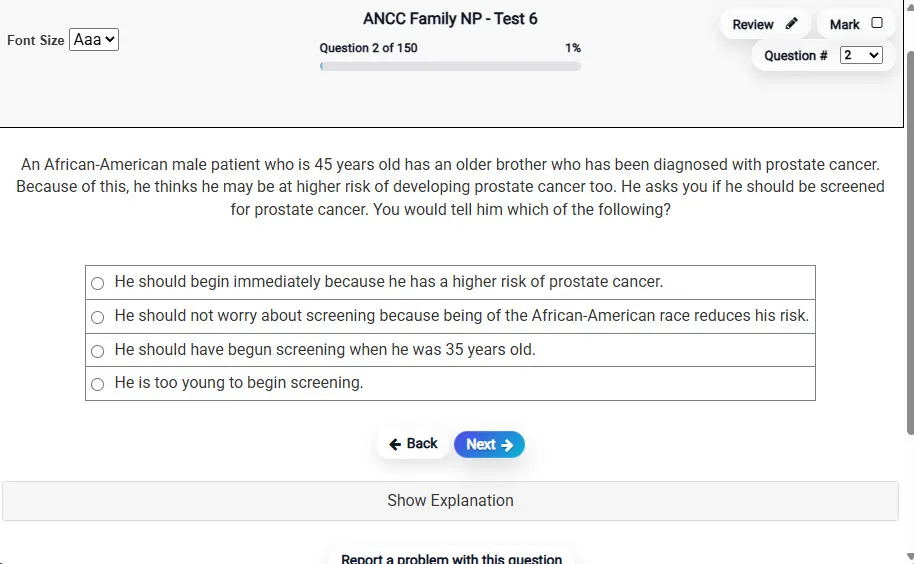
Answering a Question screen – Multiple-choice item view with navigation controls and progress tracker.
Answering a Question Multiple-choice item view with navigation controls and progress tracker.

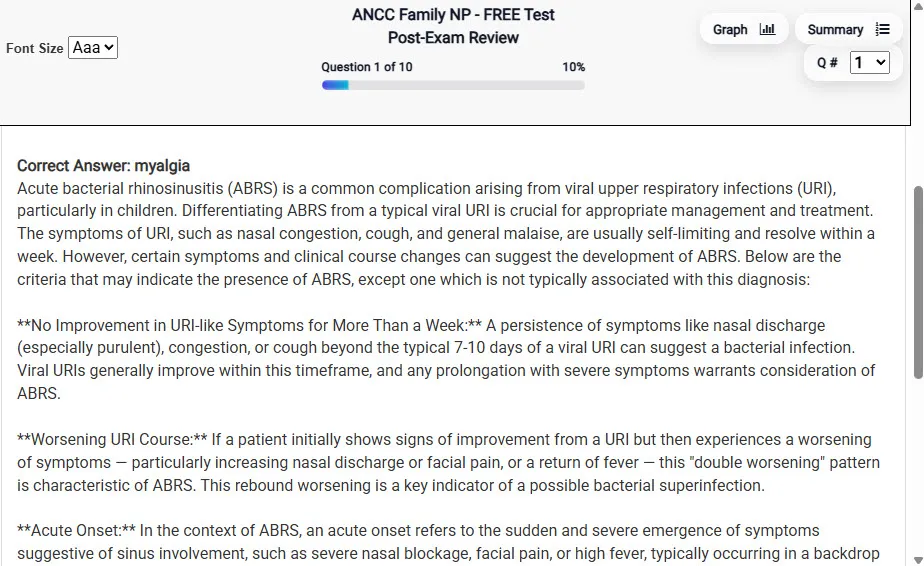
                           Detailed Explanation screen – 
                         Review mode showing chosen answer and rationale and references.
Detailed Explanation Review mode showing chosen answer and rationale and references.

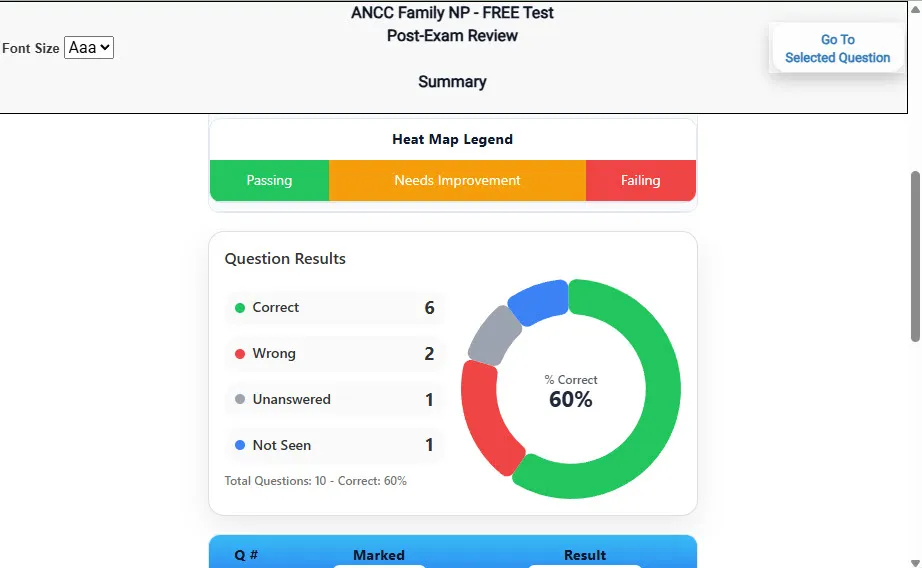
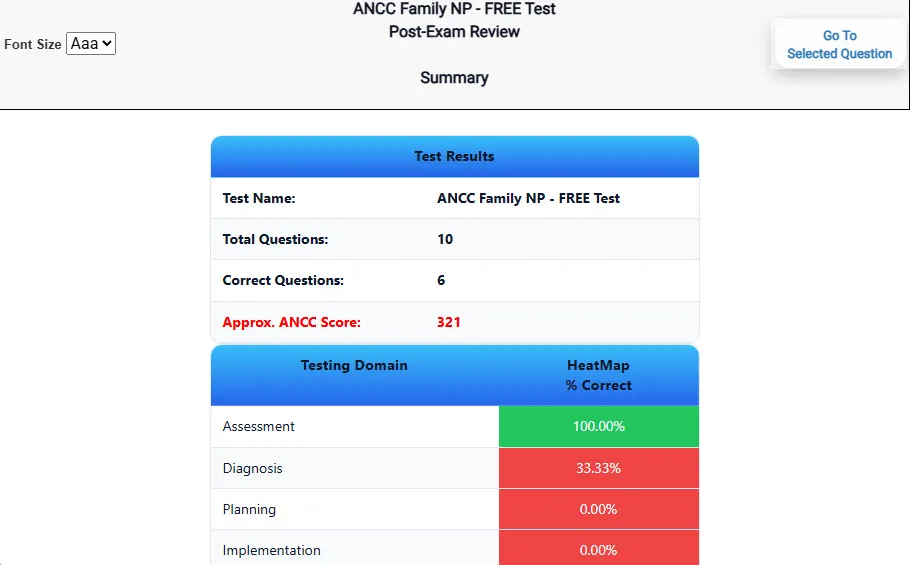
                           Review Summary 1 screen – 
                         Summary with counts for correct/wrong/unanswered and not seen items.
Review Summary 1 Summary with counts for correct/wrong/unanswered and not seen items.

                           Review Summary 2 screen – 
                         Advanced summary with category/domain breakdown and performance insights.
Review Summary 2 Advanced summary with category/domain breakdown and performance insights.

What Each Screen Shows

Answer Question Screen

  • Clean multiple-choice interface with progress bar.
  • Mark for review feature.
  • Matches real test pacing.

Detailed Explanation

  • Correct answer plus rationale.
  • Key concepts and guidelines highlighted.
  • Move between questions to fill knowledge gaps.

Review Summary 1

  • Overall results with total questions and scaled score.
  • Domain heatmap shows strengths and weaknesses.
  • Quick visual feedback on study priorities.

Review Summary 2

  • Chart of correct, wrong, unanswered, not seen.
  • Color-coded results for easy review.
  • Links back to missed items.

Top 10 Reasons to Use Exam Edge for your Praxis Business Education Exam Prep

  1. Focused on the Praxis Business Education Exam

    Our practice tests are built specifically for the Praxis Business Education exam — every question mirrors the real topics, format, and difficulty so you're studying exactly what matters.

  2. Real Exam Simulation

    We match the per-question time limits and pressure of the actual Praxis exam, so test day feels familiar and stress-free.

  3. 20 Full Practice Tests & 2,400 Unique Questions

    You'll have more than enough material to master every Praxis Business Education concept — no repeats, no fluff.

  4. Lower Cost Than a Retake

    Ordering 5 practice exams costs less than retaking the Praxis Business Education exam after a failure. One low fee could save you both time and money.

  5. Flexible Testing

    Need to step away mid-exam? Pick up right where you left off — with your remaining time intact.

  6. Instant Scoring & Feedback

    See your raw score and an estimated Praxis Business Education score immediately after finishing each practice test.

  7. Detailed Explanations for Every Question

    Review correct and incorrect answers with clear, step-by-step explanations so you truly understand each topic.

  8. Trusted & Accredited

    We're fully accredited by the Better Business Bureau and uphold the highest standards of trust and transparency.

  9. Web-Based & Always Available

    No software to install. Access your Praxis Business Education practice exams 24/7 from any computer or mobile device.

  10. Expert Support When You Need It

    Need extra help? Our specialized tutors are highly qualified and ready to support your Praxis exam prep.


Pass the Praxis Business Education Exam with Realistic Practice Tests from Exam Edge

Preparing for your upcoming Praxis Business Education (5101) Certification Exam can feel overwhelming — but the right practice makes all the difference. Exam Edge gives you the tools, structure, and confidence to pass on your first try. Our online practice exams are built to match the real Praxis Business Education exam in content, format, and difficulty.

  • 📝 20 Praxis Business Education Practice Tests: Access 20 full-length exams with 120 questions each, covering every major Praxis Business Education topic in depth.
  • Instant Online Access: Start practicing right away — no software, no waiting.
  • 🧠 Step-by-Step Explanations: Understand the reasoning behind every correct answer so you can master Praxis Business Education exam concepts.
  • 🔄 Retake Each Exam Up to 4 Times: Build knowledge through repetition and track your improvement over time.
  • 🌐 Web-Based & Available 24/7: Study anywhere, anytime, on any device.
  • 🧘 Boost Your Test-Day Confidence: Familiarity with the Praxis format reduces anxiety and helps you perform under pressure.

These Praxis Business Education practice exams are designed to simulate the real testing experience by matching question types, timing, and difficulty level. This approach helps you get comfortable not just with the exam content, but also with the testing environment, so you walk into your exam day focused and confident.


Exam Edge Praxis Reviews


Hello, I just wanted you all to know that I passed my test today on my first try, thanks to your excellent program. I purchased ten (10) of the tests and it was the best investment I ever made. I've been out of college for nearly 35 years, although I've been working in the business field. When I too ...
Read More
Cross, Mississippi

Just wanted to tell anyone who is taking the Business Praxis that your website was the primary reason I passed the test! I just got my scores and I scored higher on the actual test than any of the practice tests! Your practice tests do what they are designed to do. They do not stroke your ego so you ...
Read More
Dane , North Carolina

I was just writing to let you know the only tool I used to pass my Praxis II Business Education (0101/5101) was your tests. I have been out of school for over fifteen years and I took the test today, for the first time. My score was 199/200, much better than the minimum needed to pass.

Robert, Utah

I am a horrible test taker. I get nervous and over think the questions. I am excited to report that I took the Business Education test and PASSED on my first try. I needed a 154 and I scored a 167. I am so happy I am going to try another certification. This is a great way to build confidence and pra ...
Read More
Jecker, Effort PA

I highly recommend this service. The school whose faculty I was joining switched my position to the Business Department, and I was given two weeks to pass the Business Education Praxis. I considered my options and decided that, in such a short period of time, my best option was to complete a series ...
Read More
Matt, Kentucky

I failed the Praxis Math test five times before I found your site. After taking all your practice tests, on my next attempt I passed by five points! I can honestly say this site is the reason I passed. Thank you!!!

Nikki P, Tennessee


Praxis Business Education Aliases Test Name

Here is a list of alternative names used for this exam.

  • Praxis Business Education
  • Praxis Business Education test
  • Praxis Business Education Certification Test
  • Praxis
  • Praxis 5101
  • 5101 test
  • Praxis Business Education (5101)
  • Business Education certification