This is the content of the pop-over!

Praxis Biology (5235) Practice Tests & Test Prep by Exam Edge


Praxis Biology Content Knowledge  product image
(5.0)
Based on 22 Reviews

  • Real Exam Simulation: Timed questions and matching content build comfort for your Praxis Biology Content test day.
  • Instant, 24/7 Access: Web-based Praxis Biology Content Knowledge practice exams with no software needed.
  • Clear Explanations: Step-by-step answers and explanations for your Praxis exam to strengthen understanding.
  • Boosted Confidence: Reduces anxiety and improves test-taking skills to ace your Praxis Biology Content Knowledge (5235).

Featured on

Praxis Biology Content Knowledge Online Practice Test Bundles

BEST VALUE
15 practice tests

$149.25

$599.25

SAVE $450

Only $9.95 per test!

  • 100% Pass Guarantee
  • 15 online practice tests
  • 150 questions per test
  • Bonus: 100 Flash Cards + Study Guide
  • Instant access
  • Detailed Explanations
  • Practice tests never expire
  • Timed, untimed, or study guide mode
MOST POPULAR
10 practice tests

$99.50

$399.50

SAVE $300

Only $9.95 per test!

  • 10 online practice tests
  • 150 questions per test
  • Bonus: 100 Flash Cards + Study Guide
  • Instant access
  • Detailed Explanations
  • Practice tests never expire
  • Timed, untimed, or study guide mode
5 practice tests

$69.75

$199.75

SAVE $130

Only $13.95 per test!

  • 5 online practice tests
  • 150 questions per test
  • Bonus: 100 Flash Cards
  • Instant access
  • Detailed Explanations
  • Practice tests never expire
  • Timed, untimed, or study guide mode
1 practice test

$39.95

  • 1 online practice test
  • 150 questions per test
  • Instant access
  • Detailed Explanations
  • Practice tests never expire
  • Timed, untimed, or study guide mode
Quick Select
Tap to choose a bundle

** All Prices are in US Dollars (USD) **


Praxis Biology Content (5235) Resources

Jump to the section you need most.

Understanding the exact breakdown of the Praxis Biology Content Knowledge test will help you know what to expect and how to most effectively prepare. The Praxis Biology Content Knowledge has 150 multiple-choice questions . The exam will be broken down into the sections below:

Praxis Biology Content Knowledge Exam Blueprint
Domain Name % Number of
Questions
Nature of Science: Scientific Inquiry - Methodology - Techniques History 14% 21
Molecular and Cellular Biology 20% 30
Classical Genetics and Evolution 20% 30
Diversity of Life and Organismal Biology 20% 30
Ecology: Organisms and Environments 16% 24
Science - Technology Social Perspectives 10% 15

Praxis Biology Content Knowledge Study Tips by Domain

  • Distinguish hypotheses, theories, and laws by what they claim and how they’re supported—common trap: calling a theory a “guess” despite broad, converging evidence.
  • Identify independent vs. dependent variables and proper controls—red flag: changing more than one factor at a time (confounding) makes causal claims invalid.
  • Evaluate experimental design for sample size, random assignment, and blinding—priority rule: lack of randomization or blinding increases bias and weakens inference.
  • Interpret graphs and statistics (mean, variability, correlation vs. causation, p-values)—common trap: a statistically significant result can still have a trivial effect size or poor practical significance.
  • Match tools/techniques to questions (microscopy, electrophoresis, PCR, spectrophotometry, aseptic technique)—contraindication: contamination or missing negative/positive controls can invalidate molecular or culture results.
  • Recognize major historical milestones (e.g., Darwin/Wallace, Mendel, Watson-Crick-Franklin, Pasteur, Avery/MacLeod/McCarty) and how evidence shifted ideas—red flag: attributing discoveries to a single person when multiple lines of work established the conclusion.
  • Track macromolecule structure–function links (e.g., enzyme active site, phospholipid bilayer); red flag: mixing up dehydration synthesis vs. hydrolysis and their energy/water directions.
  • Know membrane transport categories (simple/facilitated diffusion, osmosis, active transport, endo/exocytosis); common trap: calling any movement “active” without ATP use or movement against the gradient.
  • Compare prokaryotic vs. eukaryotic cell structures and organelles; priority rule: 70S ribosomes and no membrane-bound nucleus are prokaryote cues.
  • Map cellular respiration and photosynthesis by location and inputs/outputs (glycolysis in cytosol, Krebs/ETC in mitochondria; light reactions in thylakoids, Calvin cycle in stroma); red flag: flipping where NADH vs. NADPH are produced/used.
  • Follow the central dogma and gene regulation basics (transcription, RNA processing, translation, operons); common trap: forgetting that mRNA is read 5’→3’ and translation proceeds N-terminus to C-terminus.
  • Understand mitosis vs. meiosis and cell-cycle checkpoints; threshold cue: nondisjunction occurs in meiosis I or II and leads to aneuploidy—don’t confuse it with simple mutation.
  • Use Mendel’s laws to predict offspring ratios from crosses (monohybrid 3:1; dihybrid 9:3:3:1) and flag any ratio that suggests linkage or epistasis as a common trap.
  • Apply probability rules (product and sum) for pedigrees and test crosses; a red flag is treating independent events as additive (or exclusive events as multiplicative).
  • Interpret pedigrees for inheritance patterns (autosomal dominant/recessive, X-linked, mitochondrial) and remember that “skips generations” strongly points to recessive inheritance as a priority cue.
  • Analyze chromosome behavior (meiosis, nondisjunction, crossing over) and connect recombination frequency to map distance; a key threshold is that recombination frequencies max out near 50% even for unlinked loci.
  • Use Hardy–Weinberg (p + q = 1; p² + 2pq + q² = 1) to detect evolution in populations; a common trap is forgetting to check the HW assumptions before concluding selection is occurring.
  • Explain evolution by natural selection and mechanisms that change allele frequencies (selection, drift, gene flow, mutation) and note the red flag that individuals do not evolve—populations do across generations.
  • Use diagnostic traits to place organisms into the correct domain/kingdom (e.g., cell wall composition, uni- vs. multicellularity, mode of nutrition)—red flag: calling all prokaryotes “bacteria” ignores Archaea.
  • Know major plant groups and their key innovations (vascular tissue, seeds, flowers, fruits) and match them to life-cycle patterns—common trap: confusing alternation of generations terminology (gametophyte vs. sporophyte dominance).
  • Compare animal body plans (symmetry, tissue layers, body cavity, segmentation, protostome vs. deuterostome) as a framework for phyla—priority rule: coelom type and embryonic development often separate look-alike groups.
  • Link form to function in organ systems across taxa (gas exchange, circulation, excretion, reproduction) and predict tradeoffs—red flag: assuming all vertebrates have four-chambered hearts or that insects use lungs.
  • Master basic physiology homeostasis loops (stimulus → receptor → control center → effector) and key hormonal vs. neural control differences—common trap: mixing up negative vs. positive feedback (e.g., thermoregulation vs. oxytocin during labor).
  • Interpret cladograms/phylogenies using shared derived characters (synapomorphies) and most recent common ancestor relationships—threshold cue: node order matters, but branch length only implies time/change if explicitly scaled.
  • Track energy flow and trophic efficiency using the 10% rule; red flag: confusing energy pyramids (always upright) with biomass pyramids (can invert in aquatic systems).
  • Apply logistic growth (carrying capacity, K) versus exponential growth (r) and interpret survivorship curves; common trap: assuming density-dependent limits (e.g., competition, disease) act the same as density-independent events (e.g., storms, freezes).
  • Use population interactions (competition, predation, parasitism, mutualism) to predict outcomes; priority rule: distinguish fundamental vs. realized niche when a species’ range shrinks under competition.
  • Connect abiotic factors (light, temperature, water, salinity) to biome patterns and organism tolerances; red flag: mixing up acclimation (within a lifetime) with adaptation (across generations).
  • Analyze nutrient cycles (carbon, nitrogen, phosphorus) and limiting nutrients in productivity; common trap: forgetting phosphorus is often limiting in freshwater while nitrogen is frequently limiting in marine/coastal systems.
  • Evaluate human impacts (habitat fragmentation, invasive species, pollution, climate change) on communities and biodiversity; threshold cue: edge effects and small population size increase extinction risk via genetic drift and inbreeding.
  • Evaluate cost–benefit and risk–benefit tradeoffs in biotechnology (e.g., GM crops, gene therapy) using specific evidence; red flag: arguing from “natural = safe” or “new = dangerous” without data.
  • Know core bioethics principles (autonomy, beneficence, nonmaleficence, justice) as they apply to human subjects and genetics; common trap: ignoring informed consent and privacy when interpreting DNA testing scenarios.
  • Interpret how scientific uncertainty and confidence levels guide policy decisions (precautionary principle vs. action thresholds); cue: distinguish “no evidence of harm” from “evidence of no harm.”
  • Connect epidemiology to public health decisions (vaccination, screening) using measures like incidence, prevalence, relative risk, and herd immunity; red flag: confusing correlation with causation in observational studies.
  • Assess environmental and conservation technologies (e.g., pesticides, bioremediation, renewable energy impacts) for unintended ecological effects; priority rule: consider non-target species and bioaccumulation/biomagnification in food webs.
  • Recognize how science interacts with society through funding, peer review, conflicts of interest, and communication; common trap: treating a single study or anecdote as definitive rather than weighing replication and consensus.


Built to Fit Into Your Busy Life

Everything you need to prepare with confidence—without wasting a minute.

Three Study Modes

Timed, No Time Limit, or Explanation mode.

Actionable Analytics

Heatmaps and scaled scores highlight weak areas.

High-Yield Rationales

Concise explanations emphasize key concepts.

Realistic Interface

Matches the feel of the actual exam environment.

Accessible by Design

Clean layout reduces cognitive load.

Anytime, Anywhere

Web-based access 24/7 on any device.
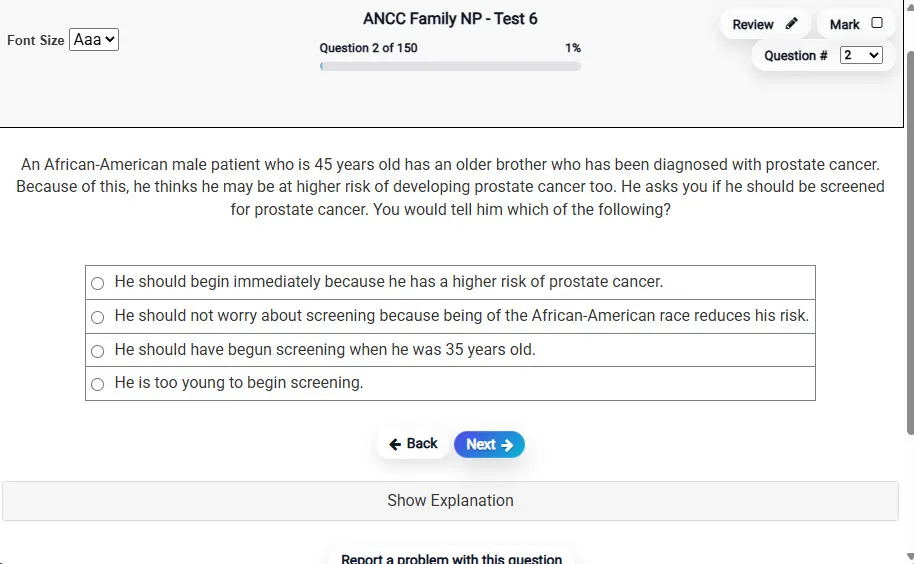
Answering a Question screen – Multiple-choice item view with navigation controls and progress tracker.
Answering a Question Multiple-choice item view with navigation controls and progress tracker.

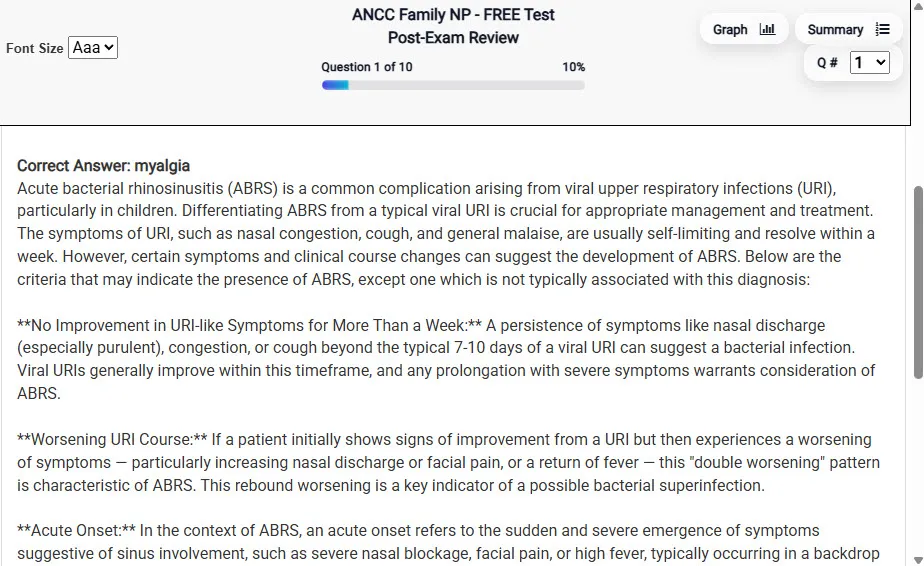
                           Detailed Explanation screen – 
                         Review mode showing chosen answer and rationale and references.
Detailed Explanation Review mode showing chosen answer and rationale and references.

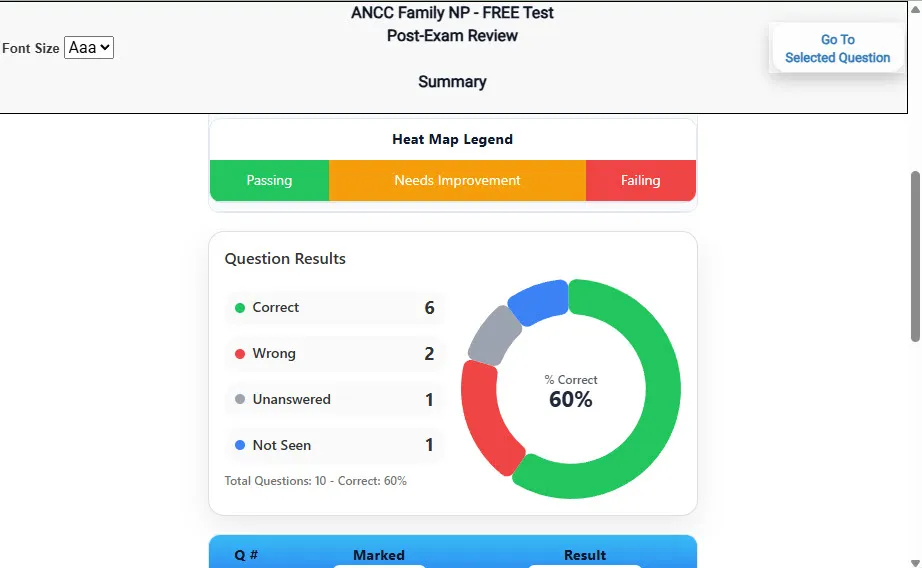
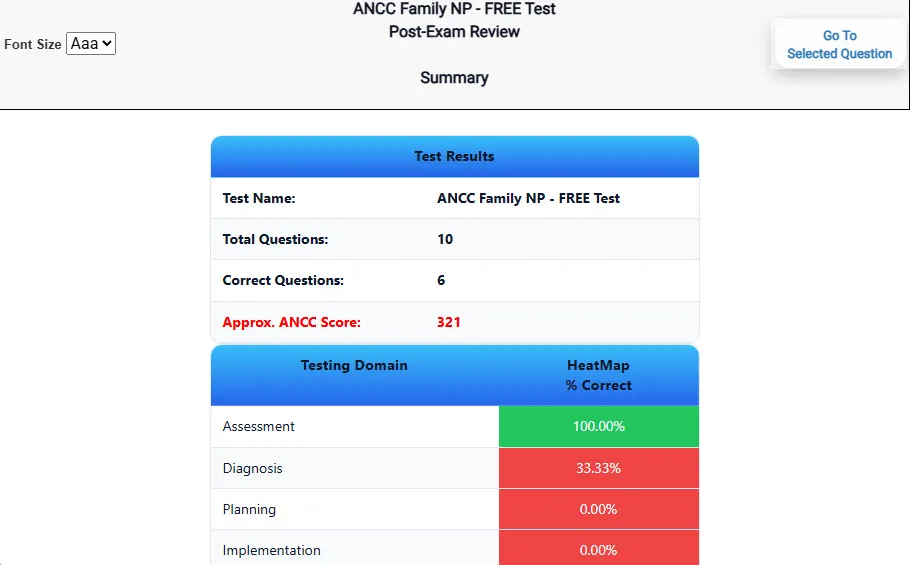
                           Review Summary 1 screen – 
                         Summary with counts for correct/wrong/unanswered and not seen items.
Review Summary 1 Summary with counts for correct/wrong/unanswered and not seen items.

                           Review Summary 2 screen – 
                         Advanced summary with category/domain breakdown and performance insights.
Review Summary 2 Advanced summary with category/domain breakdown and performance insights.

What Each Screen Shows

Answer Question Screen

  • Clean multiple-choice interface with progress bar.
  • Mark for review feature.
  • Matches real test pacing.

Detailed Explanation

  • Correct answer plus rationale.
  • Key concepts and guidelines highlighted.
  • Move between questions to fill knowledge gaps.

Review Summary 1

  • Overall results with total questions and scaled score.
  • Domain heatmap shows strengths and weaknesses.
  • Quick visual feedback on study priorities.

Review Summary 2

  • Chart of correct, wrong, unanswered, not seen.
  • Color-coded results for easy review.
  • Links back to missed items.

Top 10 Reasons to Use Exam Edge for your Praxis Biology Content Knowledge Exam Prep

  1. Focused on the Praxis Biology Content Knowledge Exam

    Our practice tests are built specifically for the Praxis Biology Content exam — every question mirrors the real topics, format, and difficulty so you're studying exactly what matters.

  2. Real Exam Simulation

    We match the per-question time limits and pressure of the actual Praxis exam, so test day feels familiar and stress-free.

  3. 15 Full Practice Tests & 2,250 Unique Questions

    You'll have more than enough material to master every Praxis Biology Content concept — no repeats, no fluff.

  4. Lower Cost Than a Retake

    Ordering 5 practice exams costs less than retaking the Praxis Biology Content Knowledge exam after a failure. One low fee could save you both time and money.

  5. Flexible Testing

    Need to step away mid-exam? Pick up right where you left off — with your remaining time intact.

  6. Instant Scoring & Feedback

    See your raw score and an estimated Praxis Biology Content Knowledge score immediately after finishing each practice test.

  7. Detailed Explanations for Every Question

    Review correct and incorrect answers with clear, step-by-step explanations so you truly understand each topic.

  8. Trusted & Accredited

    We're fully accredited by the Better Business Bureau and uphold the highest standards of trust and transparency.

  9. Web-Based & Always Available

    No software to install. Access your Praxis Biology Content practice exams 24/7 from any computer or mobile device.

  10. Expert Support When You Need It

    Need extra help? Our specialized tutors are highly qualified and ready to support your Praxis exam prep.


Pass the Praxis Biology Content Knowledge Exam with Realistic Practice Tests from Exam Edge

Preparing for your upcoming Praxis Biology Content Knowledge (5235) Certification Exam can feel overwhelming — but the right practice makes all the difference. Exam Edge gives you the tools, structure, and confidence to pass on your first try. Our online practice exams are built to match the real Praxis Biology Content exam in content, format, and difficulty.

  • 📝 15 Praxis Biology Content Knowledge Practice Tests: Access 15 full-length exams with 150 questions each, covering every major Praxis Biology Content Knowledge topic in depth.
  • Instant Online Access: Start practicing right away — no software, no waiting.
  • 🧠 Step-by-Step Explanations: Understand the reasoning behind every correct answer so you can master Praxis Biology Content exam concepts.
  • 🔄 Retake Each Exam Up to 4 Times: Build knowledge through repetition and track your improvement over time.
  • 🌐 Web-Based & Available 24/7: Study anywhere, anytime, on any device.
  • 🧘 Boost Your Test-Day Confidence: Familiarity with the Praxis format reduces anxiety and helps you perform under pressure.

These Praxis Biology Content Knowledge practice exams are designed to simulate the real testing experience by matching question types, timing, and difficulty level. This approach helps you get comfortable not just with the exam content, but also with the testing environment, so you walk into your exam day focused and confident.


Exam Edge Praxis Reviews


Your biology questions were just like the real test. I learned a lot from your explanations. I easily passed with a 175 thanks to your practice tests! I've already recommended this site to several people.

Justin D., Pennsylvania

I passed the Praxis II Biology today!!!! I scored 160! THANK YOU SO VERY MUCH! Your site is priceless! I can't thank you enough!

Meadows, Michigan

I AM SO HAPPY I DECIDED TO USE YOUR PRACTICE EXAMS AND EXPLANATIONS TO HELP ME SCORE A 178 ON MY BIO PRAXIS. THE FIRST TIME WITHOUT YOUR PROGRAM I ONLY SCORE 149. I ABSOLUTELY RECOMMEND ExamEdge.com/PRAXIS!

Rich, CT

Thank you very much! This is my first testimonial to any organization but I am so impressed with the way Exam Edge helped me to be successful on the Praxis II Biology that I felt obligated to share my story. I am becoming a high school biology teacher after retiring from the military and needed help ...
Read More
Adam, PA

Exams are good however, why can't we have 5 resets per exam? The explanations are really helpful especially for those who have been out of school for while.

Patrick , Newark, New Jersey

I failed the Praxis Math test five times before I found your site. After taking all your practice tests, on my next attempt I passed by five points! I can honestly say this site is the reason I passed. Thank you!!!

Nikki P, Tennessee


Praxis Biology Content Knowledge Aliases Test Name

Here is a list of alternative names used for this exam.

  • Praxis Biology Content Knowledge
  • Praxis Biology Content Knowledge test
  • Praxis Biology Content Knowledge Certification Test
  • Praxis Biology Content test
  • Praxis
  • Praxis 5235
  • 5235 test
  • Praxis Biology Content Knowledge (5235)
  • Biology Content Knowledge certification