This is the content of the pop-over!

Lightning Deal Alert – 12% Off Ends at Midnight!

Strike while the savings are hot! Use promo code FlashSale at checkout for 12% off any Exam Edge test or bundle. Hurry—the clock is ticking!

NCCT NCPT (NCPT) Practice Tests & Test Prep by Exam Edge


NCCT National Certified Phlebotomy Technician  product image
(4.4)
Based on 22 Reviews

  • Real Exam Simulation: Timed questions and matching content build comfort for your NCCT NCPT test day.
  • Instant, 24/7 Access: Web-based NCCT National Certified Phlebotomy Technician practice exams with no software needed.
  • Clear Explanations: Step-by-step answers and explanations for your NCCT exam to strengthen understanding.
  • Boosted Confidence: Reduces anxiety and improves test-taking skills to ace your NCCT National Certified Phlebotomy Technician (NCPT).

Featured on

NCCT National Certified Phlebotomy Technician Online Practice Test Bundles

BEST VALUE
10 practice tests

$99.50

$399.50

SAVE $300

Only $9.95 per test!

  • 100% Pass Guarantee
  • 10 online practice tests
  • 100 questions per test
  • Bonus: 100 Flash Cards + Study Guide
  • Instant access
  • Detailed Explanations
  • Practice tests never expire
  • Timed, untimed, or study guide mode
5 practice tests

$69.75

$199.75

SAVE $130

Only $13.95 per test!

  • 5 online practice tests
  • 100 questions per test
  • Bonus: 100 Flash Cards + Study Guide
  • Instant access
  • Detailed Explanations
  • Practice tests never expire
  • Timed, untimed, or study guide mode
1 practice test

$39.95

  • 1 online practice test
  • 100 questions per test
  • Instant access
  • Detailed Explanations
  • Practice tests never expire
  • Timed, untimed, or study guide mode
Quick Select
Tap to choose a bundle

** All Prices are in US Dollars (USD) **


NCCT NCPT (NCPT) Resources

Jump to the section you need most.

Understanding the exact breakdown of the NCCT National Certified Phlebotomy Technician test will help you know what to expect and how to most effectively prepare. The NCCT National Certified Phlebotomy Technician has 200 multiple-choice questions . The exam will be broken down into the sections below:

NCCT National Certified Phlebotomy Technician Exam Blueprint
Domain Name % Number of
Questions
Obtaining Blood Samples 41.5% 83
Specimen Collection and Processing 15.5% 31
Time Management and Assignment Organization 8% 16
Professional Communications 5.5% 11
Clerical Skills and Duties 4.5% 9
Safety Standards and Procedures 10% 20
Legal - Ethical Professional Considerations 6% 12
Terminology - Anatomy Physiology 9% 18

NCCT National Certified Phlebotomy Technician Study Tips by Domain

  • Verify patient identity with at least two identifiers (e.g., full name and DOB) and match to the requisition and labels—red flag: drawing a patient who cannot be positively identified requires following facility policy, not “best guess.”
  • Select the correct site and vein (median cubital preferred; avoid areas with edema, hematoma, IVs, fistulas, or mastectomy side per policy)—common trap: drawing above an active IV can dilute specimens and invalidate results.
  • Apply the tourniquet 3–4 inches above the site and do not exceed 1 minute—priority rule: prolonged stasis can cause hemoconcentration and falsely elevated analytes (e.g., potassium, protein).
  • Choose the proper needle and technique (typically 21–23 gauge; use a butterfly for small/fragile veins) and anchor the vein before insertion—red flag: “fishing” or multiple redirects increases hemolysis and patient injury risk.
  • Follow the correct order of draw and fill tubes to the stated volume to maintain additive-to-blood ratio—common trap: underfilling citrate (light blue) tubes can prolong coagulation results and lead to recollect.
  • Minimize hemolysis by allowing antiseptic to dry, using appropriate tube mixing (gentle inversions), and avoiding forceful syringe transfer—contraindication: never push blood through a needle into a tube due to hemolysis and needlestick risk.
  • Verify the order and patient identifiers before labeling; red flag: labeling tubes away from the bedside is a frequent cause of misidentification rejections.
  • Select the correct tube/additive and maintain the proper order of draw; common trap: drawing an EDTA (lavender) before serum can falsely elevate potassium and depress calcium results.
  • Fill tubes to the stated volume to preserve additive-to-blood ratio; threshold cue: underfilled citrate (light blue) tubes can invalidate coagulation studies.
  • Immediately and gently invert additive tubes the required number of times; red flag: shaking or delayed mixing increases hemolysis and microclot formation.
  • Process specimens within required time/temperature limits (e.g., prompt centrifugation and serum/plasma separation when indicated); common trap: leaving serum on cells too long can alter glucose and potassium values.
  • Follow transport and storage requirements for light, temperature, and timing (e.g., protect bilirubin from light, keep ammonia chilled); red flag: using a pneumatic tube or warm transport when contraindicated can compromise analytes.
  • Prioritize by acuity and test stability—STAT/Timed labs and specimens with short stability windows (e.g., lactate, ammonia) come before routine draws; red flag: delaying a timed draw can invalidate the result.
  • Batch tasks by location and required supplies (e.g., one cart pass per unit) while keeping patient-specific identifiers separate; common trap: setting up multiple patients’ labels/supplies at once increases mislabel risk.
  • Verify orders and special requirements before entering the room (fasting status, draw time, tube types, transport conditions); priority rule: clarify missing/contradictory orders before venipuncture.
  • Build a contingency plan for hard sticks, isolation rooms, and add-on tests by allowing extra time and having backup equipment ready; red flag: rushing a difficult draw increases hemolysis and repeat collections.
  • Coordinate handoffs and transport to meet downstream deadlines (centrifugation time limits, lab pickup/courier schedules); common trap: leaving specimens unprocessed on the unit can exceed time-to-spin requirements.
  • Document completion and exceptions immediately (unable to collect, patient unavailable, specimen issue) and notify the correct party per facility policy; red flag: failing to report a missed timed draw can delay critical treatment decisions.
  • Use closed-loop communication for orders and specimen requirements (read-back/confirm) — red flag: acting on a verbal order without confirmation and documentation per facility policy.
  • Verify patient identity using at least two identifiers and match to requisition/labels before any discussion or collection — common trap: using room number or appearance as an identifier.
  • Explain the procedure in plain language, obtain cooperation, and check understanding — contraindication cue: stop and escalate if the patient refuses, becomes combative, or cannot provide informed participation per policy.
  • Maintain professionalism and confidentiality in all settings (hallways, elevators, phones) — red flag: discussing PHI where others can overhear or leaving paperwork/screens visible.
  • Handle difficult interactions with de-escalation (calm tone, set limits, involve charge nurse/security as needed) — priority rule: personal safety first; do not proceed if the environment is unsafe.
  • Document and communicate critical pre-analytical issues (hemolysis, short draw, delayed transport, collection time, site) promptly to the appropriate party — common trap: failing to notify the lab/provider, leading to rejected specimens or inaccurate results.
  • Verify patient identity using at least two identifiers (e.g., full name and DOB or MRN) and match to the order—red flag: collecting from a room number or verbal “yes” only.
  • Confirm requisition completeness (tests, priority STAT/ASAP/routine, provider, collection time/date) before sticking—common trap: missing diagnosis or order details that cause specimen rejection.
  • Label specimens immediately at the bedside with required elements (identifiers, date/time, collector initials)—contraindication: pre-labeling tubes before the draw.
  • Document collection details accurately in the LIS/EHR (site, number of attempts, complications, specimen condition)—red flag: unrecorded difficult draw that later impacts result interpretation.
  • Maintain chain-of-custody steps for regulated testing (sealed containers, signatures, timed transfers)—common trap: leaving specimens unattended or breaking seal integrity.
  • Follow facility-specific specimen handling instructions from the order (special tubes, fasting status, timed draws, transport temperature)—priority rule: clarify discrepancies before collection rather than “fixing it later.”
  • Use Standard Precautions on every patient encounter; red flag: assuming “low risk” means no gloves or hand hygiene.
  • Follow OSHA sharps safety—activate safety devices immediately and never recap needles; common trap: carrying an uncapped needle to find a sharps container.
  • Confirm patient ID with two identifiers and match labels at bedside; red flag: pre-labeling tubes before the draw.
  • Prevent specimen mix-ups/contamination by using correct antisepsis and order of draw; common trap: drawing blood cultures after other tubes or touching the site after cleaning.
  • Respond to exposure incidents promptly—wash/flush, report, and follow facility post-exposure protocol; priority rule: reporting delays can jeopardize indicated prophylaxis windows.
  • Maintain a safe environment—PPE for splashes, spill cleanup with approved disinfectant/contact time, and biohazard waste segregation; red flag: disposing of saturated items in regular trash.
  • Know key blood vessel structure and location for venipuncture: vein vs artery (veins are thin-walled with valves) — red flag: bright red, pulsatile flow suggests arterial puncture and you should stop immediately.
  • Match common venipuncture sites to anatomy: median cubital (preferred), cephalic, basilic (near brachial artery/median nerve) — trap: using the basilic without careful palpation increases risk of nerve/artery injury.
  • Understand basic blood components and function: plasma, RBCs, WBCs, platelets — priority cue: platelet-related issues (e.g., thrombocytopenia) raise bleeding risk, so hold pressure longer after draw.
  • Identify capillary collection physiology: dermal puncture yields mixed arterial/venous/capillary blood with interstitial fluid — trap: excessive squeezing (“milking”) hemolyzes samples and dilutes with tissue fluid.
  • Recognize common patient conditions affecting draws: edema, dehydration, obesity, and mastectomy-side lymph flow changes — red flag: avoid the arm on the side of a mastectomy due to lymphedema/infection risk.
  • Use correct medical terminology for directional and location terms (proximal/distal, medial/lateral, antecubital) and specimen terms (serum vs plasma) — trap: confusing serum (no clotting factors) with plasma (has clotting factors) can lead to wrong tube selection.


Built to Fit Into Your Busy Life

Everything you need to prepare with confidence—without wasting a minute.

Three Study Modes

Timed, No Time Limit, or Explanation mode.

Actionable Analytics

Heatmaps and scaled scores highlight weak areas.

High-Yield Rationales

Concise explanations emphasize key concepts.

Realistic Interface

Matches the feel of the actual exam environment.

Accessible by Design

Clean layout reduces cognitive load.

Anytime, Anywhere

Web-based access 24/7 on any device.
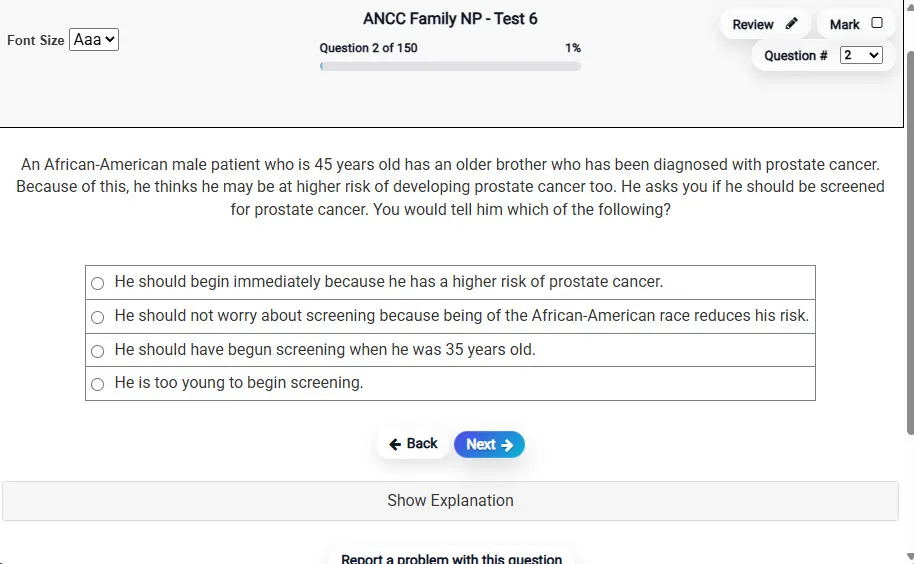
Answering a Question screen – Multiple-choice item view with navigation controls and progress tracker.
Answering a Question Multiple-choice item view with navigation controls and progress tracker.

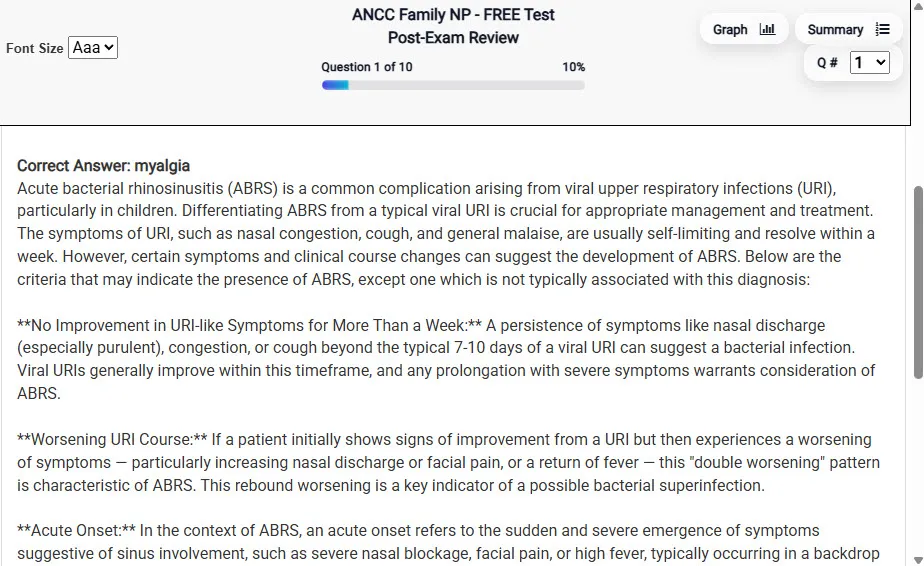
                           Detailed Explanation screen – 
                         Review mode showing chosen answer and rationale and references.
Detailed Explanation Review mode showing chosen answer and rationale and references.

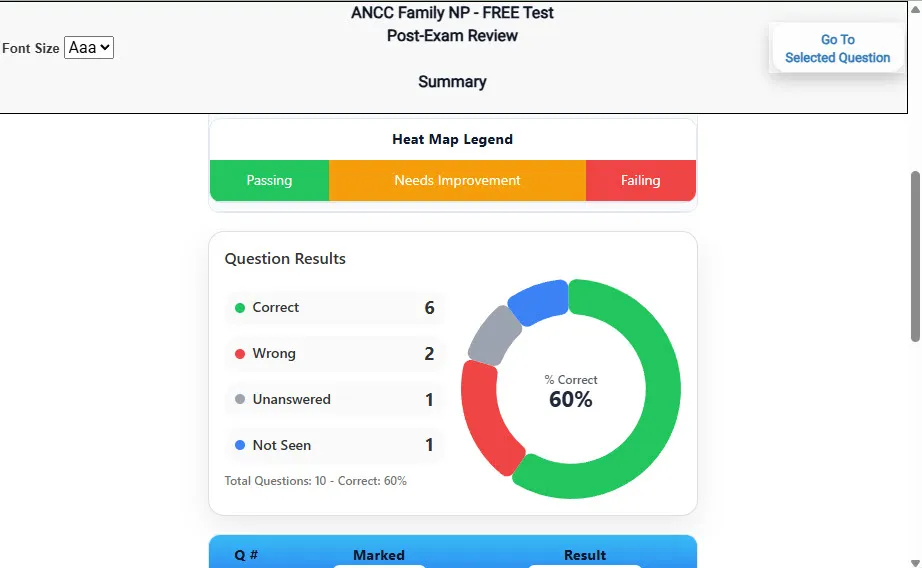
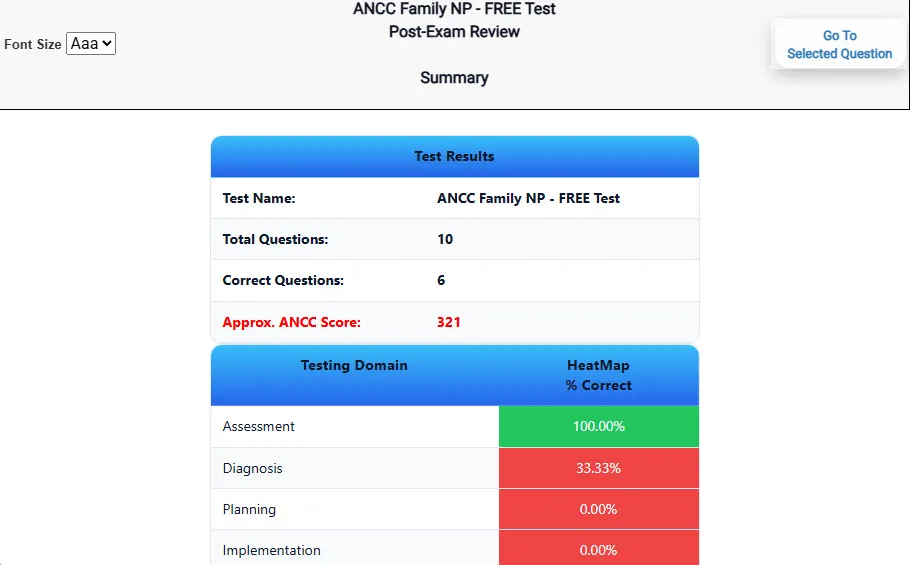
                           Review Summary 1 screen – 
                         Summary with counts for correct/wrong/unanswered and not seen items.
Review Summary 1 Summary with counts for correct/wrong/unanswered and not seen items.

                           Review Summary 2 screen – 
                         Advanced summary with category/domain breakdown and performance insights.
Review Summary 2 Advanced summary with category/domain breakdown and performance insights.

What Each Screen Shows

Answer Question Screen

  • Clean multiple-choice interface with progress bar.
  • Mark for review feature.
  • Matches real test pacing.

Detailed Explanation

  • Correct answer plus rationale.
  • Key concepts and guidelines highlighted.
  • Move between questions to fill knowledge gaps.

Review Summary 1

  • Overall results with total questions and scaled score.
  • Domain heatmap shows strengths and weaknesses.
  • Quick visual feedback on study priorities.

Review Summary 2

  • Chart of correct, wrong, unanswered, not seen.
  • Color-coded results for easy review.
  • Links back to missed items.

Top 10 Reasons to Use Exam Edge for your NCCT National Certified Phlebotomy Technician Exam Prep

  1. Focused on the NCCT National Certified Phlebotomy Technician Exam

    Our practice tests are built specifically for the NCCT NCPT exam — every question mirrors the real topics, format, and difficulty so you're studying exactly what matters.

  2. Real Exam Simulation

    We match the per-question time limits and pressure of the actual NCCT exam, so test day feels familiar and stress-free.

  3. 10 Full Practice Tests & 1,000 Unique Questions

    You'll have more than enough material to master every NCCT NCPT concept — no repeats, no fluff.

  4. Lower Cost Than a Retake

    Ordering 5 practice exams costs less than retaking the NCCT National Certified Phlebotomy Technician exam after a failure. One low fee could save you both time and money.

  5. Flexible Testing

    Need to step away mid-exam? Pick up right where you left off — with your remaining time intact.

  6. Instant Scoring & Feedback

    See your raw score and an estimated NCCT National Certified Phlebotomy Technician score immediately after finishing each practice test.

  7. Detailed Explanations for Every Question

    Review correct and incorrect answers with clear, step-by-step explanations so you truly understand each topic.

  8. Trusted & Accredited

    We're fully accredited by the Better Business Bureau and uphold the highest standards of trust and transparency.

  9. Web-Based & Always Available

    No software to install. Access your NCCT NCPT practice exams 24/7 from any computer or mobile device.

  10. Expert Support When You Need It

    Need extra help? Our specialized tutors are highly qualified and ready to support your NCCT exam prep.


Pass the NCCT National Certified Phlebotomy Technician Exam with Realistic Practice Tests from Exam Edge

Preparing for your upcoming NCCT National Certified Phlebotomy Technician (NCPT) Certification Exam can feel overwhelming — but the right practice makes all the difference. Exam Edge gives you the tools, structure, and confidence to pass on your first try. Our online practice exams are built to match the real NCCT NCPT exam in content, format, and difficulty.

  • 📝 10 NCCT National Certified Phlebotomy Technician Practice Tests: Access 10 full-length exams with 100 questions each, covering every major NCCT National Certified Phlebotomy Technician topic in depth.
  • Instant Online Access: Start practicing right away — no software, no waiting.
  • 🧠 Step-by-Step Explanations: Understand the reasoning behind every correct answer so you can master NCCT NCPT exam concepts.
  • 🔄 Retake Each Exam Up to 4 Times: Build knowledge through repetition and track your improvement over time.
  • 🌐 Web-Based & Available 24/7: Study anywhere, anytime, on any device.
  • 🧘 Boost Your Test-Day Confidence: Familiarity with the NCCT format reduces anxiety and helps you perform under pressure.

These NCCT National Certified Phlebotomy Technician practice exams are designed to simulate the real testing experience by matching question types, timing, and difficulty level. This approach helps you get comfortable not just with the exam content, but also with the testing environment, so you walk into your exam day focused and confident.


Exam Edge NCCT Reviews


I just wanted to say thank you! Your study guides have been more than a blessing for me. I passed the ncct medical assistant's exam with no problems, other than self stress. Thanks again. Will recommend to anyone taking future exams.

CHARLES, KINGSTON, NY


NCCT National Certified Phlebotomy Technician Aliases Test Name

Here is a list of alternative names used for this exam.

  • NCCT National Certified Phlebotomy Technician
  • NCCT National Certified Phlebotomy Technician test
  • NCCT National Certified Phlebotomy Technician Certification Test
  • NCCT NCPT test
  • NCCT
  • NCCT NCPT
  • NCPT test
  • NCCT National Certified Phlebotomy Technician (NCPT)
  • National Certified Phlebotomy Technician certification