This is the content of the pop-over!

Lightning Deal Alert – 12% Off Ends at Midnight!

Strike while the savings are hot! Use promo code FlashSale at checkout for 12% off any Exam Edge test or bundle. Hurry—the clock is ticking!

NACE PN to RN (NACE I) Practice Tests & Test Prep by Exam Edge


Nursing Acceleration Challenge Exam - PN To RN  product image
(4.4)
Based on 20 Reviews

  • Real Exam Simulation: Timed questions and matching content build comfort for your NACE PN to RN test day.
  • Instant, 24/7 Access: Web-based Nursing Acceleration Challenge Exam - PN To RN practice exams with no software needed.
  • Clear Explanations: Step-by-step answers and explanations for your Nursing exam to strengthen understanding.
  • Boosted Confidence: Reduces anxiety and improves test-taking skills to ace your Nursing Acceleration Challenge Exam - PN To RN (NACE I).

Featured on

Nursing Acceleration Challenge Exam - PN To RN Online Practice Test Bundles

BEST VALUE
20 practice tests

$174.00

$799.00

SAVE $625

Only $8.70 per test!

  • 100% Pass Guarantee
  • 20 online practice tests
  • 100 questions per test
  • Bonus: 100 Flash Cards + Study Guide
  • Instant access
  • Detailed Explanations
  • Practice tests never expire
  • Timed, untimed, or study guide mode
MOST POPULAR
10 practice tests

$99.50

$399.50

SAVE $300

Only $9.95 per test!

  • 10 online practice tests
  • 100 questions per test
  • Bonus: 100 Flash Cards + Study Guide
  • Instant access
  • Detailed Explanations
  • Practice tests never expire
  • Timed, untimed, or study guide mode
5 practice tests

$69.75

$199.75

SAVE $130

Only $13.95 per test!

  • 5 online practice tests
  • 100 questions per test
  • Bonus: 100 Flash Cards
  • Instant access
  • Detailed Explanations
  • Practice tests never expire
  • Timed, untimed, or study guide mode
1 practice test

$39.95

  • 1 online practice test
  • 100 questions per test
  • Instant access
  • Detailed Explanations
  • Practice tests never expire
  • Timed, untimed, or study guide mode
Quick Select
Tap to choose a bundle

** All Prices are in US Dollars (USD) **


NACE PN to RN (NACE I) Resources

Jump to the section you need most.

Understanding the exact breakdown of the Nursing Acceleration Challenge Exam - PN To RN test will help you know what to expect and how to most effectively prepare. The Nursing Acceleration Challenge Exam - PN To RN has multiple-choice questions . The exam will be broken down into the sections below:

Nursing Acceleration Challenge Exam - PN To RN Exam Blueprint
Domain Name % Number of
Questions
Physiological Needs  
Psychosocial Needs  
Communication  
General Principles of Drug Administration  
Moral - Ethical - Legal Issues  
Nursing processes included in the exam  
     Assessing  
     Planning  
     Implementing  
     Evaluating  

Nursing Acceleration Challenge Exam - PN To RN Study Tips by Domain

  • Prioritize airway, breathing, circulation (ABC) before pain or comfort; red flag: new stridor, SpO2 < 90% (or below ordered target in COPD) needs immediate action.
  • Recognize shock early and intervene (oxygen, IV access, fluids per protocol/orders); red flag: hypotension with tachycardia, cool clammy skin, and decreasing urine output (< 30 mL/hr).
  • Manage fluid and electrolytes with trend review, not single values; common trap: giving potassium when urine output is low or absent (risk of fatal dysrhythmias).
  • Prevent and detect infection/sepsis using vital sign trends and mental-status changes; red flag: fever or hypothermia with tachycardia, tachypnea, and new confusion warrants rapid escalation.
  • Maintain skin integrity and mobility with scheduled turning and offloading; priority rule: nonblanchable erythema over bony prominences is an early pressure injury and requires immediate pressure relief.
  • Ensure safe nutrition and elimination support; contraindication: hold oral intake if decreased LOC or impaired swallow (aspiration risk) and report persistent constipation with abdominal distention or absent bowel sounds (possible obstruction/ileus).
  • Prioritize safety first: if a patient expresses suicidal ideation, ask directly about plan/means and initiate 1:1 observation per policy—red flag is vague reassurance without immediate safety actions.
  • Use therapeutic communication (open-ended questions, reflection, silence) and avoid “why” questions or false reassurance—common trap is giving advice or changing the subject when emotion appears.
  • Set clear, consistent boundaries with manipulative or splitting behaviors; document objective behaviors and team-plan responses—priority rule is consistency across staff to prevent escalation.
  • For anxiety, match interventions to severity (mild–moderate: teaching, deep breathing; severe–panic: stay with patient, reduce stimuli)—red flag is trying detailed education during panic.
  • Support coping and grief: assess for maladaptive coping (substance use, social withdrawal) and complicated grief indicators—common trap is assuming tears always mean poor coping.
  • Respect culture and family dynamics: assess decision-maker, health beliefs, and preferred supports before teaching—red flag is assuming nonadherence is “noncompliance” without exploring barriers and beliefs.
  • Use SBAR (Situation–Background–Assessment–Recommendation) for provider calls; red flag: giving vague updates without current vitals, focused assessment findings, and what you need ordered.
  • When taking/receiving report, prioritize ABCs, neuro changes, and new/worsening pain; common trap: overfocusing on routine history while missing time-critical deterioration cues.
  • Apply therapeutic communication—open-ended questions, reflection, and silence; contraindication: false reassurance (“You’ll be fine”) or “why” questions that sound accusatory.
  • With angry or anxious patients/families, acknowledge feelings and set limits while maintaining safety; red flag: escalating tone or arguing, which can worsen agitation and compromise care.
  • Use teach-back for discharge meds, wound care, and follow-up; threshold: if the patient cannot repeat key steps in their own words, re-teach using simpler language and confirm understanding again.
  • Document communication that affects care (who was notified, time, content, and patient response); common trap: charting opinions or leaving out critical details after an abnormal finding or provider notification.
  • Use the rights of medication administration (right patient, medication, dose, route, time, documentation, reason, response) and treat any mismatch as a stop-now red flag requiring recheck against the MAR and provider order.
  • Verify allergies and cross-sensitivities (e.g., penicillin – cephalosporin, sulfa, latex) before first dose; a common trap is accepting “NKDA” without reconciling the chart, patient report, and prior reactions.
  • Apply safe dose calculations and double-check high-alert meds (insulin, heparin, opioids, concentrated electrolytes) with a second nurse per policy; red flag: trailing zeros (e.g., 1.0 mg) or missing leading zeros (e.g., .5 mg).
  • Assess route-specific safety: never crush extended-release/enteric-coated meds, hold PO if NPO or swallowing is unsafe, and confirm tube placement per policy before administering via enteral tube; contraindication cue: altered LOC with aspiration risk.
  • Know hold parameters and required pre-assessments (e.g., check apical pulse before digoxin, BP/HR before beta-blockers, RR/sedation before opioids); red flag: giving despite vitals outside ordered thresholds.
  • Monitor for therapeutic effect and adverse reactions with timely follow-up and documentation; priority rule: treat suspected anaphylaxis (airway, epinephrine per protocol) before completing routine charting or calling for non-urgent clarifications.
  • Use the nursing process in order: Assess → Diagnose (NANDA) → Plan (SMART outcomes) → Implement → Evaluate; red flag: jumping to interventions without completing a focused assessment first.
  • Differentiate nursing diagnoses from medical diagnoses by using patient response language (e.g., “Impaired gas exchange” vs. pneumonia); common trap: selecting a medical diagnosis when the question asks for the nursing diagnosis.
  • Prioritize diagnoses and actions using ABCs, circulation/perfusion, safety, and acute vs. chronic; priority rule: unstable airway/breathing problems outrank pain and psychosocial concerns.
  • Write measurable outcomes with time frames (e.g., “SpO2 ≥ 94% within 30 minutes”); red flag: goals that are vague (“will improve”) or not patient-centered.
  • Implement interventions by matching independent vs. dependent vs. collaborative actions; common trap: initiating a provider-dependent action without an order (unless emergency protocol allows).
  • Evaluate by comparing outcomes to baseline data and revising the plan as needed; red flag: documenting an intervention as “effective” without objective evidence or follow-up assessment.
  • Perform rapid prioritization using ABCs and safety first; red flag: any airway compromise, new confusion, or SpO2 drop needs immediate assessment before routine tasks.
  • Trend vital signs and pain with context (baseline, meds, activity); common trap: treating a single “normal” reading as reassuring when the trend shows deterioration.
  • Complete focused head-to-toe assessment with high-risk systems first (neuro, cardio, resp); priority rule: a change from baseline is more significant than an isolated abnormal finding.
  • Assess fluid status (I&O, daily weights, edema, lung sounds, mucous membranes); red flag: sudden weight gain or new crackles can indicate fluid overload even with stable blood pressure.
  • Assess skin integrity and pressure injury risk each shift and with status changes; common trap: missing nonblanchable erythema on darker skin tones—use palpation for warmth, firmness, and tenderness.
  • Validate abnormal findings with focused reassessment and appropriate screening tools (e.g., neuro checks, fall risk); red flag: new unilateral weakness, slurred speech, or unequal pupils requires immediate escalation.
  • Write measurable outcomes using SMART criteria (e.g., “SpO2 ≥ 94% on room air within 24 hr”)—red flag: vague goals like “patient will improve” are not gradeable.
  • Prioritize nursing diagnoses and interventions using ABCs, safety, and acute vs. chronic—common trap: addressing pain or teaching before airway/breathing/circulation threats are stabilized.
  • Develop individualized interventions that match the etiology and patient context (age, comorbidities, culture, resources)—priority rule: don’t copy generic care plans that ignore the “related to” cause.
  • Plan time-sensitive reassessments and monitoring parameters tied to risk (e.g., neuro checks q2h after head injury)—red flag: failing to set reassessment frequency for high-risk changes.
  • Include collaborative care and appropriate consults (PT/OT, RT, wound care, case management) when outcomes require interdisciplinary action—common trap: omitting provider notification/consult criteria in deterioration scenarios.
  • Plan patient education with readiness-to-learn, teach-back, and discharge needs (meds, follow-up, warning signs)—contraindication cue: delay teaching if the patient is in severe pain, hypoxic, or confused.
  • Prioritize immediate safety actions first (ABCs, fall precautions, seizure precautions, aspiration precautions) before routine tasks; red flag: completing documentation or meds before addressing airway or active bleeding.
  • Use infection-control implementation correctly—hand hygiene, PPE, isolation type, and device care bundles; common trap: contaminating sterile fields by reaching over or turning away from the field.
  • Implement medication administration with the “rights” plus allergy verification and clinical hold parameters; red flag: giving antihypertensives or opioids when BP/respirations are below ordered thresholds.
  • Carry out delegated tasks with clear instructions, required supervision, and follow-up assessment; priority rule: the RN must evaluate outcomes—don’t assume a UAP/LPN report replaces reassessment.
  • Implement patient education using teach-back and timing it to readiness; common trap: providing complex discharge teaching when pain, nausea, or anxiety is uncontrolled.
  • Execute and document interventions with time, dose, response, and escalation when outcomes aren’t met; red flag: charting “tolerated well” without objective reassessment data (e.g., pain score, lung sounds, neuro checks).
  • Evaluate outcomes against measurable criteria (time-bound and numeric when possible); red flag: goals like “patient will feel better” aren’t evaluable.
  • Reassess priority physiologic indicators first (ABCs, pain score, vital signs, I&O); common trap: documenting “stable” without current objective data.
  • Compare pre- and post-intervention data to determine effectiveness; priority rule: if an intervention doesn’t change the targeted indicator, revise the plan rather than repeating it unchanged.
  • Identify unexpected responses and adverse effects promptly; red flag: new confusion, hypotension, respiratory depression, rash, or decreased urine output requires immediate escalation.
  • Determine if outcomes are met, partially met, or not met and state the evidence; common trap: marking “met” when the outcome criteria are only partially achieved.
  • Evaluate teaching/learning by return demonstration or teach-back; red flag: patient can repeat information but cannot perform the skill or explain when to seek help.


Built to Fit Into Your Busy Life

Everything you need to prepare with confidence—without wasting a minute.

Three Study Modes

Timed, No Time Limit, or Explanation mode.

Actionable Analytics

Heatmaps and scaled scores highlight weak areas.

High-Yield Rationales

Concise explanations emphasize key concepts.

Realistic Interface

Matches the feel of the actual exam environment.

Accessible by Design

Clean layout reduces cognitive load.

Anytime, Anywhere

Web-based access 24/7 on any device.
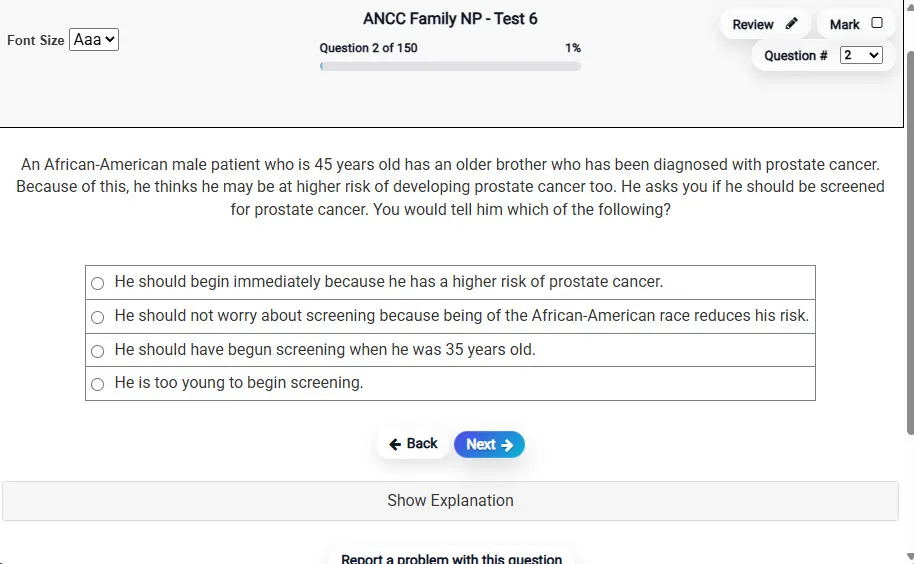
Answering a Question screen – Multiple-choice item view with navigation controls and progress tracker.
Answering a Question Multiple-choice item view with navigation controls and progress tracker.

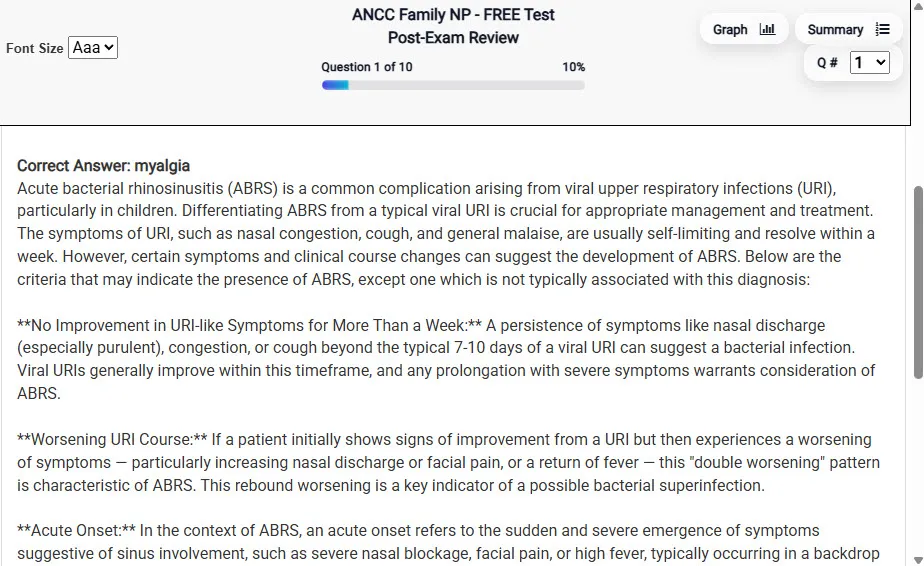
                           Detailed Explanation screen – 
                         Review mode showing chosen answer and rationale and references.
Detailed Explanation Review mode showing chosen answer and rationale and references.

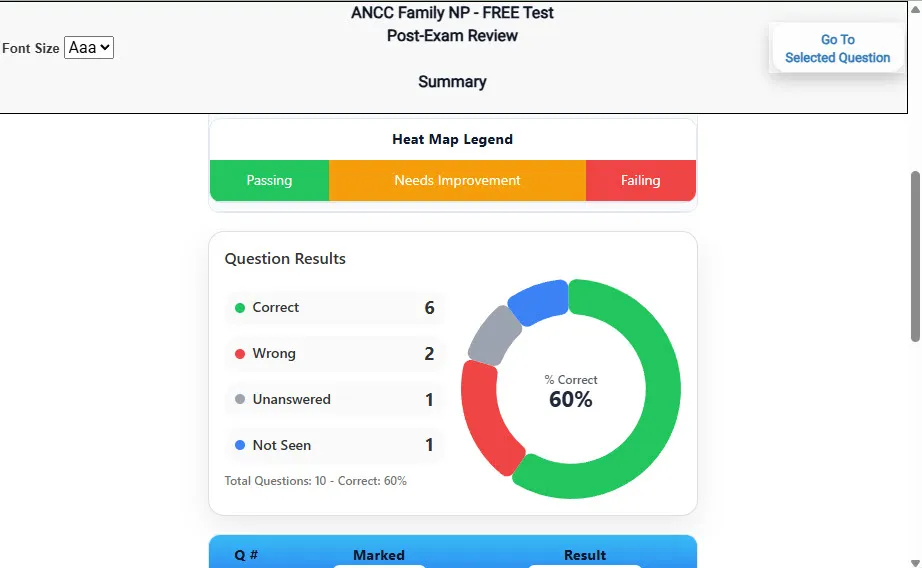
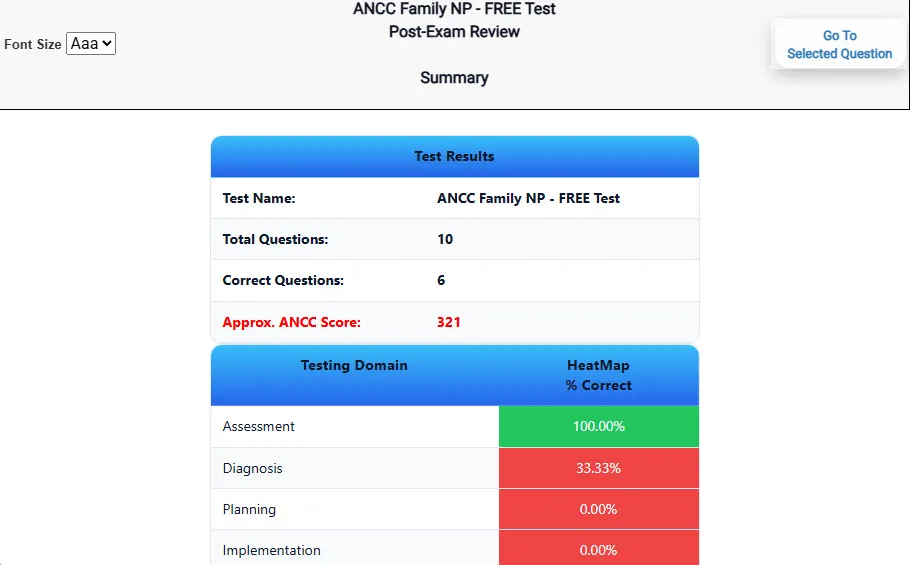
                           Review Summary 1 screen – 
                         Summary with counts for correct/wrong/unanswered and not seen items.
Review Summary 1 Summary with counts for correct/wrong/unanswered and not seen items.

                           Review Summary 2 screen – 
                         Advanced summary with category/domain breakdown and performance insights.
Review Summary 2 Advanced summary with category/domain breakdown and performance insights.

What Each Screen Shows

Answer Question Screen

  • Clean multiple-choice interface with progress bar.
  • Mark for review feature.
  • Matches real test pacing.

Detailed Explanation

  • Correct answer plus rationale.
  • Key concepts and guidelines highlighted.
  • Move between questions to fill knowledge gaps.

Review Summary 1

  • Overall results with total questions and scaled score.
  • Domain heatmap shows strengths and weaknesses.
  • Quick visual feedback on study priorities.

Review Summary 2

  • Chart of correct, wrong, unanswered, not seen.
  • Color-coded results for easy review.
  • Links back to missed items.

Top 10 Reasons to Use Exam Edge for your Nursing Acceleration Challenge Exam - PN To RN Exam Prep

  1. Focused on the Nursing Acceleration Challenge Exam - PN To RN Exam

    Our practice tests are built specifically for the NACE PN to RN exam — every question mirrors the real topics, format, and difficulty so you're studying exactly what matters.

  2. Real Exam Simulation

    We match the per-question time limits and pressure of the actual Nursing exam, so test day feels familiar and stress-free.

  3. 20 Full Practice Tests & 2,000 Unique Questions

    You'll have more than enough material to master every NACE PN to RN concept — no repeats, no fluff.

  4. Lower Cost Than a Retake

    Ordering 5 practice exams costs less than retaking the Nursing Acceleration Challenge Exam - PN To RN exam after a failure. One low fee could save you both time and money.

  5. Flexible Testing

    Need to step away mid-exam? Pick up right where you left off — with your remaining time intact.

  6. Instant Scoring & Feedback

    See your raw score and an estimated Nursing Acceleration Challenge Exam - PN To RN score immediately after finishing each practice test.

  7. Detailed Explanations for Every Question

    Review correct and incorrect answers with clear, step-by-step explanations so you truly understand each topic.

  8. Trusted & Accredited

    We're fully accredited by the Better Business Bureau and uphold the highest standards of trust and transparency.

  9. Web-Based & Always Available

    No software to install. Access your NACE PN to RN practice exams 24/7 from any computer or mobile device.

  10. Expert Support When You Need It

    Need extra help? Our specialized tutors are highly qualified and ready to support your Nursing exam prep.


Pass the Nursing Acceleration Challenge Exam - PN To RN Exam with Realistic Practice Tests from Exam Edge

Preparing for your upcoming Nursing Acceleration Challenge Exam - PN To RN (NACE I) Certification Exam can feel overwhelming — but the right practice makes all the difference. Exam Edge gives you the tools, structure, and confidence to pass on your first try. Our online practice exams are built to match the real NACE PN to RN exam in content, format, and difficulty.

  • 📝 20 Nursing Acceleration Challenge Exam - PN To RN Practice Tests: Access 20 full-length exams with 100 questions each, covering every major Nursing Acceleration Challenge Exam - PN To RN topic in depth.
  • Instant Online Access: Start practicing right away — no software, no waiting.
  • 🧠 Step-by-Step Explanations: Understand the reasoning behind every correct answer so you can master NACE PN to RN exam concepts.
  • 🔄 Retake Each Exam Up to 4 Times: Build knowledge through repetition and track your improvement over time.
  • 🌐 Web-Based & Available 24/7: Study anywhere, anytime, on any device.
  • 🧘 Boost Your Test-Day Confidence: Familiarity with the Nursing format reduces anxiety and helps you perform under pressure.

These Nursing Acceleration Challenge Exam - PN To RN practice exams are designed to simulate the real testing experience by matching question types, timing, and difficulty level. This approach helps you get comfortable not just with the exam content, but also with the testing environment, so you walk into your exam day focused and confident.


Exam Edge NACE Reviews


I just passed the exam.... 92%! The review materials were great and even harder than the actual exam. I probably have an average of 75% on the 1,000 questions I purchased.

Ramon , Ca


Nursing Acceleration Challenge Exam - PN To RN Aliases Test Name

Here is a list of alternative names used for this exam.

  • Nursing Acceleration Challenge Exam - PN To RN
  • Nursing Acceleration Challenge Exam - PN To RN test
  • Nursing Acceleration Challenge Exam - PN To RN Certification Test
  • NACE PN to RN test
  • NACE
  • NACE NACE I
  • NACE I test
  • Nursing Acceleration Challenge Exam - PN To RN (NACE I)
  • Nursing Acceleration Challenge Exam - PN To RN certification