This is the content of the pop-over!

Lightning Deal Alert – 12% Off Ends at Midnight!

Strike while the savings are hot! Use promo code FlashSale at checkout for 12% off any Exam Edge test or bundle. Hurry—the clock is ticking!

MTEL Math/Science (Middle School) (51) Practice Tests & Test Prep by Exam Edge


MTEL Mathematics/Science (Middle School)  product image
(4.8)
Based on 32 Reviews

  • Real Exam Simulation: Timed questions and matching content build comfort for your MTEL Math/Science (Middle School) test day.
  • Instant, 24/7 Access: Web-based MTEL Mathematics/Science (Middle School) practice exams with no software needed.
  • Clear Explanations: Step-by-step answers and explanations for your MTEL exam to strengthen understanding.
  • Boosted Confidence: Reduces anxiety and improves test-taking skills to ace your MTEL Mathematics/Science (Middle School) (51).

Featured on

MTEL Mathematics/Science (Middle School) Online Practice Test Bundles

BEST VALUE
15 practice tests

$149.25

$599.25

SAVE $450

Only $9.95 per test!

  • 100% Pass Guarantee
  • 15 online practice tests
  • 98 questions + 2 essays per test
  • Bonus: 100 Flash Cards + Study Guide
  • Instant access
  • Detailed Explanations
  • Practice tests never expire
  • Timed, untimed, or study guide mode
MOST POPULAR
10 practice tests

$99.50

$399.50

SAVE $300

Only $9.95 per test!

  • 10 online practice tests
  • 98 questions + 2 essays per test
  • Bonus: 100 Flash Cards + Study Guide
  • Instant access
  • Detailed Explanations
  • Practice tests never expire
  • Timed, untimed, or study guide mode
5 practice tests

$69.75

$199.75

SAVE $130

Only $13.95 per test!

  • 5 online practice tests
  • 98 questions + 2 essays per test
  • Bonus: 100 Flash Cards
  • Instant access
  • Detailed Explanations
  • Practice tests never expire
  • Timed, untimed, or study guide mode
1 practice test

$39.95

  • 1 online practice test
  • 98 questions + 2 essays per test
  • Instant access
  • Detailed Explanations
  • Practice tests never expire
  • Timed, untimed, or study guide mode
Quick Select
Tap to choose a bundle

** All Prices are in US Dollars (USD) **


MTEL Math/Science (Middle School) (51) Resources

Jump to the section you need most.

Understanding the exact breakdown of the MTEL Mathematics/Science (Middle School) test will help you know what to expect and how to most effectively prepare. The MTEL Mathematics/Science (Middle School) has multiple-choice questions . The exam will be broken down into the sections below:

MTEL Mathematics/Science (Middle School) Exam Blueprint
Domain Name % Number of
Questions
Number Sense and Operations 8% 8
Patterns - Relations Algebra 12% 12
Geometry and Measurement 9% 9
Data Analysis - Statistics Probability 6% 6
Trigonometry - Calculus Discrete Mathematics 5% 5
History - Philosophy Methodology of Science 8% 8
Chemistry 8% 8
Physics 8% 8
Biology 8% 8
Earth and Space Science 8% 8
Open Response 20% 20
     Integration of Knowledge and Understanding of Mathematics  
     Integration of Knowledge and Understanding Science  

MTEL Mathematics/Science (Middle School) Study Tips by Domain

  • Convert fluently among fractions, decimals, and percents and compare rational numbers on a number line; red flag: mixing up decimal place value (e.g., thinking 0.4 > 0.35 because 4 > 35).
  • Apply integer rules with attention to sign and order of operations; common trap: treating −a2 as (−a)2 or dropping the negative when distributing.
  • Use ratio, rate, and proportion reasoning (including unit rates and scale factors); priority rule: always label units to avoid “cross-multiplying” mismatched quantities.
  • Demonstrate understanding of exponents and roots (including negative exponents and scientific notation); red flag: forgetting that a0 = 1 for a ≠ 0 or misplacing the decimal when multiplying powers of 10.
  • Interpret and compute with absolute value and magnitude in contexts (distance, deviation, temperature); common trap: assuming |a − b| = |a| − |b|.
  • Estimate and check reasonableness of results using benchmarks and rounding; priority cue: if an answer violates a basic bound (e.g., product of two numbers > 1 should be larger), re-check computation.
  • Translate between representations (table, graph, equation, verbal rule) and check with a quick input—red flag: a rule that fits two points but fails on the third.
  • Distinguish linear vs. nonlinear patterns using constant first differences vs. non-constant differences—common trap: assuming equal ratios imply linear growth.
  • Write and simplify expressions using correct order of operations and distribution—priority rule: distribute before combining like terms, especially with negatives.
  • Solve one- and two-step equations/inequalities and justify each step—threshold cue: when multiplying/dividing by a negative in an inequality, the sign must flip.
  • Interpret slope and intercept in context (rate of change and initial value) from graphs or equations—common trap: confusing y-intercept with x-intercept when reading a graph quickly.
  • Work with proportional relationships and direct variation (y = kx) and identify k from data—red flag: a relationship is not proportional if the graph doesn’t pass through (0,0).
  • Use similarity and congruence to justify results (e.g., AA for similarity, SSS/SAS/ASA for congruence); red flag: assuming “looks the same” without stating a valid criterion.
  • Apply the Pythagorean Theorem and its converse to classify triangles and find distances; common trap: forgetting to square side lengths or misidentifying the hypotenuse (opposite the right angle).
  • Work fluently with perimeter, area, surface area, and volume formulas and track units; priority rule: area units are squared and volume units are cubed, so mismatched units signal an error.
  • Use coordinate geometry for slope, distance, midpoint, and basic transformations; red flag: mixing up rise/run or dropping absolute values when interpreting distance.
  • Reason with angles formed by parallel lines and transversals and with polygon angle sums; common trap: using the (n−2)180° interior-sum formula on exterior angles (which always sum to 360°).
  • Convert measurement units and use scale factors correctly in geometric scaling; priority rule: if lengths scale by k, then areas scale by k2 and volumes by k3 (don’t apply k to everything).
  • Match the display to the question: use median and IQR for skewed data/outliers and mean and standard deviation for roughly symmetric data; red flag: a single extreme value can pull the mean far more than the median.
  • Compare distributions using center, spread, and shape (and outliers) rather than just one statistic; common trap: claiming one group is “higher” based only on a larger mean when variability or skew differs.
  • Use correct probability language and structure: mutually exclusive events add, independent events multiply, and conditional probability changes the sample space; red flag: treating “independent” as “disjoint.”
  • When counting outcomes, decide first whether order matters and whether repetition is allowed (permutations vs. combinations); common trap: using nCr when order clearly matters (e.g., arranging students in seats).
  • Inferences from samples must consider bias and size: random sampling reduces selection bias, and a larger sample generally reduces sampling variability; red flag: drawing population conclusions from a convenience sample.
  • Interpret association vs. causation correctly, especially with scatterplots and trend lines; priority rule: correlation does not imply causation—watch for lurking variables or reverse causality.
  • Use right-triangle trig with SOH–CAH–TOA and special triangles (30–60–90, 45–45–90); red flag: mixing radians and degrees in the same problem.
  • On the unit circle, know key angles and sign by quadrant; common trap: giving a reference-angle value but forgetting the quadrant sign for sine/cosine/tangent.
  • For rate-of-change ideas, interpret slope as average change and connect to instantaneous change by using small intervals; priority rule: always label units (e.g., ft/s) or you may lose credit on MTEL open-response scoring.
  • With area/accumulation contexts, treat definite integrals as “net change” (areas below the axis subtract); red flag: assuming all areas are positive when the graph is below the x-axis.
  • In counting/probability, distinguish permutations vs. combinations (order matters vs. not) and apply the multiplication principle; common trap: counting the same outcomes multiple times when cases overlap.
  • For sequences/recursion and basic discrete structures, check base cases and validate patterns with small n; red flag: claiming a rule from one example without testing at least two additional terms or boundary values.
  • Differentiate scientific laws, theories, and hypotheses: theories are well-supported explanatory frameworks, not “guesses”—red flag if a question treats a theory as weaker than a law.
  • Know the steps of experimental design (question, hypothesis, variables, controls, data, conclusion) and identify independent vs. dependent variables—common trap is confusing the manipulated variable with the measured outcome.
  • Apply criteria for good evidence: reproducibility, peer review, adequate sample size, and controlled conditions—priority rule is that claims require data that others can replicate.
  • Distinguish correlation from causation and recognize confounding variables—red flag when a conclusion claims causation from observational data without controls or random assignment.
  • Use measurement and uncertainty concepts (precision vs. accuracy, significant figures, percent error) appropriately—common trap is reporting more significant digits than the instrument allows.
  • Understand how scientific knowledge changes (model revision with new evidence, paradigm shifts) while remaining grounded in testable predictions—red flag if an explanation relies on untestable or unfalsifiable claims.
  • Use conservation of mass and balanced equations to justify reaction predictions; red flag: treating subscripts as coefficients when balancing.
  • Distinguish physical vs. chemical changes using evidence (new substance, gas formation, precipitate, energy change); common trap: calling dissolving a chemical change without other evidence.
  • Apply particle model (atoms, ions, molecules) to explain states of matter and phase changes; priority rule: phase changes do not break chemical bonds.
  • Classify reactions (synthesis, decomposition, single/double replacement, combustion, acid–base) and predict products; red flag: forgetting diatomic elements (H2, N2, O2, F2, Cl2, Br2, I2) in elemental form.
  • Interpret acids, bases, and pH qualitatively (strong vs. weak, concentration vs. strength); common trap: assuming a lower pH always means more moles of acid rather than higher [H+].
  • Relate energy changes to chemical reactions (endothermic/exothermic) and to bonding; red flag: mixing up sign conventions—exothermic releases heat to surroundings (temperature rises if insulated).
  • Apply Newton’s laws with correct free-body diagrams—red flag: adding forces that aren’t interactions (e.g., “force of motion”) or mixing up weight (mg) with mass (kg).
  • Use energy methods (KE, PE, conservation) only when nonconservative work is negligible—common trap: assuming mechanical energy is conserved when friction or an applied force does significant work.
  • Relate force, mass, and acceleration in common contexts (inclines, elevators, tension) and keep sign conventions consistent—priority rule: choose axes first and stick to them.
  • Connect momentum and impulse (p = mv, J = FΔt) and distinguish elastic vs. inelastic collisions—threshold cue: in perfectly inelastic collisions objects share a final velocity, but momentum is still conserved (not necessarily kinetic energy).
  • Interpret waves (speed = fλ) and basic optics (reflection/refraction) with correct units and diagrams—common trap: confusing frequency with wavelength when the wave speed in a medium is fixed.
  • Analyze basic electricity (V, I, R; series/parallel) with conservation rules—red flag: treating current as “used up”; priority rule: current is the same in series, voltage is the same in parallel.
  • Cell structure and function: distinguish prokaryotes vs. eukaryotes and plant vs. animal cells; red flag—don’t claim mitochondria or nuclei exist in prokaryotes.
  • Photosynthesis and cellular respiration: track matter and energy (CO2 + H2O → glucose + O2, then reversed in respiration); common trap—confusing energy transformation with “creating” energy.
  • Genetics and heredity: apply Punnett squares and recognize limits (polygenic traits, incomplete dominance); cue—in a monohybrid cross of two heterozygotes, the genotypic ratio is 1:2:1.
  • Evolution and natural selection: emphasize variation, heritability, and differential reproductive success; red flag—avoid teleological statements like organisms “evolve because they need to.”
  • Ecology: interpret food webs, trophic levels, and energy transfer; priority rule—only about 10% of energy typically passes to the next trophic level, so top predators are most vulnerable to energy loss and biomagnification.
  • Human body systems and homeostasis: connect negative feedback loops (e.g., thermoregulation, blood glucose) to system interactions; contraindication—positive feedback is not the usual mechanism for maintaining stable internal conditions.
  • Interpret Earth’s structure and plate tectonics—use seismic-wave evidence (S vs. P) to justify crust/mantle/core differences; red flag: confusing convection in the mantle with “plates floating on magma.”
  • Relate rock cycle processes (igneous, sedimentary, metamorphic) to energy sources and conditions; common trap: labeling any rock with layers as metamorphic rather than sedimentary with bedding.
  • Use the water cycle to explain weathering, erosion, and deposition and predict where sediments accumulate; priority rule: velocity drop (e.g., river to delta) is the key threshold for deposition.
  • Explain atmospheric layers and the greenhouse effect with correct mechanisms; red flag: mixing up ozone-layer function (UV absorption) with greenhouse gases (IR absorption/re-emission).
  • Analyze seasons, lunar phases, eclipses, and tides using geometry of Sun–Earth–Moon; common trap: attributing seasons to Earth–Sun distance instead of axial tilt and angle of insolation.
  • Apply basic astronomy relationships (apparent magnitude vs. luminosity, distance, and motion) and read star charts; contraindication: using brightness alone as a distance indicator without controlling for intrinsic luminosity.
  • Lead with a one-sentence claim that directly answers the prompt, then support it with math/science evidence—MTEL open responses are scored for both correctness and completeness, so an unexplained answer is a red flag.
  • Show your work transparently (equations, units, labeled steps, and brief reasoning); a common trap is skipping unit conversions or omitting units on the final value.
  • Use a quick “reasonableness check” (estimate, magnitude, sign, or limiting case) and state it explicitly; implausible results without a check often lose points even if the process looks formal.
  • When interpreting data/graphs, cite specific features (slope, intercept, trend, outliers) rather than vague descriptions; a frequent error is confusing rate (slope) with total (y-value) or mixing up axes.
  • In science explanations, connect claim → evidence → reasoning using correct vocabulary (e.g., conservation, forces, cycles) and avoid overgeneralizing from one example—unsupported causal language is a scoring pitfall.
  • Allocate time for a final scan: verify arithmetic/signs, label diagrams, and restate the conclusion in context; leaving the response without a clear final statement is a common last-minute point loss.
  • Connect representations (table, graph, equation, verbal) and check consistency; red flag: a graph’s intercept/slope doesn’t match the stated rule or the table values.
  • Use proportional reasoning and units to justify results; common trap: canceling units incorrectly or treating additive changes as multiplicative (e.g., confusing percent points with percent change).
  • Interpret and critique real-world models, stating assumptions and limits; priority rule: always note domain/range restrictions (e.g., negative time, impossible lengths, non-integer counts).
  • Estimate first, then compute to verify reasonableness; red flag: an answer’s magnitude contradicts the estimate (e.g., area smaller than a side length, probability > 1).
  • Combine concepts across strands (number, geometry, algebra, statistics) to solve multi-step tasks; common trap: applying the right formula to the wrong quantity (e.g., using diameter where radius is required, mixing mean vs. median).
  • Communicate a coherent solution path with correct symbols and justified steps; MTEL cue: in constructed work, unsupported jumps or missing units/labels can cost credit even if the final answer is correct.
  • Design investigations that isolate variables and include a control — red flag: changing more than one factor at a time makes conclusions invalid.
  • Interpret data with units, uncertainty, and appropriate graphs — common trap: claiming causation from correlation or ignoring outliers without justification.
  • Use energy and matter conservation to connect phenomena across biology, chemistry, and physics — priority rule: if matter seems to “disappear,” account for gases, solutions, and system boundaries.
  • Apply scale, proportion, and rate reasoning (e.g., density, speed, concentration) — red flag: mixing units or failing to convert (mL to L, cm to m) leads to wrong magnitude.
  • Evaluate models and explanations against evidence and alternative hypotheses — common trap: treating a model as the real thing rather than a simplified representation with limits.
  • In open-response style reasoning, state a claim, cite specific evidence, and link with scientific principles — contraindication: explanations without data or with vague “because it changes” language typically miss MTEL points.


Built to Fit Into Your Busy Life

Everything you need to prepare with confidence—without wasting a minute.

Three Study Modes

Timed, No Time Limit, or Explanation mode.

Actionable Analytics

Heatmaps and scaled scores highlight weak areas.

High-Yield Rationales

Concise explanations emphasize key concepts.

Realistic Interface

Matches the feel of the actual exam environment.

Accessible by Design

Clean layout reduces cognitive load.

Anytime, Anywhere

Web-based access 24/7 on any device.
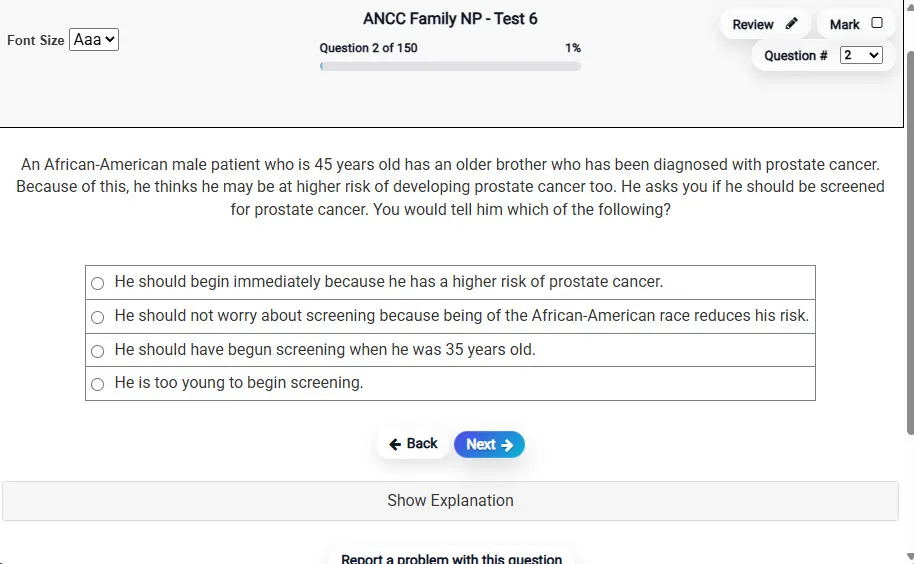
Answering a Question screen – Multiple-choice item view with navigation controls and progress tracker.
Answering a Question Multiple-choice item view with navigation controls and progress tracker.

                           Detailed Explanation screen – 
                         Review mode showing chosen answer and rationale and references.
Detailed Explanation Review mode showing chosen answer and rationale and references.

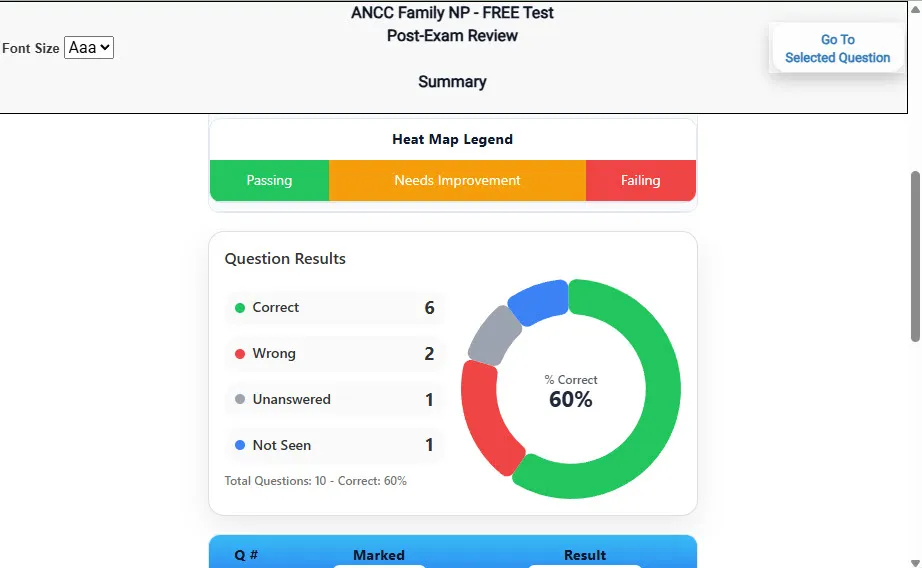
                           Review Summary 1 screen – 
                         Summary with counts for correct/wrong/unanswered and not seen items.
Review Summary 1 Summary with counts for correct/wrong/unanswered and not seen items.

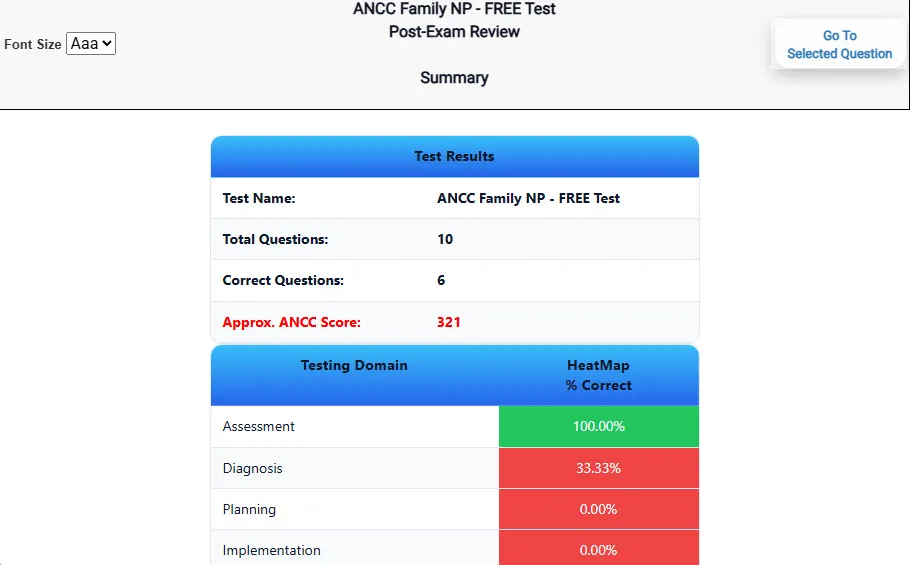
                           Review Summary 2 screen – 
                         Advanced summary with category/domain breakdown and performance insights.
Review Summary 2 Advanced summary with category/domain breakdown and performance insights.

What Each Screen Shows

Answer Question Screen

  • Clean multiple-choice interface with progress bar.
  • Mark for review feature.
  • Matches real test pacing.

Detailed Explanation

  • Correct answer plus rationale.
  • Key concepts and guidelines highlighted.
  • Move between questions to fill knowledge gaps.

Review Summary 1

  • Overall results with total questions and scaled score.
  • Domain heatmap shows strengths and weaknesses.
  • Quick visual feedback on study priorities.

Review Summary 2

  • Chart of correct, wrong, unanswered, not seen.
  • Color-coded results for easy review.
  • Links back to missed items.

Top 10 Reasons to Use Exam Edge for your MTEL Mathematics/Science (Middle School) Exam Prep

  1. Focused on the MTEL Mathematics/Science (Middle School) Exam

    Our practice tests are built specifically for the MTEL Math/Science (Middle School) exam — every question mirrors the real topics, format, and difficulty so you're studying exactly what matters.

  2. Real Exam Simulation

    We match the per-question time limits and pressure of the actual MTEL exam, so test day feels familiar and stress-free.

  3. 15 Full Practice Tests & 1,500 Unique Questions

    You'll have more than enough material to master every MTEL Math/Science (Middle School) concept — no repeats, no fluff.

  4. Lower Cost Than a Retake

    Ordering 5 practice exams costs less than retaking the MTEL Mathematics/Science (Middle School) exam after a failure. One low fee could save you both time and money.

  5. Flexible Testing

    Need to step away mid-exam? Pick up right where you left off — with your remaining time intact.

  6. Instant Scoring & Feedback

    See your raw score and an estimated MTEL Mathematics/Science (Middle School) score immediately after finishing each practice test.

  7. Detailed Explanations for Every Question

    Review correct and incorrect answers with clear, step-by-step explanations so you truly understand each topic.

  8. Trusted & Accredited

    We're fully accredited by the Better Business Bureau and uphold the highest standards of trust and transparency.

  9. Web-Based & Always Available

    No software to install. Access your MTEL Math/Science (Middle School) practice exams 24/7 from any computer or mobile device.

  10. Expert Support When You Need It

    Need extra help? Our specialized tutors are highly qualified and ready to support your MTEL exam prep.


Pass the MTEL Mathematics/Science (Middle School) Exam with Realistic Practice Tests from Exam Edge

Preparing for your upcoming MTEL Mathematics/Science (Middle School) (51) Certification Exam can feel overwhelming — but the right practice makes all the difference. Exam Edge gives you the tools, structure, and confidence to pass on your first try. Our online practice exams are built to match the real MTEL Math/Science (Middle School) exam in content, format, and difficulty.

  • 📝 15 MTEL Mathematics/Science (Middle School) Practice Tests: Access 15 full-length exams with 100 questions each, covering every major MTEL Mathematics/Science (Middle School) topic in depth.
  • Instant Online Access: Start practicing right away — no software, no waiting.
  • 🧠 Step-by-Step Explanations: Understand the reasoning behind every correct answer so you can master MTEL Math/Science (Middle School) exam concepts.
  • 🔄 Retake Each Exam Up to 4 Times: Build knowledge through repetition and track your improvement over time.
  • 🌐 Web-Based & Available 24/7: Study anywhere, anytime, on any device.
  • 🧘 Boost Your Test-Day Confidence: Familiarity with the MTEL format reduces anxiety and helps you perform under pressure.

These MTEL Mathematics/Science (Middle School) practice exams are designed to simulate the real testing experience by matching question types, timing, and difficulty level. This approach helps you get comfortable not just with the exam content, but also with the testing environment, so you walk into your exam day focused and confident.

Exam Edge MTEL Reviews


I wanted to thank ExamEdge for helping me pass this teacher test the  first time. I had a lot of material to absorb in a short space of time and so I purchased the 15 practice tests and by test 15 I was so much more confident due to getting consistent passing scores. Thank you again, in my ...
Read More
Paul, Quincy, MA

I would like to commend your site in assisting me in passing the high school math test MTEL. I used your tests for practice and review and passed the test the first time. I was a little worried going into the test because the online tests were at such a high level. I found that I was very well prepa ...
Read More
Julie, MA


MTEL Mathematics/Science (Middle School) Aliases Test Name

Here is a list of alternative names used for this exam.

  • MTEL Mathematics/Science (Middle School)
  • MTEL Mathematics/Science (Middle School) test
  • MTEL Mathematics/Science (Middle School) Certification Test
  • MTEL Math/Science (Middle School) test
  • MTEL
  • MTEL 51
  • 51 test
  • MTEL Mathematics/Science (Middle School) (51)
  • Mathematics/Science (Middle School) certification