This is the content of the pop-over!

MTEL Chemistry (67) Practice Tests & Test Prep by Exam Edge


MTEL Chemistry  product image
(4.8)
Based on 28 Reviews

  • Real Exam Simulation: Timed questions and matching content build comfort for your MTEL Chemistry test day.
  • Instant, 24/7 Access: Web-based MTEL Chemistry practice exams with no software needed.
  • Clear Explanations: Step-by-step answers and explanations for your MTEL exam to strengthen understanding.
  • Boosted Confidence: Reduces anxiety and improves test-taking skills to ace your MTEL Chemistry (67).

Featured on

MTEL Chemistry Online Practice Test Bundles

BEST VALUE
15 practice tests

$149.25

$599.25

SAVE $450

Only $9.95 per test!

  • 100% Pass Guarantee
  • 15 online practice tests
  • 100 questions per test
  • Bonus: 100 Flash Cards + Study Guide
  • Instant access
  • Detailed Explanations
  • Practice tests never expire
  • Timed, untimed, or study guide mode
MOST POPULAR
10 practice tests

$99.50

$399.50

SAVE $300

Only $9.95 per test!

  • 10 online practice tests
  • 100 questions per test
  • Bonus: 100 Flash Cards + Study Guide
  • Instant access
  • Detailed Explanations
  • Practice tests never expire
  • Timed, untimed, or study guide mode
5 practice tests

$69.75

$199.75

SAVE $130

Only $13.95 per test!

  • 5 online practice tests
  • 100 questions per test
  • Bonus: 100 Flash Cards
  • Instant access
  • Detailed Explanations
  • Practice tests never expire
  • Timed, untimed, or study guide mode
1 practice test

$39.95

  • 1 online practice test
  • 100 questions per test
  • Instant access
  • Detailed Explanations
  • Practice tests never expire
  • Timed, untimed, or study guide mode
Quick Select
Tap to choose a bundle

** All Prices are in US Dollars (USD) **


MTEL Chemistry (67) Resources

Jump to the section you need most.

Understanding the exact breakdown of the MTEL Chemistry test will help you know what to expect and how to most effectively prepare. The MTEL Chemistry has 100 multiple-choice questions and 2 essay questions. The exam will be broken down into the sections below:

MTEL Chemistry Exam Blueprint
Domain Name % Number of
Questions
Matter and Its Interactions: Periodic Properties 12% 15
Matter and Its Interactions: Chemical Structure and Reactions 22% 28
Matter and Its Interactions: Substances - Mixtures Solutions 12% 15
Motion and Stability: Forces and Interactions 15% 19
Energy in Chemical Systems 19% 24

MTEL Chemistry Study Tips by Domain

  • Relate periodic trends to effective nuclear charge and shielding: across a period, Zeff increases so atomic radius decreases; red flag—don’t treat the jump in principal energy level as “more shielding” within the same period.
  • Predict ion size correctly: cations are smaller than their neutral atoms and anions are larger; common trap—in an isoelectronic series, radius decreases as nuclear charge increases (e.g., O2− > F > Ne > Na+ > Mg2+).
  • Use ionization energy patterns with known exceptions: ionization energy generally increases across and decreases down, but dips at Group 13 (p1) and Group 16 (paired p electrons); cue—explain anomalies via subshell energy and electron–electron repulsion, not “random exceptions.”
  • Handle electron affinity and electronegativity with nuance: halogens have strongly negative electron affinities, while Groups 2 and 18 are much less favorable; red flag—don’t assume “more negative” always down a group because increased size can reduce attraction.
  • Connect metallic character and common ion charges to periodic position: metals (left) tend to form cations, nonmetals (right) tend to form anions, and transition metals show variable oxidation states; trap—don’t assign fixed charges to transition metals without a compound context.
  • Link reactivity trends to electron transfer driving forces: alkali metals become more reactive down the group (lower ionization energy) while halogens become less reactive down the group (less favorable electron gain); cue—justify with energy considerations rather than “more reactive because bigger.”
  • Relate electron configuration to bonding and geometry (VSEPR, hybridization, polarity); red flag: forgetting lone pairs often changes both shape and molecular polarity.
  • Write and balance molecular, complete ionic, and net ionic equations; common trap: canceling spectator ions before confirming solubility/strong vs. weak electrolytes.
  • Use stoichiometry with limiting reactants, percent yield, and empirical/molecular formulas; priority rule: always convert to moles first and identify the limiting reagent before any yield calculation.
  • Classify reactions (acid–base, redox, precipitation, synthesis/decomposition, combustion) and predict products; red flag: assigning oxidation numbers incorrectly when oxygen is in peroxides or in OF2.
  • Apply equilibrium concepts (K, Q, Le Châtelier) to predict direction and shifts; common trap: changing K with concentration/pressure—only temperature changes K.
  • Connect reaction rate to collision theory, concentration, temperature, catalysts, and mechanisms; red flag: assuming a catalyst changes equilibrium position—it lowers activation energy and speeds both directions equally.
  • Classify matter efficiently: pure substances (elements/compounds) have fixed composition, while mixtures vary—red flag: assuming a uniform-looking sample (e.g., saltwater) is a pure substance.
  • Choose a separation method by property: filtration (particle size), distillation (boiling point), chromatography (polarity/affinity), decanting/centrifugation (density)—common trap: using distillation for solids that decompose on heating.
  • Apply solubility rules and temperature effects: most solids increase solubility with temperature, gases decrease—priority cue: a sudden temperature drop can cause crystallization or gas bubble formation.
  • Compute concentration correctly (molarity, molality, mass percent, ppm) and track units—common trap: using final solution volume incorrectly when dilution follows mixing (use M1V1 = M2V2 only for dilutions, not reactions).
  • Use intermolecular forces to predict miscibility and solution behavior (“like dissolves like”)—red flag: expecting nonpolar solutes to dissolve well in water without an emulsifier or co-solvent.
  • Connect colligative properties to particle count: boiling point elevation/freezing point depression scale with van’t Hoff factor—common trap: treating strong electrolytes as i = 1 or ignoring incomplete dissociation at higher concentrations.
  • Apply Coulomb’s law and vector addition for electrostatic forces; red flag: forgetting the inverse-square dependence or the sign (attraction vs. repulsion) when charges differ.
  • Use Newton’s laws and free-body diagrams to connect net force to acceleration; common trap: including forces that are not acting (e.g., treating “centrifugal force” as real in an inertial frame).
  • Relate potential energy changes to conservative forces (gravity/electric) and use work–energy; priority rule: check whether the force is path-independent before using ΔU = −W.
  • Analyze circular motion with centripetal acceleration a = v2/r; threshold cue: if speed doubles, required centripetal force quadruples—don’t scale linearly.
  • Connect torque and rotational equilibrium (Στ = 0) to lever arms; common trap: using the full distance instead of the perpendicular moment arm to the line of action.
  • Apply conservation of momentum for isolated systems and impulse J = Δp; red flag: treating a system with a significant external force (e.g., friction with ground) as isolated.
  • Set up thermochemistry problems with a clear system boundary and sign convention: q>0 and ΔH>0 for endothermic, q<0 and ΔH<0 for exothermic; red flag—students often flip the sign when heat flows from the surroundings into the system.
  • Use Hess’s law by reversing and scaling equations (and their enthalpies) to match the target reaction; common trap—forgetting to multiply ΔH when coefficients are multiplied.
  • Relate calorimetry to measurable quantities using q = mcΔT (or q = CΔT) and connect to reaction enthalpy via qrxn = −qcal; priority rule—units must be consistent (g, J/g·°C, °C) before interpreting magnitude.
  • Distinguish state functions (U, H, S, G) from path-dependent quantities (q, w); red flag—treating work or heat as properties of the state rather than of the process.
  • Apply spontaneity criteria: ΔG = ΔH − TΔS and spontaneity at constant T,P requires ΔG<0; common trap—mixing kJ and J in TΔS or using Celsius instead of Kelvin.
  • Connect equilibrium and energy with ΔG° = −RT ln K and interpret K>1 as product-favored under standard conditions; red flag—using log base 10 without converting (ln vs log) or using the wrong temperature in R units.


Built to Fit Into Your Busy Life

Everything you need to prepare with confidence—without wasting a minute.

Three Study Modes

Timed, No Time Limit, or Explanation mode.

Actionable Analytics

Heatmaps and scaled scores highlight weak areas.

High-Yield Rationales

Concise explanations emphasize key concepts.

Realistic Interface

Matches the feel of the actual exam environment.

Accessible by Design

Clean layout reduces cognitive load.

Anytime, Anywhere

Web-based access 24/7 on any device.
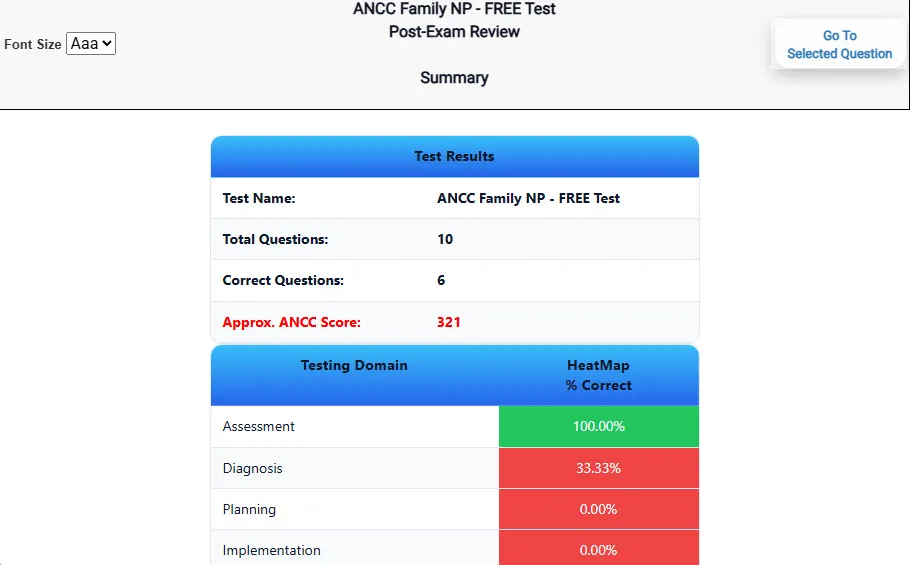
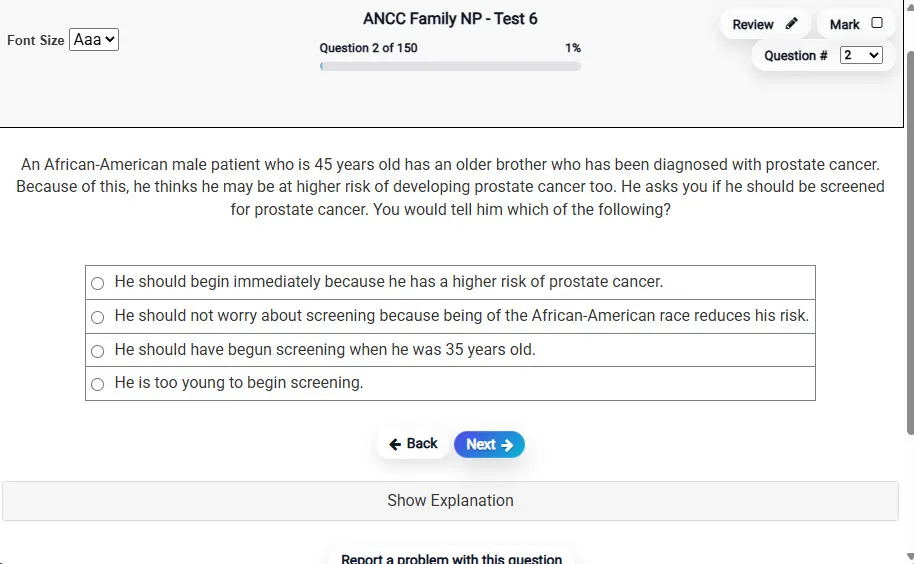
Answering a Question screen – Multiple-choice item view with navigation controls and progress tracker.
Answering a Question Multiple-choice item view with navigation controls and progress tracker.

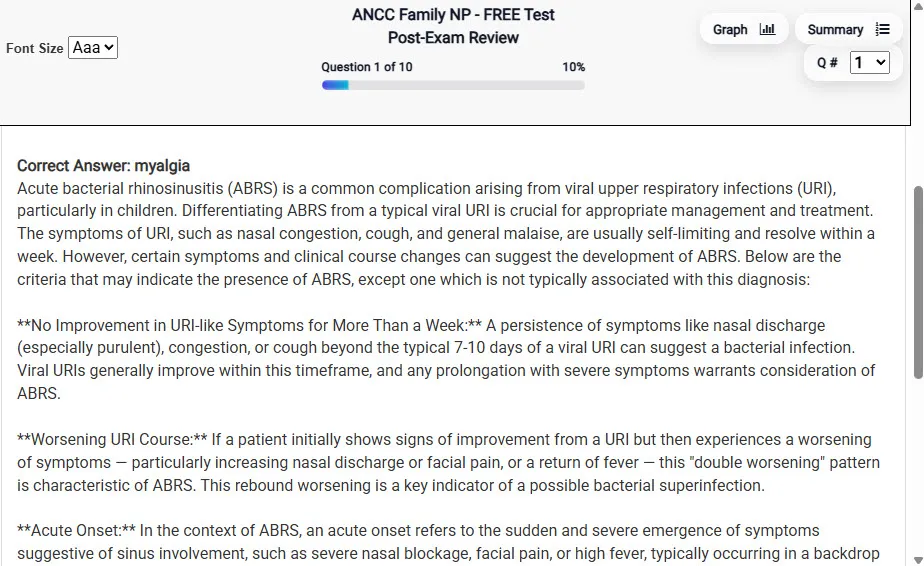
                           Detailed Explanation screen – 
                         Review mode showing chosen answer and rationale and references.
Detailed Explanation Review mode showing chosen answer and rationale and references.

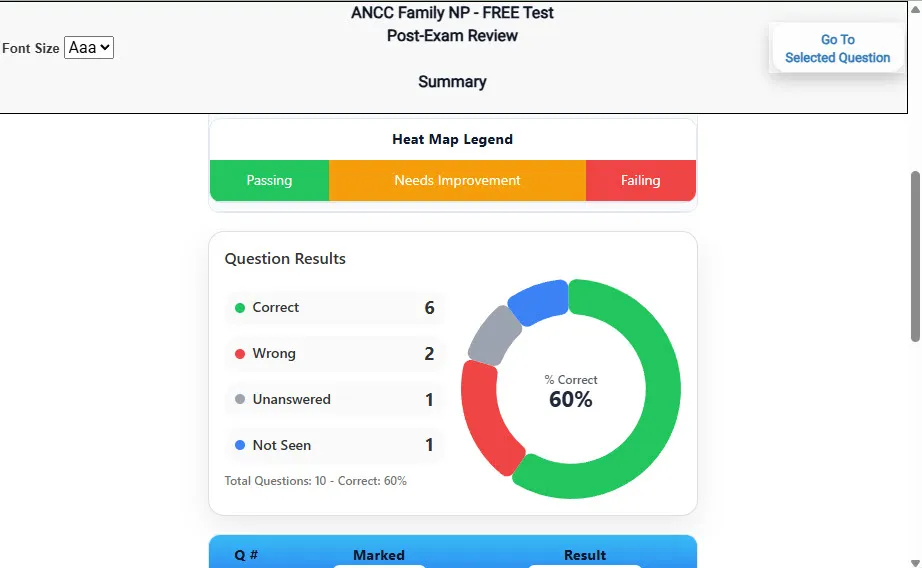
                           Review Summary 1 screen – 
                         Summary with counts for correct/wrong/unanswered and not seen items.
Review Summary 1 Summary with counts for correct/wrong/unanswered and not seen items.

                           Review Summary 2 screen – 
                         Advanced summary with category/domain breakdown and performance insights.
Review Summary 2 Advanced summary with category/domain breakdown and performance insights.

What Each Screen Shows

Answer Question Screen

  • Clean multiple-choice interface with progress bar.
  • Mark for review feature.
  • Matches real test pacing.

Detailed Explanation

  • Correct answer plus rationale.
  • Key concepts and guidelines highlighted.
  • Move between questions to fill knowledge gaps.

Review Summary 1

  • Overall results with total questions and scaled score.
  • Domain heatmap shows strengths and weaknesses.
  • Quick visual feedback on study priorities.

Review Summary 2

  • Chart of correct, wrong, unanswered, not seen.
  • Color-coded results for easy review.
  • Links back to missed items.

Top 10 Reasons to Use Exam Edge for your MTEL Chemistry Exam Prep

  1. Focused on the MTEL Chemistry Exam

    Our practice tests are built specifically for the MTEL Chemistry exam — every question mirrors the real topics, format, and difficulty so you're studying exactly what matters.

  2. Real Exam Simulation

    We match the per-question time limits and pressure of the actual MTEL exam, so test day feels familiar and stress-free.

  3. 15 Full Practice Tests & 1,500 Unique Questions

    You'll have more than enough material to master every MTEL Chemistry concept — no repeats, no fluff.

  4. Lower Cost Than a Retake

    Ordering 5 practice exams costs less than retaking the MTEL Chemistry exam after a failure. One low fee could save you both time and money.

  5. Flexible Testing

    Need to step away mid-exam? Pick up right where you left off — with your remaining time intact.

  6. Instant Scoring & Feedback

    See your raw score and an estimated MTEL Chemistry score immediately after finishing each practice test.

  7. Detailed Explanations for Every Question

    Review correct and incorrect answers with clear, step-by-step explanations so you truly understand each topic.

  8. Trusted & Accredited

    We're fully accredited by the Better Business Bureau and uphold the highest standards of trust and transparency.

  9. Web-Based & Always Available

    No software to install. Access your MTEL Chemistry practice exams 24/7 from any computer or mobile device.

  10. Expert Support When You Need It

    Need extra help? Our specialized tutors are highly qualified and ready to support your MTEL exam prep.


Pass the MTEL Chemistry Exam with Realistic Practice Tests from Exam Edge

Preparing for your upcoming MTEL Chemistry (67) Certification Exam can feel overwhelming — but the right practice makes all the difference. Exam Edge gives you the tools, structure, and confidence to pass on your first try. Our online practice exams are built to match the real MTEL Chemistry exam in content, format, and difficulty.

  • 📝 15 MTEL Chemistry Practice Tests: Access 15 full-length exams with 100 questions each, covering every major MTEL Chemistry topic in depth.
  • Instant Online Access: Start practicing right away — no software, no waiting.
  • 🧠 Step-by-Step Explanations: Understand the reasoning behind every correct answer so you can master MTEL Chemistry exam concepts.
  • 🔄 Retake Each Exam Up to 4 Times: Build knowledge through repetition and track your improvement over time.
  • 🌐 Web-Based & Available 24/7: Study anywhere, anytime, on any device.
  • 🧘 Boost Your Test-Day Confidence: Familiarity with the MTEL format reduces anxiety and helps you perform under pressure.

These MTEL Chemistry practice exams are designed to simulate the real testing experience by matching question types, timing, and difficulty level. This approach helps you get comfortable not just with the exam content, but also with the testing environment, so you walk into your exam day focused and confident.


Exam Edge MTEL Reviews


I wanted to thank ExamEdge for helping me pass this teacher test the  first time. I had a lot of material to absorb in a short space of time and so I purchased the 15 practice tests and by test 15 I was so much more confident due to getting consistent passing scores. Thank you again, in my ...
Read More
Paul, Quincy, MA

I would like to commend your site in assisting me in passing the high school math test MTEL. I used your tests for practice and review and passed the test the first time. I was a little worried going into the test because the online tests were at such a high level. I found that I was very well prepa ...
Read More
Julie, MA


MTEL Chemistry Aliases Test Name

Here is a list of alternative names used for this exam.

  • MTEL Chemistry
  • MTEL Chemistry test
  • MTEL Chemistry Certification Test
  • MTEL
  • MTEL 67
  • 67 test
  • MTEL Chemistry (67)
  • Chemistry certification