This is the content of the pop-over!

MTEL Adult Basic Education (55) Practice Tests & Test Prep by Exam Edge


MTEL Adult Basic Education  product image
(4.8)
Based on 29 Reviews

  • Real Exam Simulation: Timed questions and matching content build comfort for your MTEL Adult Basic Education test day.
  • Instant, 24/7 Access: Web-based MTEL Adult Basic Education practice exams with no software needed.
  • Clear Explanations: Step-by-step answers and explanations for your MTEL exam to strengthen understanding.
  • Boosted Confidence: Reduces anxiety and improves test-taking skills to ace your MTEL Adult Basic Education (55).

Featured on

MTEL Adult Basic Education Online Practice Test Bundles

BEST VALUE
15 practice tests

$149.25

$599.25

SAVE $450

Only $9.95 per test!

  • 100% Pass Guarantee
  • 15 online practice tests
  • 100 questions + 2 essays per test
  • Bonus: 100 Flash Cards + Study Guide
  • Instant access
  • Detailed Explanations
  • Practice tests never expire
  • Timed, untimed, or study guide mode
MOST POPULAR
10 practice tests

$99.50

$399.50

SAVE $300

Only $9.95 per test!

  • 10 online practice tests
  • 100 questions + 2 essays per test
  • Bonus: 100 Flash Cards + Study Guide
  • Instant access
  • Detailed Explanations
  • Practice tests never expire
  • Timed, untimed, or study guide mode
5 practice tests

$69.75

$199.75

SAVE $130

Only $13.95 per test!

  • 5 online practice tests
  • 100 questions + 2 essays per test
  • Bonus: 100 Flash Cards
  • Instant access
  • Detailed Explanations
  • Practice tests never expire
  • Timed, untimed, or study guide mode
1 practice test

$39.95

  • 1 online practice test
  • 100 questions + 2 essays per test
  • Instant access
  • Detailed Explanations
  • Practice tests never expire
  • Timed, untimed, or study guide mode
Quick Select
Tap to choose a bundle

** All Prices are in US Dollars (USD) **


MTEL Adult Basic Education (55) Resources

Jump to the section you need most.

Understanding the exact breakdown of the MTEL Adult Basic Education test will help you know what to expect and how to most effectively prepare. The MTEL Adult Basic Education has 100 multiple-choice questions and 2 essay questions. The exam will be broken down into the sections below:

MTEL Adult Basic Education Exam Blueprint
Domain Name % Number of
Questions
English Language Arts 15% 15
English for Speakers of Other Languages 25% 25
Mathematics 25% 25
History and Social Science 10% 10
Science 10% 10
Application of Knowledge and Understanding 15% 15

MTEL Adult Basic Education Study Tips by Domain

  • Use text-dependent questions that require citing specific evidence; red flag: prompts that can be answered from background knowledge alone.
  • Differentiate main idea from supporting details and track how claims are developed across paragraphs; common trap: treating the first sentence as the main idea without checking the whole passage.
  • Target vocabulary in context (denotation, connotation, figurative language) and use context clues/word parts; priority rule: verify meaning by rereading surrounding sentences before choosing an answer.
  • Analyze author’s purpose, tone, and bias using specific language choices and omissions; red flag: confusing a neutral summary with an evaluation of the author’s stance.
  • Teach writing as a process (plan–draft–revise–edit) with clear thesis, organization, and audience awareness; common trap: focusing on grammar edits before fixing unclear ideas and structure.
  • Apply conventions (sentence boundaries, agreement, pronoun reference, punctuation) to improve clarity; threshold: if a sentence has two independent clauses, ensure a coordinating conjunction, semicolon, or proper separation to avoid a run-on.
  • Prioritize communicative competence over perfect accuracy—red flag: stopping learners mid-utterance for minor grammar errors that derail fluency and willingness to speak.
  • Use proficiency-aligned objectives (e.g., can-do statements) and scaffolded tasks; common trap: assigning grade-level texts or multi-step directions without supports for emerging-level learners.
  • Teach vocabulary in high-utility chunks (collocations, sentence frames) with repeated recycling; red flag: long isolated word lists without context, practice, or review.
  • Explicitly address pronunciation features that affect intelligibility (stress, rhythm, key consonant/vowel contrasts); priority rule: focus first on errors that change meaning rather than accent reduction.
  • Build reading and writing through integrated skills and genre models (forms, emails, workplace notes); common trap: overemphasizing phonics or grammar drills without authentic literacy tasks adults must perform.
  • Use ongoing formative checks (quick retells, exit tickets, comprehension questions) and adjust instruction; red flag: relying on a single high-stakes test and confusing test-taking difficulty with language proficiency.
  • Use place value and number sense to estimate and check reasonableness (e.g., rounding before/after computing)—red flag: an answer with the wrong sign or magnitude often indicates a place-value or decimal-point slip.
  • Work fluently with fractions, decimals, and percents (including conversions and percent change)—common trap: treating “percent of” as add/subtract instead of multiply, especially in discount/tax problems.
  • Solve linear equations and inequalities and interpret solutions in context—priority rule: when multiplying/dividing an inequality by a negative number, you must reverse the inequality symbol.
  • Apply proportional reasoning (ratios, rates, unit rates, scaling, and simple interest)—threshold cue: always label units to avoid mixing rates (e.g., miles/hour vs. minutes/mile).
  • Represent and analyze data using tables, graphs, and summary measures (mean, median, mode, range)—common trap: choosing the mean when outliers skew the data; consider median as a better measure of center.
  • Use geometry and measurement to solve real-world problems (perimeter, area, volume, angle relationships)—red flag: confusing area vs. perimeter or using inconsistent units (e.g., mixing inches and feet) leads to systematic errors.
  • Sequence major eras (e.g., Indigenous societies → colonization → Revolution → industrialization → modern civil rights/globalization) using cause-and-effect; red flag: memorizing dates without explaining what changed and why.
  • Connect core civics concepts (separation of powers, checks and balances, federalism, rights/responsibilities) to everyday scenarios like voting, taxes, and local ordinances; common trap: confusing civil liberties (freedoms) with civil rights (equal protection).
  • Use primary/secondary sources to identify author, audience, purpose, and bias, and corroborate across documents; priority rule: treat a single source as insufficient evidence unless verified by another.
  • Interpret maps, charts, timelines, and basic demographic/economic graphs to draw supported conclusions; red flag: mixing up correlation with causation when trends move together.
  • Explain how economic choices reflect scarcity, incentives, trade-offs, and opportunity cost in household/community contexts; common trap: ignoring what is given up when selecting an option.
  • Apply geographic reasoning (location, place, region, human-environment interaction, movement) to historical and current issues like migration or resource use; contraindication: attributing outcomes to geography alone without human/policy factors.
  • Use the scientific method to frame investigations (question → hypothesis → test → analyze → conclude); red flag: claiming a hypothesis is “proven” from one trial or one data point.
  • Identify variables clearly (independent, dependent, controlled) and design a fair test; common trap: changing more than one variable at a time and still attributing cause to a single factor.
  • Read graphs/tables for trends, slope, and outliers, and distinguish correlation from causation; red flag: inferring cause just because two variables move together.
  • Apply core physical science ideas (forces, motion, energy, heat transfer, simple circuits) using correct units and basic calculations; common trap: mixing up mass vs. weight or power vs. energy.
  • Connect life science concepts (cells, heredity, ecosystems, human body systems) to evidence-based explanations; red flag: teleological reasoning (e.g., “organisms evolved because they needed to”) instead of natural selection mechanisms.
  • Use Earth/space science fundamentals (rock cycle, weather vs. climate, water cycle, seasons, Moon phases) with accurate causal explanations; common trap: attributing seasons to Earth being closer to the Sun rather than axial tilt.
  • Start every instructional decision with a quick needs/diagnostic check (skill, level, goal) and align the objective to the learner’s purpose; red flag: teaching content that doesn’t connect to an identified workforce, credential, or transition goal.
  • Plan lessons with explicit, measurable targets (condition–behavior–criterion) and a short sequence of modeling, guided practice, and independent practice; common trap: objectives that describe activities (e.g., “do a worksheet”) instead of outcomes.
  • Use formative checks (hinge questions, brief performance tasks, error analysis) to adjust pacing in real time; priority rule: reteach immediately when multiple learners miss the same prerequisite step.
  • Select materials and tasks that match reading level and cognitive demand, and provide scaffolds without lowering the standard; red flag: over-scaffolding that prevents learners from demonstrating independent skill (e.g., answering for them).
  • Integrate adult-appropriate contexts (workplace, civic, health, finance) and require transfer to a new but similar task; common trap: learners can perform in practice but fail when the numbers/text/context changes.
  • Document progress with clear criteria and consistent evidence (work samples, rubrics, brief assessments) and use results to set the next goal; red flag: relying only on participation or attendance as proof of learning.


Built to Fit Into Your Busy Life

Everything you need to prepare with confidence—without wasting a minute.

Three Study Modes

Timed, No Time Limit, or Explanation mode.

Actionable Analytics

Heatmaps and scaled scores highlight weak areas.

High-Yield Rationales

Concise explanations emphasize key concepts.

Realistic Interface

Matches the feel of the actual exam environment.

Accessible by Design

Clean layout reduces cognitive load.

Anytime, Anywhere

Web-based access 24/7 on any device.
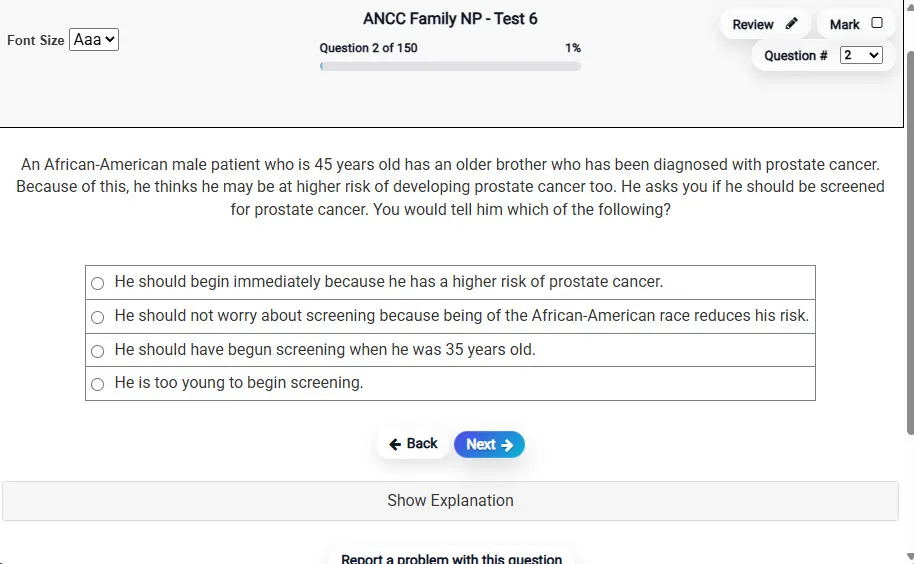
Answering a Question screen – Multiple-choice item view with navigation controls and progress tracker.
Answering a Question Multiple-choice item view with navigation controls and progress tracker.

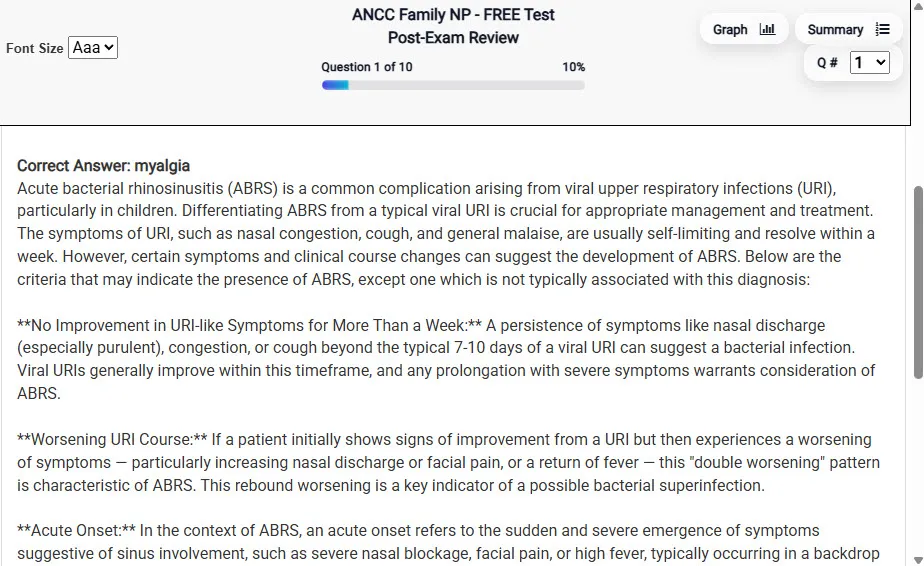
                           Detailed Explanation screen – 
                         Review mode showing chosen answer and rationale and references.
Detailed Explanation Review mode showing chosen answer and rationale and references.

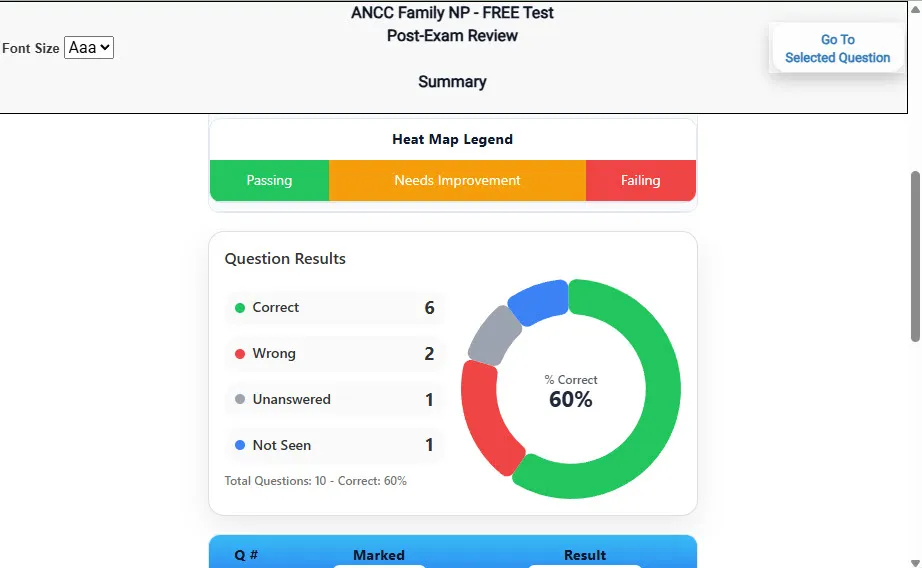
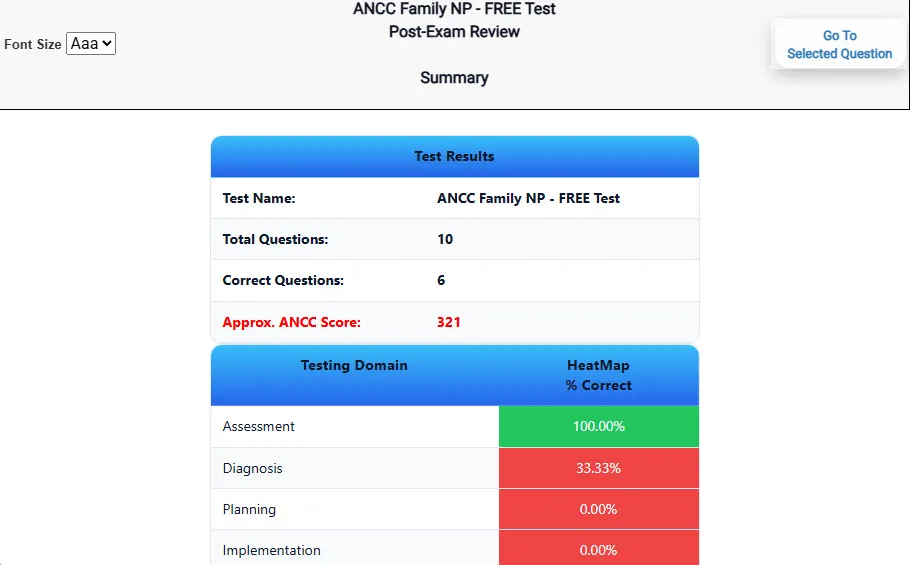
                           Review Summary 1 screen – 
                         Summary with counts for correct/wrong/unanswered and not seen items.
Review Summary 1 Summary with counts for correct/wrong/unanswered and not seen items.

                           Review Summary 2 screen – 
                         Advanced summary with category/domain breakdown and performance insights.
Review Summary 2 Advanced summary with category/domain breakdown and performance insights.

What Each Screen Shows

Answer Question Screen

  • Clean multiple-choice interface with progress bar.
  • Mark for review feature.
  • Matches real test pacing.

Detailed Explanation

  • Correct answer plus rationale.
  • Key concepts and guidelines highlighted.
  • Move between questions to fill knowledge gaps.

Review Summary 1

  • Overall results with total questions and scaled score.
  • Domain heatmap shows strengths and weaknesses.
  • Quick visual feedback on study priorities.

Review Summary 2

  • Chart of correct, wrong, unanswered, not seen.
  • Color-coded results for easy review.
  • Links back to missed items.

Top 10 Reasons to Use Exam Edge for your MTEL Adult Basic Education Exam Prep

  1. Focused on the MTEL Adult Basic Education Exam

    Our practice tests are built specifically for the MTEL Adult Basic Education exam — every question mirrors the real topics, format, and difficulty so you're studying exactly what matters.

  2. Real Exam Simulation

    We match the per-question time limits and pressure of the actual MTEL exam, so test day feels familiar and stress-free.

  3. 15 Full Practice Tests & 1,530 Unique Questions

    You'll have more than enough material to master every MTEL Adult Basic Education concept — no repeats, no fluff.

  4. Lower Cost Than a Retake

    Ordering 5 practice exams costs less than retaking the MTEL Adult Basic Education exam after a failure. One low fee could save you both time and money.

  5. Flexible Testing

    Need to step away mid-exam? Pick up right where you left off — with your remaining time intact.

  6. Instant Scoring & Feedback

    See your raw score and an estimated MTEL Adult Basic Education score immediately after finishing each practice test.

  7. Detailed Explanations for Every Question

    Review correct and incorrect answers with clear, step-by-step explanations so you truly understand each topic.

  8. Trusted & Accredited

    We're fully accredited by the Better Business Bureau and uphold the highest standards of trust and transparency.

  9. Web-Based & Always Available

    No software to install. Access your MTEL Adult Basic Education practice exams 24/7 from any computer or mobile device.

  10. Expert Support When You Need It

    Need extra help? Our specialized tutors are highly qualified and ready to support your MTEL exam prep.


Pass the MTEL Adult Basic Education Exam with Realistic Practice Tests from Exam Edge

Preparing for your upcoming MTEL Adult Basic Education (55) Certification Exam can feel overwhelming — but the right practice makes all the difference. Exam Edge gives you the tools, structure, and confidence to pass on your first try. Our online practice exams are built to match the real MTEL Adult Basic Education exam in content, format, and difficulty.

  • 📝 15 MTEL Adult Basic Education Practice Tests: Access 15 full-length exams with 102 questions each, covering every major MTEL Adult Basic Education topic in depth.
  • Instant Online Access: Start practicing right away — no software, no waiting.
  • 🧠 Step-by-Step Explanations: Understand the reasoning behind every correct answer so you can master MTEL Adult Basic Education exam concepts.
  • 🔄 Retake Each Exam Up to 4 Times: Build knowledge through repetition and track your improvement over time.
  • 🌐 Web-Based & Available 24/7: Study anywhere, anytime, on any device.
  • 🧘 Boost Your Test-Day Confidence: Familiarity with the MTEL format reduces anxiety and helps you perform under pressure.

These MTEL Adult Basic Education practice exams are designed to simulate the real testing experience by matching question types, timing, and difficulty level. This approach helps you get comfortable not just with the exam content, but also with the testing environment, so you walk into your exam day focused and confident.

Exam Edge MTEL Reviews


I would like to commend your site in assisting me in passing the high school math test MTEL. I used your tests for practice and review and passed the test the first time. I was a little worried going into the test because the online tests were at such a high level. I found that I was very well prepa ...
Read More
Julie, MA

I wanted to thank ExamEdge for helping me pass this teacher test the  first time. I had a lot of material to absorb in a short space of time and so I purchased the 15 practice tests and by test 15 I was so much more confident due to getting consistent passing scores. Thank you again, in my ...
Read More
Paul, Quincy, MA


MTEL Adult Basic Education Aliases Test Name

Here is a list of alternative names used for this exam.

  • MTEL Adult Basic Education
  • MTEL Adult Basic Education test
  • MTEL Adult Basic Education Certification Test
  • MTEL
  • MTEL 55
  • 55 test
  • MTEL Adult Basic Education (55)
  • Adult Basic Education certification