This is the content of the pop-over!

HESI ACNP Practice Tests & Test Prep by Exam Edge


HESI Acute Care Nurse Practitioner  product image
(4.7)
Based on 32 Reviews

  • Real Exam Simulation: Timed questions and matching content build comfort for your HESI ACNP test day.
  • Instant, 24/7 Access: Web-based HESI Acute Care Nurse Practitioner practice exams with no software needed.
  • Clear Explanations: Step-by-step answers and explanations for your HESI exam to strengthen understanding.
  • Boosted Confidence: Reduces anxiety and improves test-taking skills to ace your HESI Acute Care Nurse Practitioner .

Featured on

HESI Acute Care Nurse Practitioner Online Practice Test Bundles

BEST VALUE
15 practice tests

$149.25

$599.25

SAVE $450

Only $9.95 per test!

  • 100% Pass Guarantee
  • 15 online practice tests
  • 100 questions per test
  • Bonus: 100 Flash Cards + Study Guide
  • Instant access
  • Detailed Explanations
  • Practice tests never expire
  • Timed, untimed, or study guide mode
MOST POPULAR
10 practice tests

$99.50

$399.50

SAVE $300

Only $9.95 per test!

  • 10 online practice tests
  • 100 questions per test
  • Bonus: 100 Flash Cards + Study Guide
  • Instant access
  • Detailed Explanations
  • Practice tests never expire
  • Timed, untimed, or study guide mode
5 practice tests

$69.75

$199.75

SAVE $130

Only $13.95 per test!

  • 5 online practice tests
  • 100 questions per test
  • Bonus: 100 Flash Cards
  • Instant access
  • Detailed Explanations
  • Practice tests never expire
  • Timed, untimed, or study guide mode
1 practice test

$39.95

  • 1 online practice test
  • 100 questions per test
  • Instant access
  • Detailed Explanations
  • Practice tests never expire
  • Timed, untimed, or study guide mode
Quick Select
Tap to choose a bundle

** All Prices are in US Dollars (USD) **


HESI ACNP () Resources

Jump to the section you need most.

Understanding the exact breakdown of the HESI Acute Care Nurse Practitioner test will help you know what to expect and how to most effectively prepare. The HESI Acute Care Nurse Practitioner has multiple-choice questions . The exam will be broken down into the sections below:

HESI Acute Care Nurse Practitioner Exam Blueprint
Domain Name % Number of
Questions
Nurse Practitioner/Patient Relationship 14.30% 14
Assessment and Diagnosis 23.60% 24
Clinical Management 33.90% 34
Health Care Delivery 14.10% 14
Professional Responsibility 14.10% 14

HESI Acute Care Nurse Practitioner Study Tips by Domain

  • Establish rapport quickly with acute patients by using a focused introduction, role clarification, and agenda setting; red flag: skipping informed consent for procedures because the unit is busy.
  • Use trauma-informed communication (ask permission, explain steps, offer choices) when performing sensitive exams; common trap: proceeding after a patient hesitates or withdraws consent.
  • Confirm understanding with teach-back for discharge instructions and high-risk meds (e.g., anticoagulants, insulin, opioids); priority rule: if the patient can’t repeat key steps, revise the plan before discharge.
  • Manage difficult interactions with de-escalation (calm tone, boundaries, safety plan) and document behavior objectively; red flag: arguing or making promises you can’t keep about outcomes or timing.
  • Navigate family dynamics and surrogate decision-making by identifying the legal decision-maker and the patient’s stated wishes; common trap: sharing PHI with “family” without verifying permission or authority.
  • Address health literacy, language, and cultural needs by using qualified interpreters and plain language; contraindication: relying on minors or family members to interpret critical or end-of-life discussions.
  • Prioritize ABCs and instability first—red flag: hypotension, altered mental status, or respiratory distress means assess and treat simultaneously rather than completing a full history.
  • Use a focused HPI plus targeted exam tied to the chief complaint; common trap: ordering broad “panels” without a working differential and pretest probability.
  • Recognize time-critical presentations (ACS, stroke, sepsis) and document last-known-well/onset; red flag: normal initial ECG or troponin does not exclude evolving MI.
  • Interpret vitals and trends, not single values; priority rule: persistent tachycardia, fever, or rising oxygen requirement should trigger reassessment and escalation even if the patient “looks okay.”
  • Choose diagnostic tests based on sensitivity/specificity and clinical context; common trap: relying on a negative D-dimer in high-risk PE or ordering contrast CT without checking renal function and allergy history.
  • Differentiate colonization vs infection and contamination vs true bacteremia; red flag: positive blood culture in only one bottle (e.g., skin flora) needs correlation with symptoms, source, and repeat cultures before labeling sepsis.
  • Stabilize first: address airway, breathing, circulation before diagnostics; red flag—any hypotension, hypoxia, or altered mental status triggers immediate resuscitation while you work up the cause.
  • Use evidence-based initial bundles for time-sensitive emergencies (e.g., sepsis, ACS, stroke) and document time zero; common trap—waiting for confirmatory tests before giving antibiotics/fluids, antiplatelet therapy, or activating stroke protocols.
  • Order and interpret therapeutics with renal/hepatic function in mind; priority rule—check creatinine/eGFR and weight-based dosing before nephrotoxic drugs, contrast, or anticoagulants.
  • Manage pain and sedation safely with monitoring and reversal plans; contraindication—avoid oversedation in COPD/OSA or hemodynamic instability and ensure naloxone/flumazenil availability when appropriate.
  • Anticipate complications and escalate level of care early; red flag—increasing oxygen requirement, rising lactate, refractory tachycardia, or new arrhythmia should prompt ICU consult/rapid response rather than serial reassessments alone.
  • Plan disposition and transitions with clear criteria and follow-up; common trap—discharging patients without documented return precautions, medication reconciliation, and a specific outpatient plan for abnormal but noncritical results (e.g., repeat labs/imaging timeframe).
  • Use acuity-based triage and level-of-care placement (ICU vs step-down vs floor) early; red flag: persistent hypotension, rising lactate, or escalating O2 needs should trigger immediate escalation and rapid response activation.
  • Coordinate safe handoffs with a standardized tool (e.g., SBAR) including active problems, pending tests, and contingency plans; common trap: transferring a patient with “pending cultures/critical imaging” without documenting who will follow results and by when.
  • Implement infection prevention bundles (CLABSI, CAUTI, VAP) and daily device-necessity review; priority rule: remove unnecessary lines/catheters within 24 hours when no clear indication persists.
  • Align care with institutional sepsis, stroke, and STEMI pathways and time targets; threshold cue: suspected sepsis requires antibiotics and fluids without waiting for full workup when organ dysfunction is present.
  • Plan discharge from admission with medication reconciliation, follow-up, and education using teach-back; red flag: high-risk meds (anticoagulants, insulin, opioids) without clear dosing changes and monitoring plan increases readmission risk.
  • Engage interprofessional resources (pharmacy, RT, case management, PT/OT, palliative care) based on goals and barriers; common trap: delaying palliative consult in refractory symptoms or high-burden illness until “all options” are exhausted.
  • Practice within state APRN scope, facility privileges, and any supervisory/collaborative requirements; red flag: independently prescribing controlled substances or ordering restricted services without documented authority.
  • Prioritize patient safety and duty to warn/protect when legally required while maintaining confidentiality; common trap: releasing information without a valid consent, exception, or minimum-necessary justification.
  • Obtain and document informed consent as a process (risks, benefits, alternatives, capacity, and questions answered); red flag: relying on a signed form when the patient lacks decision-making capacity or was not informed.
  • Follow evidence-based standards and timely escalation/consultation for high-risk findings; priority rule: unstable vitals, sepsis concern, stroke symptoms, or acute chest pain require immediate escalation rather than routine outpatient-style management.
  • Manage controlled substances and opioid prescribing with monitoring and risk mitigation; common trap: missing PDMP check, failing to document functional goals, or co-prescribing opioids and benzodiazepines without a clear rationale and safety plan.
  • Ensure accurate, timely, and non-altered documentation that supports clinical reasoning and continuity of care; red flag: late entries without notation, copying forward outdated data, or documenting care not personally performed.


Built to Fit Into Your Busy Life

Everything you need to prepare with confidence—without wasting a minute.

Three Study Modes

Timed, No Time Limit, or Explanation mode.

Actionable Analytics

Heatmaps and scaled scores highlight weak areas.

High-Yield Rationales

Concise explanations emphasize key concepts.

Realistic Interface

Matches the feel of the actual exam environment.

Accessible by Design

Clean layout reduces cognitive load.

Anytime, Anywhere

Web-based access 24/7 on any device.
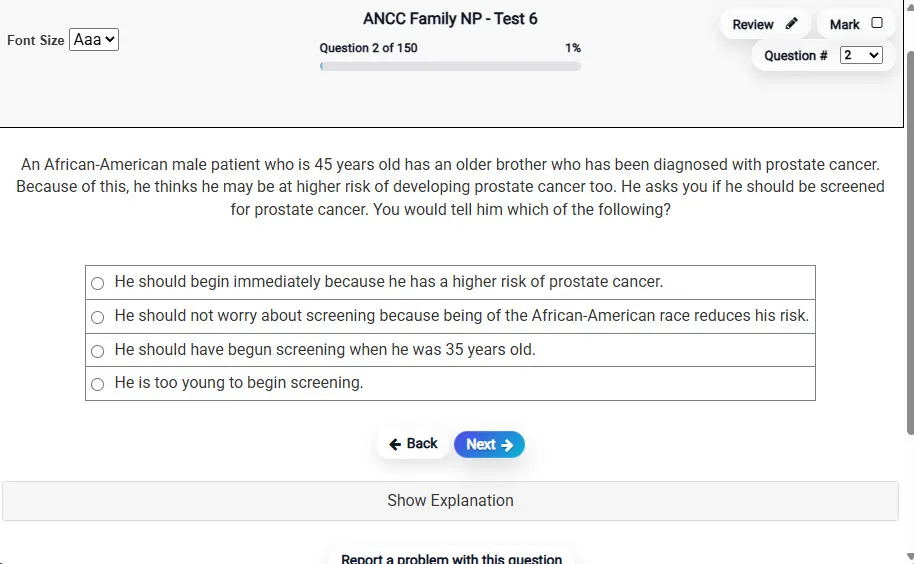
Answering a Question screen – Multiple-choice item view with navigation controls and progress tracker.
Answering a Question Multiple-choice item view with navigation controls and progress tracker.

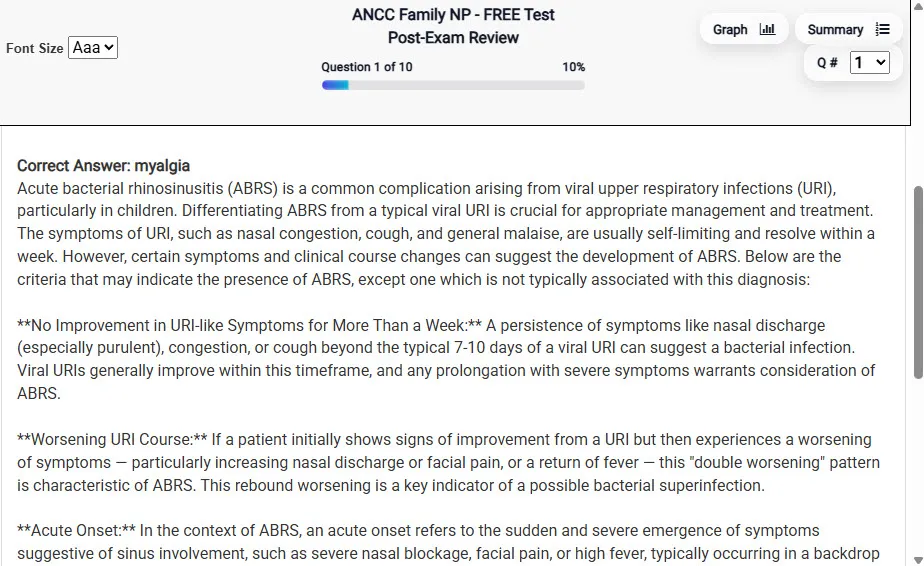
                           Detailed Explanation screen – 
                         Review mode showing chosen answer and rationale and references.
Detailed Explanation Review mode showing chosen answer and rationale and references.

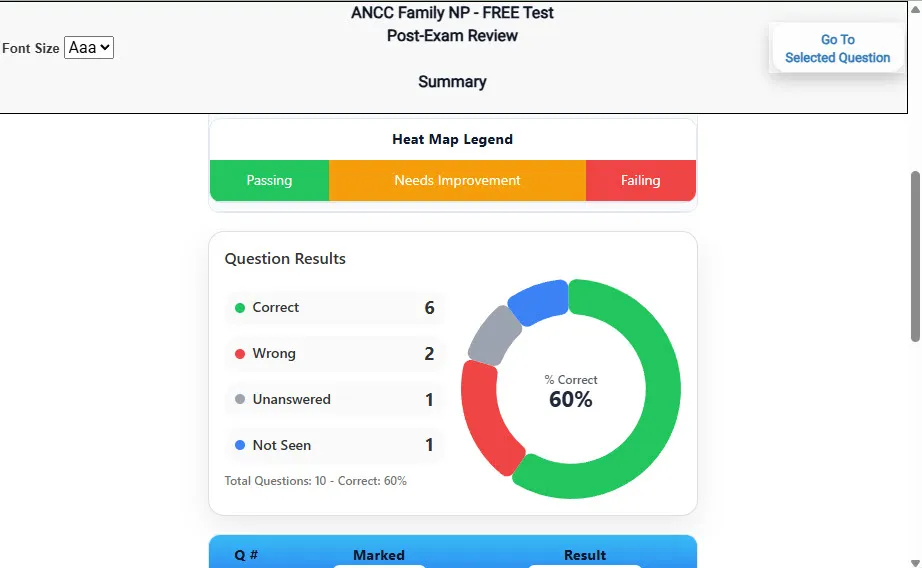
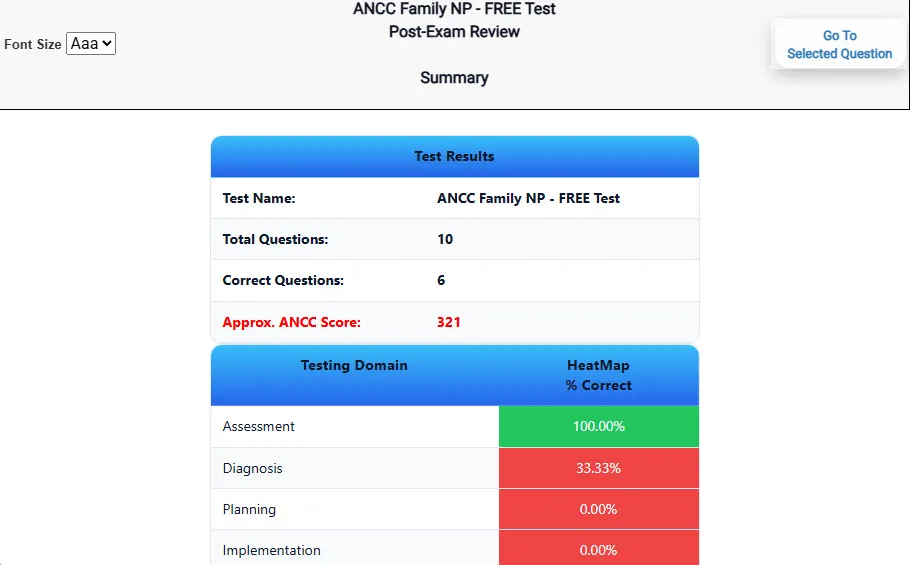
                           Review Summary 1 screen – 
                         Summary with counts for correct/wrong/unanswered and not seen items.
Review Summary 1 Summary with counts for correct/wrong/unanswered and not seen items.

                           Review Summary 2 screen – 
                         Advanced summary with category/domain breakdown and performance insights.
Review Summary 2 Advanced summary with category/domain breakdown and performance insights.

What Each Screen Shows

Answer Question Screen

  • Clean multiple-choice interface with progress bar.
  • Mark for review feature.
  • Matches real test pacing.

Detailed Explanation

  • Correct answer plus rationale.
  • Key concepts and guidelines highlighted.
  • Move between questions to fill knowledge gaps.

Review Summary 1

  • Overall results with total questions and scaled score.
  • Domain heatmap shows strengths and weaknesses.
  • Quick visual feedback on study priorities.

Review Summary 2

  • Chart of correct, wrong, unanswered, not seen.
  • Color-coded results for easy review.
  • Links back to missed items.

Top 10 Reasons to Use Exam Edge for your HESI Acute Care Nurse Practitioner Exam Prep

  1. Focused on the HESI Acute Care Nurse Practitioner Exam

    Our practice tests are built specifically for the HESI ACNP exam — every question mirrors the real topics, format, and difficulty so you're studying exactly what matters.

  2. Real Exam Simulation

    We match the per-question time limits and pressure of the actual HESI exam, so test day feels familiar and stress-free.

  3. 15 Full Practice Tests & 1,500 Unique Questions

    You'll have more than enough material to master every HESI ACNP concept — no repeats, no fluff.

  4. Lower Cost Than a Retake

    Ordering 5 practice exams costs less than retaking the HESI Acute Care Nurse Practitioner exam after a failure. One low fee could save you both time and money.

  5. Flexible Testing

    Need to step away mid-exam? Pick up right where you left off — with your remaining time intact.

  6. Instant Scoring & Feedback

    See your raw score and an estimated HESI Acute Care Nurse Practitioner score immediately after finishing each practice test.

  7. Detailed Explanations for Every Question

    Review correct and incorrect answers with clear, step-by-step explanations so you truly understand each topic.

  8. Trusted & Accredited

    We're fully accredited by the Better Business Bureau and uphold the highest standards of trust and transparency.

  9. Web-Based & Always Available

    No software to install. Access your HESI ACNP practice exams 24/7 from any computer or mobile device.

  10. Expert Support When You Need It

    Need extra help? Our specialized tutors are highly qualified and ready to support your HESI exam prep.


Pass the HESI Acute Care Nurse Practitioner Exam with Realistic Practice Tests from Exam Edge

Preparing for your upcoming HESI Acute Care Nurse Practitioner () Certification Exam can feel overwhelming — but the right practice makes all the difference. Exam Edge gives you the tools, structure, and confidence to pass on your first try. Our online practice exams are built to match the real HESI ACNP exam in content, format, and difficulty.

  • 📝 15 HESI Acute Care Nurse Practitioner Practice Tests: Access 15 full-length exams with 100 questions each, covering every major HESI Acute Care Nurse Practitioner topic in depth.
  • Instant Online Access: Start practicing right away — no software, no waiting.
  • 🧠 Step-by-Step Explanations: Understand the reasoning behind every correct answer so you can master HESI ACNP exam concepts.
  • 🔄 Retake Each Exam Up to 4 Times: Build knowledge through repetition and track your improvement over time.
  • 🌐 Web-Based & Available 24/7: Study anywhere, anytime, on any device.
  • 🧘 Boost Your Test-Day Confidence: Familiarity with the HESI format reduces anxiety and helps you perform under pressure.

These HESI Acute Care Nurse Practitioner practice exams are designed to simulate the real testing experience by matching question types, timing, and difficulty level. This approach helps you get comfortable not just with the exam content, but also with the testing environment, so you walk into your exam day focused and confident.


Exam Edge HESI Reviews


I can't believe this website doesn't have a high following status. I bought 40 practice questions, and I did 20 practice questions and took my Hesi exit. I scored 1070. I completed all 40 practice exams and passed my boards for the first time. Exam Edge introduced me to a bunch of topics and boosted ...
Read More
Juliet M., Tarpon Springs, Florida

I just took my Hesi exit PN today and got a Hesi score of 1205 and a conversion score of 99.99%. Thanks for the help. Doing all those tests helped so much. Not because I saw the same questions but because I learned so much from the answer reasoning section. Hope to fly through my boards in a couple ...
Read More
Sharon, Texas

I recently had to test out of my school with an 850 on the Hesi PN, so I purchased the exams from you guys, about 5 to 7 exams, and passed the exit HesiPn with a 988! First time around! Then I purchased the NclexPN exam tests from you guys and I passed my nclex the first time around! These tests rea ...
Read More
Welsh, NC

I want to thank you. The tests are really helpful. I took them three times and after using your exams, I finally passed. The tests helped me especially in the math section, in which I got a 90.

DIANA , Texas


HESI Acute Care Nurse Practitioner Aliases Test Name

Here is a list of alternative names used for this exam.

  • HESI Acute Care Nurse Practitioner
  • HESI Acute Care Nurse Practitioner test
  • HESI Acute Care Nurse Practitioner Certification Test
  • HESI ACNP test
  • HESI
  • HESI
  • test
  • HESI Acute Care Nurse Practitioner ()
  • Acute Care Nurse Practitioner certification