This is the content of the pop-over!

RHIA Registered Health Information Administrator Practice Tests & Test Prep by Exam Edge


AHIMA Registered Health Information Administrator product image
(4.8)
Based on 22 Reviews

  • Real Exam Simulation: Timed questions and matching content build comfort for your AHIMA Reg Health Info Admin test day.
  • Instant, 24/7 Access: Web-based AHIMA Registered Health Information Administrator practice exams with no software needed.
  • Clear Explanations: Step-by-step answers and explanations for your RHIA exam to strengthen understanding.
  • Boosted Confidence: Reduces anxiety and improves test-taking skills to ace your AHIMA Registered Health Information Administrator (RHIA).

Featured on

AHIMA Registered Health Information Administrator Online Practice Test Bundles

BEST VALUE
1 practice test

$39.95

  • 1 online practice test
  • 130 questions per test
  • Instant access
  • Detailed Explanations
  • Practice tests never expire
  • Timed, untimed, or study guide mode
Quick Select
Tap to choose a bundle

** All Prices are in US Dollars (USD) **


AHIMA Reg Health Info Admin (RHIA) Resources

Jump to the section you need most.

Understanding the exact breakdown of the AHIMA Registered Health Information Administrator test will help you know what to expect and how to most effectively prepare. The AHIMA Registered Health Information Administrator has 130 multiple-choice questions . The exam will be broken down into the sections below:

AHIMA Registered Health Information Administrator Exam Blueprint
Domain Name % Number of
Questions
Data and Information Governance 17% 22
Compliance with Access, Use, and Disclosure of Health Information 16% 21
Data Analytics and Informatics 22% 29
Revenue Cycle Management 21% 27
Management and Leadership 24% 31

AHIMA Registered Health Information Administrator Study Tips by Domain

  • Define and enforce a data governance structure (data owners, stewards, custodians) with documented decision rights; red flag: “no one owns the data” leading to inconsistent definitions and uncontrolled change.
  • Set and monitor data quality standards (accuracy, completeness, timeliness, consistency, validity) using routine audits and dashboards; common trap: fixing downstream reports instead of correcting the upstream source system/workflow.
  • Maintain a data dictionary/metadata repository and master data management rules (e.g., patient, provider, location identifiers); red flag: multiple identifiers for the same entity causing duplicates and patient-matching errors.
  • Implement retention and legal hold processes aligned to record type and regulatory requirements, including secure destruction; priority rule: suspend destruction immediately when a legal hold is issued.
  • Establish information lifecycle controls from creation/capture through storage, archival, and disposal with standardized naming and version control; common trap: uncontrolled document versions in shared drives being treated as the record of truth.
  • Use risk-based access classification and technical safeguards (least privilege, audit logs, integrity checks) as part of governance, not just security; red flag: missing audit trail review cadence that leaves inappropriate changes undetected.
  • Apply HIPAA Privacy Rule minimum necessary to uses/disclosures (not to treatment disclosures or to the individual)—red flag: sharing full records when a limited data set or summary would meet the purpose.
  • Differentiate authorization vs. consent vs. right of access; a valid authorization must be specific and time-limited—common trap: using a “blanket” release or missing required elements (recipient, purpose, expiration, signature).
  • Meet the HIPAA right-of-access timeline (generally within 30 days; one 30-day extension with written notice) and provide in requested form/format when readily producible—priority rule: do not delay for unpaid bills or provider “approval.”
  • Release information for public health, abuse/neglect, law enforcement, and judicial/administrative proceedings only under the correct condition (e.g., subpoena vs. court order) and document the basis—red flag: treating every subpoena as mandatory disclosure.
  • Follow 42 CFR Part 2 and other special protections (behavioral health/SUD programs, HIV, genetic, minors) when applicable—contraindication: redisclosure without the required patient consent or mandated notice where required.
  • Operate breach response under HIPAA Breach Notification Rule: assess probability of compromise and notify affected individuals, HHS, and media when thresholds are met (500+ in a state/jurisdiction)—common trap: labeling an incident “no breach” without a documented risk assessment.
  • Validate data quality before analysis (completeness, accuracy, timeliness, consistency, uniqueness) and document remediation; red flag: reporting KPIs from known backlogged coding or duplicate MRNs.
  • Select the correct data source and grain (encounter vs. patient vs. claim) and define the denominator explicitly; common trap: mixing discharged cases with ED visits and calling it an inpatient rate.
  • Use appropriate risk adjustment and case-mix methods (e.g., CMI, severity, comorbidity indices) when comparing outcomes across providers; priority rule: no benchmarking without adjusting for patient acuity.
  • Apply sound statistical practices (confidence intervals, control charts, outlier rules) and avoid overinterpreting small samples; red flag: acting on month-to-month swings with low volume and no control limits.
  • Manage interoperability and terminology mapping (ICD-10-CM/PCS, CPT, SNOMED CT, LOINC) with version control; common trap: trend breaks caused by code set updates or local-to-standard mapping changes.
  • Implement privacy-by-design in analytics (minimum necessary, de-identification, role-based access, audit trails) and assess re-identification risk; red flag: sharing row-level extracts when aggregated or masked data would meet the need.
  • Validate payer requirements up front (eligibility, authorization, medical necessity) because missing prior auth is a high-frequency denial red flag that often cannot be appealed successfully.
  • Align clinical documentation and coding to reimbursement rules (IPPS/OPPS, APC/DRG, MS-DRG, HCC) — a common trap is querying too late, after billing has dropped and rebilling triggers timeliness limits.
  • Manage the chargemaster and charge capture controls; a key cue is any service routinely performed without an order/documentation match (high over/undercharge risk and audit exposure).
  • Monitor claim edits and clean-claim rates (NCCI, MUE, payer-specific edits) — prioritize fixes for high-dollar edits first rather than high-volume low-impact rejections.
  • Run denial management by category (authorization, coding, medical necessity, eligibility, timely filing) with a threshold rule: denials over a set dollar amount or nearing filing deadlines must be fast-tracked to avoid write-offs.
  • Ensure patient financial communications and collections follow policy and law; a compliance red flag is surprise-billing disputes or missing good-faith estimates that can escalate to refunds, complaints, and payer/provider sanctions.
  • Apply staffing and productivity management (e.g., case mix index, discharges/FTE, DNFB days) to justify FTE requests—red flag: using outdated volume assumptions when forecasting labor needs.
  • Use formal change management (stakeholder analysis, communication plan, training, go-live support) for EHR/HIM workflow changes—common trap: skipping end-user competency validation and then blaming “resistance” for errors.
  • Establish policies/procedures with clear ownership, version control, and review cadence—priority rule: if it isn’t documented and current, assume it won’t be defensible during an audit or legal hold.
  • Manage vendor and contract performance with defined service-level metrics (turnaround time, accuracy, uptime, security obligations)—red flag: contracts that omit breach notification timelines and right-to-audit language.
  • Lead quality and risk programs (RCA, CAPA, KPI dashboards, incident tracking) tied to patient safety and documentation integrity—common trap: tracking many KPIs without setting thresholds and escalation triggers.
  • Align budget planning and strategic initiatives to organizational goals (compliance, revenue integrity, data governance) with a business case—priority rule: fund projects that reduce risk exposure or regulatory penalties before “nice-to-have” enhancements.


Built to Fit Into Your Busy Life

Everything you need to prepare with confidence—without wasting a minute.

Three Study Modes

Timed, No Time Limit, or Explanation mode.

Actionable Analytics

Heatmaps and scaled scores highlight weak areas.

High-Yield Rationales

Concise explanations emphasize key concepts.

Realistic Interface

Matches the feel of the actual exam environment.

Accessible by Design

Clean layout reduces cognitive load.

Anytime, Anywhere

Web-based access 24/7 on any device.
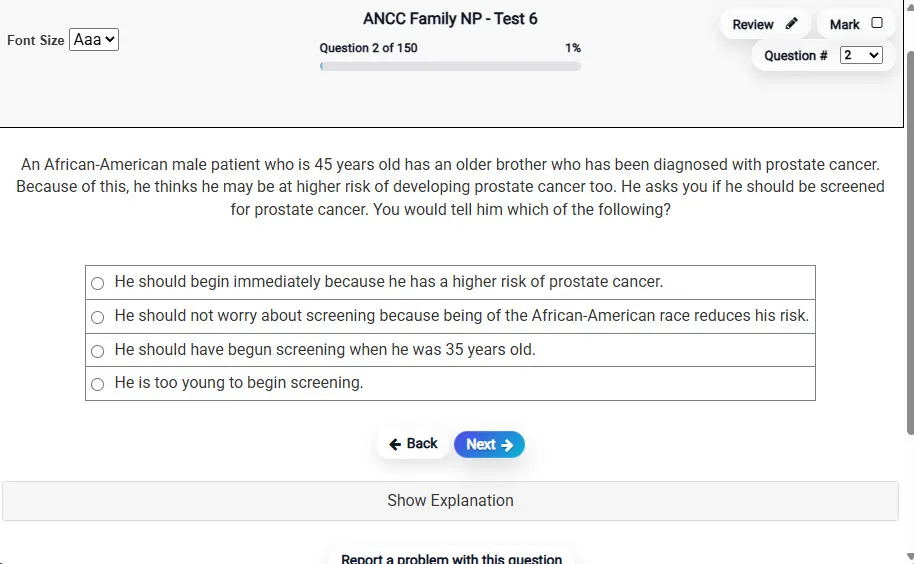
Answering a Question screen – Multiple-choice item view with navigation controls and progress tracker.
Answering a Question Multiple-choice item view with navigation controls and progress tracker.

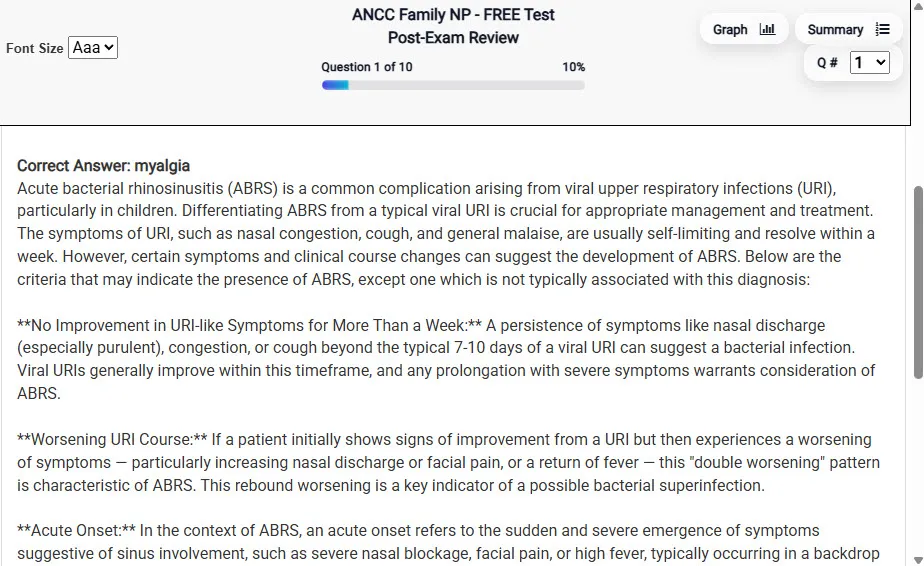
                           Detailed Explanation screen – 
                         Review mode showing chosen answer and rationale and references.
Detailed Explanation Review mode showing chosen answer and rationale and references.

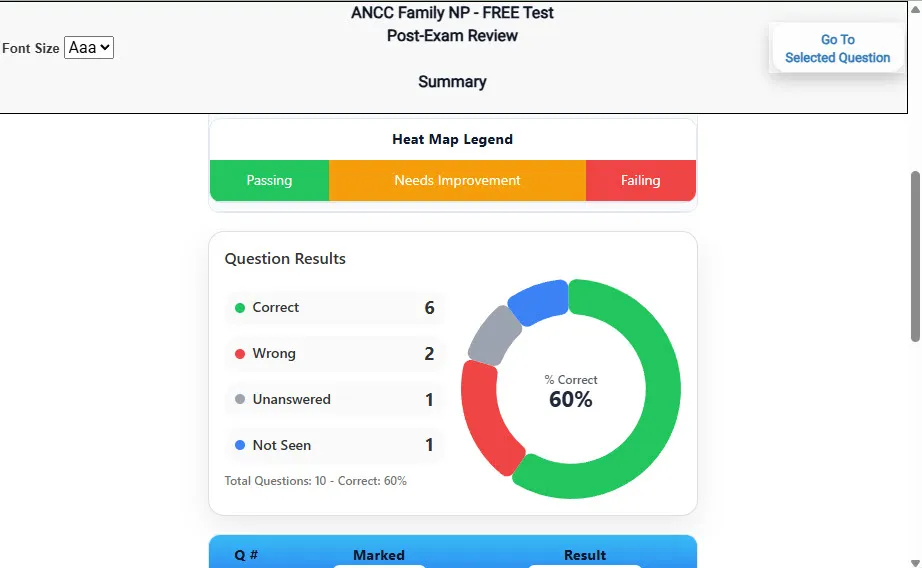
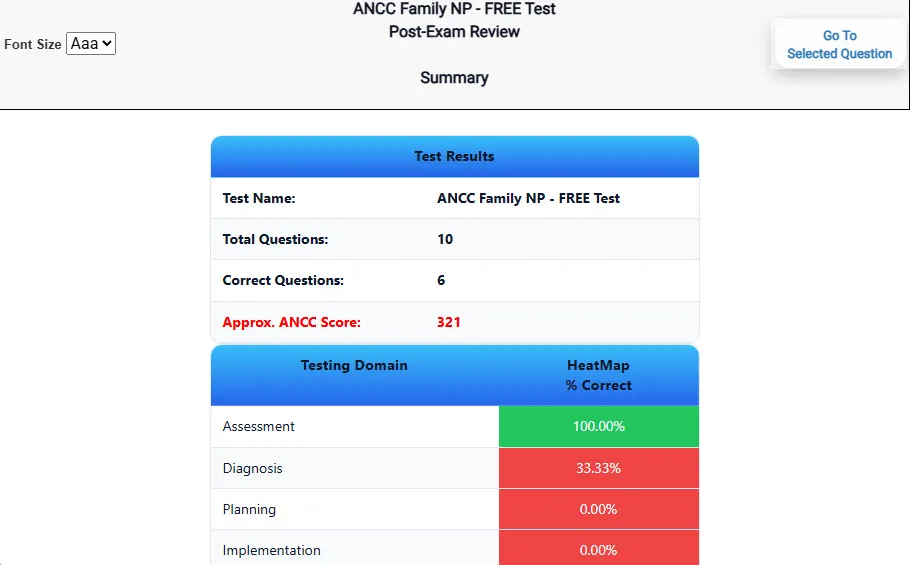
                           Review Summary 1 screen – 
                         Summary with counts for correct/wrong/unanswered and not seen items.
Review Summary 1 Summary with counts for correct/wrong/unanswered and not seen items.

                           Review Summary 2 screen – 
                         Advanced summary with category/domain breakdown and performance insights.
Review Summary 2 Advanced summary with category/domain breakdown and performance insights.

What Each Screen Shows

Answer Question Screen

  • Clean multiple-choice interface with progress bar.
  • Mark for review feature.
  • Matches real test pacing.

Detailed Explanation

  • Correct answer plus rationale.
  • Key concepts and guidelines highlighted.
  • Move between questions to fill knowledge gaps.

Review Summary 1

  • Overall results with total questions and scaled score.
  • Domain heatmap shows strengths and weaknesses.
  • Quick visual feedback on study priorities.

Review Summary 2

  • Chart of correct, wrong, unanswered, not seen.
  • Color-coded results for easy review.
  • Links back to missed items.

Top 10 Reasons to Use Exam Edge for your AHIMA Registered Health Information Administrator Exam Prep

  1. Focused on the AHIMA Registered Health Information Administrator Exam

    Our practice tests are built specifically for the AHIMA Reg Health Info Admin exam — every question mirrors the real topics, format, and difficulty so you're studying exactly what matters.

  2. Real Exam Simulation

    We match the per-question time limits and pressure of the actual RHIA exam, so test day feels familiar and stress-free.

  3. 1 Full Practice Tests & 130 Unique Questions

    You'll have more than enough material to master every AHIMA Reg Health Info Admin concept — no repeats, no fluff.

  4. Lower Cost Than a Retake

    Ordering 5 practice exams costs less than retaking the AHIMA Registered Health Information Administrator exam after a failure. One low fee could save you both time and money.

  5. Flexible Testing

    Need to step away mid-exam? Pick up right where you left off — with your remaining time intact.

  6. Instant Scoring & Feedback

    See your raw score and an estimated AHIMA Registered Health Information Administrator score immediately after finishing each practice test.

  7. Detailed Explanations for Every Question

    Review correct and incorrect answers with clear, step-by-step explanations so you truly understand each topic.

  8. Trusted & Accredited

    We're fully accredited by the Better Business Bureau and uphold the highest standards of trust and transparency.

  9. Web-Based & Always Available

    No software to install. Access your AHIMA Reg Health Info Admin practice exams 24/7 from any computer or mobile device.

  10. Expert Support When You Need It

    Need extra help? Our specialized tutors are highly qualified and ready to support your RHIA exam prep.


Pass the AHIMA Registered Health Information Administrator Exam with Realistic Practice Tests from Exam Edge

Preparing for your upcoming AHIMA Registered Health Information Administrator (RHIA) Certification Exam can feel overwhelming — but the right practice makes all the difference. Exam Edge gives you the tools, structure, and confidence to pass on your first try. Our online practice exams are built to match the real AHIMA Reg Health Info Admin exam in content, format, and difficulty.

  • 📝 1 AHIMA Registered Health Information Administrator Practice Tests: Access 1 full-length exams with 130 questions each, covering every major AHIMA Registered Health Information Administrator topic in depth.
  • Instant Online Access: Start practicing right away — no software, no waiting.
  • 🧠 Step-by-Step Explanations: Understand the reasoning behind every correct answer so you can master AHIMA Reg Health Info Admin exam concepts.
  • 🔄 Retake Each Exam Up to 4 Times: Build knowledge through repetition and track your improvement over time.
  • 🌐 Web-Based & Available 24/7: Study anywhere, anytime, on any device.
  • 🧘 Boost Your Test-Day Confidence: Familiarity with the RHIA format reduces anxiety and helps you perform under pressure.

These AHIMA Registered Health Information Administrator practice exams are designed to simulate the real testing experience by matching question types, timing, and difficulty level. This approach helps you get comfortable not just with the exam content, but also with the testing environment, so you walk into your exam day focused and confident.


Exam Edge AHIMA Reviews


This a good training material. However, it is not quite CCS format. Too many billing related questions, for instance. Still, I am happy with the purchase - no regrets whatsoever, and would recommend it as an additional prep to CCS.

Tatyana, San Francisco, California


AHIMA Registered Health Information Administrator Aliases Test Name

Here is a list of alternative names used for this exam.

  • AHIMA Registered Health Information Administrator
  • AHIMA Registered Health Information Administrator test
  • AHIMA Registered Health Information Administrator Certification Test
  • AHIMA Reg Health Info Admin test
  • AHIMA
  • AHIMA RHIA
  • RHIA test
  • AHIMA Registered Health Information Administrator (RHIA)
  • Registered Health Information Administrator certification