This is the content of the pop-over!

Lightning Deal Alert – 12% Off Ends at Midnight!

Strike while the savings are hot! Use promo code FlashSale at checkout for 12% off any Exam Edge test or bundle. Hurry—the clock is ticking!

FTCE Chemistry (003) Practice Tests & Test Prep by Exam Edge


FTCE Chemistry 6-12  product image
(4.8)
Based on 20 Reviews

  • Real Exam Simulation: Timed questions and matching content build comfort for your FTCE Chemistry test day.
  • Instant, 24/7 Access: Web-based FTCE Chemistry 6-12 practice exams with no software needed.
  • Clear Explanations: Step-by-step answers and explanations for your FTCE exam to strengthen understanding.
  • Boosted Confidence: Reduces anxiety and improves test-taking skills to ace your FTCE Chemistry 6-12 (003).

Featured on

FTCE Chemistry 6-12 Online Practice Test Bundles

BEST VALUE
15 practice tests

$149.25

$599.25

SAVE $450

Only $9.95 per test!

  • 100% Pass Guarantee
  • 15 online practice tests
  • 85 questions per test
  • Bonus: 100 Flash Cards + Study Guide
  • Instant access
  • Detailed Explanations
  • Practice tests never expire
  • Timed, untimed, or study guide mode
MOST POPULAR
10 practice tests

$99.50

$399.50

SAVE $300

Only $9.95 per test!

  • 10 online practice tests
  • 85 questions per test
  • Bonus: 100 Flash Cards + Study Guide
  • Instant access
  • Detailed Explanations
  • Practice tests never expire
  • Timed, untimed, or study guide mode
5 practice tests

$69.75

$199.75

SAVE $130

Only $13.95 per test!

  • 5 online practice tests
  • 85 questions per test
  • Bonus: 100 Flash Cards
  • Instant access
  • Detailed Explanations
  • Practice tests never expire
  • Timed, untimed, or study guide mode
1 practice test

$39.95

  • 1 online practice test
  • 85 questions per test
  • Instant access
  • Detailed Explanations
  • Practice tests never expire
  • Timed, untimed, or study guide mode
Quick Select
Tap to choose a bundle

** All Prices are in US Dollars (USD) **


FTCE Chemistry (003) Resources

Jump to the section you need most.

Understanding the exact breakdown of the FTCE Chemistry 6-12 test will help you know what to expect and how to most effectively prepare. The FTCE Chemistry 6-12 has 85 multiple-choice questions . The exam will be broken down into the sections below:

FTCE Chemistry 6-12 Exam Blueprint
Domain Name % Number of
Questions
Knowledge of the nature of matter 10% 9
Knowledge of energy and its interaction with matter 14% 12
Knowledge of bonding and molecular structure 18% 15
Knowledge of chemical reactions and stoichiometry 21% 18
Knowledge of atomic theory and structure 12% 10
Knowledge of the nature of science 10% 9
Knowledge of measurement 10% 9
Knowledge of appropriate laboratory use and procedures 5% 4

FTCE Chemistry 6-12 Study Tips by Domain

  • Classify matter by physical state and particle model (solid/liquid/gas) and predict how changing temperature/pressure shifts behavior; red flag: treating gases as having fixed volume or “no mass.”
  • Differentiate pure substances (elements/compounds) from mixtures (homogeneous/heterogeneous) and choose a separation method; common trap: calling a solution a compound or using filtration to separate dissolved solute.
  • Identify physical vs. chemical properties/changes and justify with evidence; cue: color change or bubbles alone don’t prove a chemical reaction without new substance indicators (e.g., precipitate, gas ID, energy change).
  • Use phase-change vocabulary (melting, vaporization, sublimation, deposition) and read heating/cooling curves; priority rule: during a phase change temperature stays constant while energy changes as latent heat.
  • Apply intermolecular forces (London, dipole–dipole, hydrogen bonding) to explain boiling point, viscosity, surface tension, and solubility; red flag: assuming stronger bonds always mean higher boiling point without considering IMF type.
  • Relate density to mass/volume and to floating/sinking and mixture layers; threshold cue: check units (g/mL vs g/cm3) and watch for temperature dependence when comparing densities.
  • Distinguish endothermic vs exothermic processes from a potential energy diagram—red flag: students often label ΔH by the activation energy instead of products minus reactants.
  • Apply calorimetry with q = mcΔT and q = nΔH—common trap: forgetting that qsystem = −qsurroundings when the water (calorimeter) gains heat.
  • Use Hess’s Law to add reactions and enthalpies consistently—priority rule: if you reverse a reaction, you must change the sign of ΔH; if you multiply coefficients, you must multiply ΔH.
  • Relate temperature change to kinetic energy and phase change to potential energy—contraindication: during melting/boiling, temperature stays constant even though heat is added/removed.
  • Analyze heat transfer mechanisms (conduction, convection, radiation) in lab contexts—red flag: metal feels “colder” because it conducts heat away faster, not because it has a lower temperature.
  • Connect photon energy to electromagnetic radiation using E = hν and c = λν—common trap: higher frequency means higher energy and shorter wavelength (not longer).
  • Use electronegativity differences to predict bond type and polarity; red flag: confusing polar covalent with ionic when values are intermediate (check for partial charges and dipole direction).
  • Draw Lewis structures with correct total valence electrons and formal charges; common trap: giving second-row elements (C, N, O, F) expanded octets or missing lone pairs.
  • Apply VSEPR to determine molecular geometry and bond angles; priority rule: count electron domains (bonding + lone pairs) because lone pairs compress angles and change shape.
  • Identify hybridization and associated geometries (sp, sp2, sp3); red flag: assigning hybridization by counting atoms instead of regions of electron density around the central atom.
  • Use molecular geometry to decide overall molecular polarity; common trap: assuming any polar bond makes the molecule polar even when dipoles cancel in symmetric shapes (e.g., CO2, CF4).
  • Compare intermolecular forces (London, dipole–dipole, hydrogen bonding) to predict trends in boiling point and solubility; threshold cue: H-bonding requires H bonded to N, O, or F—not just the presence of those atoms.
  • Balance equations by conserving atoms and net charge; red flag: changing subscripts (not coefficients) to “make it balance.”
  • Convert mass → moles → moles → mass using molar mass and coefficients; common trap: skipping the mole ratio step when units seem to “cancel.”
  • Identify limiting reactant by comparing required moles (or theoretical yield from each reactant); priority rule: the smaller theoretical yield determines the limiting reactant.
  • Compute percent yield = (actual/theoretical)×100 and interpret values; red flag: yields >100% usually indicate impure product, wet crystals, or measurement error.
  • Classify reactions (synthesis, decomposition, single/double replacement, combustion) and predict products using activity series/solubility rules; common trap: writing ions that form soluble salts as precipitates.
  • Handle solution stoichiometry with M = mol/L and dilution M1V1 = M2V2; red flag: using total solution volume after mixing when the question asks for moles delivered from a specific aliquot.
  • Use atomic number (Z) to identify an element and mass number (A) to count nucleons; red flag: confusing A with average atomic mass from the periodic table.
  • Compute average atomic mass via weighted isotopic abundances (fractional abundance × isotopic mass); common trap: using percent values without converting to decimals.
  • Write electron configurations using Aufbau, Pauli, and Hund’s rule; priority rule: fill 4s before 3d, but remember transition-metal ions lose 4s electrons first (common exam pitfall).
  • Relate quantum numbers (n, l, ml, ms) to orbitals and electron capacity; red flag: assigning l values outside 0 to n−1 or exceeding 2 electrons per orbital.
  • Determine periodic trends (atomic radius, ionization energy, electronegativity) from effective nuclear charge and shielding; common trap: assuming ionization energy always increases down a group (it generally decreases).
  • Interpret atomic spectra and photon energy with E = hν and c = λν; red flag: reversing frequency and wavelength trends (shorter λ means higher ν and higher energy).
  • Differentiate observation vs inference and hypothesis vs theory vs law; red flag: calling a theory a “guess” or claiming laws “become” theories with more evidence.
  • Use experimental design logic (independent/dependent variables, constants, control group) to test causal claims; common trap: changing more than one variable and still attributing cause.
  • Identify sources of error and uncertainty (systematic vs random) and how they affect accuracy vs precision; cue: multiple trials reduce random error but do not fix systematic bias.
  • Evaluate evidence quality using replication, peer review, and reproducibility; priority rule: extraordinary claims require strong, repeatable data, not a single trial.
  • Interpret scientific models (particle, atomic, energy diagrams) as tools with limits; contraindication: treating models as literal reality when the question asks about assumptions or scope.
  • Apply scientific reasoning to claims in context (correlation vs causation, sampling bias, confounding variables); red flag: concluding a cause from a trend line without a mechanism or controlled test.
  • Use significant-figure rules consistently: for multiplication/division keep the fewest sig figs; for addition/subtraction round to the least decimal place (trap: rounding mid-calculation instead of at the end).
  • Convert units with dimensional analysis and cancel units every step (red flag: a final unit that doesn’t match the question, e.g., g/mL when mol/L is required).
  • Apply metric prefixes and scientific notation accurately (common trap: confusing milli- (10−3) with micro- (10−6) or misplacing the decimal in exponent moves).
  • Distinguish accuracy vs precision and interpret percent error vs percent difference (priority rule: percent error uses an accepted value; percent difference compares two experimental values).
  • Read instruments correctly: record one estimated digit beyond the smallest marked increment and include units (red flag: reporting a balance reading without the last uncertain digit or without units).
  • Handle uncertainty and propagation: report results with appropriate sig figs and, when adding/subtracting measurements, combine absolute uncertainties rather than percent (trap: mixing relative and absolute uncertainty rules).
  • Follow the hierarchy of controls in lab safety—substitute/engineer/administrative/PPE—and treat “PPE only” as a red flag when a fume hood or splash shield is required.
  • Use the fume hood for volatile, toxic, or corrosive chemicals; common trap: thinking a hood is for storage—keep it uncluttered and work 6–8 inches inside with the sash at the marked safe height.
  • Know core spill/accident responses (flush eyewash/safety shower 15 minutes; remove contaminated clothing) and prioritize “people first, then containment” as the rule when minutes matter.
  • Handle acids/bases correctly—always add acid to water (AAW)—and treat rapid heat release or splattering during dilution as an immediate stop-and-reassess cue.
  • Use proper labeling and chemical compatibility in storage/disposal (segregate acids from bases; oxidizers from organics; keep flammables in approved cabinets); a common trap is mixing incompatible waste streams “because it’s dilute.”
  • Apply correct glassware/equipment procedures (never pipet by mouth; use a bulb/pump; inspect glassware for star cracks) and treat using a volumetric flask for heating as a contraindication.


Built to Fit Into Your Busy Life

Everything you need to prepare with confidence—without wasting a minute.

Three Study Modes

Timed, No Time Limit, or Explanation mode.

Actionable Analytics

Heatmaps and scaled scores highlight weak areas.

High-Yield Rationales

Concise explanations emphasize key concepts.

Realistic Interface

Matches the feel of the actual exam environment.

Accessible by Design

Clean layout reduces cognitive load.

Anytime, Anywhere

Web-based access 24/7 on any device.
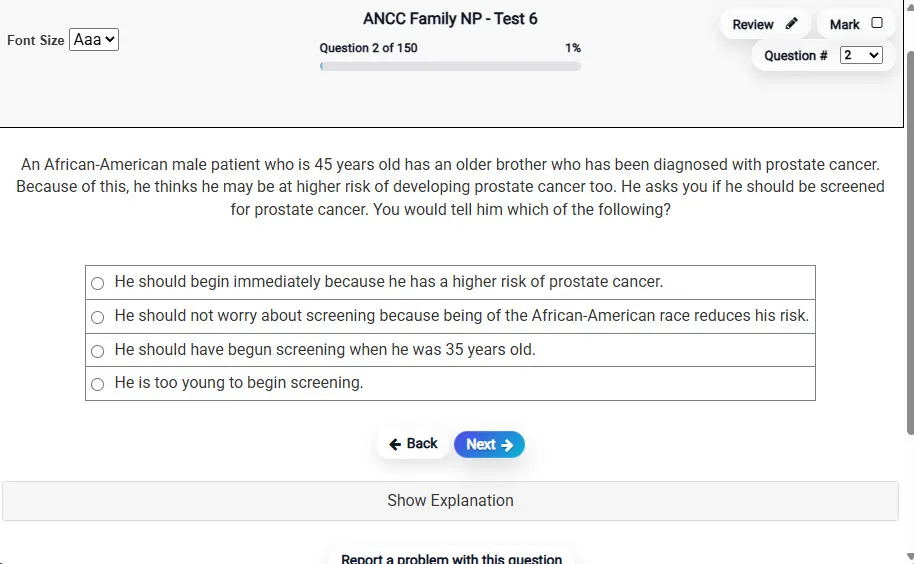
Answering a Question screen – Multiple-choice item view with navigation controls and progress tracker.
Answering a Question Multiple-choice item view with navigation controls and progress tracker.

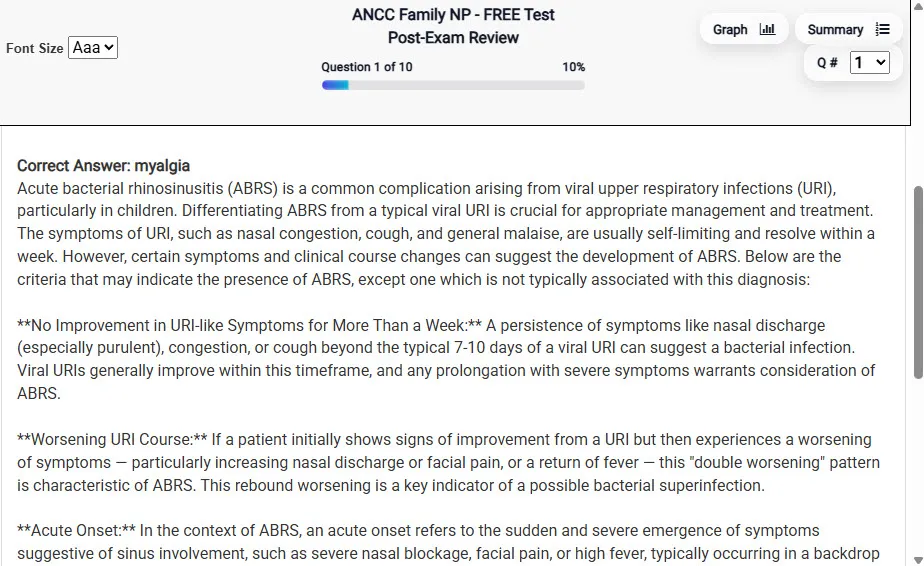
                           Detailed Explanation screen – 
                         Review mode showing chosen answer and rationale and references.
Detailed Explanation Review mode showing chosen answer and rationale and references.

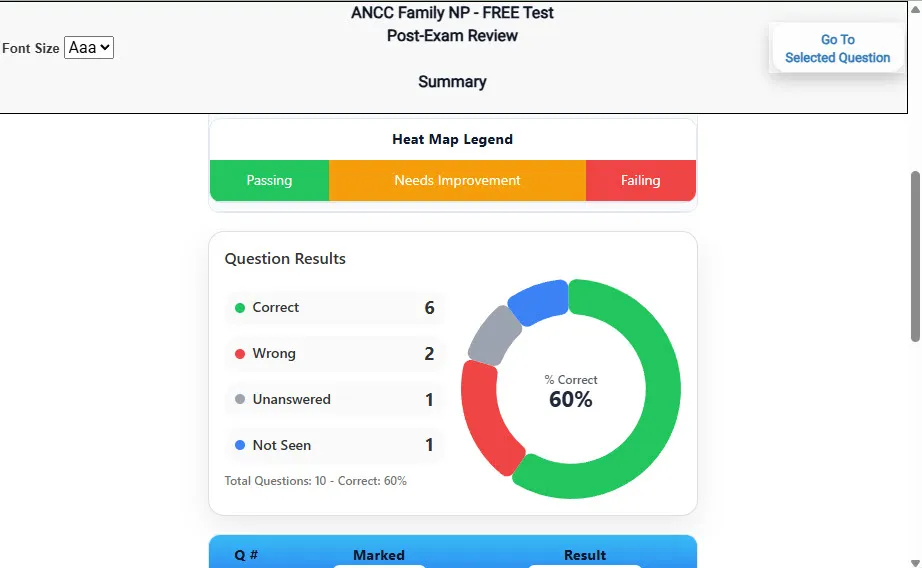
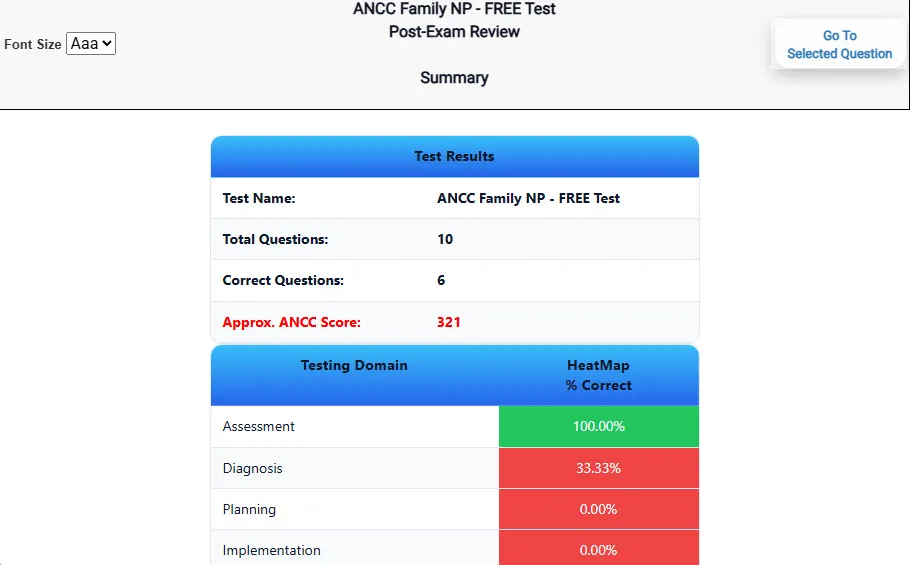
                           Review Summary 1 screen – 
                         Summary with counts for correct/wrong/unanswered and not seen items.
Review Summary 1 Summary with counts for correct/wrong/unanswered and not seen items.

                           Review Summary 2 screen – 
                         Advanced summary with category/domain breakdown and performance insights.
Review Summary 2 Advanced summary with category/domain breakdown and performance insights.

What Each Screen Shows

Answer Question Screen

  • Clean multiple-choice interface with progress bar.
  • Mark for review feature.
  • Matches real test pacing.

Detailed Explanation

  • Correct answer plus rationale.
  • Key concepts and guidelines highlighted.
  • Move between questions to fill knowledge gaps.

Review Summary 1

  • Overall results with total questions and scaled score.
  • Domain heatmap shows strengths and weaknesses.
  • Quick visual feedback on study priorities.

Review Summary 2

  • Chart of correct, wrong, unanswered, not seen.
  • Color-coded results for easy review.
  • Links back to missed items.

Top 10 Reasons to Use Exam Edge for your FTCE Chemistry 6-12 Exam Prep

  1. Focused on the FTCE Chemistry 6-12 Exam

    Our practice tests are built specifically for the FTCE Chemistry exam — every question mirrors the real topics, format, and difficulty so you're studying exactly what matters.

  2. Real Exam Simulation

    We match the per-question time limits and pressure of the actual FTCE exam, so test day feels familiar and stress-free.

  3. 15 Full Practice Tests & 1,275 Unique Questions

    You'll have more than enough material to master every FTCE Chemistry concept — no repeats, no fluff.

  4. Lower Cost Than a Retake

    Ordering 5 practice exams costs less than retaking the FTCE Chemistry 6-12 exam after a failure. One low fee could save you both time and money.

  5. Flexible Testing

    Need to step away mid-exam? Pick up right where you left off — with your remaining time intact.

  6. Instant Scoring & Feedback

    See your raw score and an estimated FTCE Chemistry 6-12 score immediately after finishing each practice test.

  7. Detailed Explanations for Every Question

    Review correct and incorrect answers with clear, step-by-step explanations so you truly understand each topic.

  8. Trusted & Accredited

    We're fully accredited by the Better Business Bureau and uphold the highest standards of trust and transparency.

  9. Web-Based & Always Available

    No software to install. Access your FTCE Chemistry practice exams 24/7 from any computer or mobile device.

  10. Expert Support When You Need It

    Need extra help? Our specialized tutors are highly qualified and ready to support your FTCE exam prep.


Pass the FTCE Chemistry 6-12 Exam with Realistic Practice Tests from Exam Edge

Preparing for your upcoming FTCE Chemistry 6-12 (003) Certification Exam can feel overwhelming — but the right practice makes all the difference. Exam Edge gives you the tools, structure, and confidence to pass on your first try. Our online practice exams are built to match the real FTCE Chemistry exam in content, format, and difficulty.

  • 📝 15 FTCE Chemistry 6-12 Practice Tests: Access 15 full-length exams with 85 questions each, covering every major FTCE Chemistry 6-12 topic in depth.
  • Instant Online Access: Start practicing right away — no software, no waiting.
  • 🧠 Step-by-Step Explanations: Understand the reasoning behind every correct answer so you can master FTCE Chemistry exam concepts.
  • 🔄 Retake Each Exam Up to 4 Times: Build knowledge through repetition and track your improvement over time.
  • 🌐 Web-Based & Available 24/7: Study anywhere, anytime, on any device.
  • 🧘 Boost Your Test-Day Confidence: Familiarity with the FTCE format reduces anxiety and helps you perform under pressure.

These FTCE Chemistry 6-12 practice exams are designed to simulate the real testing experience by matching question types, timing, and difficulty level. This approach helps you get comfortable not just with the exam content, but also with the testing environment, so you walk into your exam day focused and confident.


Exam Edge FTCE Reviews


The practice has really helped me prepare to be successful on the real exam.

Gary , Lakeland, FL

Just wanted to let you guys know that your tests really helped me prepare for the ftce math exam. I took it yesterday and passed. I will tell other people about your site.

Shawna M, Florida

I passed my FTCE today! This was the second time I took the test. My first time I scored 192 and then I took your tests and passed on my second try. Taking your practice tests helped me a great deal, because several types of questions on the real test were also on your practice tests. Thanks so mu ...
Read More
TIm F, Florida

For the last year, I have been trying to pass the reading section of the FTCE. I had taken it six times and if I did not pass it this month, then I could not take my college courses in education. I went to Google and typed in practice reading tests and your website came up. I clicked on, signed up a ...
Read More
Stacy S, Florida

Thank you so much for your reading tests. I just passed the real FTCE Reading test by 12 points! After failing it 3 other times, I thought I would have to quit. I've already told everyone in my class about your site.

Sara L, Florida

Thank you for all the biology practice. Your tests were exactly what I needed to pass! I recommended your website to my friends.

Ashley K., Kingsport


FTCE Chemistry 6-12 Aliases Test Name

Here is a list of alternative names used for this exam.

  • FTCE Chemistry 6-12
  • FTCE Chemistry 6-12 test
  • FTCE Chemistry 6-12 Certification Test
  • FTCE Chemistry test
  • FTCE
  • FTCE 003
  • 003 test
  • FTCE Chemistry 6-12 (003)
  • Chemistry 6-12 certification