This is the content of the pop-over!

NYSTCE CST Technology Education (118) Practice Tests & Test Prep by Exam Edge


NYSTCE Technology Education  product image
(4.8)
Based on 34 Reviews

  • Real Exam Simulation: Timed questions and matching content build comfort for your NYSTCE CST Technology Education test day.
  • Instant, 24/7 Access: Web-based NYSTCE Technology Education practice exams with no software needed.
  • Clear Explanations: Step-by-step answers and explanations for your NYSTCE exam to strengthen understanding.
  • Boosted Confidence: Reduces anxiety and improves test-taking skills to ace your NYSTCE Technology Education (118).

Featured on

NYSTCE Technology Education Online Practice Test Bundles

BEST VALUE
15 practice tests

$149.25

$599.25

SAVE $450

Only $9.95 per test!

  • 100% Pass Guarantee
  • 15 online practice tests
  • 90 questions per test
  • Bonus: 100 Flash Cards + Study Guide
  • Instant access
  • Detailed Explanations
  • Practice tests never expire
  • Timed, untimed, or study guide mode
MOST POPULAR
10 practice tests

$99.50

$399.50

SAVE $300

Only $9.95 per test!

  • 10 online practice tests
  • 90 questions per test
  • Bonus: 100 Flash Cards + Study Guide
  • Instant access
  • Detailed Explanations
  • Practice tests never expire
  • Timed, untimed, or study guide mode
5 practice tests

$69.75

$199.75

SAVE $130

Only $13.95 per test!

  • 5 online practice tests
  • 90 questions per test
  • Bonus: 100 Flash Cards
  • Instant access
  • Detailed Explanations
  • Practice tests never expire
  • Timed, untimed, or study guide mode
1 practice test

$39.95

  • 1 online practice test
  • 90 questions per test
  • Instant access
  • Detailed Explanations
  • Practice tests never expire
  • Timed, untimed, or study guide mode
Quick Select
Tap to choose a bundle

** All Prices are in US Dollars (USD) **


NYSTCE CST Technology Education (118) Resources

Jump to the section you need most.

Understanding the exact breakdown of the NYSTCE Technology Education test will help you know what to expect and how to most effectively prepare. The NYSTCE Technology Education has 90 multiple-choice questions and 1 essay questions. The exam will be broken down into the sections below:

NYSTCE Technology Education Exam Blueprint
Domain Name % Number of
Questions
Fundamentals of Technology and Engineering Education 16% 14
Technological and Engineering Design 16% 14
Manufacturing - Construction Materials 14% 13
Information and Communication 12% 11
Transportation and Energy 13% 12
Biotechnology and Environmental Quality 9% 8
Pedagogical Content Knowledge 20% 18

NYSTCE Technology Education Study Tips by Domain

  • Differentiate technology (human-made solutions) from science (natural phenomena) and engineering (design under constraints); red flag: treating “technology” as synonymous with computers only.
  • Apply core systems thinking (inputs–processes–outputs–feedback) to analyze devices and processes; common trap: ignoring feedback/control elements when explaining system performance.
  • Use measurement, units, and precision appropriately (SI and customary, tolerances, significant figures); priority rule: never report a measurement more precise than the tool allows.
  • Interpret and produce technical communication (sketches, orthographic/isometric views, schematics, symbols); red flag: confusing a pictorial drawing with a working/engineering drawing that needs dimensions and notes.
  • Follow safety, health, and regulatory practices in labs/shops (PPE, guarding, lockout/tagout concepts, chemical/thermal/electrical hazards); contraindication: bypassing a guard or using damaged cords—stop and correct before operation.
  • Connect materials properties and basic mechanics (stress/strain, compression vs. tension, friction, simple machines) to technology applications; common trap: selecting a material by appearance/cost without checking required strength, stiffness, or heat/chemical resistance.
  • Use an iterative design process (define problem → criteria/constraints → brainstorm → prototype → test → refine) and document each iteration; red flag: jumping to a single “best” idea without stated constraints or evidence from testing.
  • Write measurable criteria and realistic constraints (cost, time, safety, materials, user needs) before selecting a solution; common trap: using vague criteria like “works well” that can’t be evaluated.
  • Select appropriate modeling methods (sketches, CAD, physical models, simulations) to predict performance prior to building; priority rule: validate critical assumptions early to avoid costly redesign later.
  • Plan and run fair tests with controlled variables, repeat trials, and clear data tables/graphs; red flag: changing multiple variables at once and claiming causation.
  • Apply risk assessment and safety constraints (tool use, guarding, PPE, electrical/chemical hazards) as nonnegotiable design requirements; contraindication: proceeding with a prototype that lacks a documented safety check.
  • Communicate design solutions with technical drawings/specifications (dimensions, tolerances, materials, process steps) and justify trade-offs using data; common trap: presenting an attractive prototype without specs that allow replication.
  • Differentiate manufacturing processes (casting, forming, machining, joining, additive) and match them to material properties and tolerances; red flag: choosing a process that can’t meet required tolerance/finish without excessive secondary operations.
  • Apply construction measurement, layout, and codes (plans, symbols, fasteners, framing) with safety/compliance in mind; common trap: ignoring local code constraints (e.g., fire rating, egress, load path) when proposing a build.
  • Select materials (wood, metals, polymers, composites, masonry) based on strength, durability, corrosion/rot resistance, and environment; priority rule: material choice must align with service conditions (moisture, UV, temperature) not just cost.
  • Use appropriate tools/machines and guarding for shop and construction tasks (PPE, lockout/tagout, ventilation, dust control); red flag: operating without proper guarding or control of particulates (silica/wood dust) in enclosed spaces.
  • Interpret and create basic manufacturing/construction documentation (working drawings, cut lists, process plans, bills of materials) and maintain quality control; common trap: incomplete specs (units, tolerances, grain direction, fastener type) leading to rework.
  • Evaluate sustainability impacts in materials and construction (life-cycle, waste minimization, recycling, embodied energy) and propose safer alternatives; threshold cue: if a material/process introduces hazardous waste or VOC exposure, you must specify mitigation or substitution.
  • Differentiate analog vs. digital signals and basic encoding concepts; red flag: treating sampling and quantization as the same step when explaining digitization.
  • Apply networking fundamentals (LAN/WAN, bandwidth, latency, protocols); common trap: assuming higher bandwidth always means faster performance when latency or congestion is the bottleneck.
  • Explain data representation (bits/bytes, number systems, ASCII/Unicode, compression); priority rule: show conversions clearly (e.g., binary/hex) and state assumptions about units (KB vs. KiB).
  • Use information literacy and cybersecurity practices (authentication, encryption, backups, least privilege); red flag: recommending “security by obscurity” or sharing credentials for convenience.
  • Address legal/ethical issues (copyright, fair use, licensing, privacy); common trap: assuming anything found online is free to reuse in student projects without attribution or permission.
  • Evaluate communication technologies for classroom and lab use (presentation, collaboration, assistive tech, accessibility); priority rule: verify ADA-style accessibility needs (captions, contrast, alt text) before choosing a tool.
  • Distinguish energy forms and transfers (kinetic, potential, thermal, electrical) using conservation of energy; red flag: claiming energy is “used up” rather than transformed with losses to heat.
  • Compare transportation modes (road, rail, air, water) by efficiency, capacity, safety, and infrastructure; common trap: ignoring how rolling resistance and aerodynamic drag dominate energy use at higher speeds.
  • Interpret powertrain basics (ICE, hybrid, battery electric, fuel cell) and key metrics (torque, horsepower, efficiency); priority rule: always state units and conditions (e.g., kW at the shaft vs. fuel energy input).
  • Explain electrical energy systems for transportation (batteries, charging, motors, regenerative braking); contraindication: treating regen as “free energy” instead of limited by traction, battery acceptance, and conversion losses.
  • Apply energy production and distribution concepts (grid, renewables, storage, transmission) to transportation impacts; threshold cue: use well-to-wheel (or life-cycle) analysis when comparing fuels to avoid tailpipe-only conclusions.
  • Address safety and regulations in transportation/energy labs (lockout/tagout, high-voltage systems, fuel handling, ventilation); red flag: bypassing guards or PPE because a system is “low current” despite hazardous voltage.
  • Compare traditional breeding, genetic engineering, and cloning in terms of goals, constraints, and impacts; red flag: conflating gene therapy (individual treatment) with germline modification (heritable change).
  • Apply microbiology and bioprocess basics (sterile technique, fermentation, bioreactors, scaling) to classroom scenarios; common trap: assuming lab-scale yield or purity automatically translates to industrial scale without process controls.
  • Evaluate environmental systems using cycles (carbon, nitrogen, water) and energy flow; priority rule: always track system boundaries and inputs/outputs before drawing cause-and-effect conclusions.
  • Interpret environmental quality data (pH, dissolved oxygen, turbidity, BOD/COD, nitrates/phosphates) for water/soil/air; red flag: using a single measurement to claim a trend without replication or calibration checks.
  • Assess pollution prevention and remediation options (source reduction, filtration, bioremediation, phytoremediation, containment) with trade-offs; contraindication: selecting a “green” method that introduces invasive species or secondary contamination.
  • Address ethics, safety, and regulation in biotech and environmental work (PPE, waste disposal, biosafety, risk communication); common trap: treating “natural” as inherently safe and skipping hazard analysis or proper labeling.
  • Plan instruction with measurable objectives aligned to NYS learning standards and explicit performance criteria; red flag: activities listed without stating what students must produce and how it will be scored.
  • Use safety and legal compliance as nonnegotiable routines (PPE, tool checkouts, lockout/tagout where applicable, accommodations); common trap: treating safety as a one-time lecture instead of assessed practice.
  • Differentiate for IEP/504/ELL through scaffolded CAD/technical reading supports and alternative demonstrations of competence; priority rule: maintain the same performance standard while varying access and supports.
  • Assess with technology-education-appropriate evidence (design notebooks, prototypes, lab data, critique protocols) using rubrics; red flag: grading mainly on effort/participation rather than documented process and specs.
  • Teach equity and inclusion in labs by structuring roles, rotations, and accountable talk; common trap: allowing “expert” students to dominate tools, reducing others’ hands-on time.
  • Integrate literacy, numeracy, and career readiness authentically (technical writing, tolerances/measurement, ethics, and CTSO-style documentation); red flag: add-on worksheets that don’t connect to the design/problem-solving task.


Built to Fit Into Your Busy Life

Everything you need to prepare with confidence—without wasting a minute.

Three Study Modes

Timed, No Time Limit, or Explanation mode.

Actionable Analytics

Heatmaps and scaled scores highlight weak areas.

High-Yield Rationales

Concise explanations emphasize key concepts.

Realistic Interface

Matches the feel of the actual exam environment.

Accessible by Design

Clean layout reduces cognitive load.

Anytime, Anywhere

Web-based access 24/7 on any device.
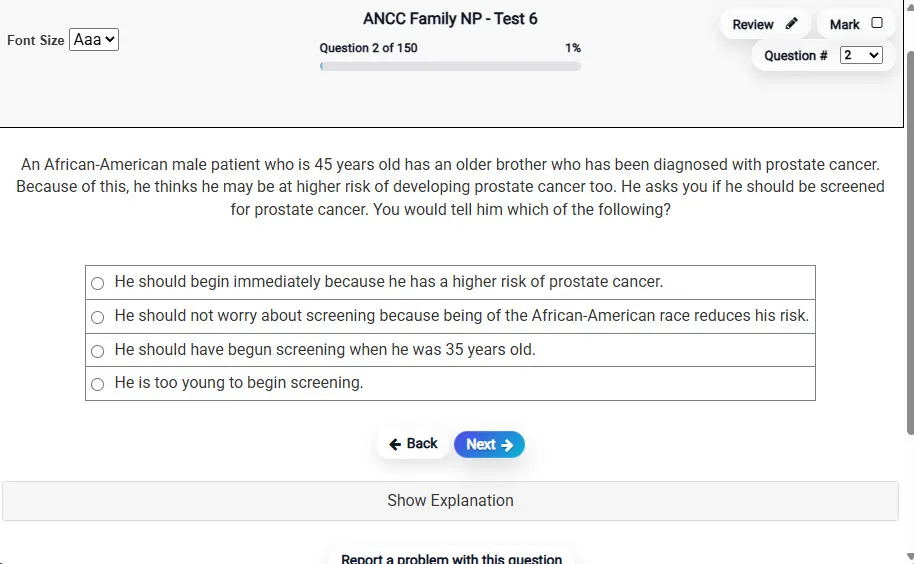
Answering a Question screen – Multiple-choice item view with navigation controls and progress tracker.
Answering a Question Multiple-choice item view with navigation controls and progress tracker.

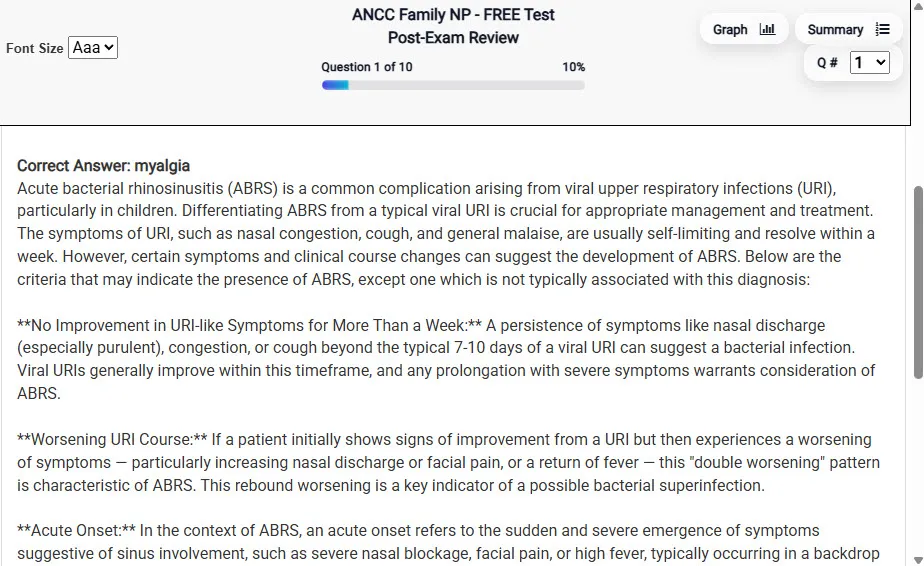
                           Detailed Explanation screen – 
                         Review mode showing chosen answer and rationale and references.
Detailed Explanation Review mode showing chosen answer and rationale and references.

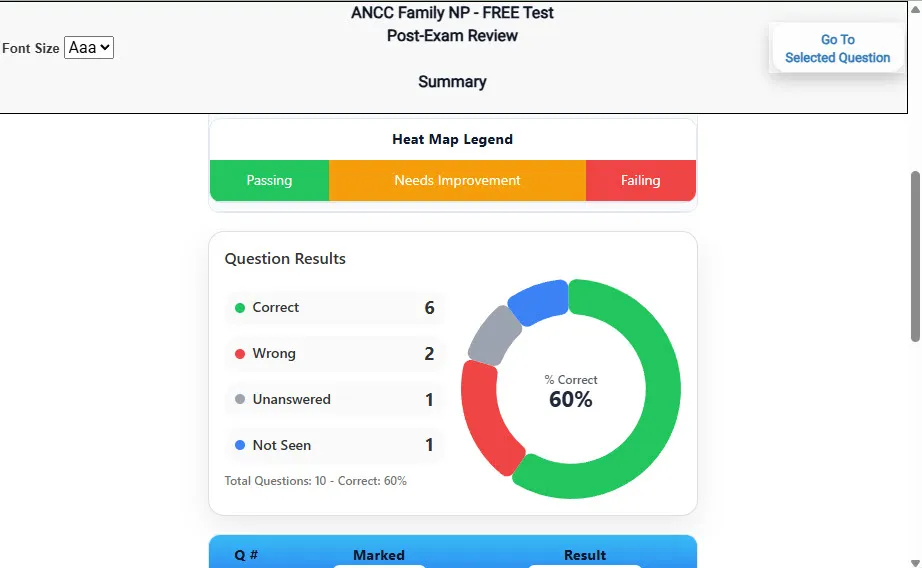
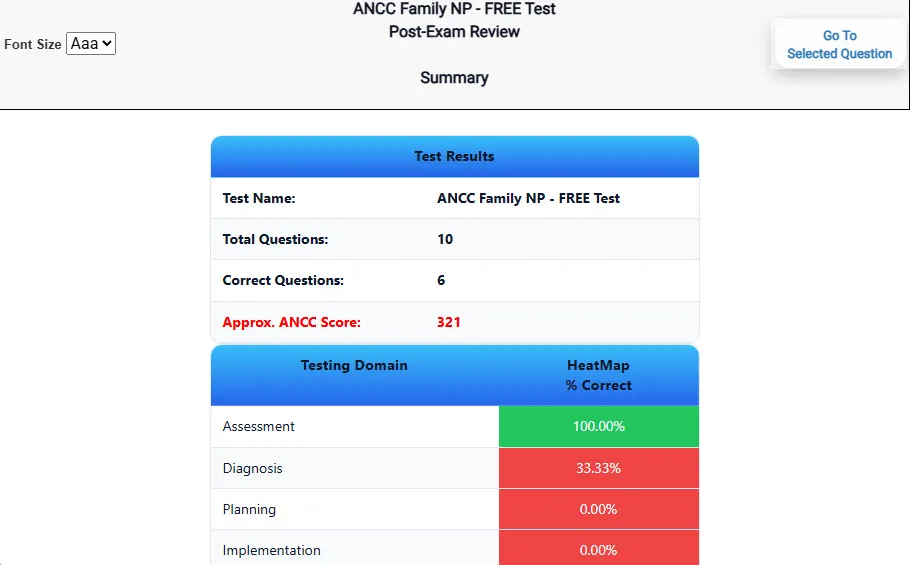
                           Review Summary 1 screen – 
                         Summary with counts for correct/wrong/unanswered and not seen items.
Review Summary 1 Summary with counts for correct/wrong/unanswered and not seen items.

                           Review Summary 2 screen – 
                         Advanced summary with category/domain breakdown and performance insights.
Review Summary 2 Advanced summary with category/domain breakdown and performance insights.

What Each Screen Shows

Answer Question Screen

  • Clean multiple-choice interface with progress bar.
  • Mark for review feature.
  • Matches real test pacing.

Detailed Explanation

  • Correct answer plus rationale.
  • Key concepts and guidelines highlighted.
  • Move between questions to fill knowledge gaps.

Review Summary 1

  • Overall results with total questions and scaled score.
  • Domain heatmap shows strengths and weaknesses.
  • Quick visual feedback on study priorities.

Review Summary 2

  • Chart of correct, wrong, unanswered, not seen.
  • Color-coded results for easy review.
  • Links back to missed items.

Top 10 Reasons to Use Exam Edge for your NYSTCE Technology Education Exam Prep

  1. Focused on the NYSTCE Technology Education Exam

    Our practice tests are built specifically for the NYSTCE CST Technology Education exam — every question mirrors the real topics, format, and difficulty so you're studying exactly what matters.

  2. Real Exam Simulation

    We match the per-question time limits and pressure of the actual NYSTCE exam, so test day feels familiar and stress-free.

  3. 15 Full Practice Tests & 1,350 Unique Questions

    You'll have more than enough material to master every NYSTCE CST Technology Education concept — no repeats, no fluff.

  4. Lower Cost Than a Retake

    Ordering 5 practice exams costs less than retaking the NYSTCE Technology Education exam after a failure. One low fee could save you both time and money.

  5. Flexible Testing

    Need to step away mid-exam? Pick up right where you left off — with your remaining time intact.

  6. Instant Scoring & Feedback

    See your raw score and an estimated NYSTCE Technology Education score immediately after finishing each practice test.

  7. Detailed Explanations for Every Question

    Review correct and incorrect answers with clear, step-by-step explanations so you truly understand each topic.

  8. Trusted & Accredited

    We're fully accredited by the Better Business Bureau and uphold the highest standards of trust and transparency.

  9. Web-Based & Always Available

    No software to install. Access your NYSTCE CST Technology Education practice exams 24/7 from any computer or mobile device.

  10. Expert Support When You Need It

    Need extra help? Our specialized tutors are highly qualified and ready to support your NYSTCE exam prep.


Pass the NYSTCE Technology Education Exam with Realistic Practice Tests from Exam Edge

Preparing for your upcoming NYSTCE Technology Education (118) Certification Exam can feel overwhelming — but the right practice makes all the difference. Exam Edge gives you the tools, structure, and confidence to pass on your first try. Our online practice exams are built to match the real NYSTCE CST Technology Education exam in content, format, and difficulty.

  • 📝 15 NYSTCE Technology Education Practice Tests: Access 15 full-length exams with 90 questions each, covering every major NYSTCE Technology Education topic in depth.
  • Instant Online Access: Start practicing right away — no software, no waiting.
  • 🧠 Step-by-Step Explanations: Understand the reasoning behind every correct answer so you can master NYSTCE CST Technology Education exam concepts.
  • 🔄 Retake Each Exam Up to 4 Times: Build knowledge through repetition and track your improvement over time.
  • 🌐 Web-Based & Available 24/7: Study anywhere, anytime, on any device.
  • 🧘 Boost Your Test-Day Confidence: Familiarity with the NYSTCE format reduces anxiety and helps you perform under pressure.

These NYSTCE Technology Education practice exams are designed to simulate the real testing experience by matching question types, timing, and difficulty level. This approach helps you get comfortable not just with the exam content, but also with the testing environment, so you walk into your exam day focused and confident.


Exam Edge NYSTCE Reviews


Not a user friendly experience

Amelia , Rochester, New York

Didn't really reflect the questions that were on the test for the most part. Also, they totally got the format of the constructed response question wrong, which never changes. Overall OK if you have nothing else, but definitely not worth the price they charge in my opinion.

Randy , Queens, New York

It was a good test run. Now I know what to expect and what I need to study.

Timothy , Eden, New York

The experience was very practical and I did well.

Trina , Silver Spring , MD

Very easy to navigate.

Collene , Silver Spring , MD

Exam Edge was terrific. Even better than I hoped. Just completing and reviewing the tests are a great learning experience. I can't wait to take the certification test. Tom S.

Thomas , Port Washington, NY


NYSTCE Technology Education Aliases Test Name

Here is a list of alternative names used for this exam.

  • NYSTCE Technology Education
  • NYSTCE Technology Education test
  • NYSTCE Technology Education Certification Test
  • NYSTCE CST Technology Education test
  • NYSTCE
  • NYSTCE 118
  • 118 test
  • NYSTCE Technology Education (118)
  • Technology Education certification