This is the content of the pop-over!

Safety Net Gifted Education CST (964) Practice Tests & Test Prep by Exam Edge


NYSTCE Safety Net Gifted Education CST   product image
(4.7)
Based on 25 Reviews

  • Real Exam Simulation: Timed questions and matching content build comfort for your Safety Net Gifted Education CST test day.
  • Instant, 24/7 Access: Web-based NYSTCE Safety Net Gifted Education CST practice exams with no software needed.
  • Clear Explanations: Step-by-step answers and explanations for your NYSTCE exam to strengthen understanding.
  • Boosted Confidence: Reduces anxiety and improves test-taking skills to ace your NYSTCE Safety Net Gifted Education CST (964).

Featured on

NYSTCE Safety Net Gifted Education CST Online Practice Test Bundles

BEST VALUE
10 practice tests

$99.50

$399.50

SAVE $300

Only $9.95 per test!

  • 100% Pass Guarantee
  • 10 online practice tests
  • 90 questions per test
  • Bonus: 100 Flash Cards + Study Guide
  • Instant access
  • Detailed Explanations
  • Practice tests never expire
  • Timed, untimed, or study guide mode
5 practice tests

$69.75

$199.75

SAVE $130

Only $13.95 per test!

  • 5 online practice tests
  • 90 questions per test
  • Bonus: 100 Flash Cards + Study Guide
  • Instant access
  • Detailed Explanations
  • Practice tests never expire
  • Timed, untimed, or study guide mode
1 practice test

$39.95

  • 1 online practice test
  • 90 questions per test
  • Instant access
  • Detailed Explanations
  • Practice tests never expire
  • Timed, untimed, or study guide mode
Quick Select
Tap to choose a bundle

** All Prices are in US Dollars (USD) **


Safety Net Gifted Education CST (964) Resources

Jump to the section you need most.

Understanding the exact breakdown of the NYSTCE Safety Net Gifted Education CST test will help you know what to expect and how to most effectively prepare. The NYSTCE Safety Net Gifted Education CST has 90 multiple-choice questions and 1 essay questions. The exam will be broken down into the sections below:

NYSTCE Safety Net Gifted Education CST Exam Blueprint
Domain Name
Understanding Students with Gifts and Talents  
Assessment and Evaluation of Students with Gifts and Talents  
Promoting Student Development and Learning  
Working in the Professional Environment  
Promoting Student Development and Learning  

NYSTCE Safety Net Gifted Education CST Study Tips by Domain

  • Distinguish high achievement from gifted potential by looking for advanced reasoning, rapid learning, and transfer across contexts; red flag: relying on grades or compliant behavior as the primary identifier.
  • Recognize asynchronous development (e.g., advanced cognition with age-typical social/emotional skills) and plan supports accordingly; common trap: assuming “maturity” matches test scores.
  • Identify characteristics of twice-exceptional (2e) learners where disability may mask giftedness or vice versa; priority rule: investigate discrepant profiles (very high reasoning with weak output/attention) before concluding “lazy” or “unmotivated.”
  • Account for cultural, linguistic, and socioeconomic factors that influence how giftedness is expressed; red flag: overidentifying students with high verbal English while missing nonverbal problem-solvers and creative thinkers.
  • Understand social-emotional traits common in gifted learners (intensity, perfectionism, heightened sensitivity) and differentiate them from behavior disorders; common trap: pathologizing intensity without looking at triggers like lack of challenge.
  • Use multiple measures and sources (observations, performance tasks, portfolios, teacher/parent input) to build a defensible learner profile; threshold cue: a single test score should never be the sole gatekeeper for services.
  • Use multiple measures for identification and placement (e.g., ability, achievement, performance tasks, portfolios) and document decision rules—red flag: relying on a single cutoff score or one test date.
  • Evaluate assessments for validity, reliability, and bias across culture, language, disability, and SES—common trap: treating English proficiency or compliance behaviors as a proxy for giftedness.
  • Differentiate between screening, diagnosis/identification, and progress monitoring, and match the tool to the purpose—priority rule: do not use a progress-monitoring tool as the sole basis for initial gifted identification.
  • Interpret scores correctly (percentile vs. standard score; norm-referenced vs. criterion-referenced) and report limits of inference—red flag: claiming a percentile is “percent correct” or implying causation from correlational data.
  • Build and score performance-based assessments with clear rubrics (analytic/holistic), exemplars, and inter-rater checks—common trap: grading for neatness/behavior and inflating scores without consistent criteria.
  • Use evaluation results to adjust services (acceleration, enrichment, grouping) and monitor outcomes over time—threshold cue: if growth plateaus for two consecutive cycles, revise the plan rather than increasing workload only.
  • Plan differentiated instruction using readiness, interest, and learning profile data—red flag: offering only “more of the same” (extra worksheets) instead of increased complexity, depth, or abstraction.
  • Use flexible grouping (cluster, pull-out, seminars, independent study) with clear entry/exit criteria—common trap: keeping students in a fixed “gifted group” without ongoing evidence of need and progress.
  • Apply acceleration options (curriculum compacting, subject acceleration, early access) based on documented mastery—priority rule: compact only after preassessment shows proficiency to avoid skipping essential skill gaps.
  • Design culturally responsive enrichment and talent-development experiences—red flag: equating compliant, high-verbal behavior with giftedness and overlooking students who show potential through creativity, leadership, or problem-solving.
  • Support social-emotional needs (asynchronous development, perfectionism, underachievement) within instruction—common trap: mislabeling gifted students’ intensity or boredom as defiance and responding only with behavior consequences.
  • Teach advanced learning skills explicitly (metacognition, goal-setting, research ethics, academic integrity)—contraindication: assuming gifted students automatically know how to plan, revise, and persevere through productive struggle.
  • Follow legal/ethical requirements for identification and services (e.g., confidentiality and nondiscrimination) — red flag: sharing screening results or IQ/achievement data with unauthorized staff or other parents.
  • Use NYS/LEA policies to guide referral, identification, and service delivery decisions — common trap: treating a single test score as determinative rather than using required multiple criteria and documentation.
  • Collaborate with families as partners using culturally responsive communication — priority rule: document contacts and provide language access supports when needed (don’t rely on the student as interpreter).
  • Coordinate with general educators, special educators, ENL staff, counselors, and administrators to implement appropriate programming — red flag: enrichment that replaces core instruction without a plan to ensure grade-level standards are met.
  • Advocate for equitable access to advanced learning opportunities — common trap: gatekeeping based on behavior, compliance, or teacher preference rather than evidence of need and potential.
  • Engage in ongoing professional learning and use data to refine programming — practical cue: if outcomes show persistent underrepresentation or stagnant growth, review identification practices and service fidelity before blaming student motivation.
  • Differentiate using readiness, interest, and learning profile while keeping grade-level standards visible—red flag: giving “more work” instead of more complex work (depth, abstraction, novelty).
  • Plan for acceleration (curriculum compacting, subject/grade acceleration, dual enrollment) when evidence shows mastery—common trap: delaying action until the student is bored or disengaged.
  • Use enrichment models (e.g., problem-based inquiry, mentorships, independent investigations) with explicit products and timelines—priority rule: enrichment must target advanced outcomes, not just enjoyable activities.
  • Support social-emotional development (perfectionism, asynchronous development, peer fit) and teach coping/goal-setting skills—red flag: interpreting underachievement as lack of ability rather than mismatch or stress.
  • Implement culturally responsive, strengths-based instruction to sustain engagement of diverse gifted learners—common trap: relying on participation style or “polished” behavior as a proxy for advanced potential.
  • Design learning environments that promote autonomy and challenge with clear expectations and feedback cycles—threshold cue: if tasks don’t require analysis, synthesis, or evaluation, the level of challenge is likely too low.


Built to Fit Into Your Busy Life

Everything you need to prepare with confidence—without wasting a minute.

Three Study Modes

Timed, No Time Limit, or Explanation mode.

Actionable Analytics

Heatmaps and scaled scores highlight weak areas.

High-Yield Rationales

Concise explanations emphasize key concepts.

Realistic Interface

Matches the feel of the actual exam environment.

Accessible by Design

Clean layout reduces cognitive load.

Anytime, Anywhere

Web-based access 24/7 on any device.
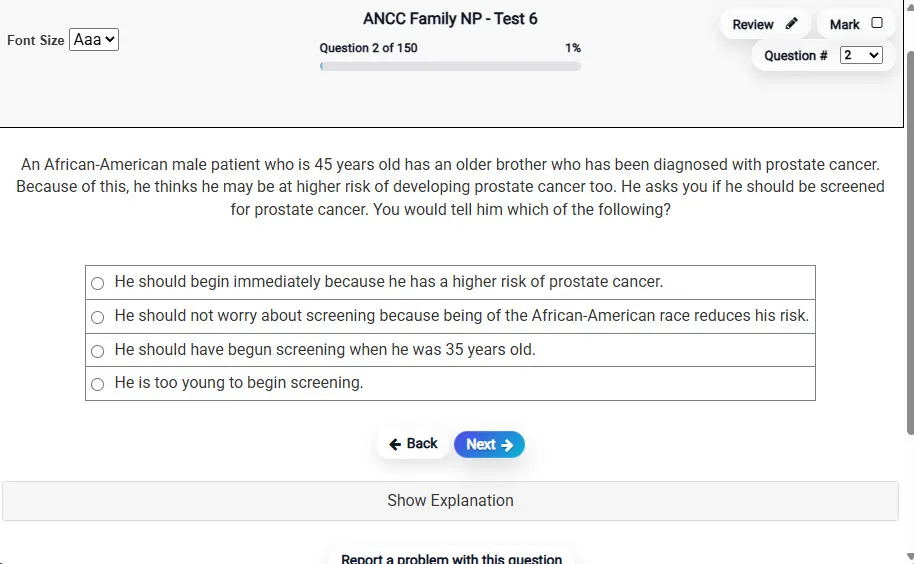
Answering a Question screen – Multiple-choice item view with navigation controls and progress tracker.
Answering a Question Multiple-choice item view with navigation controls and progress tracker.

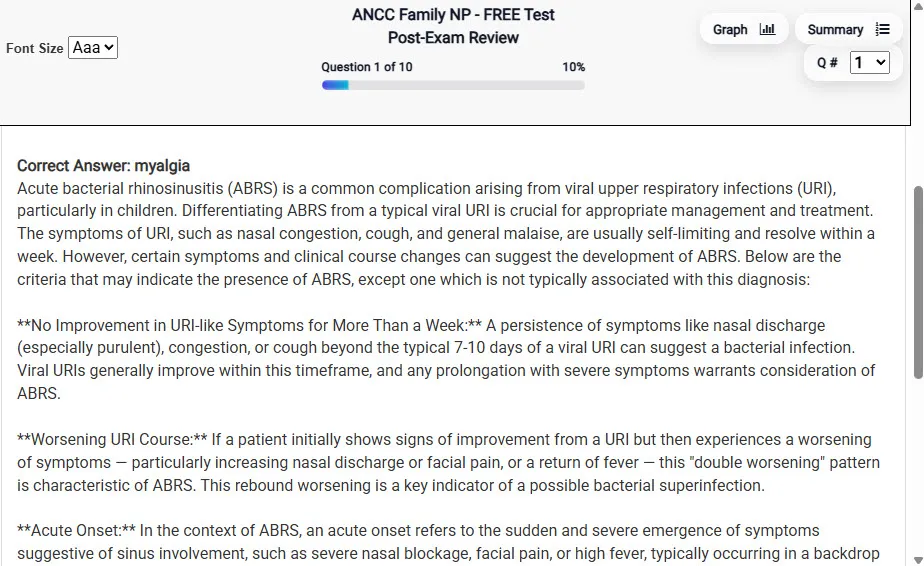
                           Detailed Explanation screen – 
                         Review mode showing chosen answer and rationale and references.
Detailed Explanation Review mode showing chosen answer and rationale and references.

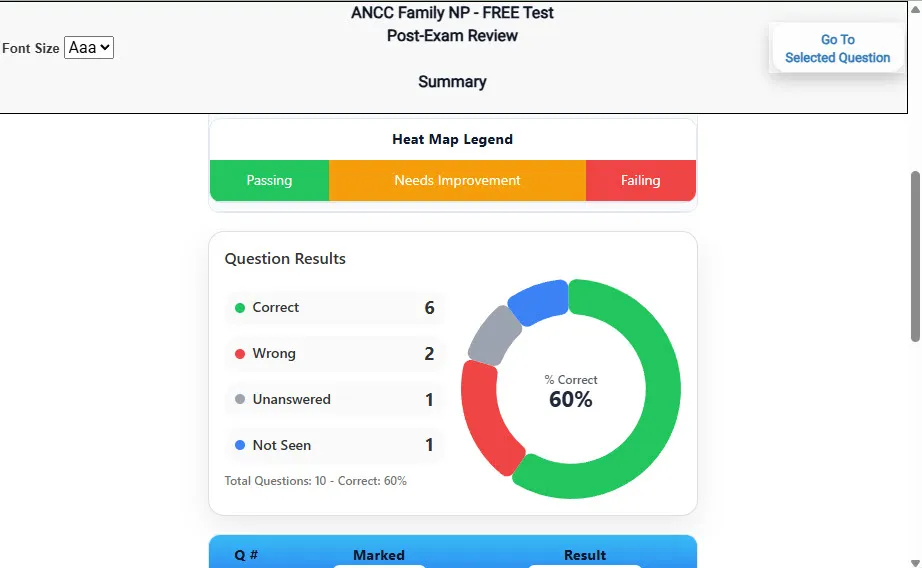
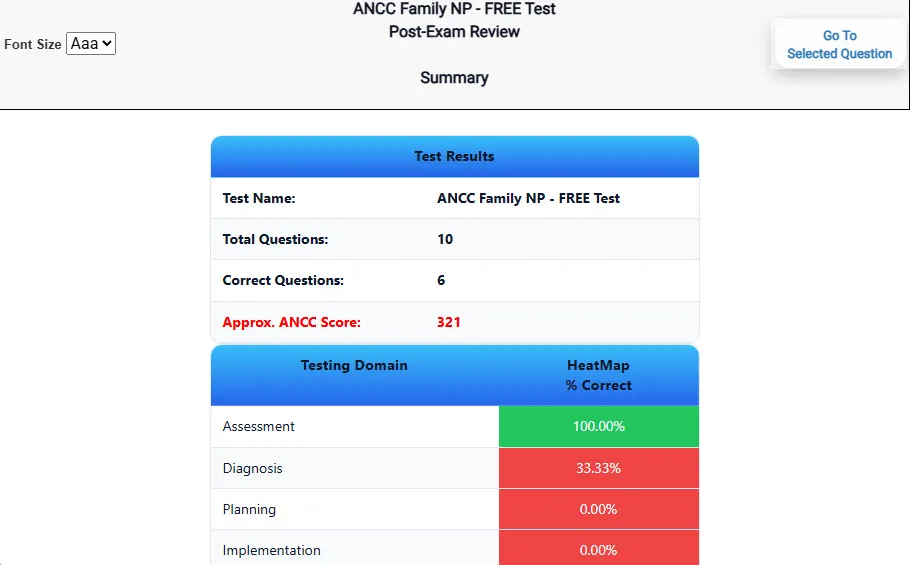
                           Review Summary 1 screen – 
                         Summary with counts for correct/wrong/unanswered and not seen items.
Review Summary 1 Summary with counts for correct/wrong/unanswered and not seen items.

                           Review Summary 2 screen – 
                         Advanced summary with category/domain breakdown and performance insights.
Review Summary 2 Advanced summary with category/domain breakdown and performance insights.

What Each Screen Shows

Answer Question Screen

  • Clean multiple-choice interface with progress bar.
  • Mark for review feature.
  • Matches real test pacing.

Detailed Explanation

  • Correct answer plus rationale.
  • Key concepts and guidelines highlighted.
  • Move between questions to fill knowledge gaps.

Review Summary 1

  • Overall results with total questions and scaled score.
  • Domain heatmap shows strengths and weaknesses.
  • Quick visual feedback on study priorities.

Review Summary 2

  • Chart of correct, wrong, unanswered, not seen.
  • Color-coded results for easy review.
  • Links back to missed items.

Top 10 Reasons to Use Exam Edge for your NYSTCE Safety Net Gifted Education CST Exam Prep

  1. Focused on the NYSTCE Safety Net Gifted Education CST Exam

    Our practice tests are built specifically for the Safety Net Gifted Education CST exam — every question mirrors the real topics, format, and difficulty so you're studying exactly what matters.

  2. Real Exam Simulation

    We match the per-question time limits and pressure of the actual NYSTCE exam, so test day feels familiar and stress-free.

  3. 10 Full Practice Tests & 900 Unique Questions

    You'll have more than enough material to master every Safety Net Gifted Education CST concept — no repeats, no fluff.

  4. Lower Cost Than a Retake

    Ordering 5 practice exams costs less than retaking the NYSTCE Safety Net Gifted Education CST exam after a failure. One low fee could save you both time and money.

  5. Flexible Testing

    Need to step away mid-exam? Pick up right where you left off — with your remaining time intact.

  6. Instant Scoring & Feedback

    See your raw score and an estimated NYSTCE Safety Net Gifted Education CST score immediately after finishing each practice test.

  7. Detailed Explanations for Every Question

    Review correct and incorrect answers with clear, step-by-step explanations so you truly understand each topic.

  8. Trusted & Accredited

    We're fully accredited by the Better Business Bureau and uphold the highest standards of trust and transparency.

  9. Web-Based & Always Available

    No software to install. Access your Safety Net Gifted Education CST practice exams 24/7 from any computer or mobile device.

  10. Expert Support When You Need It

    Need extra help? Our specialized tutors are highly qualified and ready to support your NYSTCE exam prep.


Pass the NYSTCE Safety Net Gifted Education CST Exam with Realistic Practice Tests from Exam Edge

Preparing for your upcoming NYSTCE Safety Net Gifted Education CST (964) Certification Exam can feel overwhelming — but the right practice makes all the difference. Exam Edge gives you the tools, structure, and confidence to pass on your first try. Our online practice exams are built to match the real Safety Net Gifted Education CST exam in content, format, and difficulty.

  • 📝 10 NYSTCE Safety Net Gifted Education CST Practice Tests: Access 10 full-length exams with 90 questions each, covering every major NYSTCE Safety Net Gifted Education CST topic in depth.
  • Instant Online Access: Start practicing right away — no software, no waiting.
  • 🧠 Step-by-Step Explanations: Understand the reasoning behind every correct answer so you can master Safety Net Gifted Education CST exam concepts.
  • 🔄 Retake Each Exam Up to 4 Times: Build knowledge through repetition and track your improvement over time.
  • 🌐 Web-Based & Available 24/7: Study anywhere, anytime, on any device.
  • 🧘 Boost Your Test-Day Confidence: Familiarity with the NYSTCE format reduces anxiety and helps you perform under pressure.

These NYSTCE Safety Net Gifted Education CST practice exams are designed to simulate the real testing experience by matching question types, timing, and difficulty level. This approach helps you get comfortable not just with the exam content, but also with the testing environment, so you walk into your exam day focused and confident.


Exam Edge NYSTCE Reviews


Not a user friendly experience

Amelia , Rochester, New York

Didn't really reflect the questions that were on the test for the most part. Also, they totally got the format of the constructed response question wrong, which never changes. Overall OK if you have nothing else, but definitely not worth the price they charge in my opinion.

Randy , Queens, New York

It was a good test run. Now I know what to expect and what I need to study.

Timothy , Eden, New York

The experience was very practical and I did well.

Trina , Silver Spring , MD

Very easy to navigate.

Collene , Silver Spring , MD

Exam Edge was terrific. Even better than I hoped. Just completing and reviewing the tests are a great learning experience. I can't wait to take the certification test. Tom S.

Thomas , Port Washington, NY


NYSTCE Safety Net Gifted Education CST Aliases Test Name

Here is a list of alternative names used for this exam.

  • NYSTCE Safety Net Gifted Education CST
  • NYSTCE Safety Net Gifted Education CST test
  • NYSTCE Safety Net Gifted Education CST Certification Test
  • Safety Net Gifted Education CST test
  • NYSTCE
  • NYSTCE 964
  • 964 test
  • NYSTCE Safety Net Gifted Education CST (964)
  • Safety Net Gifted Education CST certification