This is the content of the pop-over!

NYSTCE CST Earth Science (162) Practice Tests & Test Prep by Exam Edge


NYSTCE CST Earth Science  product image
(4.6)
Based on 20 Reviews

  • Real Exam Simulation: Timed questions and matching content build comfort for your NYSTCE CST Earth Science test day.
  • Instant, 24/7 Access: Web-based NYSTCE CST Earth Science practice exams with no software needed.
  • Clear Explanations: Step-by-step answers and explanations for your NYSTCE exam to strengthen understanding.
  • Boosted Confidence: Reduces anxiety and improves test-taking skills to ace your NYSTCE CST Earth Science (162).

Featured on

NYSTCE CST Earth Science Online Practice Test Bundles

BEST VALUE
15 practice tests

$149.25

$599.25

SAVE $450

Only $9.95 per test!

  • 100% Pass Guarantee
  • 15 online practice tests
  • 100 questions + 1 essay per test
  • Bonus: 100 Flash Cards + Study Guide
  • Instant access
  • Detailed Explanations
  • Practice tests never expire
  • Timed, untimed, or study guide mode
MOST POPULAR
10 practice tests

$99.50

$399.50

SAVE $300

Only $9.95 per test!

  • 10 online practice tests
  • 100 questions + 1 essay per test
  • Bonus: 100 Flash Cards + Study Guide
  • Instant access
  • Detailed Explanations
  • Practice tests never expire
  • Timed, untimed, or study guide mode
5 practice tests

$69.75

$199.75

SAVE $130

Only $13.95 per test!

  • 5 online practice tests
  • 100 questions + 1 essay per test
  • Bonus: 100 Flash Cards
  • Instant access
  • Detailed Explanations
  • Practice tests never expire
  • Timed, untimed, or study guide mode
1 practice test

$39.95

  • 1 online practice test
  • 100 questions + 1 essay per test
  • Instant access
  • Detailed Explanations
  • Practice tests never expire
  • Timed, untimed, or study guide mode
Quick Select
Tap to choose a bundle

** All Prices are in US Dollars (USD) **


NYSTCE CST Earth Science (162) Resources

Jump to the section you need most.

Understanding the exact breakdown of the NYSTCE CST Earth Science test will help you know what to expect and how to most effectively prepare. The NYSTCE CST Earth Science has 90 multiple-choice questions . The exam will be broken down into the sections below:

NYSTCE CST Earth Science Exam Blueprint
Domain Name % Number of
Questions
Space Systems 16% 14
Earth Materials and the History of Earth 16% 14
Geologic Systems 16% 14
Water - Weather Climate 16% 14
Human Impacts and Sustainability 16% 14
Pedagogical Content Knowledge (Constructed-Response ) - Not included 20% 18

NYSTCE CST Earth Science Study Tips by Domain

  • Apply Kepler’s laws and Newton’s gravitation to compare orbits (e.g., higher altitude → longer period); common trap: mixing up orbital speed vs orbital period when distance changes.
  • Use the HR diagram to infer stellar properties; red flag: assuming brighter always means hotter—giants can be bright but cool due to large radius.
  • Explain stellar evolution using mass as the priority rule (low-mass → white dwarf, high-mass → supernova → neutron star/black hole); common trap: thinking all stars become supernovae.
  • Interpret electromagnetic spectrum observations (radio to gamma) and basic spectroscopy (redshift/blueshift); contraindication: using visible-light conclusions when the question specifies nonvisible data (e.g., IR for dust clouds).
  • Relate Moon phases, eclipses, and tides to Sun–Earth–Moon geometry; common trap: attributing seasons to Earth–Sun distance instead of axial tilt (~23.5°).
  • Compare solar system bodies and formation evidence (differentiation, crater density for relative age); red flag: assuming more craters means “more impacts recently” rather than an older, less-resurfaced surface.
  • Identify and classify minerals by diagnostic properties (hardness, cleavage, streak, density) and use a dichotomous key; red flag: calling quartz “cleavage” when it actually has conchoidal fracture.
  • Differentiate igneous textures and compositions to infer cooling history (intrusive vs. extrusive); common trap: assuming all dark rocks are extrusive when coarse-grained gabbro is intrusive.
  • Use sedimentary structures and fossil/particle characteristics to interpret depositional environments; priority rule: cross-bedding indicates current direction, but graded bedding indicates energy decrease — don’t swap them.
  • Apply metamorphic grade and foliation to infer pressure–temperature conditions and tectonic setting; contraindication: marble and quartzite are nonfoliated even at high grade because they form from monomineralic protoliths.
  • Sequence geologic events using relative dating principles (superposition, cross-cutting, inclusions, unconformities); threshold cue: an angular unconformity requires tilting/uplift and erosion before younger layers are deposited.
  • Connect absolute dating (radiometric decay, half-life, isotopic systems) with geologic time and Earth history; red flag: dating sedimentary rocks directly with radiometric methods — date interbedded ash or igneous intrusions instead.
  • Apply relative dating principles (superposition, original horizontality, cross-cutting) and match them to geologic maps/diagrams; red flag: assuming an unconformity represents “no time missing” rather than a time gap.
  • Use plate-tectonic evidence (seafloor age, magnetic stripes, earthquake depth patterns) to infer boundary type; common trap: labeling deep-focus earthquakes as divergent-boundary features.
  • Predict rock deformation and fault type from stress regime (compression, tension, shear) and recognize folds vs faults in cross-sections; cue: normal faults indicate extension, not compression.
  • Connect magma composition/viscosity/gas content to eruption style and volcanic landforms; priority rule: high-silica, high-viscosity magmas are more explosive, so don’t default to “basalt = explosive.”
  • Explain how weathering, erosion, transport, and deposition shape landscapes and sediment characteristics; red flag: confusing weathering (breakdown in place) with erosion (movement).
  • Interpret Earthquake/volcano hazards using magnitude vs intensity, recurrence, and local site effects; common trap: equating Richter magnitude with damage without considering distance, depth, and soil amplification.
  • Use the water cycle to trace phase changes and energy flow (latent heat) — red flag: treating condensation as a cooling-only process when it releases heat to the atmosphere.
  • Interpret weather maps with fronts, pressure, and winds (PGF vs. Coriolis) — common trap: stating surface winds move straight from high to low without accounting for frictional cross-isobar flow and rotation.
  • Apply humidity measures (relative humidity, dew point, mixing ratio) to cloud/fog formation — priority rule: dew point is a better indicator of moisture content than relative humidity.
  • Explain cloud types and precipitation mechanisms (collision-coalescence vs. Bergeron) — red flag: attributing all rain formation to “clouds getting heavier” without the microphysical process.
  • Distinguish weather vs. climate and use climate controls (latitude, altitude, ocean currents, proximity to water) — common trap: using a single extreme event to “prove” climate change rather than long-term trends and variability.
  • Connect ocean–atmosphere interactions (El Niño/La Niña, sea surface temperature, thermohaline circulation) to regional patterns — red flag: claiming ENSO is caused by Earth’s seasons rather than coupled Pacific wind and current shifts.
  • Distinguish renewable vs. nonrenewable resources and link each to extraction impacts (e.g., mining runoff, habitat fragmentation)—common trap: calling groundwater or old-growth forests “renewable” without recharge/regrowth timescales.
  • Evaluate land-use change (urbanization, agriculture, deforestation) using carrying capacity and ecosystem services—red flag: ignoring feedbacks like increased runoff/flood risk from impervious surfaces.
  • Interpret carbon-cycle and climate data (CO2 trends, radiative forcing, sea-level/cryosphere indicators) and separate weather from climate—common trap: using a single cold spell to argue against long-term warming.
  • Assess air and water pollution sources, transport, and mitigation (point vs. nonpoint, bioaccumulation/biomagnification, eutrophication)—priority rule: nonpoint nutrient pollution often requires watershed-scale solutions, not just “end-of-pipe” controls.
  • Compare energy options (fossil, nuclear, hydro, wind, solar, geothermal) by life-cycle impacts, reliability, and risks—red flag: judging sustainability only by operational emissions while ignoring extraction, waste, or land-use footprint.
  • Apply risk analysis and hazard mitigation for human communities (floodplains, coasts, seismic zones) using probability and vulnerability—common trap: confusing hazard (natural process) with disaster (human exposure and preparedness).


Built to Fit Into Your Busy Life

Everything you need to prepare with confidence—without wasting a minute.

Three Study Modes

Timed, No Time Limit, or Explanation mode.

Actionable Analytics

Heatmaps and scaled scores highlight weak areas.

High-Yield Rationales

Concise explanations emphasize key concepts.

Realistic Interface

Matches the feel of the actual exam environment.

Accessible by Design

Clean layout reduces cognitive load.

Anytime, Anywhere

Web-based access 24/7 on any device.
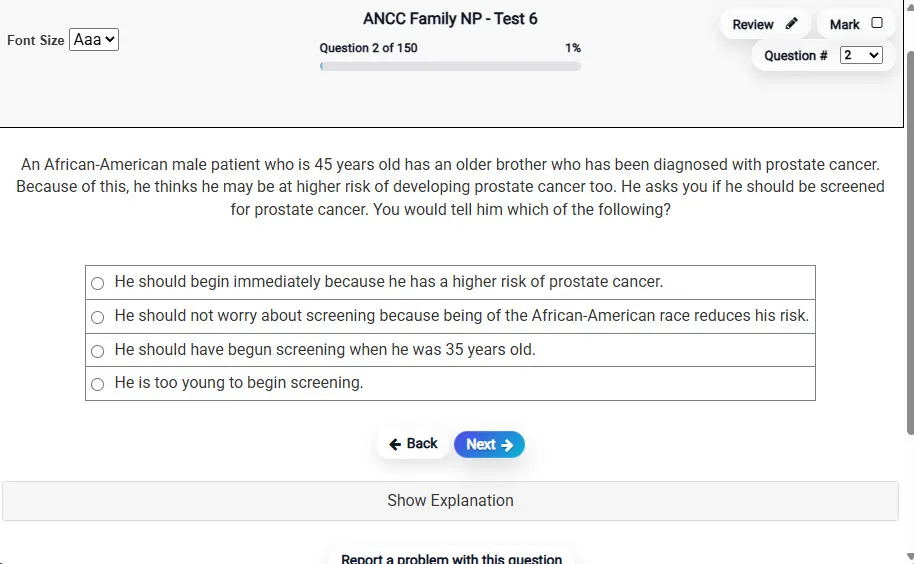
Answering a Question screen – Multiple-choice item view with navigation controls and progress tracker.
Answering a Question Multiple-choice item view with navigation controls and progress tracker.

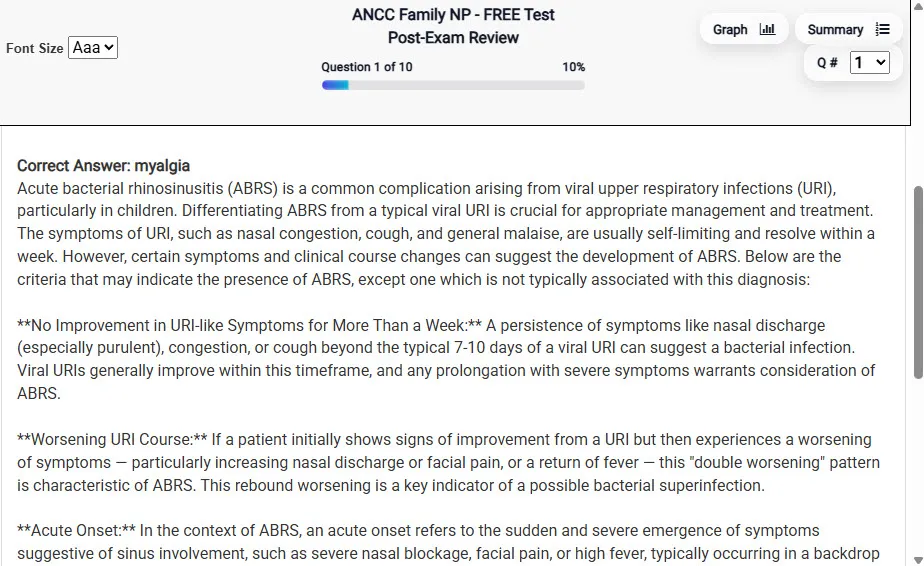
                           Detailed Explanation screen – 
                         Review mode showing chosen answer and rationale and references.
Detailed Explanation Review mode showing chosen answer and rationale and references.

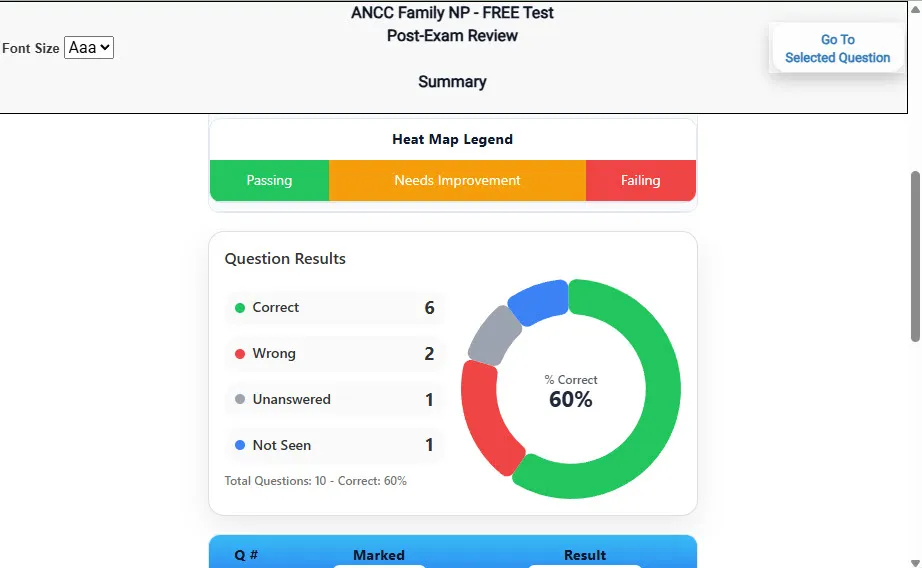
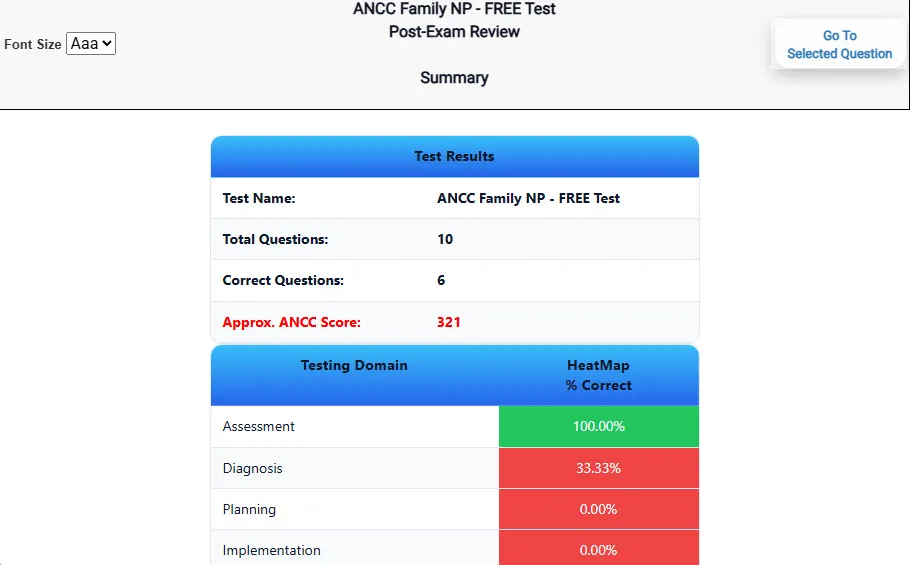
                           Review Summary 1 screen – 
                         Summary with counts for correct/wrong/unanswered and not seen items.
Review Summary 1 Summary with counts for correct/wrong/unanswered and not seen items.

                           Review Summary 2 screen – 
                         Advanced summary with category/domain breakdown and performance insights.
Review Summary 2 Advanced summary with category/domain breakdown and performance insights.

What Each Screen Shows

Answer Question Screen

  • Clean multiple-choice interface with progress bar.
  • Mark for review feature.
  • Matches real test pacing.

Detailed Explanation

  • Correct answer plus rationale.
  • Key concepts and guidelines highlighted.
  • Move between questions to fill knowledge gaps.

Review Summary 1

  • Overall results with total questions and scaled score.
  • Domain heatmap shows strengths and weaknesses.
  • Quick visual feedback on study priorities.

Review Summary 2

  • Chart of correct, wrong, unanswered, not seen.
  • Color-coded results for easy review.
  • Links back to missed items.

Top 10 Reasons to Use Exam Edge for your NYSTCE CST Earth Science Exam Prep

  1. Focused on the NYSTCE CST Earth Science Exam

    Our practice tests are built specifically for the NYSTCE CST Earth Science exam — every question mirrors the real topics, format, and difficulty so you're studying exactly what matters.

  2. Real Exam Simulation

    We match the per-question time limits and pressure of the actual NYSTCE exam, so test day feels familiar and stress-free.

  3. 15 Full Practice Tests & 1,515 Unique Questions

    You'll have more than enough material to master every NYSTCE CST Earth Science concept — no repeats, no fluff.

  4. Lower Cost Than a Retake

    Ordering 5 practice exams costs less than retaking the NYSTCE CST Earth Science exam after a failure. One low fee could save you both time and money.

  5. Flexible Testing

    Need to step away mid-exam? Pick up right where you left off — with your remaining time intact.

  6. Instant Scoring & Feedback

    See your raw score and an estimated NYSTCE CST Earth Science score immediately after finishing each practice test.

  7. Detailed Explanations for Every Question

    Review correct and incorrect answers with clear, step-by-step explanations so you truly understand each topic.

  8. Trusted & Accredited

    We're fully accredited by the Better Business Bureau and uphold the highest standards of trust and transparency.

  9. Web-Based & Always Available

    No software to install. Access your NYSTCE CST Earth Science practice exams 24/7 from any computer or mobile device.

  10. Expert Support When You Need It

    Need extra help? Our specialized tutors are highly qualified and ready to support your NYSTCE exam prep.


Pass the NYSTCE CST Earth Science Exam with Realistic Practice Tests from Exam Edge

Preparing for your upcoming NYSTCE CST Earth Science (162) Certification Exam can feel overwhelming — but the right practice makes all the difference. Exam Edge gives you the tools, structure, and confidence to pass on your first try. Our online practice exams are built to match the real NYSTCE CST Earth Science exam in content, format, and difficulty.

  • 📝 15 NYSTCE CST Earth Science Practice Tests: Access 15 full-length exams with 101 questions each, covering every major NYSTCE CST Earth Science topic in depth.
  • Instant Online Access: Start practicing right away — no software, no waiting.
  • 🧠 Step-by-Step Explanations: Understand the reasoning behind every correct answer so you can master NYSTCE CST Earth Science exam concepts.
  • 🔄 Retake Each Exam Up to 4 Times: Build knowledge through repetition and track your improvement over time.
  • 🌐 Web-Based & Available 24/7: Study anywhere, anytime, on any device.
  • 🧘 Boost Your Test-Day Confidence: Familiarity with the NYSTCE format reduces anxiety and helps you perform under pressure.

These NYSTCE CST Earth Science practice exams are designed to simulate the real testing experience by matching question types, timing, and difficulty level. This approach helps you get comfortable not just with the exam content, but also with the testing environment, so you walk into your exam day focused and confident.


Exam Edge NYSTCE Reviews


Exam Edge was terrific. Even better than I hoped. Just completing and reviewing the tests are a great learning experience. I can't wait to take the certification test. Tom S.

Thomas , Port Washington, NY

Not a user friendly experience

Amelia , Rochester, New York

Didn't really reflect the questions that were on the test for the most part. Also, they totally got the format of the constructed response question wrong, which never changes. Overall OK if you have nothing else, but definitely not worth the price they charge in my opinion.

Randy , Queens, New York

It was a good test run. Now I know what to expect and what I need to study.

Timothy , Eden, New York

The experience was very practical and I did well.

Trina , Silver Spring , MD

Very easy to navigate.

Collene , Silver Spring , MD


NYSTCE CST Earth Science Aliases Test Name

Here is a list of alternative names used for this exam.

  • NYSTCE CST Earth Science
  • NYSTCE CST Earth Science test
  • NYSTCE CST Earth Science Certification Test
  • NYSTCE
  • NYSTCE 162
  • 162 test
  • NYSTCE CST Earth Science (162)
  • CST Earth Science certification