This is the content of the pop-over!

Lightning Deal Alert – 12% Off Ends at Midnight!

Strike while the savings are hot! Use promo code FlashSale at checkout for 12% off any Exam Edge test or bundle. Hurry—the clock is ticking!

CCM CMAC (CMAC) Practice Tests & Test Prep by Exam Edge


CCM Case Management Administrator Certification  product image
(4.6)
Based on 40 Reviews

  • Real Exam Simulation: Timed questions and matching content build comfort for your CCM CMAC test day.
  • Instant, 24/7 Access: Web-based CCM Case Management Administrator Certification practice exams with no software needed.
  • Clear Explanations: Step-by-step answers and explanations for your CCM exam to strengthen understanding.
  • Boosted Confidence: Reduces anxiety and improves test-taking skills to ace your CCM Case Management Administrator Certification (CMAC).

Featured on

CCM Case Management Administrator Certification Online Practice Test Bundles

BEST VALUE
35 practice tests

$248.25

$1,398.25

SAVE $1150

Only $7.09 per test!

  • 100% Pass Guarantee
  • 35 online practice tests
  • 100 questions per test
  • Bonus: 100 Flash Cards + Study Guide
  • Instant access
  • Detailed Explanations
  • Practice tests never expire
  • Timed, untimed, or study guide mode
MOST POPULAR
15 practice tests

$149.25

$599.25

SAVE $450

Only $9.95 per test!

  • 15 online practice tests
  • 100 questions per test
  • Bonus: 100 Flash Cards + Study Guide
  • Instant access
  • Detailed Explanations
  • Practice tests never expire
  • Timed, untimed, or study guide mode
5 practice tests

$69.75

$199.75

SAVE $130

Only $13.95 per test!

  • 5 online practice tests
  • 100 questions per test
  • Bonus: 100 Flash Cards
  • Instant access
  • Detailed Explanations
  • Practice tests never expire
  • Timed, untimed, or study guide mode
1 practice test

$39.95

  • 1 online practice test
  • 100 questions per test
  • Instant access
  • Detailed Explanations
  • Practice tests never expire
  • Timed, untimed, or study guide mode
Quick Select
Tap to choose a bundle

** All Prices are in US Dollars (USD) **


CCM CMAC (CMAC) Resources

Jump to the section you need most.

Understanding the exact breakdown of the CCM Case Management Administrator Certification test will help you know what to expect and how to most effectively prepare. The CCM Case Management Administrator Certification has multiple-choice questions . The exam will be broken down into the sections below:

CCM Case Management Administrator Certification Exam Blueprint
Domain Name % Number of
Questions
Identification Of At-Risk Populations 10% 10
Assessment Of Clinical System Components 10% 10
Development Of Strategies To Manage Populations 10% 10
Leadership For Change 20% 20
Market Assessment And Strategic Planning 15% 15
Program Evaluation Through Outcomes Measurement 17% 17
Human Resource Management 18% 18

CCM Case Management Administrator Certification Study Tips by Domain

  • Define “at-risk” using objective triggers (e.g., repeated ED visits, recent inpatient discharge, polypharmacy, uncontrolled chronic disease); red flag: relying on referral source perception without data confirmation.
  • Stratify risk with validated tools and consistent criteria across settings; common trap: mixing scores from different models without documenting assumptions and limitations.
  • Prioritize members with gaps in care plus high-cost utilization patterns (missed follow-ups, medication nonadherence, frequent no-shows); cue: a recent transition of care is a time-sensitive risk amplifier.
  • Include behavioral health, SDOH, and cognitive/functional barriers in risk identification; red flag: treating housing/food insecurity as “nonclinical” and excluding it from risk status.
  • Use claims, EHR, pharmacy, and case notes to triangulate risk, and validate discrepancies before outreach; common trap: acting on incomplete data that undercounts out-of-network utilization.
  • Ensure privacy and minimum necessary use when flagging or sharing at-risk lists; cue: do not broadcast PHI in mass emails or unsecured spreadsheets—use approved secure workflows.
  • Map the full continuum of care (access, triage, inpatient, post-acute, community) and verify handoffs have documented accountability—red flag: frequent readmissions tied to unclear transition ownership.
  • Assess care coordination workflows against evidence-based guidelines and scope-of-practice rules—common trap: assuming a policy exists means it is consistently followed at the point of care.
  • Evaluate information systems interoperability (EHR, claims, pharmacy, lab, HIE) for timeliness and data integrity—priority rule: decisions based on data older than 24–48 hours often miss clinical deterioration.
  • Review utilization management components (authorization, medical necessity, level-of-care criteria) for consistency and appeal processes—red flag: high overturn rates on appeal indicate weak initial criteria application.
  • Examine patient safety and risk management structures (incident reporting, RCA, medication reconciliation, infection control) for closed-loop follow-up—common trap: collecting reports without verifying corrective actions were sustained.
  • Check compliance and quality infrastructure (HIPAA privacy/security, consent, documentation standards, accreditation requirements) for audit readiness—red flag: inconsistent documentation of informed consent or release-of-information.
  • Stratify populations using clear risk tiers (e.g., high-cost/high-risk, rising risk, stable) and match intensity of services to tier—red flag: offering the same intervention to everyone without segmentation.
  • Build evidence-based care pathways for high-volume conditions (e.g., CHF, COPD, diabetes) with defined entry/exit criteria—common trap: launching pathways without physician/clinical governance sign-off.
  • Design interventions around modifiable drivers (medication adherence, follow-up, self-management, social barriers) and assign accountable owners—priority rule: tackle preventable readmissions and avoidable ED use first.
  • Use proactive outreach workflows (registries, gaps-in-care lists, triggers like new diagnosis/discharge) with documented cadence—red flag: relying solely on patient-initiated contact.
  • Integrate benefits, community resources, and vendor programs into a single coordinated plan—common trap: duplicative services from multiple programs causing member fatigue and poor engagement.
  • Embed equity and access checks (language, transportation, health literacy) into strategy design—contraindication: measuring success only by utilization reduction without monitoring quality and patient-reported outcomes.
  • Start with a clear case for change tied to measurable outcomes (e.g., reduced readmissions or avoidable ED use) and a defined baseline—red flag: launching a redesign with no agreed-upon problem statement or target metric.
  • Identify and empower change champions across disciplines (clinical, UM, social work, vendor partners) with explicit decision rights—common trap: relying on one “project owner” and expecting adoption without frontline influence.
  • Use a structured change method (e.g., stakeholder mapping, readiness assessment, phased rollout) and set a go/no-go threshold for each phase—red flag: skipping readiness checks and scaling before pilot results stabilize.
  • Communicate early and often with role-specific “what changes for me” messaging and feedback loops—priority rule: address workflow impact and documentation burden before asking for performance gains.
  • Anticipate resistance by identifying loss points (time, autonomy, perceived liability) and mitigate with training, job aids, and escalation pathways—common trap: treating resistance as noncompliance instead of a risk to patient safety and quality.
  • Align incentives and accountability (KPIs, supervisor expectations, audit cadence) and monitor for unintended consequences—red flag: incentivizing throughput without quality safeguards, leading to premature discharges or missed follow-ups.
  • Build a market scan that distinguishes internal demand (utilization, avoidable readmissions/ED use) from external demand (payer contracts, competitor offerings) — red flag: planning from anecdotes instead of data.
  • Define the service area and segmentation (geography, payer mix, clinical cohorts) before sizing opportunity; common trap: using hospital-wide averages that hide high-cost subpopulations.
  • Align strategic goals to CCM-style value drivers (quality, cost, experience) and specify measurable targets (e.g., 30-day readmissions, total cost of care) — red flag: goals without baselines or owners.
  • Assess feasibility with a resource and capability gap analysis (staffing, IT, referral workflows, vendor readiness) — priority rule: do not launch a program that lacks a clear intake/referral pathway.
  • Develop a business case with assumptions, sensitivity analysis, and payer reimbursement/contracting constraints; common trap: counting “savings” without clarifying attribution methodology and time horizon.
  • Create an implementation roadmap with governance, risk register, and stakeholder communication plan; red flag: no plan for change management leading to low clinician adoption and inconsistent referrals.
  • Define program goals with SMART outcome measures (clinical, functional, utilization, cost, satisfaction) and a baseline; red flag: tracking only activity counts (e.g., calls) without patient-level outcomes.
  • Use risk adjustment/stratification when comparing outcomes across time or sites; common trap: declaring success when case-mix changed rather than performance improving.
  • Select valid, reliable tools (e.g., PHQ-9, PAM, SF-12) and standardize timing of measurement; red flag: changing instruments midstream and losing trend comparability.
  • Monitor key thresholds (e.g., 30-day readmissions, ED visits per 1,000, medication adherence rates) and set trigger points for action; priority rule: intervene on measures tied to safety, regulatory scrutiny, or contractual penalties first.
  • Evaluate process and outcome together (fidelity, timeliness, completion of care plans) to identify why results changed; common trap: attributing poor outcomes to patients without checking workflow barriers.
  • Report results with transparent methods (data sources, inclusion/exclusion, missing-data handling) and protect confidentiality (HIPAA minimum necessary); red flag: sharing identifiable case examples in dashboards or presentations without proper safeguards.
  • Build a staffing plan that matches case volume, acuity, and regulatory obligations; red flag: chronic overtime and delayed follow-up signals understaffing or poor skill mix.
  • Define role descriptions and competency requirements (e.g., licensure, scope, documentation standards) before hiring; common trap: assigning tasks outside scope of practice or without required supervision.
  • Use structured onboarding and ongoing training tied to CCM priorities (care coordination, utilization, transitions, ethics); priority rule: validate competency with observed practice, not just completion certificates.
  • Implement performance management with clear metrics (timeliness, quality audits, patient experience, compliance); red flag: measuring only productivity can drive unsafe shortcuts in documentation and follow-up.
  • Maintain compliance-focused HR processes (credential verification, exclusions checks where applicable, privacy training); common trap: letting credentials lapse or failing to document corrective actions consistently.
  • Support retention and resilience (manageable caseloads, supervision cadence, escalation pathways for complex cases); contraindication: ignoring burnout indicators increases errors, grievances, and turnover.


Built to Fit Into Your Busy Life

Everything you need to prepare with confidence—without wasting a minute.

Three Study Modes

Timed, No Time Limit, or Explanation mode.

Actionable Analytics

Heatmaps and scaled scores highlight weak areas.

High-Yield Rationales

Concise explanations emphasize key concepts.

Realistic Interface

Matches the feel of the actual exam environment.

Accessible by Design

Clean layout reduces cognitive load.

Anytime, Anywhere

Web-based access 24/7 on any device.
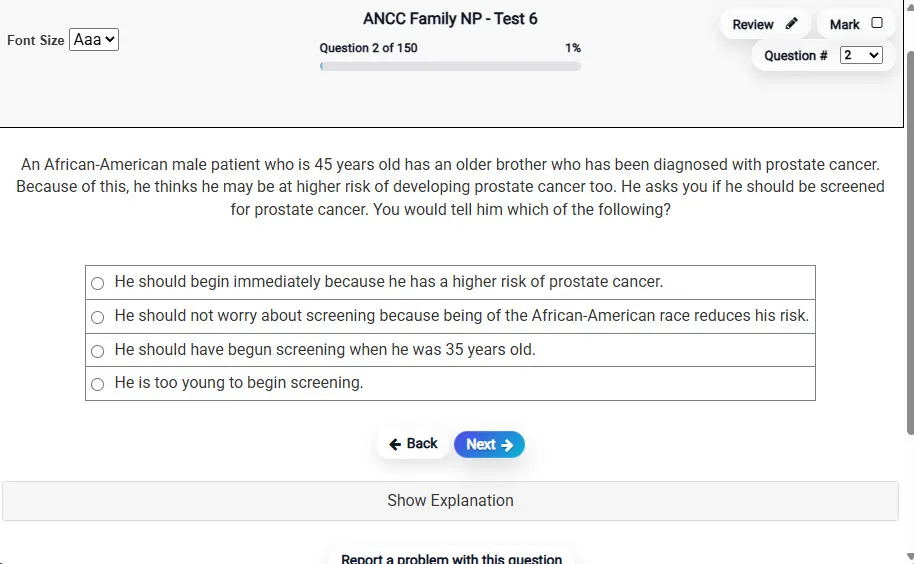
Answering a Question screen – Multiple-choice item view with navigation controls and progress tracker.
Answering a Question Multiple-choice item view with navigation controls and progress tracker.

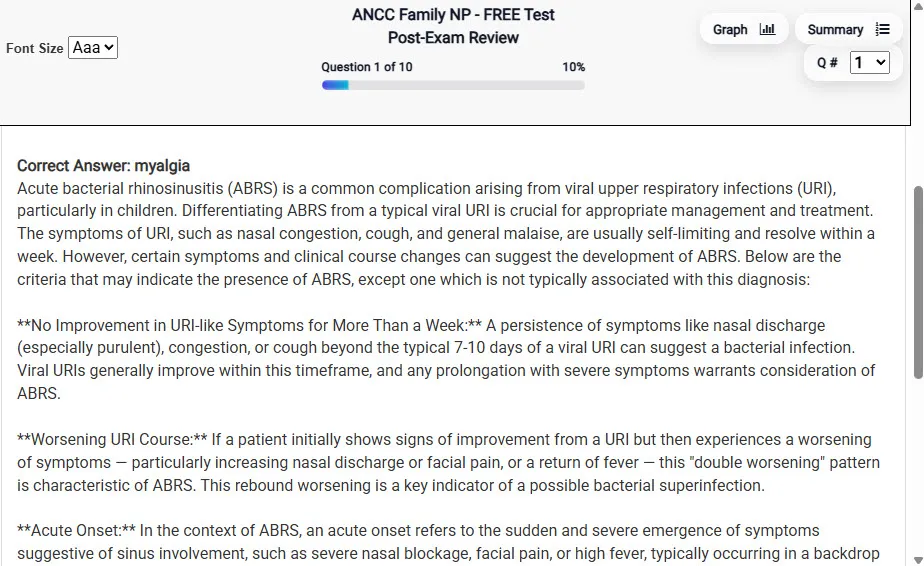
                           Detailed Explanation screen – 
                         Review mode showing chosen answer and rationale and references.
Detailed Explanation Review mode showing chosen answer and rationale and references.

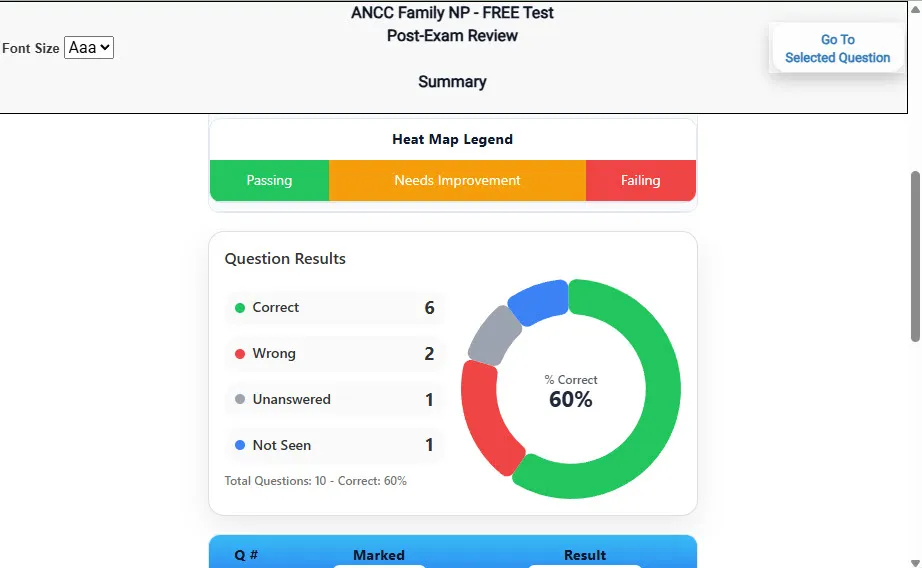
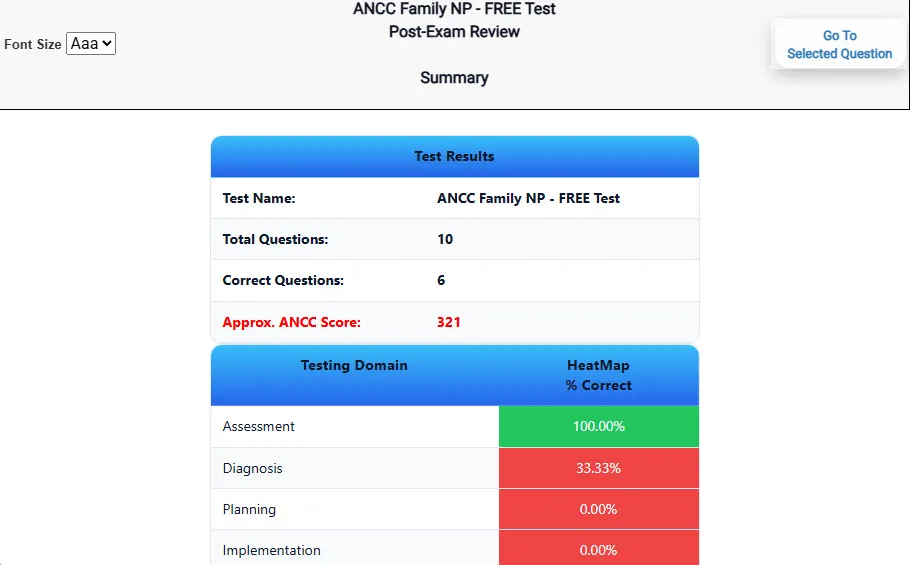
                           Review Summary 1 screen – 
                         Summary with counts for correct/wrong/unanswered and not seen items.
Review Summary 1 Summary with counts for correct/wrong/unanswered and not seen items.

                           Review Summary 2 screen – 
                         Advanced summary with category/domain breakdown and performance insights.
Review Summary 2 Advanced summary with category/domain breakdown and performance insights.

What Each Screen Shows

Answer Question Screen

  • Clean multiple-choice interface with progress bar.
  • Mark for review feature.
  • Matches real test pacing.

Detailed Explanation

  • Correct answer plus rationale.
  • Key concepts and guidelines highlighted.
  • Move between questions to fill knowledge gaps.

Review Summary 1

  • Overall results with total questions and scaled score.
  • Domain heatmap shows strengths and weaknesses.
  • Quick visual feedback on study priorities.

Review Summary 2

  • Chart of correct, wrong, unanswered, not seen.
  • Color-coded results for easy review.
  • Links back to missed items.

Top 10 Reasons to Use Exam Edge for your CCM Case Management Administrator Certification Exam Prep

  1. Focused on the CCM Case Management Administrator Certification Exam

    Our practice tests are built specifically for the CCM CMAC exam — every question mirrors the real topics, format, and difficulty so you're studying exactly what matters.

  2. Real Exam Simulation

    We match the per-question time limits and pressure of the actual CCM exam, so test day feels familiar and stress-free.

  3. 35 Full Practice Tests & 3,500 Unique Questions

    You'll have more than enough material to master every CCM CMAC concept — no repeats, no fluff.

  4. Lower Cost Than a Retake

    Ordering 5 practice exams costs less than retaking the CCM Case Management Administrator Certification exam after a failure. One low fee could save you both time and money.

  5. Flexible Testing

    Need to step away mid-exam? Pick up right where you left off — with your remaining time intact.

  6. Instant Scoring & Feedback

    See your raw score and an estimated CCM Case Management Administrator Certification score immediately after finishing each practice test.

  7. Detailed Explanations for Every Question

    Review correct and incorrect answers with clear, step-by-step explanations so you truly understand each topic.

  8. Trusted & Accredited

    We're fully accredited by the Better Business Bureau and uphold the highest standards of trust and transparency.

  9. Web-Based & Always Available

    No software to install. Access your CCM CMAC practice exams 24/7 from any computer or mobile device.

  10. Expert Support When You Need It

    Need extra help? Our specialized tutors are highly qualified and ready to support your CCM exam prep.


Pass the CCM Case Management Administrator Certification Exam with Realistic Practice Tests from Exam Edge

Preparing for your upcoming CCM Case Management Administrator Certification (CMAC) Certification Exam can feel overwhelming — but the right practice makes all the difference. Exam Edge gives you the tools, structure, and confidence to pass on your first try. Our online practice exams are built to match the real CCM CMAC exam in content, format, and difficulty.

  • 📝 35 CCM Case Management Administrator Certification Practice Tests: Access 35 full-length exams with 100 questions each, covering every major CCM Case Management Administrator Certification topic in depth.
  • Instant Online Access: Start practicing right away — no software, no waiting.
  • 🧠 Step-by-Step Explanations: Understand the reasoning behind every correct answer so you can master CCM CMAC exam concepts.
  • 🔄 Retake Each Exam Up to 4 Times: Build knowledge through repetition and track your improvement over time.
  • 🌐 Web-Based & Available 24/7: Study anywhere, anytime, on any device.
  • 🧘 Boost Your Test-Day Confidence: Familiarity with the CCM format reduces anxiety and helps you perform under pressure.

These CCM Case Management Administrator Certification practice exams are designed to simulate the real testing experience by matching question types, timing, and difficulty level. This approach helps you get comfortable not just with the exam content, but also with the testing environment, so you walk into your exam day focused and confident.


Exam Edge CCM Reviews


CCM Case Management Administrator Certification Aliases Test Name

Here is a list of alternative names used for this exam.

  • CCM Case Management Administrator Certification
  • CCM Case Management Administrator Certification test
  • CCM Case Management Administrator Certification Certification Test
  • CCM CMAC test
  • CCM
  • CCM CMAC
  • CMAC test
  • CCM Case Management Administrator Certification (CMAC)
  • Case Management Administrator Certification certification