This is the content of the pop-over!

ANCC Pediatric CNS (PCNS) Practice Tests & Test Prep by Exam Edge


ANCC Pediatric Clinical Nurse Specialist Certification product image
(4.8)
Based on 25 Reviews

  • Real Exam Simulation: Timed questions and matching content build comfort for your ANCC Pediatric CNS test day.
  • Instant, 24/7 Access: Web-based ANCC Pediatric Clinical Nurse Specialist Certification practice exams with no software needed.
  • Clear Explanations: Step-by-step answers and explanations for your ANCC exam to strengthen understanding.
  • Boosted Confidence: Reduces anxiety and improves test-taking skills to ace your ANCC Pediatric Clinical Nurse Specialist Certification (PCNS).

Featured on

ANCC Pediatric Clinical Nurse Specialist Certification Online Practice Test Bundles

BEST VALUE
15 practice tests

$149.25

$599.25

SAVE $450

Only $9.95 per test!

  • 100% Pass Guarantee
  • 15 online practice tests
  • 100 questions per test
  • Bonus: 100 Flash Cards + Study Guide
  • Instant access
  • Detailed Explanations
  • Practice tests never expire
  • Timed, untimed, or study guide mode
MOST POPULAR
10 practice tests

$99.50

$399.50

SAVE $300

Only $9.95 per test!

  • 10 online practice tests
  • 100 questions per test
  • Bonus: 100 Flash Cards + Study Guide
  • Instant access
  • Detailed Explanations
  • Practice tests never expire
  • Timed, untimed, or study guide mode
5 practice tests

$69.75

$199.75

SAVE $130

Only $13.95 per test!

  • 5 online practice tests
  • 100 questions per test
  • Bonus: 100 Flash Cards
  • Instant access
  • Detailed Explanations
  • Practice tests never expire
  • Timed, untimed, or study guide mode
1 practice test

$39.95

  • 1 online practice test
  • 100 questions per test
  • Instant access
  • Detailed Explanations
  • Practice tests never expire
  • Timed, untimed, or study guide mode
Quick Select
Tap to choose a bundle

** All Prices are in US Dollars (USD) **


ANCC Pediatric CNS (PCNS) Resources

Jump to the section you need most.

Understanding the exact breakdown of the ANCC Pediatric Clinical Nurse Specialist Certification test will help you know what to expect and how to most effectively prepare. The ANCC Pediatric Clinical Nurse Specialist Certification has multiple-choice questions . The exam will be broken down into the sections below:

ANCC Pediatric Clinical Nurse Specialist Certification Exam Blueprint
Domain Name % Number of
Questions
Growth and Development Theories - Concepts Findings 23% 23
Advanced Practice Nursing 33% 33
Advanced Nursing Practice Environments 06% 6
Basic and Applied Science 22% 22
Research 05% 5
Education and Health Teaching 10% 10

ANCC Pediatric Clinical Nurse Specialist Certification Study Tips by Domain

  • Use developmental theories (e.g., Erikson, Piaget, Kohlberg) to match interventions to the child’s cognitive/psychosocial stage—red flag: expecting abstract reasoning or future-oriented choices from a concrete thinker.
  • Prioritize family-centered, culturally responsive care using family systems concepts—common trap: labeling nonadherence as “noncompliant” without assessing health beliefs, literacy, and decision-making roles.
  • Apply attachment and temperament findings when planning hospitalization and procedures—red flag: escalating distress in toddlers/preschoolers when parents are separated or routines are abruptly changed.
  • Screen for atypical development using milestone patterns and variability by age—priority rule: any loss of previously acquired milestones warrants urgent referral rather than watchful waiting.
  • Use play and communication strategies aligned to developmental level (therapeutic play, teach-back, visual aids)—common trap: relying on verbal-only teaching for young children or overstimulated adolescents.
  • Recognize adolescent development tasks (identity, autonomy, peer influence, risk-taking) in care planning—red flag: confidentiality not addressed (within legal limits) leading to missed sensitive histories and decreased follow-up.
  • Apply pediatric CNS scope to improve outcomes across patients, families, and systems—red flag: answering as an NP/primary prescriber rather than a CNS consultant, educator, and systems leader.
  • Use evidence-based clinical decision-making with age-appropriate assessment, diagnostics, and management planning—common trap: using adult norms (vitals, labs, pain scales) instead of pediatric reference ranges.
  • Integrate family-centered care in plans of care (shared decision-making, caregiver capacity, health literacy)—priority rule: always assess consent/assent requirements and who is the legal decision-maker.
  • Coordinate interprofessional care for complex/chronic conditions and transitions (inpatient to home/school/community)—red flag: no explicit follow-up, handoff, or contingency plan for worsening symptoms.
  • Implement quality and safety practices (standardized protocols, error prevention, reporting)—common trap: ignoring weight-based dosing safeguards (kg-only documentation, independent double-check for high-alert meds).
  • Address ethical/legal responsibilities (mandatory reporting, confidentiality, boundaries) in pediatric contexts—contraindication cue: do not delay reporting suspected abuse/neglect while “waiting for proof” or family agreement.
  • Differentiate CNS spheres of influence (patient, nursing, system) and match interventions accordingly; red flag: proposing direct provider tasks when the question is testing system-level change.
  • Use structured quality improvement methods (e.g., PDSA, root cause analysis) with defined measures (process/outcome/balancing); common trap: listing education only without a metric or follow-up plan.
  • Apply pediatric safety and regulatory priorities (medication weight-based dosing, immunization workflows, consent/assent) in environment design; red flag: missing double-check/high-alert medication safeguards.
  • Promote interprofessional collaboration with clear role delineation and escalation pathways; priority rule: address communication failures (handoffs, SBAR) before blaming individual performance.
  • Integrate informatics and data dashboards to monitor care variation and adherence to evidence-based pathways; common trap: relying on anecdote rather than unit-level trend data to justify change.
  • Account for ethics, equity, and family-centered care in policy/protocol decisions (cultural needs, language access, disability accommodations); contraindication: implementing a policy that restricts family presence without a safety-based rationale.
  • Use age-specific pharmacokinetics/pharmacodynamics when prescribing or consulting on meds—red flag: weight-based dosing errors from kg/lb confusion or using adult max doses without pediatric limits.
  • Apply pediatric respiratory physiology to rapid assessment (small airway, higher O2 demand)—priority rule: a “quiet” child with increased work of breathing is a late sign and warrants immediate escalation.
  • Interpret pediatric acid-base and ventilation status clinically—common trap: relying on pulse oximetry alone; rising CO2 with normal SpO2 can indicate impending respiratory failure.
  • Integrate fluid/electrolyte science with maintenance and replacement therapy—threshold cue: avoid hypotonic maintenance fluids in hospitalized children when risk of SIADH is present (watch for headache, nausea, lethargy).
  • Use immunology and infection science to guide isolation, testing, and prophylaxis—red flag: fever in an immunocompromised child (e.g., neutropenia) is an emergency requiring prompt cultures and empiric antibiotics per protocol.
  • Apply pain and sedation science across developmental stages—common trap: assuming a sleeping child is pain-free; use validated age-appropriate scales and monitor for opioid-related hypoventilation, especially in infants.
  • Formulate answerable pediatric CNS questions using PICOT (Population, Intervention, Comparison, Outcome, Time); red flag: a question so broad it can’t drive an evidence search or measurable outcome.
  • Differentiate QI/EBP vs human-subjects research (generalizable knowledge, randomization, control groups); common trap: assuming a QI project never needs IRB review—when in doubt, consult the IRB early.
  • Interpret study designs and evidence levels (RCTs, cohort, case-control, qualitative, systematic reviews) and match them to the clinical question; priority rule: use the highest feasible level of evidence without ignoring pediatric feasibility/ethics constraints.
  • Appraise validity and bias (selection, measurement, confounding) and basic statistics (p-values vs confidence intervals, effect size); red flag: statistically significant results with wide CIs or minimal clinical importance.
  • Apply pediatric research ethics (assent/consent, minimal risk, privacy/FERPA/HIPAA considerations in school-based data); contraindication: enrolling minors without appropriate guardian consent and age-appropriate assent procedures.
  • Plan implementation and evaluation (stakeholder buy-in, fidelity, outcome/balancing measures, sustainability); common trap: measuring only process metrics and missing patient-centered outcomes (e.g., function, symptom burden, caregiver impact).
  • Use family-centered education with teach-back and a written plan; red flag: caregiver can’t restate dosing or return-demonstrate key skills (e.g., inhaler/spacer) — reteach before discharge.
  • Match teaching to health literacy and preferred language using qualified interpreters; common trap: relying on adolescents or siblings to interpret, which risks omissions and violates best practice.
  • Prioritize anticipatory guidance tied to age and condition (injury prevention, sleep, nutrition, immunizations); priority rule: address safety and high-risk behaviors first (e.g., firearms, car seats, drowning) before lower-impact topics.
  • For medication education, give weight-based dosing in mg/kg and mL with one standardized measuring device; red flag: mixed units (tsp + mL) or multiple concentrations at home, which drives dosing errors.
  • In school health planning, coordinate IHP/504/IEP needs, emergency action plans (asthma/anaphylaxis/seizures), and permissions for meds; common trap: failing to specify triggers, rescue steps, and who is trained to administer.
  • Use motivational interviewing and readiness-to-change for adolescents and caregivers; contraindication: confrontational “lecturing” when ambivalence is present — instead elicit goals, barriers, and a small next step.


Built to Fit Into Your Busy Life

Everything you need to prepare with confidence—without wasting a minute.

Three Study Modes

Timed, No Time Limit, or Explanation mode.

Actionable Analytics

Heatmaps and scaled scores highlight weak areas.

High-Yield Rationales

Concise explanations emphasize key concepts.

Realistic Interface

Matches the feel of the actual exam environment.

Accessible by Design

Clean layout reduces cognitive load.

Anytime, Anywhere

Web-based access 24/7 on any device.
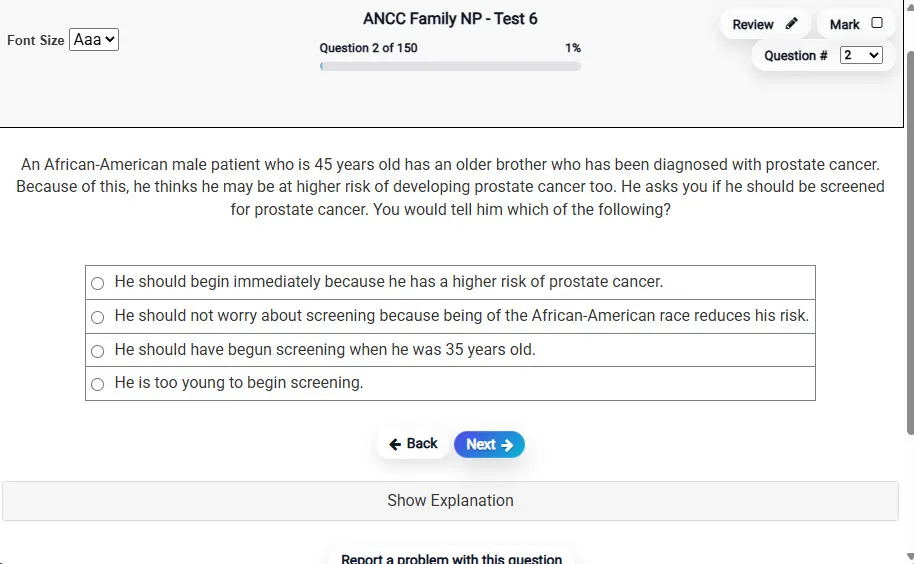
Answering a Question screen – Multiple-choice item view with navigation controls and progress tracker.
Answering a Question Multiple-choice item view with navigation controls and progress tracker.

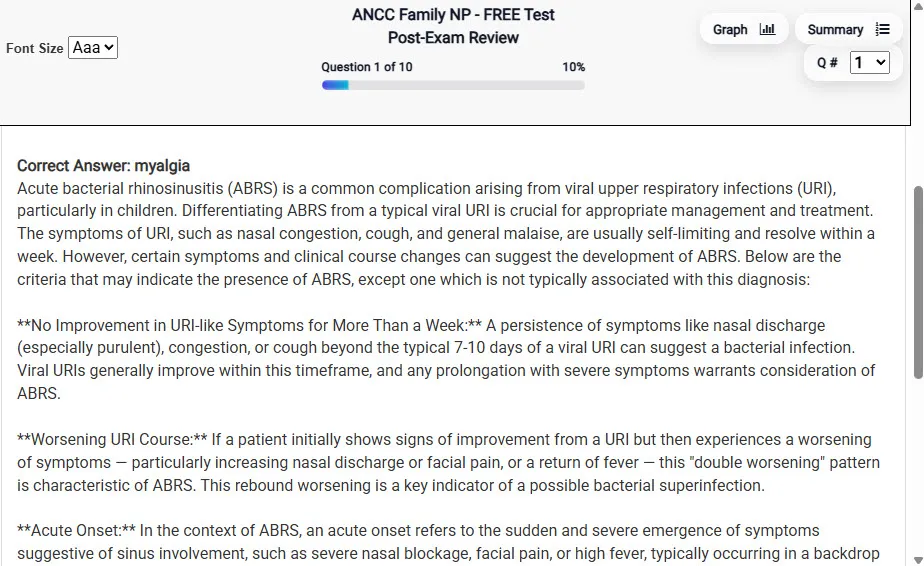
                           Detailed Explanation screen – 
                         Review mode showing chosen answer and rationale and references.
Detailed Explanation Review mode showing chosen answer and rationale and references.

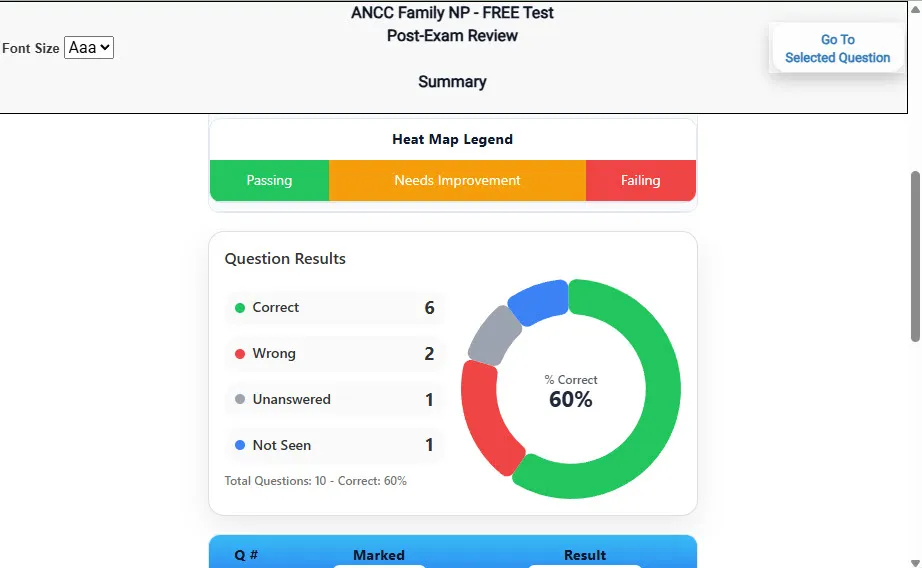
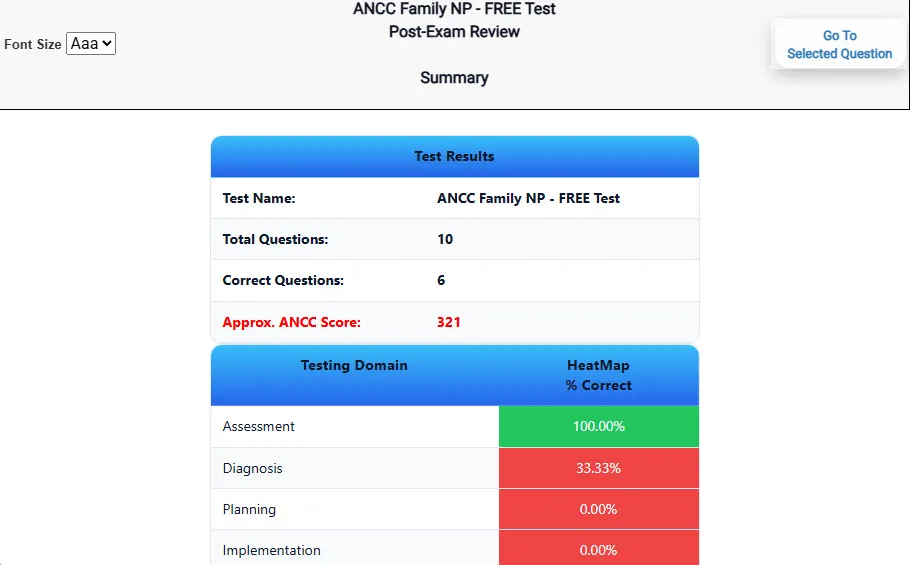
                           Review Summary 1 screen – 
                         Summary with counts for correct/wrong/unanswered and not seen items.
Review Summary 1 Summary with counts for correct/wrong/unanswered and not seen items.

                           Review Summary 2 screen – 
                         Advanced summary with category/domain breakdown and performance insights.
Review Summary 2 Advanced summary with category/domain breakdown and performance insights.

What Each Screen Shows

Answer Question Screen

  • Clean multiple-choice interface with progress bar.
  • Mark for review feature.
  • Matches real test pacing.

Detailed Explanation

  • Correct answer plus rationale.
  • Key concepts and guidelines highlighted.
  • Move between questions to fill knowledge gaps.

Review Summary 1

  • Overall results with total questions and scaled score.
  • Domain heatmap shows strengths and weaknesses.
  • Quick visual feedback on study priorities.

Review Summary 2

  • Chart of correct, wrong, unanswered, not seen.
  • Color-coded results for easy review.
  • Links back to missed items.

Top 10 Reasons to Use Exam Edge for your ANCC Pediatric Clinical Nurse Specialist Certification Exam Prep

  1. Focused on the ANCC Pediatric Clinical Nurse Specialist Certification Exam

    Our practice tests are built specifically for the ANCC Pediatric CNS exam — every question mirrors the real topics, format, and difficulty so you're studying exactly what matters.

  2. Real Exam Simulation

    We match the per-question time limits and pressure of the actual ANCC exam, so test day feels familiar and stress-free.

  3. 15 Full Practice Tests & 1,500 Unique Questions

    You'll have more than enough material to master every ANCC Pediatric CNS concept — no repeats, no fluff.

  4. Lower Cost Than a Retake

    Ordering 5 practice exams costs less than retaking the ANCC Pediatric Clinical Nurse Specialist Certification exam after a failure. One low fee could save you both time and money.

  5. Flexible Testing

    Need to step away mid-exam? Pick up right where you left off — with your remaining time intact.

  6. Instant Scoring & Feedback

    See your raw score and an estimated ANCC Pediatric Clinical Nurse Specialist Certification score immediately after finishing each practice test.

  7. Detailed Explanations for Every Question

    Review correct and incorrect answers with clear, step-by-step explanations so you truly understand each topic.

  8. Trusted & Accredited

    We're fully accredited by the Better Business Bureau and uphold the highest standards of trust and transparency.

  9. Web-Based & Always Available

    No software to install. Access your ANCC Pediatric CNS practice exams 24/7 from any computer or mobile device.

  10. Expert Support When You Need It

    Need extra help? Our specialized tutors are highly qualified and ready to support your ANCC exam prep.


Pass the ANCC Pediatric Clinical Nurse Specialist Certification Exam with Realistic Practice Tests from Exam Edge

Preparing for your upcoming ANCC Pediatric Clinical Nurse Specialist Certification (PCNS) Certification Exam can feel overwhelming — but the right practice makes all the difference. Exam Edge gives you the tools, structure, and confidence to pass on your first try. Our online practice exams are built to match the real ANCC Pediatric CNS exam in content, format, and difficulty.

  • 📝 15 ANCC Pediatric Clinical Nurse Specialist Certification Practice Tests: Access 15 full-length exams with 100 questions each, covering every major ANCC Pediatric Clinical Nurse Specialist Certification topic in depth.
  • Instant Online Access: Start practicing right away — no software, no waiting.
  • 🧠 Step-by-Step Explanations: Understand the reasoning behind every correct answer so you can master ANCC Pediatric CNS exam concepts.
  • 🔄 Retake Each Exam Up to 4 Times: Build knowledge through repetition and track your improvement over time.
  • 🌐 Web-Based & Available 24/7: Study anywhere, anytime, on any device.
  • 🧘 Boost Your Test-Day Confidence: Familiarity with the ANCC format reduces anxiety and helps you perform under pressure.

These ANCC Pediatric Clinical Nurse Specialist Certification practice exams are designed to simulate the real testing experience by matching question types, timing, and difficulty level. This approach helps you get comfortable not just with the exam content, but also with the testing environment, so you walk into your exam day focused and confident.


Exam Edge ANCC Reviews


This test bank was the most helpful aid in preparing me for my exam. I highly recommend it for anyone taking the PCNS-BC exam.

Val, Colorado

I purchased your 20 practice test after not passing the ACM exam a couple of times.I completed your practice test 2 times then took the exam.I passed the exam on my first time!!! The exam was SO easy due to your practice tests.I felt SO confident while I was taking the exam.I thank you and will let ...
Read More
Brenda , Chesapeake Virginia.

I passed my Board Certification in Gerontology as an RN using Exam Edge. Thank you so much for helping me pass my exam. Now I'm studying with Exam Edge for my Certified Case Manager exam. Excellent practice exams.

Adam R, IL

Awesome practice tests! I could not have passed my ANCC Family NP exam without them.

Maura , Sylvania, Ohio

Great exam questions, set up just like the exam. I loved the site.

Anouska , bourbonnais, Illinois

On Wednesday night, I realized that I needed to practice test questions for my APHN exam scheduled for Thursday. I found your site when I did a web search. The process of payment was easy and I started taking the tests. The tests I took on your platform were good in helping me solidify my knowledge ...
Read More
Adanna, Maryland


ANCC Pediatric Clinical Nurse Specialist Certification Aliases Test Name

Here is a list of alternative names used for this exam.

  • ANCC Pediatric Clinical Nurse Specialist Certification
  • ANCC Pediatric Clinical Nurse Specialist Certification test
  • ANCC Pediatric Clinical Nurse Specialist Certification Certification Test
  • ANCC Pediatric CNS test
  • ANCC
  • ANCC PCNS
  • PCNS test
  • ANCC Pediatric Clinical Nurse Specialist Certification (PCNS)
  • Pediatric Clinical Nurse Specialist Certification certification
  • ANA Pediatric Clinical Nurse Specialist Certification
  • ANA Pediatric Clinical Nurse Specialist Certification certification
  • ANA PCNS