This is the content of the pop-over!

AICPA FAR (FAR) Practice Tests & Test Prep by Exam Edge


AICPA Financial Accounting and Reporting product image
(4.7)
Based on 28 Reviews

  • Real Exam Simulation: Timed questions and matching content build comfort for your AICPA FAR test day.
  • Instant, 24/7 Access: Web-based AICPA Financial Accounting and Reporting practice exams with no software needed.
  • Clear Explanations: Step-by-step answers and explanations for your AICPA exam to strengthen understanding.
  • Boosted Confidence: Reduces anxiety and improves test-taking skills to ace your AICPA Financial Accounting and Reporting (FAR).

Featured on

AICPA Financial Accounting and Reporting Online Practice Test Bundles

BEST VALUE
5 practice tests

$69.75

$199.75

SAVE $130

Only $13.95 per test!

  • 100% Pass Guarantee
  • 5 online practice tests
  • 100 questions per test
  • Bonus: 100 Flash Cards + Study Guide
  • Instant access
  • Detailed Explanations
  • Practice tests never expire
  • Timed, untimed, or study guide mode
1 practice test

$39.95

  • 1 online practice test
  • 100 questions per test
  • Instant access
  • Detailed Explanations
  • Practice tests never expire
  • Timed, untimed, or study guide mode
Quick Select
Tap to choose a bundle

** All Prices are in US Dollars (USD) **


AICPA FAR (FAR) Resources

Jump to the section you need most.

Understanding the exact breakdown of the AICPA Financial Accounting and Reporting test will help you know what to expect and how to most effectively prepare. The AICPA Financial Accounting and Reporting has 66 multiple-choice questions . The exam will be broken down into the sections below:

AICPA Financial Accounting and Reporting Exam Blueprint
Domain Name % Number of
Questions
Conceptual Framework - Standard-Setting and Financial Reporting 25-35% 21
Select Financial Statement Accounts 30-40% 25
Select Transactions 20-30% 17
State and Local Governments 5-15% 4

AICPA Financial Accounting and Reporting Study Tips by Domain

  • Apply the conceptual framework hierarchy: identify the appropriate GAAP source (ASC) before using analogies; red flag—jumping to industry practice or IFRS when U.S. GAAP directly addresses the issue.
  • Recognize the primary qualitative characteristics (relevance and faithful representation) and treat enhancing characteristics (comparability, verifiability, timeliness, understandability) as secondary; common trap—choosing a less faithful measurement just because it improves comparability.
  • Use the recognition criteria (definition, measurability, relevance, faithful representation) when deciding whether to record or disclose; red flag—trying to recognize items that are only remotely probable or not reasonably estimable.
  • Know measurement bases (historical cost, current cost, fair value, net realizable value, present value) and when they better depict economic substance; priority rule—don’t default to fair value if it reduces faithful representation due to unobservable inputs.
  • Differentiate between a change in accounting principle, estimate, and reporting entity and apply the right transition (retrospective vs prospective); common trap—treating an estimate change as a prior-period error to justify restatement.
  • Understand standard-setting and oversight roles (FASB/ASC, SEC authority for public companies, PCAOB audit standards) and related disclosures; red flag—confusing SEC Regulation S-X/S-K requirements with GAAP recognition and measurement.
  • Inventory measurement: apply LCNRV for most inventory and lower of cost or market (with ceiling/floor) for LIFO/retail—common trap is using market rules for FIFO/average.
  • PPE and intangibles: capitalize costs that prepare the asset for use and expense repairs/maintenance; red flag is capitalizing training, start-up, or routine maintenance.
  • Depreciation/amortization: changes in method, life, or residual value are changes in estimate (prospective), not error corrections—trap is attempting restatement.
  • Impairment: long-lived assets held and used use the recoverability test (undiscounted CF) before measuring loss at fair value; priority cue is goodwill impairment is a separate, entity-level test.
  • Receivables and credit losses: use the CECL model (lifetime expected losses) and record an allowance via bad-debt expense; common trap is waiting for a specific default before recognizing loss.
  • Income taxes: identify temporary differences and assess valuation allowance based on “more-likely-than-not” realization; red flag is recording deferred taxes for permanent differences.
  • Revenue recognition (ASC 606)—identify the contract and performance obligations, then allocate transaction price; red flag: treating a variable consideration bonus as guaranteed without applying the constraint.
  • Leases (ASC 842)—classify as finance vs operating based on transfer of control indicators; common trap: forgetting to separate nonlease components and update the discount rate when required for modifications.
  • Income taxes (ASC 740)—compute deferred taxes for temporary differences and evaluate valuation allowances; red flag: confusing permanent differences (no DTA/DTL) with temporary differences (create DTA/DTL).
  • Pensions and other postretirement benefits—track service cost, interest cost, expected return, and amortizations in net periodic cost; common trap: misclassifying service cost (operating) versus other components (often nonoperating).
  • Business combinations and consolidations—apply acquisition method with identifiable assets/liabilities at fair value and recognize goodwill; red flag: expensing acquisition-related costs instead of capitalizing them into consideration.
  • Derivative instruments and hedging (ASC 815)—measure derivatives at fair value with specific OCI vs earnings presentation depending on hedge type; common trap: missing formal hedge documentation at inception, which forces mark-to-market through earnings.
  • Identify the reporting entity and fund types (governmental, proprietary, fiduciary) and remember the red flag: fiduciary activities are excluded from government-wide statements but still require fund statements.
  • Apply modified accrual in governmental funds — revenues only when measurable and available (often 60 days); common trap: recording long-term debt proceeds as revenue instead of other financing sources.
  • Convert fund statements to government-wide statements by adding capital assets and long-term liabilities and recording depreciation; red flag: forgetting the reconciliation schedules required on the face of the statements or in notes.
  • Distinguish net position components (net investment in capital assets, restricted, unrestricted) and apply constraint order (restricted before unrestricted); common trap: treating enabling legislation restrictions as merely “committed” instead of “restricted.”
  • Classify and recognize revenues correctly — property taxes, sales taxes, grants, and charges for services; red flag: for nonexchange grants, using “earned” instead of recognizing when eligibility requirements (including time requirements) are met.
  • Know required supplementary information (RSI) and major fund reporting thresholds (10% criteria for major funds); common trap: omitting MD&A or required budgetary comparison schedules for the general fund and major special revenue funds.


Built to Fit Into Your Busy Life

Everything you need to prepare with confidence—without wasting a minute.

Three Study Modes

Timed, No Time Limit, or Explanation mode.

Actionable Analytics

Heatmaps and scaled scores highlight weak areas.

High-Yield Rationales

Concise explanations emphasize key concepts.

Realistic Interface

Matches the feel of the actual exam environment.

Accessible by Design

Clean layout reduces cognitive load.

Anytime, Anywhere

Web-based access 24/7 on any device.
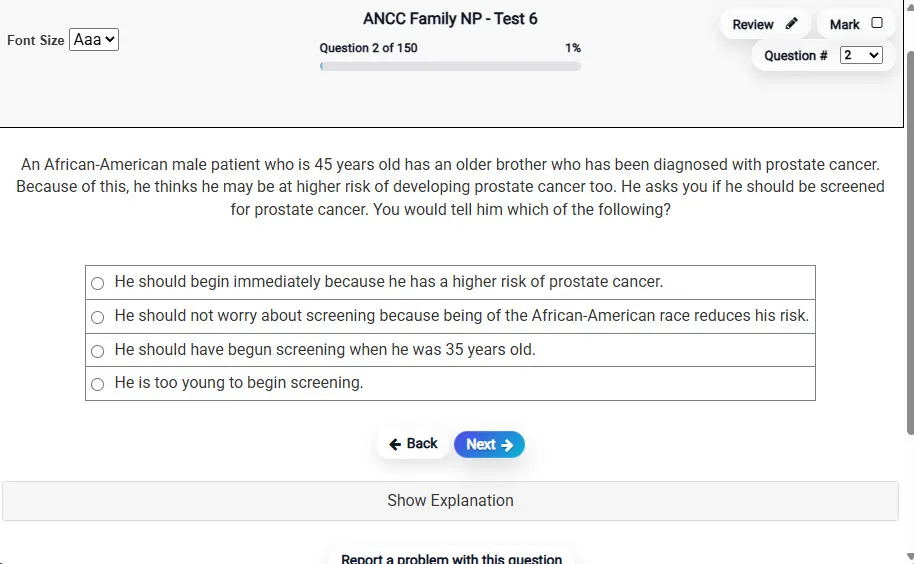
Answering a Question screen – Multiple-choice item view with navigation controls and progress tracker.
Answering a Question Multiple-choice item view with navigation controls and progress tracker.

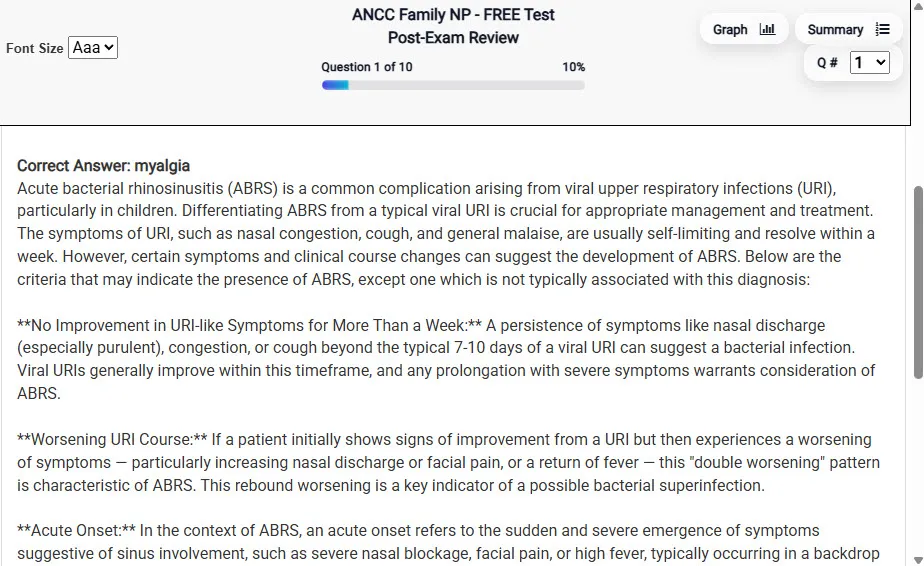
                           Detailed Explanation screen – 
                         Review mode showing chosen answer and rationale and references.
Detailed Explanation Review mode showing chosen answer and rationale and references.

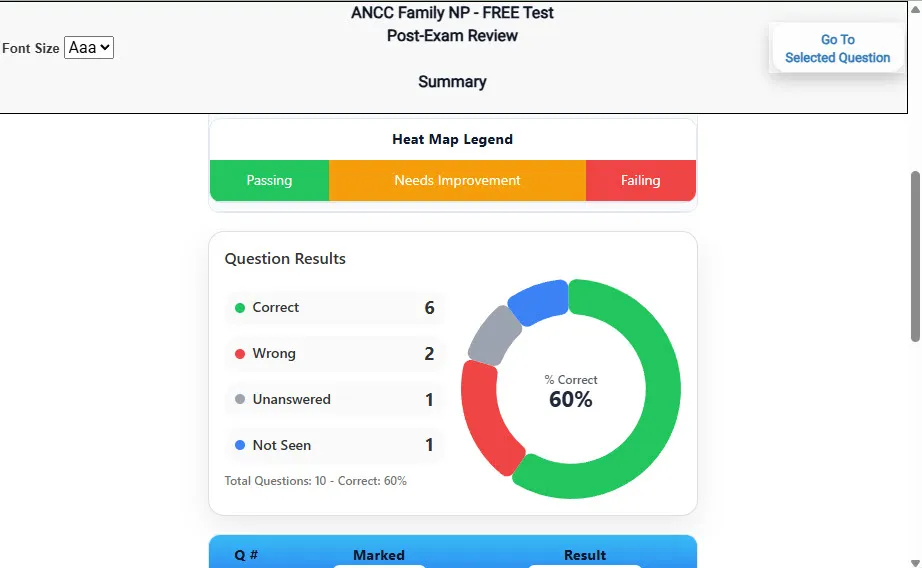
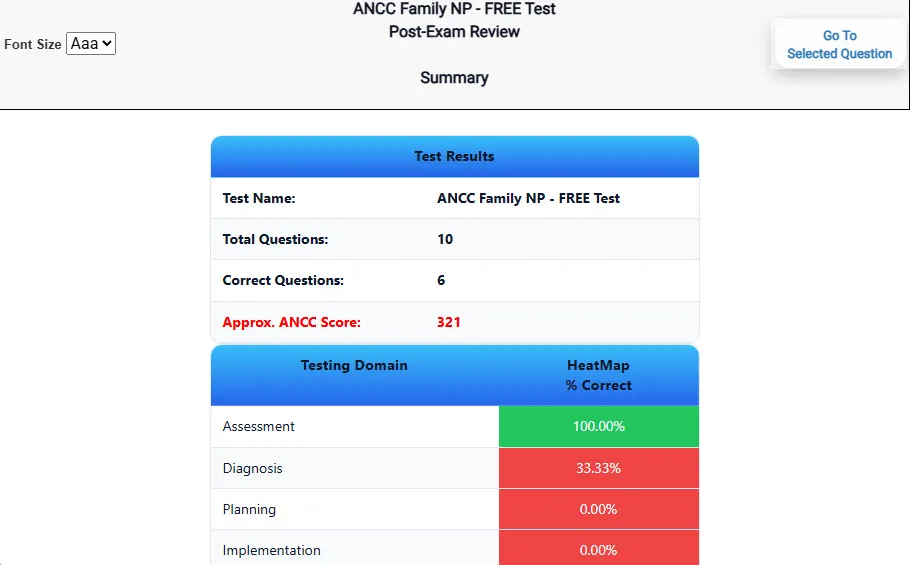
                           Review Summary 1 screen – 
                         Summary with counts for correct/wrong/unanswered and not seen items.
Review Summary 1 Summary with counts for correct/wrong/unanswered and not seen items.

                           Review Summary 2 screen – 
                         Advanced summary with category/domain breakdown and performance insights.
Review Summary 2 Advanced summary with category/domain breakdown and performance insights.

What Each Screen Shows

Answer Question Screen

  • Clean multiple-choice interface with progress bar.
  • Mark for review feature.
  • Matches real test pacing.

Detailed Explanation

  • Correct answer plus rationale.
  • Key concepts and guidelines highlighted.
  • Move between questions to fill knowledge gaps.

Review Summary 1

  • Overall results with total questions and scaled score.
  • Domain heatmap shows strengths and weaknesses.
  • Quick visual feedback on study priorities.

Review Summary 2

  • Chart of correct, wrong, unanswered, not seen.
  • Color-coded results for easy review.
  • Links back to missed items.

Top 10 Reasons to Use Exam Edge for your AICPA Financial Accounting and Reporting Exam Prep

  1. Focused on the AICPA Financial Accounting and Reporting Exam

    Our practice tests are built specifically for the AICPA FAR exam — every question mirrors the real topics, format, and difficulty so you're studying exactly what matters.

  2. Real Exam Simulation

    We match the per-question time limits and pressure of the actual AICPA exam, so test day feels familiar and stress-free.

  3. 5 Full Practice Tests & 500 Unique Questions

    You'll have more than enough material to master every AICPA FAR concept — no repeats, no fluff.

  4. Lower Cost Than a Retake

    Ordering 5 practice exams costs less than retaking the AICPA Financial Accounting and Reporting exam after a failure. One low fee could save you both time and money.

  5. Flexible Testing

    Need to step away mid-exam? Pick up right where you left off — with your remaining time intact.

  6. Instant Scoring & Feedback

    See your raw score and an estimated AICPA Financial Accounting and Reporting score immediately after finishing each practice test.

  7. Detailed Explanations for Every Question

    Review correct and incorrect answers with clear, step-by-step explanations so you truly understand each topic.

  8. Trusted & Accredited

    We're fully accredited by the Better Business Bureau and uphold the highest standards of trust and transparency.

  9. Web-Based & Always Available

    No software to install. Access your AICPA FAR practice exams 24/7 from any computer or mobile device.

  10. Expert Support When You Need It

    Need extra help? Our specialized tutors are highly qualified and ready to support your AICPA exam prep.


Pass the AICPA Financial Accounting and Reporting Exam with Realistic Practice Tests from Exam Edge

Preparing for your upcoming AICPA Financial Accounting and Reporting (FAR) Certification Exam can feel overwhelming — but the right practice makes all the difference. Exam Edge gives you the tools, structure, and confidence to pass on your first try. Our online practice exams are built to match the real AICPA FAR exam in content, format, and difficulty.

  • 📝 5 AICPA Financial Accounting and Reporting Practice Tests: Access 5 full-length exams with 100 questions each, covering every major AICPA Financial Accounting and Reporting topic in depth.
  • Instant Online Access: Start practicing right away — no software, no waiting.
  • 🧠 Step-by-Step Explanations: Understand the reasoning behind every correct answer so you can master AICPA FAR exam concepts.
  • 🔄 Retake Each Exam Up to 4 Times: Build knowledge through repetition and track your improvement over time.
  • 🌐 Web-Based & Available 24/7: Study anywhere, anytime, on any device.
  • 🧘 Boost Your Test-Day Confidence: Familiarity with the AICPA format reduces anxiety and helps you perform under pressure.

These AICPA Financial Accounting and Reporting practice exams are designed to simulate the real testing experience by matching question types, timing, and difficulty level. This approach helps you get comfortable not just with the exam content, but also with the testing environment, so you walk into your exam day focused and confident.


Exam Edge AICPA Reviews


This is the best testing resource available! I love how you can do notes with explanations. You can learn right away the correct answer.

Sydney , Ripon, California


AICPA Financial Accounting and Reporting Aliases Test Name

Here is a list of alternative names used for this exam.

  • AICPA Financial Accounting and Reporting
  • AICPA Financial Accounting and Reporting test
  • AICPA Financial Accounting and Reporting Certification Test
  • AICPA FAR test
  • AICPA
  • AICPA FAR
  • FAR test
  • AICPA Financial Accounting and Reporting (FAR)
  • Financial Accounting and Reporting certification