This is the content of the pop-over!

WEST-E Social Studies (028) Practice Tests & Test Prep by Exam Edge


WEST-E Social Studies  product image
(5.0)
Based on 20 Reviews

  • Real Exam Simulation: Timed questions and matching content build comfort for your WEST-E Social Studies test day.
  • Instant, 24/7 Access: Web-based WEST-E Social Studies practice exams with no software needed.
  • Clear Explanations: Step-by-step answers and explanations for your WEST-E exam to strengthen understanding.
  • Boosted Confidence: Reduces anxiety and improves test-taking skills to ace your WEST-E Social Studies (028).

Featured on

WEST-E Social Studies Online Practice Test Bundles

BEST VALUE
20 practice tests

$174.00

$799.00

SAVE $625

Only $8.70 per test!

  • 100% Pass Guarantee
  • 20 online practice tests
  • 110 questions per test
  • Bonus: 100 Flash Cards + Study Guide
  • Instant access
  • Detailed Explanations
  • Practice tests never expire
  • Timed, untimed, or study guide mode
MOST POPULAR
10 practice tests

$99.50

$399.50

SAVE $300

Only $9.95 per test!

  • 10 online practice tests
  • 110 questions per test
  • Bonus: 100 Flash Cards + Study Guide
  • Instant access
  • Detailed Explanations
  • Practice tests never expire
  • Timed, untimed, or study guide mode
5 practice tests

$69.75

$199.75

SAVE $130

Only $13.95 per test!

  • 5 online practice tests
  • 110 questions per test
  • Bonus: 100 Flash Cards
  • Instant access
  • Detailed Explanations
  • Practice tests never expire
  • Timed, untimed, or study guide mode
1 practice test

$39.95

  • 1 online practice test
  • 110 questions per test
  • Instant access
  • Detailed Explanations
  • Practice tests never expire
  • Timed, untimed, or study guide mode
Quick Select
Tap to choose a bundle

** All Prices are in US Dollars (USD) **


WEST-E Social Studies (028) Resources

Jump to the section you need most.

Understanding the exact breakdown of the WEST-E Social Studies test will help you know what to expect and how to most effectively prepare. The WEST-E Social Studies has 110 multiple-choice questions . The exam will be broken down into the sections below:

WEST-E Social Studies Exam Blueprint
Domain Name % Number of
Questions
Civics 16% 18
Economics 12% 13
Geography 16% 18
U.S. History 20% 22
World History 20% 22
Social Studies Concepts and Skills 16% 18

WEST-E Social Studies Study Tips by Domain

  • Differentiate forms of government (democracy, republic, authoritarian, totalitarian) by where sovereignty rests and how power is limited—red flag: calling the U.S. a direct democracy rather than a constitutional republic.
  • Apply constitutional principles (popular sovereignty, rule of law, federalism, separation of powers, checks and balances) to scenarios—common trap: confusing separation of powers (between branches) with federalism (between levels of government).
  • Know the Bill of Rights and major amendments (13th–15th, 19th, 24th, 26th, 14th due process/equal protection)—priority rule: use the 14th Amendment when rights are applied to states via incorporation.
  • Distinguish civil liberties vs. civil rights and recognize when government action triggers constitutional scrutiny—red flag: assuming free speech is unlimited (e.g., true threats, incitement, and certain time/place/manner limits can be restricted).
  • Identify roles and powers of the three branches, including enumerated vs. implied powers and key Congressional powers (tax, spend, regulate interstate commerce, declare war)—common trap: attributing treaty ratification to the House (it’s the Senate).
  • Connect citizen participation (voting, lobbying, interest groups, parties, civic engagement) to policy outcomes—threshold cue: remember primary elections choose party nominees, while the general election chooses officeholders.
  • Distinguish scarcity, opportunity cost, and trade-offs using production possibilities curves (PPC)—red flag: shifting along the curve (choice) is not the same as shifting the curve (growth/technology/resources).
  • Analyze supply and demand changes (not just price changes) and predict equilibrium effects—common trap: a price change causes a movement along a curve, while nonprice determinants shift the curve.
  • Compare market structures (perfect competition, monopoly, monopolistic competition, oligopoly) with pricing power and barriers to entry—priority rule: only a monopoly/monopolistic competitor can set price; competitive firms are price takers.
  • Interpret fiscal vs. monetary policy tools and likely short-run effects on inflation, unemployment, and interest rates—threshold cue: expansionary policy is typically used when unemployment is high, contractionary when inflation is high.
  • Explain the roles of money, banking, and the Federal Reserve (reserve requirements, open market operations, discount rate)—common trap: the Fed directly controls money supply and rates but does not set prices/wages in the economy.
  • Evaluate international trade (comparative advantage, tariffs/quotas, exchange rates) and winners/losers—red flag: protectionism can help specific domestic producers short-term but usually raises consumer prices and invites retaliation.
  • Use map essentials (scale, legend, projection) to interpret evidence—red flag: Mercator projection distorts area, so don’t compare country sizes without noting the projection.
  • Apply the five themes (location, place, human–environment interaction, movement, region) as an organizer—common trap: describing a place without separating physical from human characteristics.
  • Distinguish absolute vs. relative location and use coordinates correctly—priority rule: check N/S and E/W before answering to avoid hemisphere errors.
  • Explain spatial patterns with push/pull factors and diffusion types (relocation vs. contagious vs. hierarchical)—red flag: calling all cultural spread “migration” instead of diffusion.
  • Analyze human–environment interaction using resources, hazards, and sustainability—common trap: assuming environmental determinism rather than showing how technology and policy mediate constraints.
  • Identify regions by consistent criteria (formal, functional, perceptual) and justify boundaries—threshold cue: if a region is defined by one measurable trait (e.g., language), treat it as formal, not functional.
  • Use a chronology anchor (Colonial → Revolution → Early Republic → Expansion → Civil War/Reconstruction → Industrialization → Progressive Era → WWI → Great Depression/New Deal → WWII → Cold War → Post-1970) — red flag: answers that skip a major turning point or misplace cause/effect across eras.
  • For founding documents, match purpose to context (e.g., Articles of Confederation weaknesses leading to Constitutional Convention; Federalist/Anti-Federalist debates) — common trap: treating the Bill of Rights as applying to state actions before incorporation through the 14th Amendment.
  • On slavery and the Civil War, distinguish immediate triggers from long-term causes (territorial expansion, sectional economies, political compromises, abolitionism) — priority rule: cite primary drivers of secession as slavery-related politics rather than a vague “states’ rights” claim.
  • For Reconstruction, separate Presidential vs. Congressional approaches and track amendments (13th/14th/15th) — red flag: assuming Reconstruction ended with a law rather than the Compromise of 1877 and the withdrawal of federal enforcement.
  • Industrialization/Progressivism questions often hinge on comparing regulation types (antitrust, labor laws, consumer protections) — common trap: confusing “robber barons” with Progressive reformers or attributing New Deal programs to the Progressive Era.
  • For 20th-century foreign policy, identify the strategy and the region (isolationism, containment, détente, post-Cold War interventions) — threshold cue: if an item references Truman Doctrine/Marshall Plan/NATO, you’re in early Cold War containment, not WWII diplomacy.
  • Anchor major eras (classical, postclassical, early modern, modern) with one signature change each; red flag: mixing up causes and effects across time periods.
  • Compare belief systems (e.g., Buddhism, Christianity, Islam) by core ideas and historical diffusion routes; common trap: treating religions as monolithic and ignoring regional syncretism.
  • Trace trade networks (Silk Roads, Indian Ocean, trans-Saharan, Atlantic) and name one key commodity and one consequence; priority rule: link trade to cultural/biological exchange, not just economics.
  • Explain state-building by citing methods (bureaucracy, taxation, military innovation, legitimation) with a concrete example; red flag: describing empires without specifying how power was maintained.
  • Identify catalysts and impacts of revolutions/industrialization (political, social, economic) using primary vs. secondary evidence; common trap: confusing Enlightenment ideals with later nationalist movements.
  • For 20th-century global conflict and decolonization, connect ideology, alliances, and local independence movements to outcomes; threshold cue: always place events in a clear pre–during–post timeline to avoid anachronism.
  • Analyze primary vs. secondary sources by checking author, purpose, audience, and context—red flag: treating a textbook excerpt or encyclopedia entry as a primary source.
  • Corroborate claims across multiple sources and note agreements/discrepancies—common trap: relying on a single vivid document without seeking confirming or disconfirming evidence.
  • Distinguish fact, opinion, and inference and justify conclusions with explicit evidence—priority rule: every inference should be tied to a specific quote, data point, or detail.
  • Read and interpret quantitative displays (tables, graphs, charts) by identifying units, scale, and timeframe—red flag: confusing percent change with percentage-point change.
  • Apply chronological reasoning using cause-and-effect, turning points, and continuity and change—common trap: assuming “post hoc” timing alone proves causation.
  • Evaluate arguments for bias, perspective, and logical validity (e.g., straw man, false dilemma) while considering counterevidence—red flag: emotionally loaded language substituting for proof.


Built to Fit Into Your Busy Life

Everything you need to prepare with confidence—without wasting a minute.

Three Study Modes

Timed, No Time Limit, or Explanation mode.

Actionable Analytics

Heatmaps and scaled scores highlight weak areas.

High-Yield Rationales

Concise explanations emphasize key concepts.

Realistic Interface

Matches the feel of the actual exam environment.

Accessible by Design

Clean layout reduces cognitive load.

Anytime, Anywhere

Web-based access 24/7 on any device.
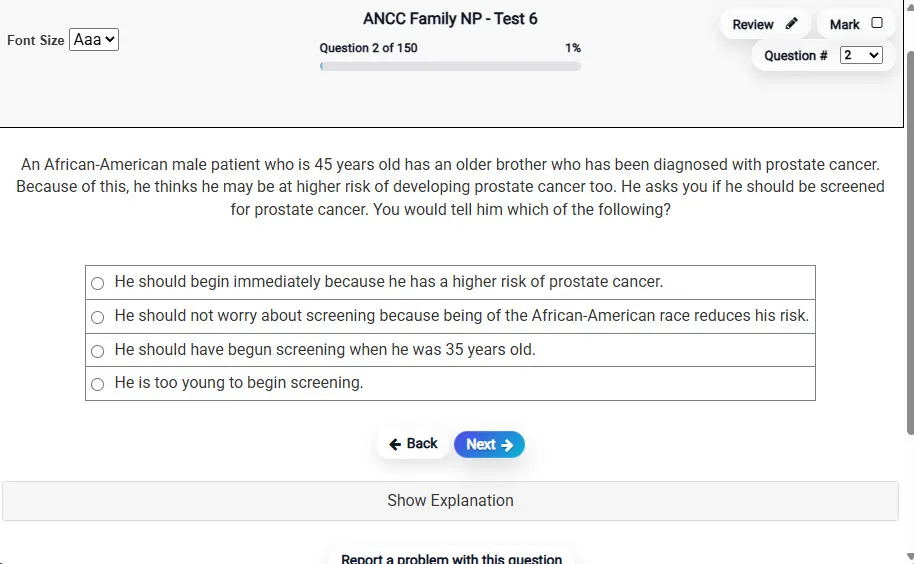
Answering a Question screen – Multiple-choice item view with navigation controls and progress tracker.
Answering a Question Multiple-choice item view with navigation controls and progress tracker.

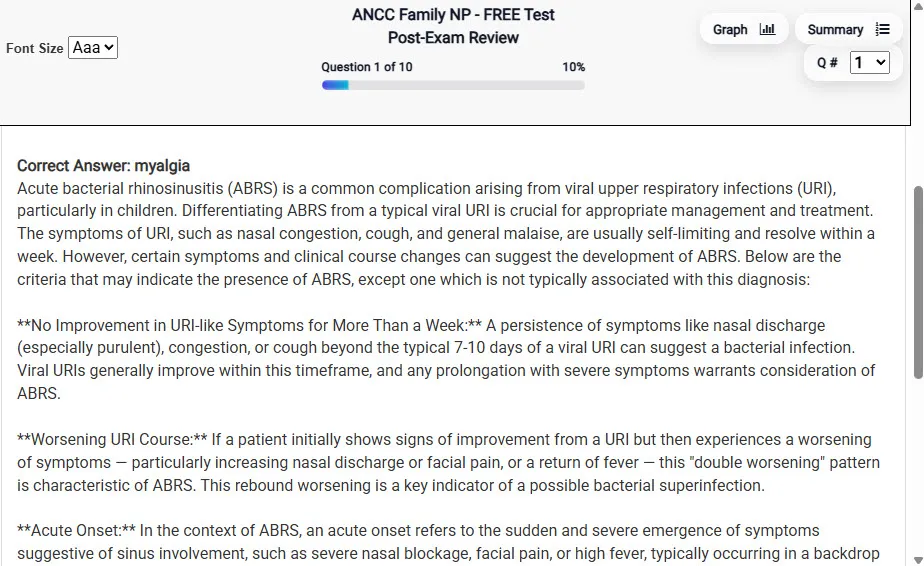
                           Detailed Explanation screen – 
                         Review mode showing chosen answer and rationale and references.
Detailed Explanation Review mode showing chosen answer and rationale and references.

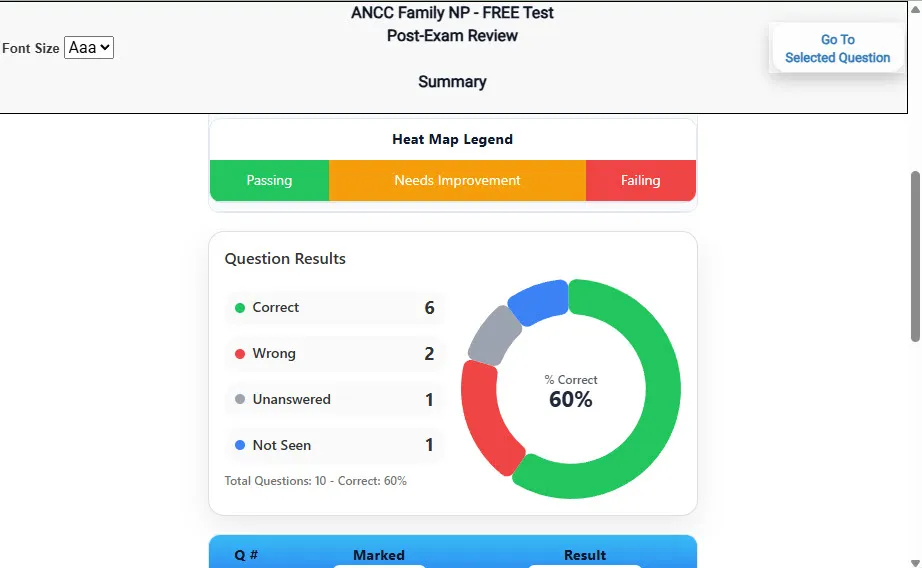
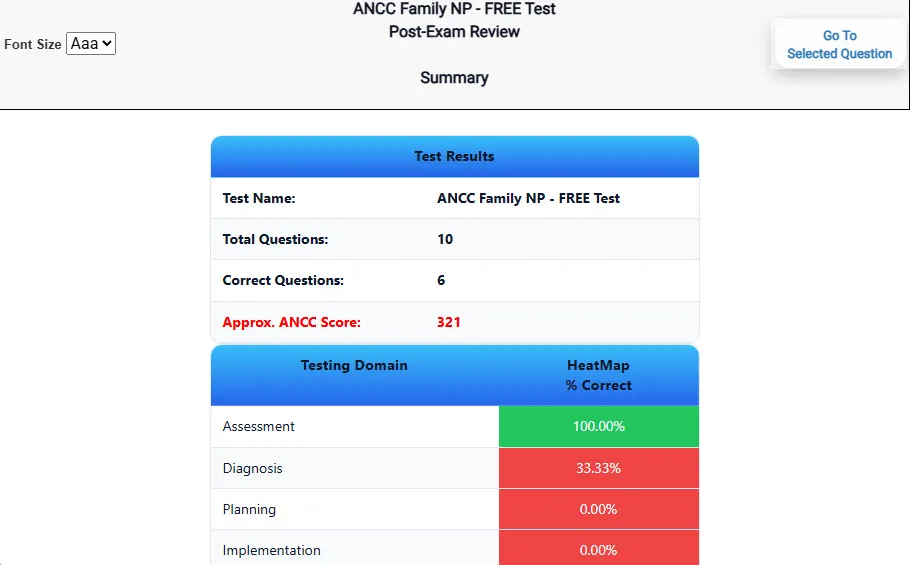
                           Review Summary 1 screen – 
                         Summary with counts for correct/wrong/unanswered and not seen items.
Review Summary 1 Summary with counts for correct/wrong/unanswered and not seen items.

                           Review Summary 2 screen – 
                         Advanced summary with category/domain breakdown and performance insights.
Review Summary 2 Advanced summary with category/domain breakdown and performance insights.

What Each Screen Shows

Answer Question Screen

  • Clean multiple-choice interface with progress bar.
  • Mark for review feature.
  • Matches real test pacing.

Detailed Explanation

  • Correct answer plus rationale.
  • Key concepts and guidelines highlighted.
  • Move between questions to fill knowledge gaps.

Review Summary 1

  • Overall results with total questions and scaled score.
  • Domain heatmap shows strengths and weaknesses.
  • Quick visual feedback on study priorities.

Review Summary 2

  • Chart of correct, wrong, unanswered, not seen.
  • Color-coded results for easy review.
  • Links back to missed items.

Top 10 Reasons to Use Exam Edge for your WEST-E Social Studies Exam Prep

  1. Focused on the WEST-E Social Studies Exam

    Our practice tests are built specifically for the WEST-E Social Studies exam — every question mirrors the real topics, format, and difficulty so you're studying exactly what matters.

  2. Real Exam Simulation

    We match the per-question time limits and pressure of the actual WEST-E exam, so test day feels familiar and stress-free.

  3. 20 Full Practice Tests & 2,200 Unique Questions

    You'll have more than enough material to master every WEST-E Social Studies concept — no repeats, no fluff.

  4. Lower Cost Than a Retake

    Ordering 5 practice exams costs less than retaking the WEST-E Social Studies exam after a failure. One low fee could save you both time and money.

  5. Flexible Testing

    Need to step away mid-exam? Pick up right where you left off — with your remaining time intact.

  6. Instant Scoring & Feedback

    See your raw score and an estimated WEST-E Social Studies score immediately after finishing each practice test.

  7. Detailed Explanations for Every Question

    Review correct and incorrect answers with clear, step-by-step explanations so you truly understand each topic.

  8. Trusted & Accredited

    We're fully accredited by the Better Business Bureau and uphold the highest standards of trust and transparency.

  9. Web-Based & Always Available

    No software to install. Access your WEST-E Social Studies practice exams 24/7 from any computer or mobile device.

  10. Expert Support When You Need It

    Need extra help? Our specialized tutors are highly qualified and ready to support your WEST-E exam prep.


Pass the WEST-E Social Studies Exam with Realistic Practice Tests from Exam Edge

Preparing for your upcoming WEST-E Social Studies (028) Certification Exam can feel overwhelming — but the right practice makes all the difference. Exam Edge gives you the tools, structure, and confidence to pass on your first try. Our online practice exams are built to match the real WEST-E Social Studies exam in content, format, and difficulty.

  • 📝 20 WEST-E Social Studies Practice Tests: Access 20 full-length exams with 110 questions each, covering every major WEST-E Social Studies topic in depth.
  • Instant Online Access: Start practicing right away — no software, no waiting.
  • 🧠 Step-by-Step Explanations: Understand the reasoning behind every correct answer so you can master WEST-E Social Studies exam concepts.
  • 🔄 Retake Each Exam Up to 4 Times: Build knowledge through repetition and track your improvement over time.
  • 🌐 Web-Based & Available 24/7: Study anywhere, anytime, on any device.
  • 🧘 Boost Your Test-Day Confidence: Familiarity with the WEST-E format reduces anxiety and helps you perform under pressure.

These WEST-E Social Studies practice exams are designed to simulate the real testing experience by matching question types, timing, and difficulty level. This approach helps you get comfortable not just with the exam content, but also with the testing environment, so you walk into your exam day focused and confident.


Exam Edge WEST Reviews


I just received notice of passing the middle school math (012) test with a score of 292. My last 4 test scores on the WESTEmath site averaged 291. I'd say the practice tests mirror the actual test quite well and the practice test scores are a very good indicator of how well you'll do on the actual t ...
Read More
Phillip ,

Thank you for the opportunities to take several practice tests! This is really helpful to see which areas I need to study more, and where I have some of my greatest misconceptions. It is helping me to prepare for the real WEST-E test!

Tyler , Olympia, Washington

I just want to say thank you! I purchased several study guides & flash cards to prepare for my test. I was feeling frustrated by the amount of content. I decided to purchase your practice tests and I wish I hadn't wasted my money on the others. Your practice tests resemble the test and I fel ...
Read More
Heather, Spokane, WA

Just wanted to thank you for making the practice tests available. They made a huge difference. Took the 2 Elementary subtests this past Saturday and passed! These practice tests were by far the best tool to use to be prepared and feel confident going into the real testing situation. Thanks again. Ri ...
Read More
Sonja, Washington

Thank you so much!! Your practice exam in Bilingual Education was so helpful! I was able to pass with no problem at all! Javier Roman

JAVIER , seattle, Washington


WEST-E Social Studies Aliases Test Name

Here is a list of alternative names used for this exam.

  • WEST-E Social Studies
  • WEST-E Social Studies test
  • WEST-E Social Studies Certification Test
  • WEST
  • WEST 028
  • 028 test
  • WEST-E Social Studies (028)
  • -E Social Studies certification