This is the content of the pop-over!

WEST-E Middle Level Humanities (052/053) Practice Tests & Test Prep by Exam Edge


WEST-E Middle Level Humanities  product image
(5.0)
Based on 25 Reviews

  • Real Exam Simulation: Timed questions and matching content build comfort for your WEST-E Middle Level Humanities test day.
  • Instant, 24/7 Access: Web-based WEST-E Middle Level Humanities practice exams with no software needed.
  • Clear Explanations: Step-by-step answers and explanations for your WEST-E exam to strengthen understanding.
  • Boosted Confidence: Reduces anxiety and improves test-taking skills to ace your WEST-E Middle Level Humanities (052/053).

Featured on

WEST-E Middle Level Humanities Online Practice Test Bundles

BEST VALUE
20 practice tests

$174.00

$799.00

SAVE $625

Only $8.70 per test!

  • 100% Pass Guarantee
  • 20 online practice tests
  • 110 questions per test
  • Bonus: 100 Flash Cards + Study Guide
  • Instant access
  • Detailed Explanations
  • Practice tests never expire
  • Timed, untimed, or study guide mode
MOST POPULAR
10 practice tests

$99.50

$399.50

SAVE $300

Only $9.95 per test!

  • 10 online practice tests
  • 110 questions per test
  • Bonus: 100 Flash Cards + Study Guide
  • Instant access
  • Detailed Explanations
  • Practice tests never expire
  • Timed, untimed, or study guide mode
5 practice tests

$69.75

$199.75

SAVE $130

Only $13.95 per test!

  • 5 online practice tests
  • 110 questions per test
  • Bonus: 100 Flash Cards
  • Instant access
  • Detailed Explanations
  • Practice tests never expire
  • Timed, untimed, or study guide mode
1 practice test

$39.95

  • 1 online practice test
  • 110 questions per test
  • Instant access
  • Detailed Explanations
  • Practice tests never expire
  • Timed, untimed, or study guide mode
Quick Select
Tap to choose a bundle

** All Prices are in US Dollars (USD) **


WEST-E Middle Level Humanities (052/053) Resources

Jump to the section you need most.

Understanding the exact breakdown of the WEST-E Middle Level Humanities test will help you know what to expect and how to most effectively prepare. The WEST-E Middle Level Humanities has 110 multiple-choice questions . The exam will be broken down into the sections below:

WEST-E Middle Level Humanities Exam Blueprint
Domain Name
Subtest 1: English Language Arts And Reading  
     Reading Process And Comprehension  
     Writing Process And Applications  
Social Studies  
     Civics And Economics  
     U.S. And World History  
     Geography And Social Studies Concepts  

WEST-E Middle Level Humanities Study Tips by Domain

  • Match questions to ELA standards focus (theme, central idea, craft, structure) before reading answer choices—red flag: selecting an option that is true in the passage but doesn’t answer the specific stem.
  • Use evidence-based reading: locate the exact line(s) that support an inference and restate the warrant—common trap: confusing prior knowledge or plausible assumptions with textual support.
  • Analyze author’s purpose and audience by tracking tone, diction, and rhetorical moves (e.g., concession, rebuttal)—priority rule: choose the option that best explains why a detail is included, not what the detail says.
  • Interpret vocabulary in context using surrounding clues and word parts—red flag: picking the most familiar dictionary meaning when the local context signals a different sense.
  • Evaluate structure (chronology, comparison, cause/effect, problem/solution) and how transitions guide meaning—common trap: misidentifying a text feature (caption, sidebar, heading) as the author’s main claim.
  • Address writing/editing items by prioritizing sentence-level clarity: agreement, pronoun reference, parallelism, and misplaced modifiers—threshold: if a revision changes meaning or adds new facts, it’s usually wrong.
  • Use an explicit purpose before reading (e.g., “trace the author’s claim and evidence”)—red flag: rereading multiple times without changing strategy or sharpening the question.
  • Distinguish main idea from supporting details by summarizing each paragraph in 5–10 words—common trap: choosing a “topic” statement (too broad) as the main idea.
  • Infer meaning from context using nearby synonyms, contrasts, and examples—priority rule: verify your inferred definition fits every occurrence in the passage.
  • Track text structure (cause/effect, compare/contrast, problem/solution, chronology) with a quick outline—red flag: missing a shift signaled by words like “however,” “consequently,” or “in contrast.”
  • Evaluate author’s point of view and purpose by noting loaded diction and what evidence is emphasized or omitted—common trap: confusing the narrator’s perspective with the author’s stance.
  • Support answers with direct textual evidence (quote or precise paraphrase tied to line/section)—threshold: if you can’t point to a specific sentence, your answer is likely opinion-based.
  • Plan writing around a clear purpose and audience (e.g., explanatory vs. argumentative) and keep a consistent controlling idea—red flag: a thesis that shifts mid-essay.
  • Use prewriting strategies (outline, concept map, quickwrite) to generate and organize evidence; common trap: listing ideas without grouping them into logical categories.
  • Draft with coherent paragraph structure (topic sentence, development, closure) and use transitions that signal relationships (cause/effect, contrast); red flag: “and then” sequencing used for analysis.
  • Revise for unity and coherence by cutting tangents and strengthening reasoning with specific support; priority rule: revise content and organization before editing grammar.
  • Integrate sources with accurate paraphrase/quotation and clear attribution; common trap: patchwriting (minor word swaps) that still counts as plagiarism.
  • Edit and proofread for sentence variety, precise word choice, and conventions (agreement, punctuation, citation format); red flag: comma splices and run-ons that obscure meaning.
  • Build and evaluate claims using evidence from multiple sources (primary/secondary, data, maps) and explicitly address sourcing — a common trap is treating a textbook excerpt as automatically authoritative.
  • Distinguish fact, opinion, and reasoned judgment and check for bias/point of view; red flag: absolute language (“always,” “everyone”) without supporting evidence.
  • Use core social studies concepts (cause/effect, change/continuity, comparison, turning points) to organize explanations; priority rule: give at least one short- and one long-term cause when asked for “reasons.”
  • Interpret data displays (charts, tables, graphs) by identifying units, scales, and trends before concluding; common trap: confusing correlation with causation when two lines move together.
  • Read and apply maps/visuals by checking legend, projection, and scale first; red flag: drawing conclusions about distance or area without noting projection distortions.
  • Connect individual rights, civic ideals, and economic choices to real scenarios using accurate terminology (e.g., incentive, scarcity, rule of law); common trap: mixing up “rights” (protected claims) with “responsibilities” (expected duties).
  • Differentiate types of government (unitary, federal, confederal) and apply them to U.S. examples; red flag: mixing up “federalism” with “separation of powers” when a prompt is really about levels of authority.
  • Analyze the U.S. Constitution—especially checks and balances, judicial review, and amendment process; common trap: confusing the Bill of Rights (limits on government) with later amendments that expand voting rights.
  • Connect civil liberties/civil rights to Supreme Court reasoning and precedent; cue: when a scenario involves speech at school or student searches, test First/Fourth Amendment limits and the government interest claimed.
  • Explain how laws and policies are made and implemented at local, state, and federal levels; priority rule: identify the correct branch and level first before evaluating whether an action is constitutional or merely unpopular.
  • Use core economic ideas—scarcity, opportunity cost, incentives, supply and demand—to interpret real-world situations; red flag: treating a price ceiling/floor as neutral when it typically creates shortages/surpluses.
  • Compare market, command, and mixed economies and evaluate the role of government (taxation, regulation, public goods); common trap: calling any government action “socialism” instead of identifying the specific market failure it addresses.
  • Place major eras in correct sequence (e.g., classical → medieval → early modern → industrial → contemporary) and tie each to a defining political/economic shift; red flag: treating the Renaissance or Enlightenment as medieval rather than early modern.
  • Use cause-and-effect to explain revolutions and reforms (American, French, Haitian, Latin American, 1848, Meiji, Russian) with at least one precipitating condition and one outcome; common trap: listing events without linking ideology (liberalism, nationalism, socialism) to actions.
  • Analyze imperialism/colonialism through motives (resources, markets, strategic power, “civilizing” claims) and impacts on colonized societies; priority rule: always distinguish economic exploitation from cultural assimilation when explaining outcomes.
  • Interpret primary/secondary sources in historical context (author purpose, audience, time/place) and corroborate across documents; red flag: assuming a primary source is automatically reliable rather than biased or limited.
  • Explain U.S. constitutional development and major turning points (federalism, rights expansion, Reconstruction, New Deal, civil rights) using evidence from key documents/cases; common trap: confusing civil liberties (freedoms) with civil rights (equal protection under law).
  • Connect 20th-century global conflicts (World Wars, Cold War, decolonization) to alliances, ideology, and technological change; threshold cue: if an explanation ignores nationalism or industrialized warfare, it’s usually incomplete for WEST-style prompts.
  • Use the five themes of geography (location, place, human–environment interaction, movement, region) to frame any prompt; red flag: describing a location without giving a relative location or regional context.
  • Interpret maps with scale, projection, and legend in mind; common trap: treating a Mercator map as equal-area when comparing the size of regions.
  • Analyze population patterns using push–pull factors and demographic measures (density, growth rate, migration); cue: if only one factor is given, add at least one complementary factor to justify the pattern.
  • Connect physical systems (climate, landforms, water, hazards) to human settlement and economies; red flag: assuming climate alone explains culture without considering resources, technology, and trade routes.
  • Apply core social studies concepts (culture, institutions, power, conflict, cooperation, diffusion) to explain continuity and change; priority rule: define the concept briefly before applying it to an example.
  • Evaluate sources and claims in social studies using evidence, perspective, and corroboration; common trap: confusing bias with perspective—note the author’s purpose and context before judging reliability.


Built to Fit Into Your Busy Life

Everything you need to prepare with confidence—without wasting a minute.

Three Study Modes

Timed, No Time Limit, or Explanation mode.

Actionable Analytics

Heatmaps and scaled scores highlight weak areas.

High-Yield Rationales

Concise explanations emphasize key concepts.

Realistic Interface

Matches the feel of the actual exam environment.

Accessible by Design

Clean layout reduces cognitive load.

Anytime, Anywhere

Web-based access 24/7 on any device.
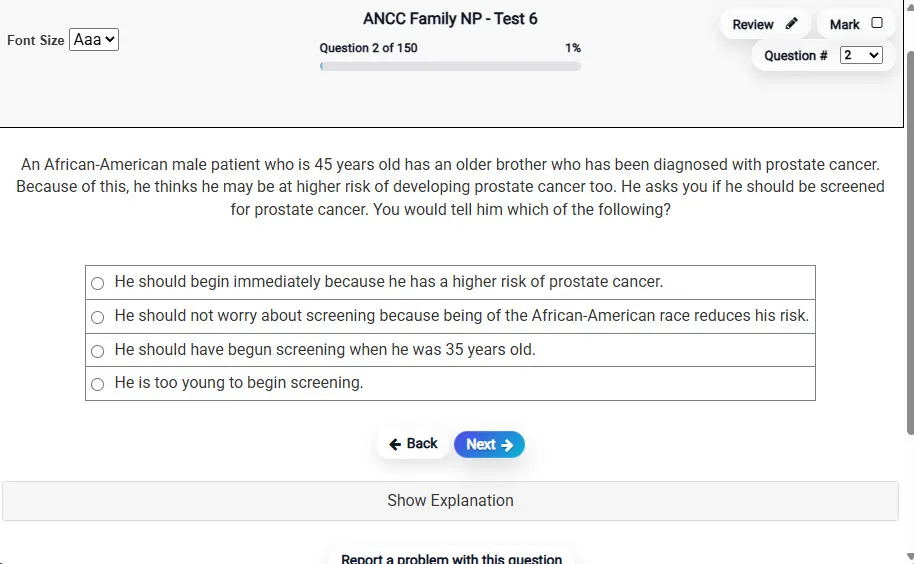
Answering a Question screen – Multiple-choice item view with navigation controls and progress tracker.
Answering a Question Multiple-choice item view with navigation controls and progress tracker.

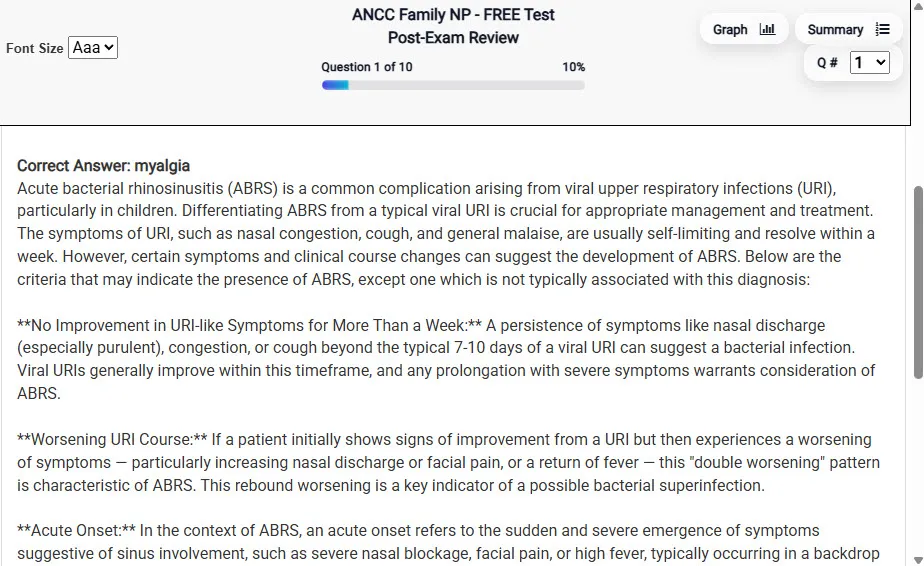
                           Detailed Explanation screen – 
                         Review mode showing chosen answer and rationale and references.
Detailed Explanation Review mode showing chosen answer and rationale and references.

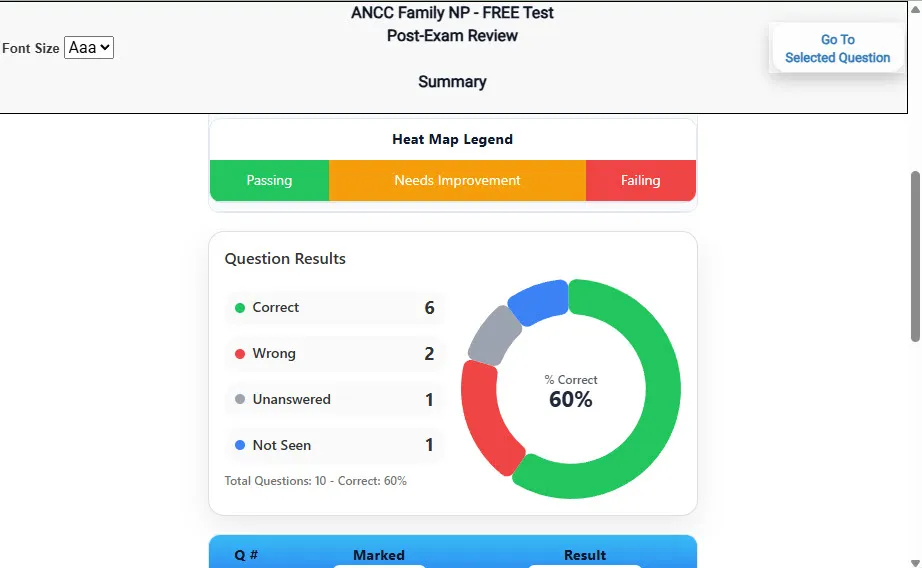
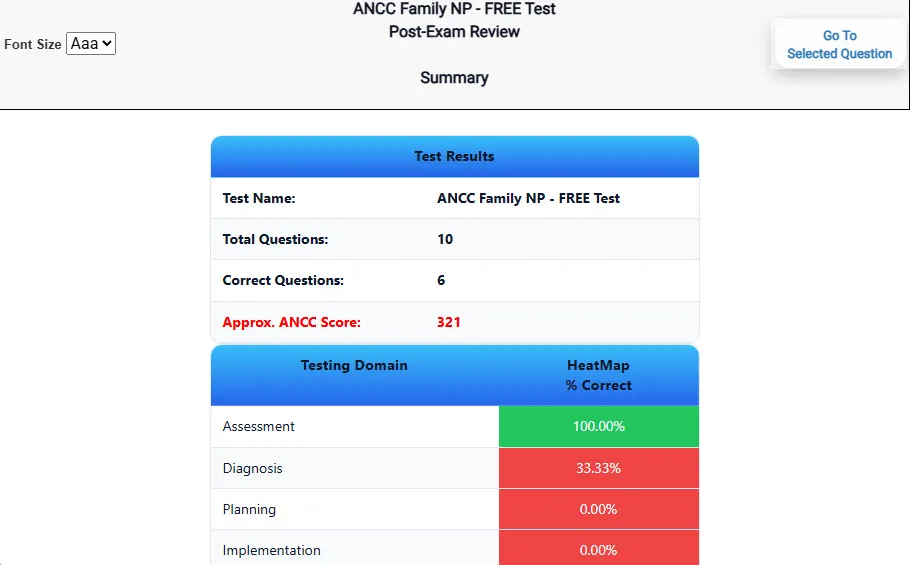
                           Review Summary 1 screen – 
                         Summary with counts for correct/wrong/unanswered and not seen items.
Review Summary 1 Summary with counts for correct/wrong/unanswered and not seen items.

                           Review Summary 2 screen – 
                         Advanced summary with category/domain breakdown and performance insights.
Review Summary 2 Advanced summary with category/domain breakdown and performance insights.

What Each Screen Shows

Answer Question Screen

  • Clean multiple-choice interface with progress bar.
  • Mark for review feature.
  • Matches real test pacing.

Detailed Explanation

  • Correct answer plus rationale.
  • Key concepts and guidelines highlighted.
  • Move between questions to fill knowledge gaps.

Review Summary 1

  • Overall results with total questions and scaled score.
  • Domain heatmap shows strengths and weaknesses.
  • Quick visual feedback on study priorities.

Review Summary 2

  • Chart of correct, wrong, unanswered, not seen.
  • Color-coded results for easy review.
  • Links back to missed items.

Top 10 Reasons to Use Exam Edge for your WEST-E Middle Level Humanities Exam Prep

  1. Focused on the WEST-E Middle Level Humanities Exam

    Our practice tests are built specifically for the WEST-E Middle Level Humanities exam — every question mirrors the real topics, format, and difficulty so you're studying exactly what matters.

  2. Real Exam Simulation

    We match the per-question time limits and pressure of the actual WEST-E exam, so test day feels familiar and stress-free.

  3. 20 Full Practice Tests & 2,200 Unique Questions

    You'll have more than enough material to master every WEST-E Middle Level Humanities concept — no repeats, no fluff.

  4. Lower Cost Than a Retake

    Ordering 5 practice exams costs less than retaking the WEST-E Middle Level Humanities exam after a failure. One low fee could save you both time and money.

  5. Flexible Testing

    Need to step away mid-exam? Pick up right where you left off — with your remaining time intact.

  6. Instant Scoring & Feedback

    See your raw score and an estimated WEST-E Middle Level Humanities score immediately after finishing each practice test.

  7. Detailed Explanations for Every Question

    Review correct and incorrect answers with clear, step-by-step explanations so you truly understand each topic.

  8. Trusted & Accredited

    We're fully accredited by the Better Business Bureau and uphold the highest standards of trust and transparency.

  9. Web-Based & Always Available

    No software to install. Access your WEST-E Middle Level Humanities practice exams 24/7 from any computer or mobile device.

  10. Expert Support When You Need It

    Need extra help? Our specialized tutors are highly qualified and ready to support your WEST-E exam prep.


Pass the WEST-E Middle Level Humanities Exam with Realistic Practice Tests from Exam Edge

Preparing for your upcoming WEST-E Middle Level Humanities (052/053) Certification Exam can feel overwhelming — but the right practice makes all the difference. Exam Edge gives you the tools, structure, and confidence to pass on your first try. Our online practice exams are built to match the real WEST-E Middle Level Humanities exam in content, format, and difficulty.

  • 📝 20 WEST-E Middle Level Humanities Practice Tests: Access 20 full-length exams with 110 questions each, covering every major WEST-E Middle Level Humanities topic in depth.
  • Instant Online Access: Start practicing right away — no software, no waiting.
  • 🧠 Step-by-Step Explanations: Understand the reasoning behind every correct answer so you can master WEST-E Middle Level Humanities exam concepts.
  • 🔄 Retake Each Exam Up to 4 Times: Build knowledge through repetition and track your improvement over time.
  • 🌐 Web-Based & Available 24/7: Study anywhere, anytime, on any device.
  • 🧘 Boost Your Test-Day Confidence: Familiarity with the WEST-E format reduces anxiety and helps you perform under pressure.

These WEST-E Middle Level Humanities practice exams are designed to simulate the real testing experience by matching question types, timing, and difficulty level. This approach helps you get comfortable not just with the exam content, but also with the testing environment, so you walk into your exam day focused and confident.

Exam Edge WEST Reviews


Thank you so much!! Your practice exam in Bilingual Education was so helpful! I was able to pass with no problem at all! Javier Roman

JAVIER , seattle, Washington

Just wanted to thank you for making the practice tests available. They made a huge difference. Took the 2 Elementary subtests this past Saturday and passed! These practice tests were by far the best tool to use to be prepared and feel confident going into the real testing situation. Thanks again. Ri ...
Read More
Sonja, Washington

I just received notice of passing the middle school math (012) test with a score of 292. My last 4 test scores on the WESTEmath site averaged 291. I'd say the practice tests mirror the actual test quite well and the practice test scores are a very good indicator of how well you'll do on the actual t ...
Read More
Phillip ,

Thank you for the opportunities to take several practice tests! This is really helpful to see which areas I need to study more, and where I have some of my greatest misconceptions. It is helping me to prepare for the real WEST-E test!

Tyler , Olympia, Washington

I just want to say thank you! I purchased several study guides & flash cards to prepare for my test. I was feeling frustrated by the amount of content. I decided to purchase your practice tests and I wish I hadn't wasted my money on the others. Your practice tests resemble the test and I fel ...
Read More
Heather, Spokane, WA


WEST-E Middle Level Humanities Aliases Test Name

Here is a list of alternative names used for this exam.

  • WEST-E Middle Level Humanities
  • WEST-E Middle Level Humanities test
  • WEST-E Middle Level Humanities Certification Test
  • WEST
  • WEST 052/053
  • 052/053 test
  • WEST-E Middle Level Humanities (052/053)
  • -E Middle Level Humanities certification