This is the content of the pop-over!

WEST-E Deaf Education (072) Practice Tests & Test Prep by Exam Edge


WEST-E Deaf Education  product image
(4.7)
Based on 32 Reviews

  • Real Exam Simulation: Timed questions and matching content build comfort for your WEST-E Deaf Education test day.
  • Instant, 24/7 Access: Web-based WEST-E Deaf Education practice exams with no software needed.
  • Clear Explanations: Step-by-step answers and explanations for your WEST-E exam to strengthen understanding.
  • Boosted Confidence: Reduces anxiety and improves test-taking skills to ace your WEST-E Deaf Education (072).

Featured on

WEST-E Deaf Education Online Practice Test Bundles

BEST VALUE
5 practice tests

$69.75

$199.75

SAVE $130

Only $13.95 per test!

  • 100% Pass Guarantee
  • 5 online practice tests
  • 110 questions per test
  • Bonus: 100 Flash Cards + Study Guide
  • Instant access
  • Detailed Explanations
  • Practice tests never expire
  • Timed, untimed, or study guide mode
1 practice test

$39.95

  • 1 online practice test
  • 110 questions per test
  • Instant access
  • Detailed Explanations
  • Practice tests never expire
  • Timed, untimed, or study guide mode
Quick Select
Tap to choose a bundle

** All Prices are in US Dollars (USD) **


WEST-E Deaf Education (072) Resources

Jump to the section you need most.

Understanding the exact breakdown of the WEST-E Deaf Education test will help you know what to expect and how to most effectively prepare. The WEST-E Deaf Education has 110 multiple-choice questions . The exam will be broken down into the sections below:

WEST-E Deaf Education Exam Blueprint
Domain Name % Number of
Questions
Individuals who are Deaf or Hard of Hearing 25% 28
Assessment and Program Development 25% 28
Promoting Development of Learning 25% 28
Foundations and Professional Practice 25% 28

WEST-E Deaf Education Study Tips by Domain

  • Differentiate degrees/configurations of hearing loss (conductive, sensorineural, mixed; unilateral vs bilateral) and predict classroom impact—red flag: assuming an audiogram alone tells you speech-perception access in noise.
  • Interpret key audiology/technology data (audiogram, aided thresholds, speech recognition, Ling 6 sounds) to guide access planning—common trap: not verifying daily device function before attributing performance issues to behavior.
  • Compare communication approaches (ASL, spoken language, cued speech, total communication, bilingual-bimodal) and align supports to family/student goals—priority rule: match instructional language to the student’s strongest accessible language, not program preference.
  • Recognize language, cognitive, and social-emotional implications of early vs delayed access to language—red flag: confusing language deprivation effects with intellectual disability or lack of effort.
  • Identify cultural and identity considerations (Deaf culture, Hard of Hearing experiences, multilingual families) and use respectful terminology and norms—common trap: treating Deafness only as a medical deficit and ignoring community resources.
  • Account for common co-occurring conditions (e.g., vestibular issues, vision loss/Usher syndrome, additional disabilities) when planning instruction—contraindication: relying on visual-only cues without checking vision/field and fatigue.
  • Use a multi-source evaluation plan (observations, work samples, standardized measures, and language samples in the student’s primary communication mode) and document how each source answers a specific referral question—red flag: relying on a single test score to determine eligibility or placement.
  • Verify accessibility and validity of assessments for students who are Deaf or Hard of Hearing (e.g., qualified interpreter, appropriate accommodations, and norms/limitations noted) and state when results are not interpretable—common trap: treating an interpreted administration as directly comparable to standard norms without qualification.
  • Differentiate language difference from disability by analyzing expressive/receptive language in ASL and/or spoken language as appropriate and comparing performance to similar peers—priority rule: do not label language deprivation effects as a cognitive or behavioral disorder without corroborating evidence.
  • Develop measurable annual goals tied to present levels (baseline data) and specify conditions, observable behavior, and performance criteria—red flag: goals that describe activities (e.g., “will practice”) instead of outcomes with a clear mastery threshold.
  • Select and justify placements and services based on data and communication access needs (e.g., interpreting, Cued Speech, auditory access, direct instruction) and document least restrictive environment decisions—common trap: choosing a program because it is available rather than because data show it meets the student’s access requirements.
  • Implement progress monitoring with a set schedule (e.g., every 2–4 weeks) using consistent measures and rules for instructional changes when growth stalls—red flag: waiting until annual review to adjust interventions despite flat or declining data.
  • Write IEP goals that are measurable and tied to present levels; red flag: goals like “will improve communication” without criteria, conditions, and mastery threshold (e.g., 80% across 3 sessions).
  • Plan instruction using a language-access first rule (visual/ASL/assistive tech as appropriate) before content delivery; common trap: teaching new concepts while the student is still missing consistent access to directions and discussion.
  • Differentiate literacy instruction with explicit vocabulary, morphology, and comprehension strategies; red flag: relying on incidental learning or “read more” assignments without direct language scaffolds.
  • Use ongoing progress monitoring (frequent probes, work samples, data charts) and adjust instruction when growth stalls; priority cue: if data plateau for 2–3 checks, change the instructional variable rather than waiting for the next reporting period.
  • Support social-emotional and self-advocacy skills within routines (turn-taking, repair strategies, requesting clarification); common trap: interpreting missed information as noncompliance instead of a communication breakdown.
  • Coordinate with families and service providers to ensure consistent use of communication modes and accommodations across settings; red flag: classroom accommodations (captioning, interpreter positioning, FM/DM checks) listed but not implemented daily.
  • Apply IDEA/Section 504 requirements by documenting eligibility, services, and accommodations in the IEP/504 plan; red flag: providing supports (e.g., interpreter, captioning) without written plan alignment and measurable goals.
  • Follow confidentiality and informed-consent rules for records, releases, and meetings; common trap: sharing audiograms, communication preferences, or progress data with non-team members or vendors without signed consent.
  • Use ethical, culturally responsive practice that respects Deaf culture and family values; red flag: treating communication mode as a deficit issue rather than a shared decision informed by data and family input.
  • Implement assessment literacy by selecting tools appropriate for language access and interpreting results cautiously; common trap: using a norm-referenced test standardized on hearing students as the sole basis for placement decisions.
  • Collaborate effectively with interpreters, SLPs, audiologists, and general educators with clear role delineation; priority rule: plan for access first (visual supports, pacing, turn-taking) before evaluating academic performance.
  • Maintain professional responsibilities in safety and duty of care (e.g., hearing devices, classroom acoustics, emergency procedures); red flag: no documented plan for device troubleshooting and emergency communication access.


Built to Fit Into Your Busy Life

Everything you need to prepare with confidence—without wasting a minute.

Three Study Modes

Timed, No Time Limit, or Explanation mode.

Actionable Analytics

Heatmaps and scaled scores highlight weak areas.

High-Yield Rationales

Concise explanations emphasize key concepts.

Realistic Interface

Matches the feel of the actual exam environment.

Accessible by Design

Clean layout reduces cognitive load.

Anytime, Anywhere

Web-based access 24/7 on any device.
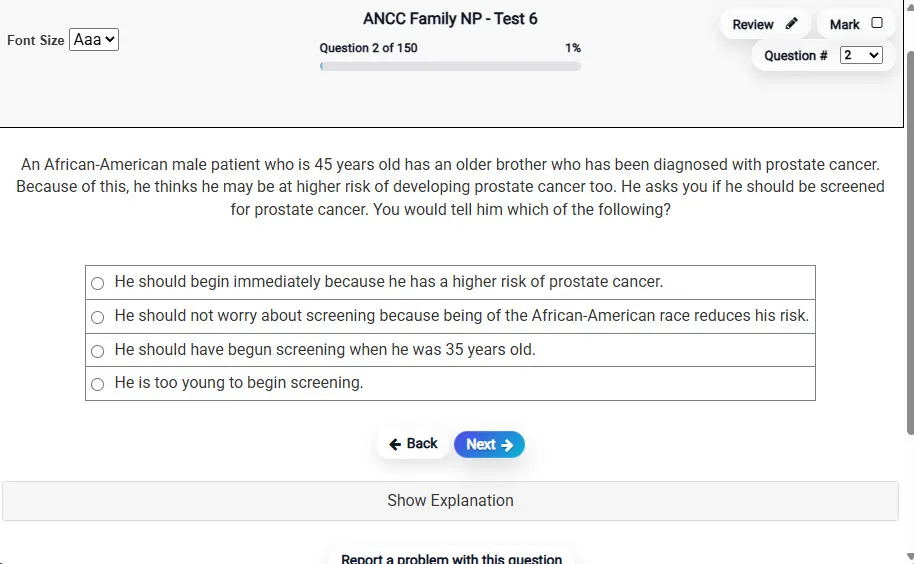
Answering a Question screen – Multiple-choice item view with navigation controls and progress tracker.
Answering a Question Multiple-choice item view with navigation controls and progress tracker.

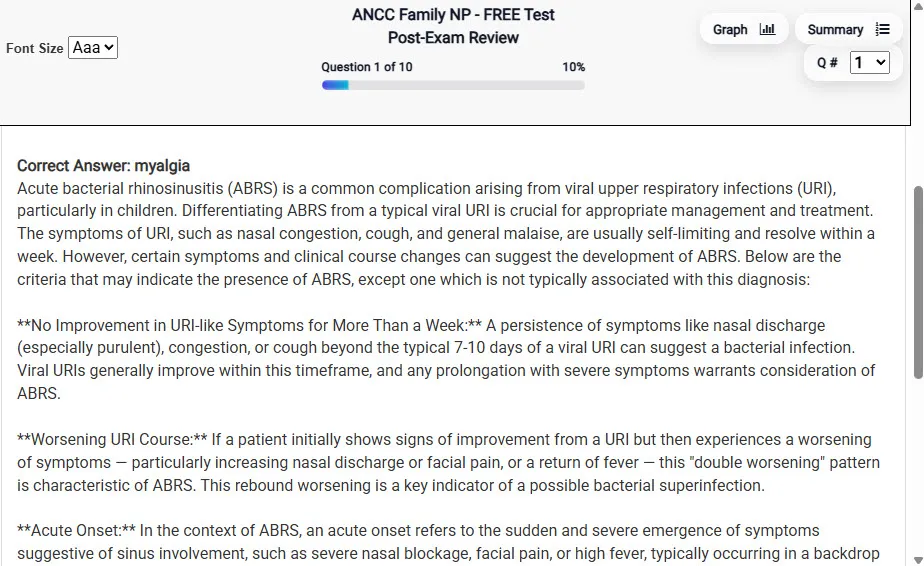
                           Detailed Explanation screen – 
                         Review mode showing chosen answer and rationale and references.
Detailed Explanation Review mode showing chosen answer and rationale and references.

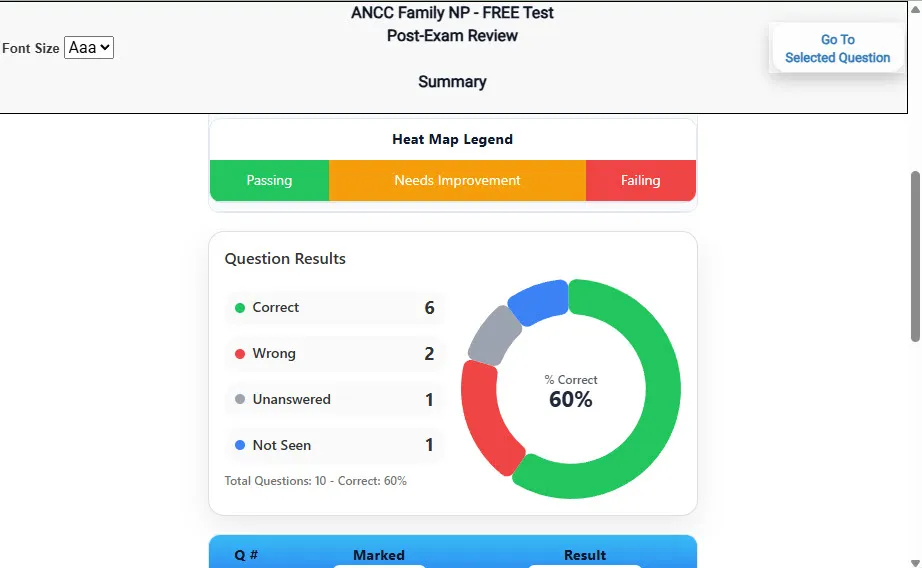
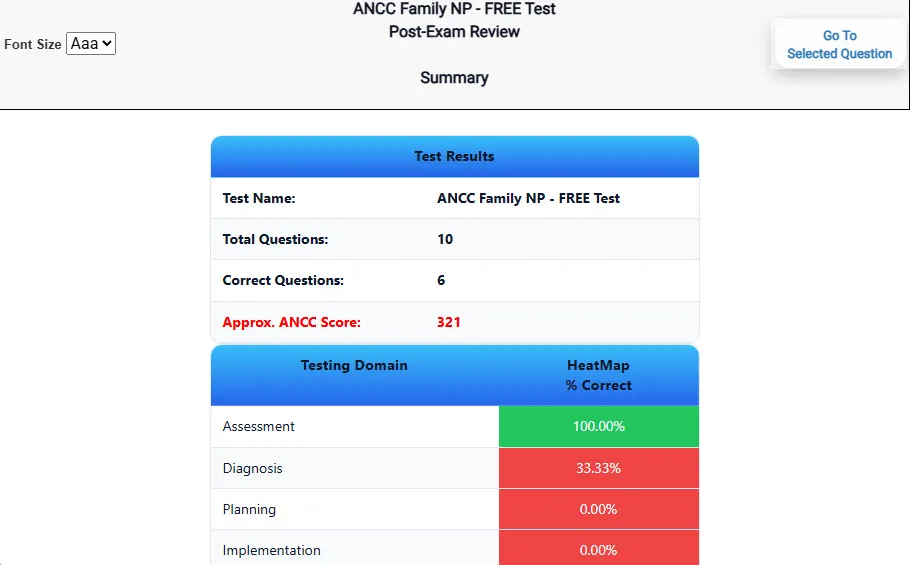
                           Review Summary 1 screen – 
                         Summary with counts for correct/wrong/unanswered and not seen items.
Review Summary 1 Summary with counts for correct/wrong/unanswered and not seen items.

                           Review Summary 2 screen – 
                         Advanced summary with category/domain breakdown and performance insights.
Review Summary 2 Advanced summary with category/domain breakdown and performance insights.

What Each Screen Shows

Answer Question Screen

  • Clean multiple-choice interface with progress bar.
  • Mark for review feature.
  • Matches real test pacing.

Detailed Explanation

  • Correct answer plus rationale.
  • Key concepts and guidelines highlighted.
  • Move between questions to fill knowledge gaps.

Review Summary 1

  • Overall results with total questions and scaled score.
  • Domain heatmap shows strengths and weaknesses.
  • Quick visual feedback on study priorities.

Review Summary 2

  • Chart of correct, wrong, unanswered, not seen.
  • Color-coded results for easy review.
  • Links back to missed items.

Top 10 Reasons to Use Exam Edge for your WEST-E Deaf Education Exam Prep

  1. Focused on the WEST-E Deaf Education Exam

    Our practice tests are built specifically for the WEST-E Deaf Education exam — every question mirrors the real topics, format, and difficulty so you're studying exactly what matters.

  2. Real Exam Simulation

    We match the per-question time limits and pressure of the actual WEST-E exam, so test day feels familiar and stress-free.

  3. 5 Full Practice Tests & 550 Unique Questions

    You'll have more than enough material to master every WEST-E Deaf Education concept — no repeats, no fluff.

  4. Lower Cost Than a Retake

    Ordering 5 practice exams costs less than retaking the WEST-E Deaf Education exam after a failure. One low fee could save you both time and money.

  5. Flexible Testing

    Need to step away mid-exam? Pick up right where you left off — with your remaining time intact.

  6. Instant Scoring & Feedback

    See your raw score and an estimated WEST-E Deaf Education score immediately after finishing each practice test.

  7. Detailed Explanations for Every Question

    Review correct and incorrect answers with clear, step-by-step explanations so you truly understand each topic.

  8. Trusted & Accredited

    We're fully accredited by the Better Business Bureau and uphold the highest standards of trust and transparency.

  9. Web-Based & Always Available

    No software to install. Access your WEST-E Deaf Education practice exams 24/7 from any computer or mobile device.

  10. Expert Support When You Need It

    Need extra help? Our specialized tutors are highly qualified and ready to support your WEST-E exam prep.


Pass the WEST-E Deaf Education Exam with Realistic Practice Tests from Exam Edge

Preparing for your upcoming WEST-E Deaf Education (072) Certification Exam can feel overwhelming — but the right practice makes all the difference. Exam Edge gives you the tools, structure, and confidence to pass on your first try. Our online practice exams are built to match the real WEST-E Deaf Education exam in content, format, and difficulty.

  • 📝 5 WEST-E Deaf Education Practice Tests: Access 5 full-length exams with 110 questions each, covering every major WEST-E Deaf Education topic in depth.
  • Instant Online Access: Start practicing right away — no software, no waiting.
  • 🧠 Step-by-Step Explanations: Understand the reasoning behind every correct answer so you can master WEST-E Deaf Education exam concepts.
  • 🔄 Retake Each Exam Up to 4 Times: Build knowledge through repetition and track your improvement over time.
  • 🌐 Web-Based & Available 24/7: Study anywhere, anytime, on any device.
  • 🧘 Boost Your Test-Day Confidence: Familiarity with the WEST-E format reduces anxiety and helps you perform under pressure.

These WEST-E Deaf Education practice exams are designed to simulate the real testing experience by matching question types, timing, and difficulty level. This approach helps you get comfortable not just with the exam content, but also with the testing environment, so you walk into your exam day focused and confident.


Exam Edge WEST Reviews


I just received notice of passing the middle school math (012) test with a score of 292. My last 4 test scores on the WESTEmath site averaged 291. I'd say the practice tests mirror the actual test quite well and the practice test scores are a very good indicator of how well you'll do on the actual t ...
Read More
Phillip ,

Thank you for the opportunities to take several practice tests! This is really helpful to see which areas I need to study more, and where I have some of my greatest misconceptions. It is helping me to prepare for the real WEST-E test!

Tyler , Olympia, Washington

I just want to say thank you! I purchased several study guides & flash cards to prepare for my test. I was feeling frustrated by the amount of content. I decided to purchase your practice tests and I wish I hadn't wasted my money on the others. Your practice tests resemble the test and I fel ...
Read More
Heather, Spokane, WA

Just wanted to thank you for making the practice tests available. They made a huge difference. Took the 2 Elementary subtests this past Saturday and passed! These practice tests were by far the best tool to use to be prepared and feel confident going into the real testing situation. Thanks again. Ri ...
Read More
Sonja, Washington

Thank you so much!! Your practice exam in Bilingual Education was so helpful! I was able to pass with no problem at all! Javier Roman

JAVIER , seattle, Washington


WEST-E Deaf Education Aliases Test Name

Here is a list of alternative names used for this exam.

  • WEST-E Deaf Education
  • WEST-E Deaf Education test
  • WEST-E Deaf Education Certification Test
  • WEST
  • WEST 072
  • 072 test
  • WEST-E Deaf Education (072)
  • -E Deaf Education certification