This is the content of the pop-over!

WEST-NES Biology (305) Practice Tests & Test Prep by Exam Edge


WEST-NES Biology  product image
(5.0)
Based on 32 Reviews

  • Real Exam Simulation: Timed questions and matching content build comfort for your WEST-NES Biology test day.
  • Instant, 24/7 Access: Web-based WEST-NES Biology practice exams with no software needed.
  • Clear Explanations: Step-by-step answers and explanations for your WEST-NES exam to strengthen understanding.
  • Boosted Confidence: Reduces anxiety and improves test-taking skills to ace your WEST-NES Biology (305).

Featured on

WEST-NES Biology Online Practice Test Bundles

BEST VALUE
20 practice tests

$174.00

$799.00

SAVE $625

Only $8.70 per test!

  • 100% Pass Guarantee
  • 20 online practice tests
  • 150 questions per test
  • Bonus: 100 Flash Cards + Study Guide
  • Instant access
  • Detailed Explanations
  • Practice tests never expire
  • Timed, untimed, or study guide mode
MOST POPULAR
10 practice tests

$99.50

$399.50

SAVE $300

Only $9.95 per test!

  • 10 online practice tests
  • 150 questions per test
  • Bonus: 100 Flash Cards + Study Guide
  • Instant access
  • Detailed Explanations
  • Practice tests never expire
  • Timed, untimed, or study guide mode
5 practice tests

$69.75

$199.75

SAVE $130

Only $13.95 per test!

  • 5 online practice tests
  • 150 questions per test
  • Bonus: 100 Flash Cards
  • Instant access
  • Detailed Explanations
  • Practice tests never expire
  • Timed, untimed, or study guide mode
1 practice test

$39.95

  • 1 online practice test
  • 150 questions per test
  • Instant access
  • Detailed Explanations
  • Practice tests never expire
  • Timed, untimed, or study guide mode
Quick Select
Tap to choose a bundle

** All Prices are in US Dollars (USD) **


WEST-NES Biology (305) Resources

Jump to the section you need most.

Understanding the exact breakdown of the WEST-NES Biology test will help you know what to expect and how to most effectively prepare. The WEST-NES Biology has 150 multiple-choice questions . The exam will be broken down into the sections below:

WEST-NES Biology Exam Blueprint
Domain Name % Number of
Questions
Nature of Science 20% 30
Biochemistry and Cell Biology 13% 20
Genetics and Evolution 27% 41
Biological Unity and Diversity 20% 30
Ecology and Environment 20% 30

WEST-NES Biology Study Tips by Domain

  • Differentiate hypothesis, theory, and law: a theory is a well-supported explanatory framework, not a “guess”—red flag when an item treats theories as becoming laws with more evidence.
  • Evaluate experimental design by identifying independent/dependent variables, controls, and confounders—common trap is calling the control group the “constant” rather than the baseline for comparison.
  • Assess reliability vs. validity: replication improves reliability, but only appropriate methods and controls address validity—red flag when conclusions are drawn from a single trial or unreplicated dataset.
  • Interpret data using graphs and statistics: correlation does not imply causation—priority rule is to match the claim to the evidence (trend, variability, and sample size) rather than a single data point.
  • Apply scientific reasoning and peer review: extraordinary claims require proportionally strong evidence—common trap is accepting anecdote, authority, or non-peer-reviewed sources as sufficient support.
  • Recognize limits and ethics in science: distinguish observation vs. inference and note when models have assumptions—red flag when a model is treated as reality without stating constraints or uncertainty.
  • Link enzyme function to environmental conditions—red flag: students forget that pH or temperature shifts can denature proteins and reduce reaction rates even if substrate is abundant.
  • Differentiate macromolecules by monomers and bonds (e.g., peptide vs. glycosidic vs. phosphodiester)—common trap: assuming all polymers are built by the same linkage or that lipids are true polymers.
  • Use membrane structure to predict transport (diffusion, osmosis, facilitated diffusion, active transport)—priority rule: moving against a concentration gradient requires energy input (ATP directly or indirectly).
  • Connect cellular respiration stages to locations and outputs—common trap: misplacing the Krebs cycle or electron transport chain and confusing where most ATP is generated (ETC/chemiosmosis).
  • Connect photosynthesis stages to locations and outputs—red flag: mixing up light-dependent reactions (thylakoids, ATP/NADPH, O2) with the Calvin cycle (stroma, CO2 fixation, sugar production).
  • Relate cell-cycle control to cancer biology—contraindication cue: loss of checkpoint regulation (e.g., p53 malfunction) allows damaged DNA to replicate, so “more division” without repair is a major warning sign.
  • Use Punnett squares and probability rules to predict offspring ratios; red flag: confusing genotype vs. phenotype or forgetting to apply the multiplication rule for independent events.
  • Know meiosis (crossing over, independent assortment, nondisjunction) as sources of variation; common trap: attributing all chromosomal disorders to point mutations rather than segregation errors.
  • Interpret pedigrees for autosomal dominant/recessive and X-linked inheritance; priority rule: check for male-to-male transmission to rule out X-linked traits.
  • Connect DNA → RNA → protein and distinguish mutation types (silent, missense, nonsense, frameshift); red flag: ignoring how a frameshift early in a coding sequence is typically more disruptive than a single-base substitution.
  • Explain evolutionary mechanisms (natural selection, genetic drift, gene flow, mutation, nonrandom mating) and Hardy–Weinberg conditions; common trap: claiming a population “evolves” because individuals acclimate rather than allele frequencies changing.
  • Read phylogenetic trees and use evidence for common ancestry (homologous vs. analogous structures, molecular data); red flag: assuming taxa at the “tips” are more advanced or that branch length always equals time without a stated scale.
  • Use phylogenetic trees/cladograms to infer relatedness by shared derived traits (synapomorphies)—red flag: don’t rank organisms by “more evolved” or by total trait count.
  • Differentiate homologous vs. analogous structures when comparing taxa—common trap: similar function does not imply common ancestry (convergent evolution yields analogy).
  • Apply the biological species concept (reproductive isolation) appropriately—contraindication: it cannot be used for fossils or asexual organisms, so use morphological/phylogenetic species concepts instead.
  • Identify the defining characteristics of major domains/kingdom-level groups (e.g., bacteria vs. archaea, plants vs. fungi)—priority rule: cell wall composition and membrane features often trump habitat in classification questions.
  • Connect form and function in organ systems across taxa (e.g., gas exchange, circulation, osmoregulation)—threshold cue: smaller organisms rely more on diffusion; increasing size typically requires specialized transport surfaces/systems.
  • Recognize key plant and animal innovations (e.g., seeds, flowers, amniotic egg, endothermy) and their adaptive value—common trap: assume an innovation is “better” rather than context-dependent for a given environment.
  • Track energy flow with the 10% rule across trophic levels; red flag: confusing energy pyramids (always upright) with biomass pyramids (can invert in some aquatic systems).
  • Use limiting factors and carrying capacity (K) to predict population shifts; common trap: assuming exponential growth persists without resource constraints or density-dependent feedback.
  • Interpret survivorship curves and r/K life-history tradeoffs; priority rule: high Type I survivorship often correlates with few offspring and parental care, not rapid population rebounds.
  • Distinguish community interactions (competition, predation, mutualism, commensalism, parasitism); red flag: mislabeling mutualism when one species benefits and the other is unaffected (commensalism).
  • Apply succession and disturbance concepts (primary vs. secondary); threshold cue: primary succession starts without soil (e.g., fresh lava), whereas secondary follows disturbance with soil remaining.
  • Link biogeochemical cycles to human impacts; common trap: mixing up nitrogen fixation (N2 → NH3/NH4+) with denitrification (NO3 → N2) when explaining eutrophication and hypoxia.


Built to Fit Into Your Busy Life

Everything you need to prepare with confidence—without wasting a minute.

Three Study Modes

Timed, No Time Limit, or Explanation mode.

Actionable Analytics

Heatmaps and scaled scores highlight weak areas.

High-Yield Rationales

Concise explanations emphasize key concepts.

Realistic Interface

Matches the feel of the actual exam environment.

Accessible by Design

Clean layout reduces cognitive load.

Anytime, Anywhere

Web-based access 24/7 on any device.
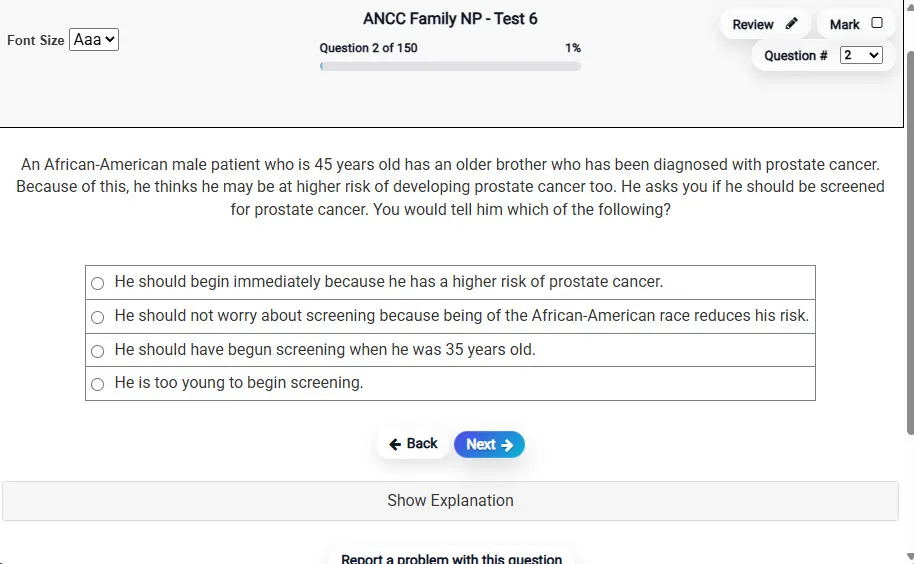
Answering a Question screen – Multiple-choice item view with navigation controls and progress tracker.
Answering a Question Multiple-choice item view with navigation controls and progress tracker.

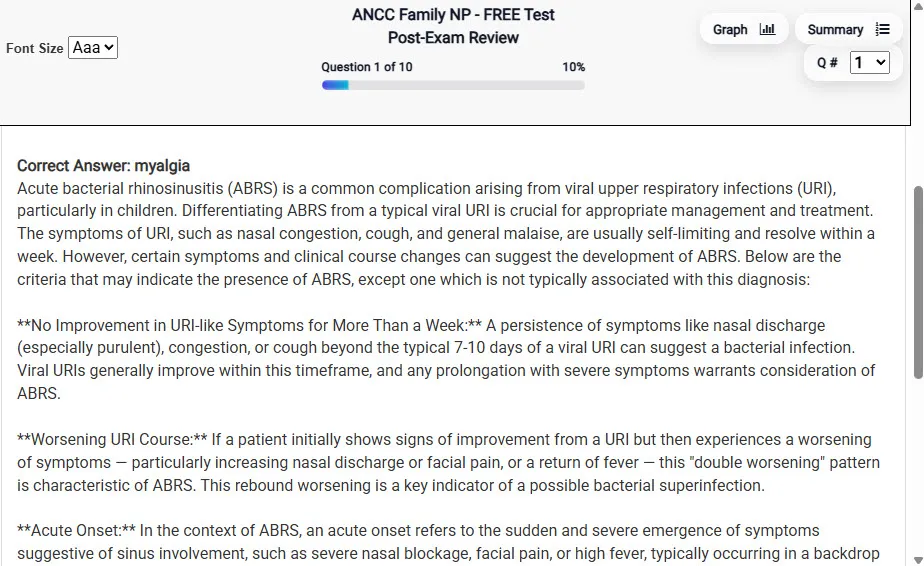
                           Detailed Explanation screen – 
                         Review mode showing chosen answer and rationale and references.
Detailed Explanation Review mode showing chosen answer and rationale and references.

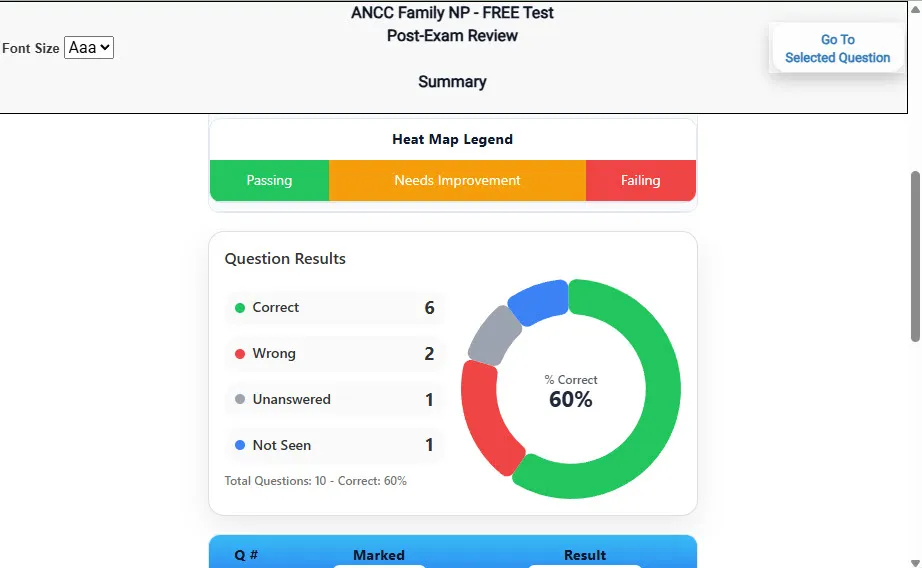
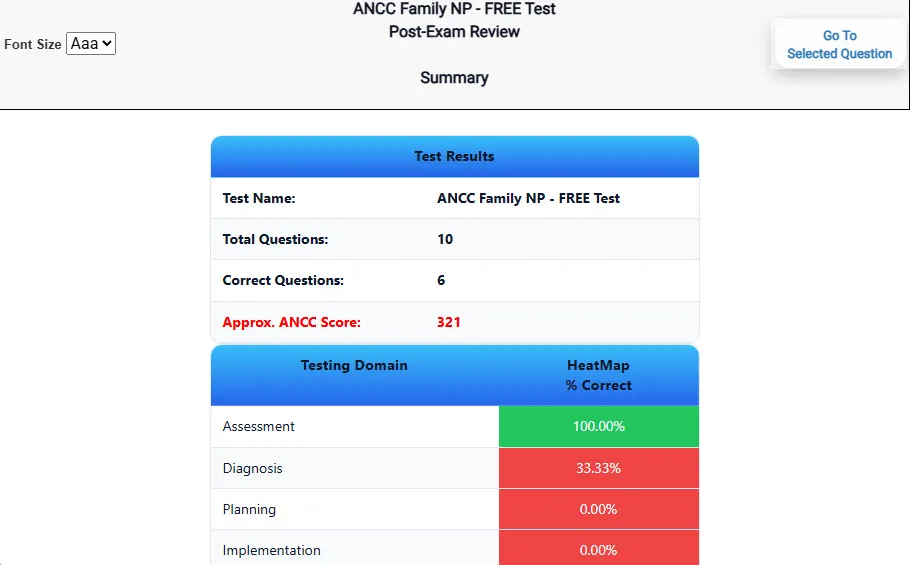
                           Review Summary 1 screen – 
                         Summary with counts for correct/wrong/unanswered and not seen items.
Review Summary 1 Summary with counts for correct/wrong/unanswered and not seen items.

                           Review Summary 2 screen – 
                         Advanced summary with category/domain breakdown and performance insights.
Review Summary 2 Advanced summary with category/domain breakdown and performance insights.

What Each Screen Shows

Answer Question Screen

  • Clean multiple-choice interface with progress bar.
  • Mark for review feature.
  • Matches real test pacing.

Detailed Explanation

  • Correct answer plus rationale.
  • Key concepts and guidelines highlighted.
  • Move between questions to fill knowledge gaps.

Review Summary 1

  • Overall results with total questions and scaled score.
  • Domain heatmap shows strengths and weaknesses.
  • Quick visual feedback on study priorities.

Review Summary 2

  • Chart of correct, wrong, unanswered, not seen.
  • Color-coded results for easy review.
  • Links back to missed items.

Top 10 Reasons to Use Exam Edge for your WEST-NES Biology Exam Prep

  1. Focused on the WEST-NES Biology Exam

    Our practice tests are built specifically for the WEST-NES Biology exam — every question mirrors the real topics, format, and difficulty so you're studying exactly what matters.

  2. Real Exam Simulation

    We match the per-question time limits and pressure of the actual WEST-NES exam, so test day feels familiar and stress-free.

  3. 20 Full Practice Tests & 3,000 Unique Questions

    You'll have more than enough material to master every WEST-NES Biology concept — no repeats, no fluff.

  4. Lower Cost Than a Retake

    Ordering 5 practice exams costs less than retaking the WEST-NES Biology exam after a failure. One low fee could save you both time and money.

  5. Flexible Testing

    Need to step away mid-exam? Pick up right where you left off — with your remaining time intact.

  6. Instant Scoring & Feedback

    See your raw score and an estimated WEST-NES Biology score immediately after finishing each practice test.

  7. Detailed Explanations for Every Question

    Review correct and incorrect answers with clear, step-by-step explanations so you truly understand each topic.

  8. Trusted & Accredited

    We're fully accredited by the Better Business Bureau and uphold the highest standards of trust and transparency.

  9. Web-Based & Always Available

    No software to install. Access your WEST-NES Biology practice exams 24/7 from any computer or mobile device.

  10. Expert Support When You Need It

    Need extra help? Our specialized tutors are highly qualified and ready to support your WEST-NES exam prep.


Pass the WEST-NES Biology Exam with Realistic Practice Tests from Exam Edge

Preparing for your upcoming WEST-NES Biology (305) Certification Exam can feel overwhelming — but the right practice makes all the difference. Exam Edge gives you the tools, structure, and confidence to pass on your first try. Our online practice exams are built to match the real WEST-NES Biology exam in content, format, and difficulty.

  • 📝 20 WEST-NES Biology Practice Tests: Access 20 full-length exams with 150 questions each, covering every major WEST-NES Biology topic in depth.
  • Instant Online Access: Start practicing right away — no software, no waiting.
  • 🧠 Step-by-Step Explanations: Understand the reasoning behind every correct answer so you can master WEST-NES Biology exam concepts.
  • 🔄 Retake Each Exam Up to 4 Times: Build knowledge through repetition and track your improvement over time.
  • 🌐 Web-Based & Available 24/7: Study anywhere, anytime, on any device.
  • 🧘 Boost Your Test-Day Confidence: Familiarity with the WEST-NES format reduces anxiety and helps you perform under pressure.

These WEST-NES Biology practice exams are designed to simulate the real testing experience by matching question types, timing, and difficulty level. This approach helps you get comfortable not just with the exam content, but also with the testing environment, so you walk into your exam day focused and confident.


Exam Edge WEST Reviews


I just received notice of passing the middle school math (012) test with a score of 292. My last 4 test scores on the WESTEmath site averaged 291. I'd say the practice tests mirror the actual test quite well and the practice test scores are a very good indicator of how well you'll do on the actual t ...
Read More
Phillip ,

Thank you for the opportunities to take several practice tests! This is really helpful to see which areas I need to study more, and where I have some of my greatest misconceptions. It is helping me to prepare for the real WEST-E test!

Tyler , Olympia, Washington

I just want to say thank you! I purchased several study guides & flash cards to prepare for my test. I was feeling frustrated by the amount of content. I decided to purchase your practice tests and I wish I hadn't wasted my money on the others. Your practice tests resemble the test and I fel ...
Read More
Heather, Spokane, WA

Just wanted to thank you for making the practice tests available. They made a huge difference. Took the 2 Elementary subtests this past Saturday and passed! These practice tests were by far the best tool to use to be prepared and feel confident going into the real testing situation. Thanks again. Ri ...
Read More
Sonja, Washington

Thank you so much!! Your practice exam in Bilingual Education was so helpful! I was able to pass with no problem at all! Javier Roman

JAVIER , seattle, Washington


WEST-NES Biology Aliases Test Name

Here is a list of alternative names used for this exam.

  • WEST-NES Biology
  • WEST-NES Biology test
  • WEST-NES Biology Certification Test
  • WEST
  • WEST 305
  • 305 test
  • WEST-NES Biology (305)
  • -NES Biology certification