This is the content of the pop-over!

WEST-B Writing (097) Practice Tests & Test Prep by Exam Edge


WEST-B Writing  product image
(5.0)
Based on 34 Reviews

  • Real Exam Simulation: Timed questions and matching content build comfort for your WEST-B Writing test day.
  • Instant, 24/7 Access: Web-based WEST-B Writing practice exams with no software needed.
  • Clear Explanations: Step-by-step answers and explanations for your WEST-B exam to strengthen understanding.
  • Boosted Confidence: Reduces anxiety and improves test-taking skills to ace your WEST-B Writing (097).

Featured on

WEST-B Writing Online Practice Test Bundles

BEST VALUE
20 practice tests

$174.00

$799.00

SAVE $625

Only $8.70 per test!

  • 100% Pass Guarantee
  • 20 online practice tests
  • 50 questions + 2 essays per test
  • Bonus: 100 Flash Cards + Study Guide
  • Instant access
  • Detailed Explanations
  • Practice tests never expire
  • Timed, untimed, or study guide mode
MOST POPULAR
10 practice tests

$99.50

$399.50

SAVE $300

Only $9.95 per test!

  • 10 online practice tests
  • 50 questions + 2 essays per test
  • Bonus: 100 Flash Cards + Study Guide
  • Instant access
  • Detailed Explanations
  • Practice tests never expire
  • Timed, untimed, or study guide mode
5 practice tests

$69.75

$199.75

SAVE $130

Only $13.95 per test!

  • 5 online practice tests
  • 50 questions + 2 essays per test
  • Bonus: 100 Flash Cards
  • Instant access
  • Detailed Explanations
  • Practice tests never expire
  • Timed, untimed, or study guide mode
1 practice test

$39.95

  • 1 online practice test
  • 50 questions + 2 essays per test
  • Instant access
  • Detailed Explanations
  • Practice tests never expire
  • Timed, untimed, or study guide mode
Quick Select
Tap to choose a bundle

** All Prices are in US Dollars (USD) **


WEST-B Writing (097) Resources

Jump to the section you need most.

Understanding the exact breakdown of the WEST-B Writing test will help you know what to expect and how to most effectively prepare. The WEST-B Writing has 50 multiple-choice questions and 2 essay questions. The exam will be broken down into the sections below:

WEST-B Writing Exam Blueprint
Domain Name
Understand the role of audience and purpose in written communication.  
Understand idea development - fluency organization within writing.  
Recognize writing that effectively communicates intended messages.  
Apply revision strategies to written works.  
Recognize the use of standard writing conventions.  
Prepare an organized - developed composition in response to instructions regarding content - purpose audience. (Written Assignment)  

WEST-B Writing Study Tips by Domain

  • Identify the writer’s primary purpose (inform, persuade, analyze, narrate, reflect) and check that most details serve that purpose—red flag: an essay that “does everything” without a clear aim.
  • Match tone and diction to the intended audience (peer, general reader, professional, academic) and avoid register shifts—common trap: dropping slang into an otherwise formal response.
  • Choose evidence types that the audience will find credible (facts/data for skeptical readers; examples/anecdotes for general readers) and don’t assume shared knowledge—red flag: unexplained references or jargon.
  • Use purpose-driven organization (e.g., problem→solution for proposals; claim→reasons→evidence for argument) and avoid structures that fight the task—common trap: a narrative structure for a persuasive prompt.
  • Maintain a consistent point of view and level of formality appropriate to audience and purpose—red flag: shifting from objective analysis to personal ranting (“I just feel like…”).
  • Control emphasis and detail based on what the audience needs to understand or do next—priority rule: front-load key context and define terms before complex reasoning rather than saving essentials for the conclusion.
  • Prioritize a controllable organizing principle (thesis or central focus) that every paragraph advances; red flag: paragraphs that could be reordered without changing meaning signal weak organization.
  • Use purposeful paragraph structure (topic sentence → evidence/elaboration → closing/bridge) to develop ideas; common trap: listing examples without explaining how they support the main point.
  • Maintain fluency with varied sentence structures and consistent verb tense; red flag: repetitive sentence openings (e.g., “I think” or “There is”) that make prose choppy.
  • Strengthen cohesion through clear transitions that show relationships (cause, contrast, sequence); priority rule: transitions should do more than announce “first/next”—they should clarify logic.
  • Develop ideas with specificity (concrete details, relevant examples, precise word choice); common trap: broad claims or clichés that read as filler and don’t add meaning.
  • Control pacing by allocating space according to importance (more for key points, less for setup); red flag: an overlong introduction or conclusion that crowds out body development.
  • Identify whether the central message is explicit and consistent across the piece; red flag: a thesis that shifts or is contradicted by later paragraphs.
  • Check that support (examples, reasons, details) clearly connects to the claim; common trap: “interesting” details that don’t explain or prove the main point.
  • Evaluate clarity and specificity of language for the intended message; red flag: vague pronouns (e.g., “it,” “they”) with unclear referents.
  • Look for logical progression that guides the reader to the intended takeaway; common trap: abrupt topic jumps without transitions that force the reader to infer connections.
  • Assess tone and word choice for alignment with the message being conveyed; contraindication: sarcasm or overly informal diction that undermines a serious purpose.
  • Verify the conclusion reinforces (not repeats or derails) the message; red flag: introducing a new main idea in the final sentences.
  • Revise globally before locally: confirm the thesis/focus, then check paragraph unity and order, and only then fix wording or mechanics—red flag: spending time on comma fixes while the main point is unclear.
  • Use a “cut/keep/move” pass to improve organization—common trap: adding more sentences to a weak paragraph instead of relocating or removing off-topic material.
  • Strengthen coherence with explicit transitions that reflect logic (cause/effect, contrast, sequence)—red flag: paragraphs that start with vague openers like “Another thing” without stating the relationship.
  • Improve clarity and concision by replacing wordy phrases and eliminating repetition—priority rule: if a sentence can be shortened without changing meaning, shorten it.
  • Revise for development by adding specific evidence, examples, or explanation where claims are unsupported—common trap: listing points without showing how they prove the main idea.
  • Do a final consistency check for tone, verb tense, and point of view across the piece—red flag: shifting from formal to casual diction or from past to present tense without a reason.
  • Check sentence boundaries—watch for comma splices and fused sentences; a quick red flag is two complete thoughts joined only by a comma or nothing.
  • Verify subject–verb agreement, especially with intervening phrases and indefinite pronouns (e.g., “each,” “neither”); trap: the verb matches the nearest noun instead of the true subject.
  • Maintain consistent verb tense and pronoun reference; red flag: shifts from past to present (or “they” with no clear antecedent) within the same time frame or paragraph.
  • Use correct punctuation for clauses and lists—commas after introductory elements, semicolons between closely related independent clauses; trap: overusing commas where a period or semicolon is required.
  • Apply apostrophes correctly for possession vs. plurals; common error: using apostrophes to make simple plurals (e.g., “student’s” when you mean “students”).
  • Ensure capitalization and spelling follow standard conventions (proper nouns, titles, sentence starts); priority rule: when in doubt, keep capitalization minimal and reserve it for proper names and formal titles.
  • Start by rephrasing the prompt into a one-sentence task statement (topic + purpose + audience) and use it as a checklist; red flag: drafting before you can state exactly what the instructions require.
  • Write a clear thesis or controlling idea in the first paragraph that matches the assigned purpose (e.g., explain, argue, describe); common trap: giving a vague “today I will talk about” opener that doesn’t commit to a point.
  • Plan an organizational pattern that fits the task (e.g., problem–solution, cause–effect, compare–contrast) and stick to it with purposeful paragraph breaks; priority rule: one main idea per body paragraph.
  • Develop each body paragraph with specific, relevant support (examples, reasons, details) and explain how it connects back to the thesis; red flag: listing details without commentary or leaving claims unsupported.
  • Use transitions to show relationships among ideas (sequence, contrast, addition, emphasis) rather than relying on “first/second/third” only; common trap: abrupt topic shifts that make the reader infer the logic.
  • Conclude by synthesizing the main point and reinforcing purpose for the intended audience (implication, recommendation, or takeaway); red flag: introducing a new major reason or example in the last lines.


Built to Fit Into Your Busy Life

Everything you need to prepare with confidence—without wasting a minute.

Three Study Modes

Timed, No Time Limit, or Explanation mode.

Actionable Analytics

Heatmaps and scaled scores highlight weak areas.

High-Yield Rationales

Concise explanations emphasize key concepts.

Realistic Interface

Matches the feel of the actual exam environment.

Accessible by Design

Clean layout reduces cognitive load.

Anytime, Anywhere

Web-based access 24/7 on any device.
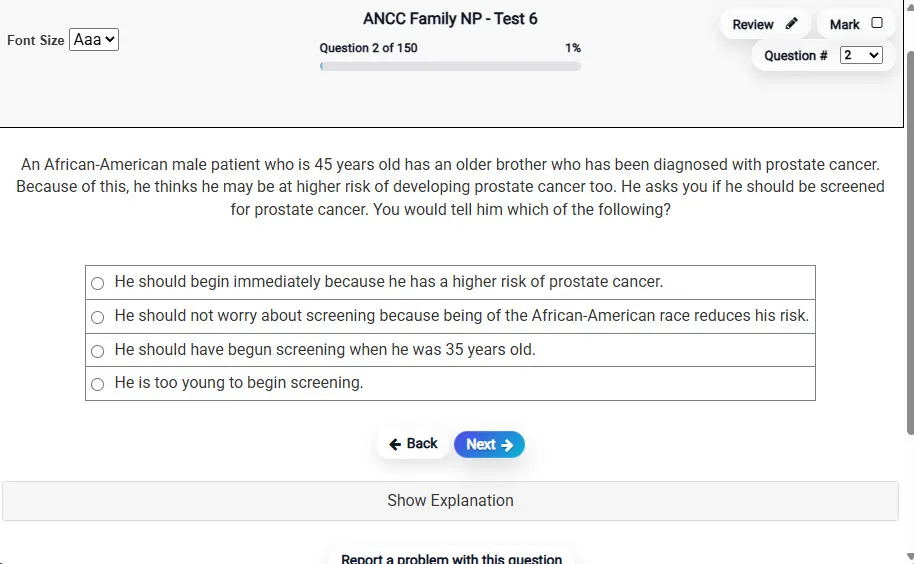
Answering a Question screen – Multiple-choice item view with navigation controls and progress tracker.
Answering a Question Multiple-choice item view with navigation controls and progress tracker.

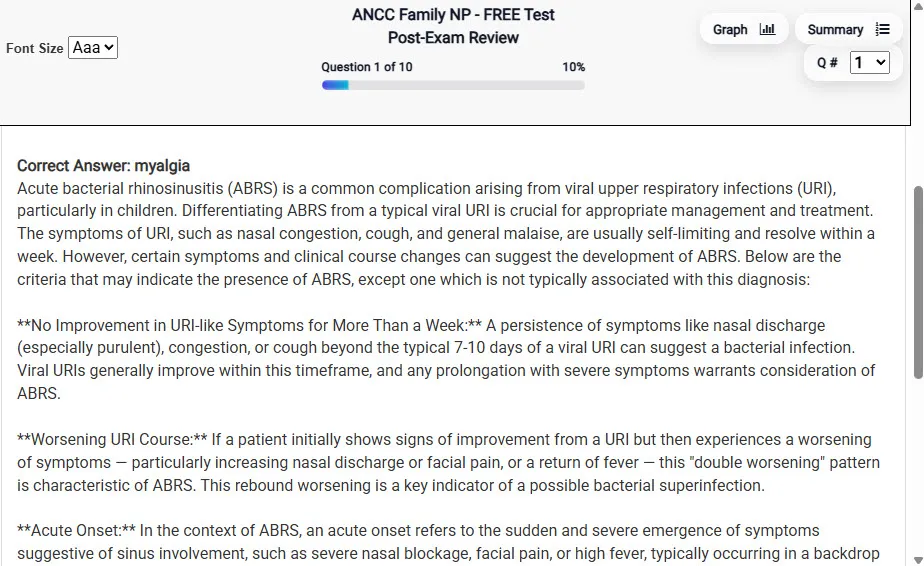
                           Detailed Explanation screen – 
                         Review mode showing chosen answer and rationale and references.
Detailed Explanation Review mode showing chosen answer and rationale and references.

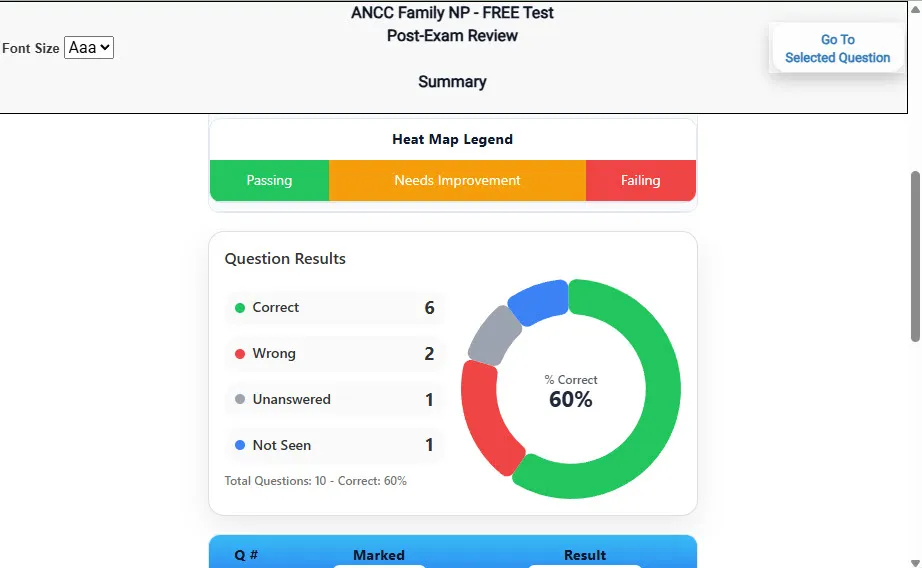
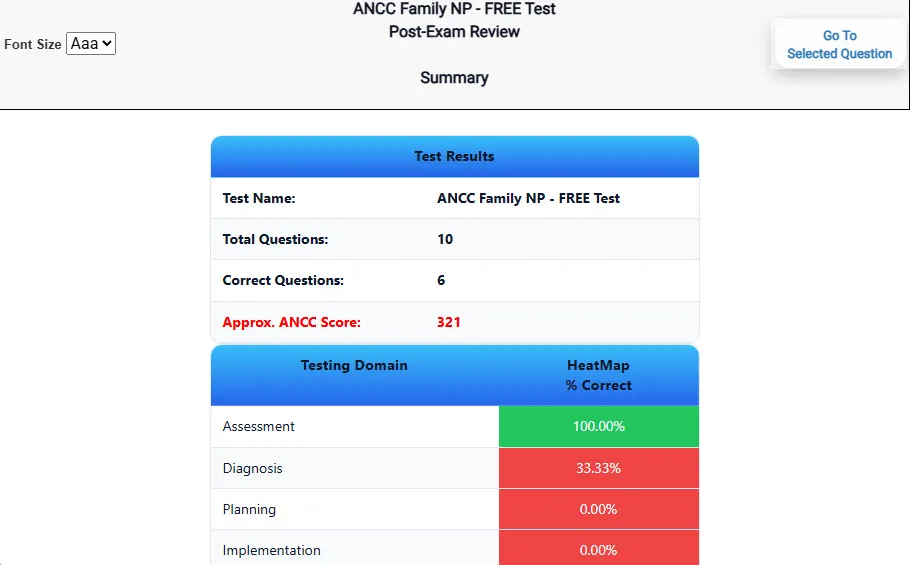
                           Review Summary 1 screen – 
                         Summary with counts for correct/wrong/unanswered and not seen items.
Review Summary 1 Summary with counts for correct/wrong/unanswered and not seen items.

                           Review Summary 2 screen – 
                         Advanced summary with category/domain breakdown and performance insights.
Review Summary 2 Advanced summary with category/domain breakdown and performance insights.

What Each Screen Shows

Answer Question Screen

  • Clean multiple-choice interface with progress bar.
  • Mark for review feature.
  • Matches real test pacing.

Detailed Explanation

  • Correct answer plus rationale.
  • Key concepts and guidelines highlighted.
  • Move between questions to fill knowledge gaps.

Review Summary 1

  • Overall results with total questions and scaled score.
  • Domain heatmap shows strengths and weaknesses.
  • Quick visual feedback on study priorities.

Review Summary 2

  • Chart of correct, wrong, unanswered, not seen.
  • Color-coded results for easy review.
  • Links back to missed items.

Top 10 Reasons to Use Exam Edge for your WEST-B Writing Exam Prep

  1. Focused on the WEST-B Writing Exam

    Our practice tests are built specifically for the WEST-B Writing exam — every question mirrors the real topics, format, and difficulty so you're studying exactly what matters.

  2. Real Exam Simulation

    We match the per-question time limits and pressure of the actual WEST-B exam, so test day feels familiar and stress-free.

  3. 20 Full Practice Tests & 1,040 Unique Questions

    You'll have more than enough material to master every WEST-B Writing concept — no repeats, no fluff.

  4. Lower Cost Than a Retake

    Ordering 5 practice exams costs less than retaking the WEST-B Writing exam after a failure. One low fee could save you both time and money.

  5. Flexible Testing

    Need to step away mid-exam? Pick up right where you left off — with your remaining time intact.

  6. Instant Scoring & Feedback

    See your raw score and an estimated WEST-B Writing score immediately after finishing each practice test.

  7. Detailed Explanations for Every Question

    Review correct and incorrect answers with clear, step-by-step explanations so you truly understand each topic.

  8. Trusted & Accredited

    We're fully accredited by the Better Business Bureau and uphold the highest standards of trust and transparency.

  9. Web-Based & Always Available

    No software to install. Access your WEST-B Writing practice exams 24/7 from any computer or mobile device.

  10. Expert Support When You Need It

    Need extra help? Our specialized tutors are highly qualified and ready to support your WEST-B exam prep.


Pass the WEST-B Writing Exam with Realistic Practice Tests from Exam Edge

Preparing for your upcoming WEST-B Writing (097) Certification Exam can feel overwhelming — but the right practice makes all the difference. Exam Edge gives you the tools, structure, and confidence to pass on your first try. Our online practice exams are built to match the real WEST-B Writing exam in content, format, and difficulty.

  • 📝 20 WEST-B Writing Practice Tests: Access 20 full-length exams with 52 questions each, covering every major WEST-B Writing topic in depth.
  • Instant Online Access: Start practicing right away — no software, no waiting.
  • 🧠 Step-by-Step Explanations: Understand the reasoning behind every correct answer so you can master WEST-B Writing exam concepts.
  • 🔄 Retake Each Exam Up to 4 Times: Build knowledge through repetition and track your improvement over time.
  • 🌐 Web-Based & Available 24/7: Study anywhere, anytime, on any device.
  • 🧘 Boost Your Test-Day Confidence: Familiarity with the WEST-B format reduces anxiety and helps you perform under pressure.

These WEST-B Writing practice exams are designed to simulate the real testing experience by matching question types, timing, and difficulty level. This approach helps you get comfortable not just with the exam content, but also with the testing environment, so you walk into your exam day focused and confident.


Exam Edge WEST Reviews


I just received notice of passing the middle school math (012) test with a score of 292. My last 4 test scores on the WESTEmath site averaged 291. I'd say the practice tests mirror the actual test quite well and the practice test scores are a very good indicator of how well you'll do on the actual t ...
Read More
Phillip ,

Thank you for the opportunities to take several practice tests! This is really helpful to see which areas I need to study more, and where I have some of my greatest misconceptions. It is helping me to prepare for the real WEST-E test!

Tyler , Olympia, Washington

I just want to say thank you! I purchased several study guides & flash cards to prepare for my test. I was feeling frustrated by the amount of content. I decided to purchase your practice tests and I wish I hadn't wasted my money on the others. Your practice tests resemble the test and I fel ...
Read More
Heather, Spokane, WA

Just wanted to thank you for making the practice tests available. They made a huge difference. Took the 2 Elementary subtests this past Saturday and passed! These practice tests were by far the best tool to use to be prepared and feel confident going into the real testing situation. Thanks again. Ri ...
Read More
Sonja, Washington

Thank you so much!! Your practice exam in Bilingual Education was so helpful! I was able to pass with no problem at all! Javier Roman

JAVIER , seattle, Washington


WEST-B Writing Aliases Test Name

Here is a list of alternative names used for this exam.

  • WEST-B Writing
  • WEST-B Writing test
  • WEST-B Writing Certification Test
  • WEST
  • WEST 097
  • 097 test
  • WEST-B Writing (097)
  • -B Writing certification