This is the content of the pop-over!

VCLA Writing (092) Practice Tests & Test Prep by Exam Edge


VCLA Virginia Communication and Literacy Assessment - Writing  product image
(4.6)
Based on 17 Reviews

  • Real Exam Simulation: Timed questions and matching content build comfort for your VCLA Writing test day.
  • Instant, 24/7 Access: Web-based VCLA Virginia Communication and Literacy Assessment - Writing practice exams with no software needed.
  • Clear Explanations: Step-by-step answers and explanations for your VCLA exam to strengthen understanding.
  • Boosted Confidence: Reduces anxiety and improves test-taking skills to ace your VCLA Virginia Communication and Literacy Assessment - Writing (092).

Featured on

VCLA Virginia Communication and Literacy Assessment - Writing Online Practice Test Bundles

BEST VALUE
20 practice tests

$174.00

$799.00

SAVE $625

Only $8.70 per test!

  • 100% Pass Guarantee
  • 20 online practice tests
  • 40 questions + 1 essay per test
  • Bonus: 100 Flash Cards + Study Guide
  • Instant access
  • Detailed Explanations
  • Practice tests never expire
  • Timed, untimed, or study guide mode
MOST POPULAR
10 practice tests

$99.50

$399.50

SAVE $300

Only $9.95 per test!

  • 10 online practice tests
  • 40 questions + 1 essay per test
  • Bonus: 100 Flash Cards + Study Guide
  • Instant access
  • Detailed Explanations
  • Practice tests never expire
  • Timed, untimed, or study guide mode
5 practice tests

$69.75

$199.75

SAVE $130

Only $13.95 per test!

  • 5 online practice tests
  • 40 questions + 1 essay per test
  • Bonus: 100 Flash Cards
  • Instant access
  • Detailed Explanations
  • Practice tests never expire
  • Timed, untimed, or study guide mode
1 practice test

$39.95

  • 1 online practice test
  • 40 questions + 1 essay per test
  • Instant access
  • Detailed Explanations
  • Practice tests never expire
  • Timed, untimed, or study guide mode
Quick Select
Tap to choose a bundle

** All Prices are in US Dollars (USD) **


VCLA Writing (092) Resources

Jump to the section you need most.

Understanding the exact breakdown of the VCLA Virginia Communication and Literacy Assessment - Writing test will help you know what to expect and how to most effectively prepare. The VCLA Virginia Communication and Literacy Assessment - Writing has multiple-choice questions . The exam will be broken down into the sections below:

VCLA Virginia Communication and Literacy Assessment - Writing Exam Blueprint
Domain Name
Understand the influence of purpose and audience in written communication  
Apply principles of unity - focus development in writing  
Apply principles of organization in writing  
Apply principles of sentence and paragraph construction in writing.  
Apply correct usage in Standard English  
Apply knowledge of mechanical conventions in Standard English.  
Improve ineffective writing by analyzing and revising sentences containing problems related to grammar and usage - construction mechanics.  
Produce a written summary of a given informational or persuasive passage  
Prepare a developed composition on a given topic using language consistent with a given audience and purpose.  

VCLA Virginia Communication and Literacy Assessment - Writing Study Tips by Domain

  • Identify the writer’s purpose (inform, persuade, analyze, narrate) and match choices accordingly; red flag: inserting opinions in an informational task or sounding neutral in a persuasive task.
  • Adjust tone and formality to the intended audience (e.g., peers vs. school board); common trap: slang, sarcasm, or overly casual contractions in a formal context.
  • Choose evidence and examples the audience will value and understand; priority rule: assume no specialized knowledge unless the prompt signals an expert audience.
  • Use appropriate appeals for purpose and audience (logos/ethos/pathos) without overreaching; red flag: emotional language that substitutes for facts or undermines credibility.
  • Maintain a consistent point of view and address the audience directly only when appropriate; common trap: shifting from third person to “you” mid-response without a rhetorical reason.
  • Align word choice and level of detail with constraints (time, stakes, relationship); threshold: if a sentence could offend, confuse, or talk down to the intended reader, revise for clarity and respect.
  • State a clear, arguable controlling idea early (thesis or main point) and ensure every body paragraph directly supports it—red flag: a paragraph that could be deleted without changing the paper’s meaning.
  • Use topic sentences that explicitly link back to the controlling idea—common trap: opening a paragraph with a broad fact or definition that never reconnects to the point.
  • Develop each main point with specific evidence (example, detail, reason, or explanation) and follow with commentary that explains how it proves the claim—priority rule: don’t let evidence sit “uninterpreted.”
  • Maintain focus by avoiding off-topic anecdotes, personal asides, or extra subtopics—red flag: a sentence that answers a different question than the prompt asks.
  • Keep unity within paragraphs by using one main idea per paragraph and moving unrelated material to a better location or cutting it—common trap: a paragraph that shifts from one reason to a second reason halfway through.
  • Strengthen development through purposeful transitions that show relationships (cause, contrast, sequence) rather than filler—red flag: relying on “also” and “in conclusion” to cover missing logical connections.
  • Build a clear macro-structure (intro with thesis, body, conclusion) and keep each paragraph tied to one controlling idea—red flag: a paragraph that can’t be summarized in one sentence.
  • Use purposeful introductions that preview the claim and direction (not a broad generality)—common trap: opening with a quote or question that doesn’t connect to the thesis.
  • Order body points logically (e.g., general-to-specific, cause-to-effect, problem-to-solution) and don’t mix patterns midstream—red flag: readers must reorient because the basis of organization changes.
  • Create cohesion with transitions that name relationships (however, therefore, for example) rather than just “first/next”—common trap: relying on list transitions that don’t show logic.
  • Write conclusions that synthesize the main points and reinforce significance without adding new evidence—priority rule: no new reasons or examples in the final paragraph.
  • Maintain consistent point of view and tense across sections to avoid organizational drift—red flag: shifting from “you” to “they” or past to present without purpose.
  • Use varied sentence structures (simple, compound, complex) but keep each sentence’s core subject–verb–object clear; red flag: long openers that bury the main clause and cause reader confusion.
  • Maintain parallel structure in lists and paired ideas (e.g., “to analyze, to draft, and to revise”); common trap: mixing forms (gerunds with infinitives) inside the same series.
  • Ensure logical relationships with correct subordination and coordination; priority rule: use subordinating conjunctions (because, although) only when the dependent clause truly cannot stand alone.
  • Build paragraphs with a clear topic sentence, supporting evidence, and a concluding/transitioning sentence; red flag: paragraphs that introduce a new point halfway through without a new paragraph.
  • Place modifiers next to what they modify and avoid dangling/opening participles; common trap: introductory phrases that accidentally modify the wrong noun (misplaced modifier).
  • Use transitions to connect sentences and paragraphs (however, for example, therefore) without overusing them; threshold: if every sentence starts with a transition, cohesion is likely forced rather than logical.
  • Ensure subject–verb agreement even with intervening phrases (e.g., “The list of items is”)—red flag: plural noun near the verb can lure you into a wrong plural verb.
  • Use correct pronoun–antecedent agreement and clarity (number, person, gender where relevant)—common trap: singular antecedents like “each/everyone/neither” require singular pronouns in formal Standard English.
  • Maintain consistent and appropriate verb tense and mood—priority rule: don’t shift tense without a time cue (e.g., “then,” “now,” “by the time”).
  • Choose the correct pronoun case (I/me, who/whom, he/him) based on function in the clause—red flag: pronouns joined with “and” (e.g., “between you and me”) often trigger case errors.
  • Use modifiers and comparisons correctly—common trap: illogical comparison (compare like items) and faulty “more/most” usage (e.g., avoid “more better”).
  • Select accurate word forms and idiomatic usage (affect/effect, fewer/less, lie/lay, can/may)—threshold cue: use fewer with count nouns and less with mass nouns in formal writing.
  • Use commas correctly with coordinating conjunctions joining two independent clauses; red flag: inserting a comma splice instead of using a semicolon or conjunction.
  • Maintain internal punctuation and capitalization in quoted material; common trap: misplacing commas/periods outside quotation marks in American English.
  • Apply apostrophes for possession (including irregular plurals) and avoid them for simple plurals; red flag: writing “teacher’s” when you mean multiple teachers.
  • Capitalize proper nouns, titles used with names, and the first word of sentences; common trap: overcapitalizing generic job titles (e.g., “the principal”).
  • Use colons and semicolons for specific functions only; priority rule: a colon must follow an independent clause and introduces a list, explanation, or quote.
  • Control end punctuation and sentence boundaries; red flag: a run-on created by using only a comma or by omitting punctuation between complete thoughts.
  • State the passage’s central claim or main idea in your opening sentence and keep it neutral; red flag: inserting your own opinion or evaluation (“I think,” “clearly”) turns a summary into a response.
  • Include only key supporting points that explain how the author develops the main idea (e.g., major reasons, findings, or steps); common trap: copying vivid examples, anecdotes, or minor statistics that don’t change the overall message.
  • Preserve the author’s purpose and tone (inform, persuade, propose, criticize) while using your own words; red flag: patchwriting—stringing together lightly edited phrases from the passage.
  • Maintain logical sequence and relationships among ideas (cause/effect, compare/contrast, problem/solution); priority rule: don’t reorder points if it changes what the author implies or which point is most important.
  • Attribute positions accurately (e.g., “The author argues…”) and represent qualifiers (“may,” “often,” “in some cases”); common trap: overgeneralizing by turning qualified claims into absolute statements.
  • Be concise and proportionate to the passage length while covering the whole text; red flag: spending most of the summary on the introduction or one paragraph and omitting the conclusion or final recommendation.
  • Write an opening that states a clear controlling idea and matches the prompt’s task (inform, persuade, explain); red flag: a hook that never transitions into a thesis-like focus.
  • Choose an audience-appropriate tone and level of formality (e.g., professional for a school memo, conversational for a peer email); common trap: mixing slang with formal diction in the same piece.
  • Develop each body paragraph with specific support (examples, reasons, brief anecdotes, or relevant details) tied back to the main point; priority rule: no paragraph should be only a claim without evidence.
  • Use purposeful organization (chronological, cause–effect, compare–contrast, problem–solution) signaled with clear transitions; red flag: “listy” paragraphs that jump topics without connective wording.
  • Maintain consistent point of view and verb tense suitable to the purpose; common trap: shifting from “you” to “we” or past to present without a reason.
  • End with a conclusion that reinforces purpose and audience (summary, implication, or call to action) without introducing new major reasons; red flag: adding a brand-new point in the final sentence.


Built to Fit Into Your Busy Life

Everything you need to prepare with confidence—without wasting a minute.

Three Study Modes

Timed, No Time Limit, or Explanation mode.

Actionable Analytics

Heatmaps and scaled scores highlight weak areas.

High-Yield Rationales

Concise explanations emphasize key concepts.

Realistic Interface

Matches the feel of the actual exam environment.

Accessible by Design

Clean layout reduces cognitive load.

Anytime, Anywhere

Web-based access 24/7 on any device.
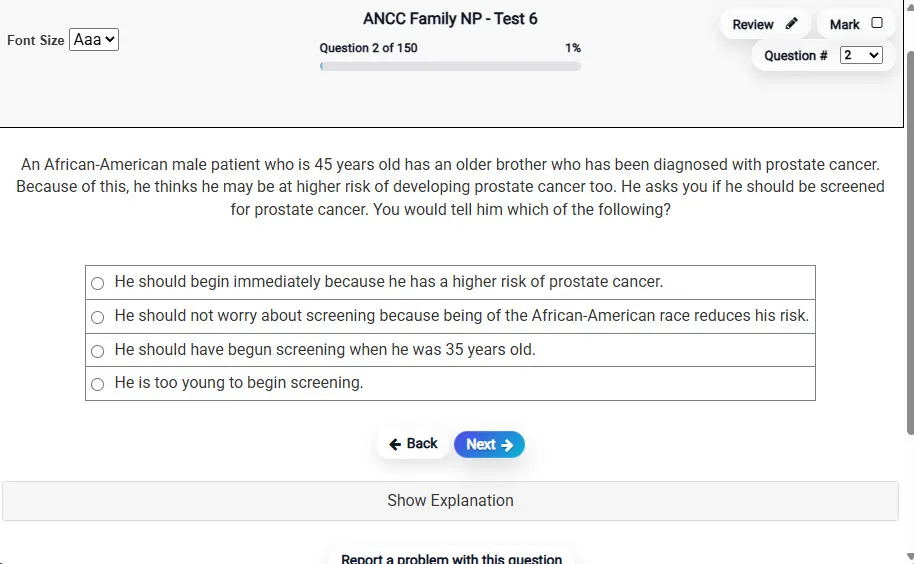
Answering a Question screen – Multiple-choice item view with navigation controls and progress tracker.
Answering a Question Multiple-choice item view with navigation controls and progress tracker.

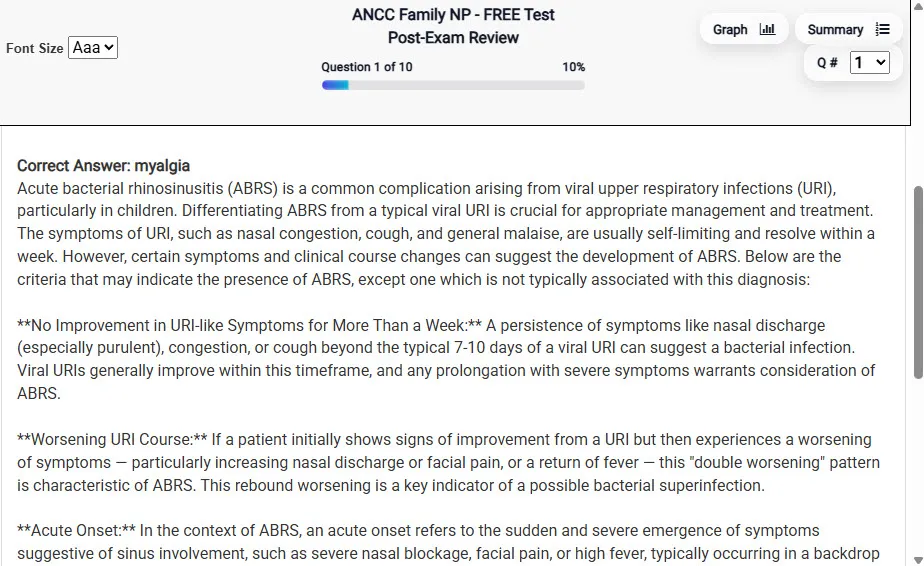
                           Detailed Explanation screen – 
                         Review mode showing chosen answer and rationale and references.
Detailed Explanation Review mode showing chosen answer and rationale and references.

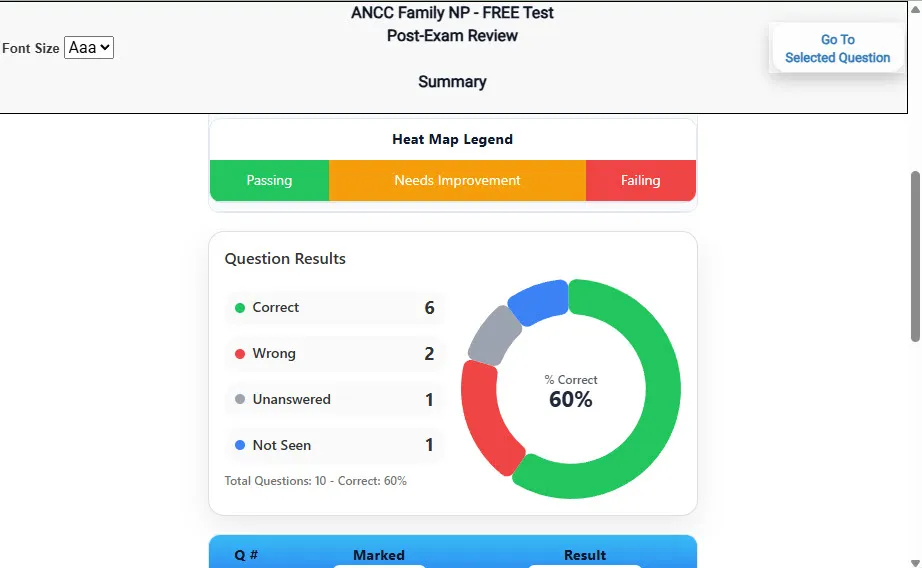
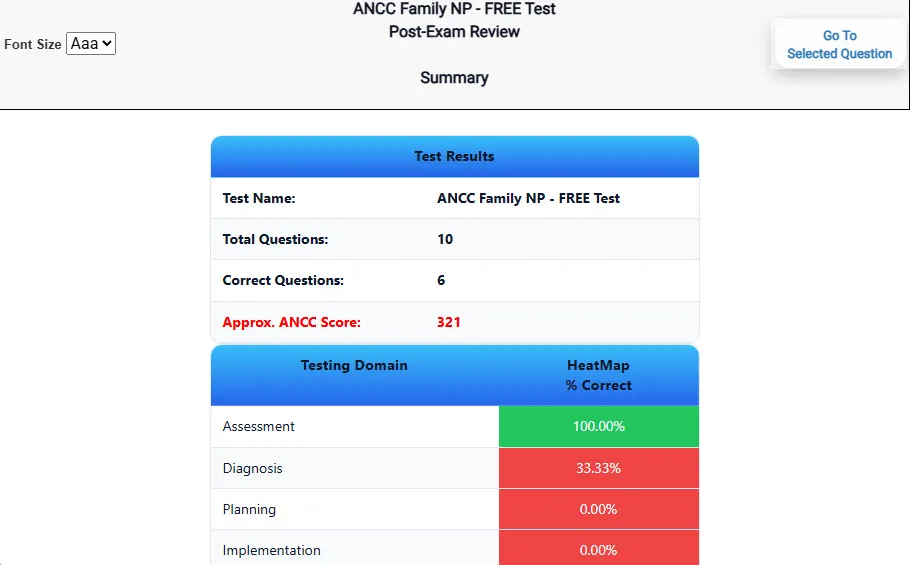
                           Review Summary 1 screen – 
                         Summary with counts for correct/wrong/unanswered and not seen items.
Review Summary 1 Summary with counts for correct/wrong/unanswered and not seen items.

                           Review Summary 2 screen – 
                         Advanced summary with category/domain breakdown and performance insights.
Review Summary 2 Advanced summary with category/domain breakdown and performance insights.

What Each Screen Shows

Answer Question Screen

  • Clean multiple-choice interface with progress bar.
  • Mark for review feature.
  • Matches real test pacing.

Detailed Explanation

  • Correct answer plus rationale.
  • Key concepts and guidelines highlighted.
  • Move between questions to fill knowledge gaps.

Review Summary 1

  • Overall results with total questions and scaled score.
  • Domain heatmap shows strengths and weaknesses.
  • Quick visual feedback on study priorities.

Review Summary 2

  • Chart of correct, wrong, unanswered, not seen.
  • Color-coded results for easy review.
  • Links back to missed items.

Top 10 Reasons to Use Exam Edge for your VCLA Virginia Communication and Literacy Assessment - Writing Exam Prep

  1. Focused on the VCLA Virginia Communication and Literacy Assessment - Writing Exam

    Our practice tests are built specifically for the VCLA Writing exam — every question mirrors the real topics, format, and difficulty so you're studying exactly what matters.

  2. Real Exam Simulation

    We match the per-question time limits and pressure of the actual VCLA exam, so test day feels familiar and stress-free.

  3. 20 Full Practice Tests & 820 Unique Questions

    You'll have more than enough material to master every VCLA Writing concept — no repeats, no fluff.

  4. Lower Cost Than a Retake

    Ordering 5 practice exams costs less than retaking the VCLA Virginia Communication and Literacy Assessment - Writing exam after a failure. One low fee could save you both time and money.

  5. Flexible Testing

    Need to step away mid-exam? Pick up right where you left off — with your remaining time intact.

  6. Instant Scoring & Feedback

    See your raw score and an estimated VCLA Virginia Communication and Literacy Assessment - Writing score immediately after finishing each practice test.

  7. Detailed Explanations for Every Question

    Review correct and incorrect answers with clear, step-by-step explanations so you truly understand each topic.

  8. Trusted & Accredited

    We're fully accredited by the Better Business Bureau and uphold the highest standards of trust and transparency.

  9. Web-Based & Always Available

    No software to install. Access your VCLA Writing practice exams 24/7 from any computer or mobile device.

  10. Expert Support When You Need It

    Need extra help? Our specialized tutors are highly qualified and ready to support your VCLA exam prep.


Pass the VCLA Virginia Communication and Literacy Assessment - Writing Exam with Realistic Practice Tests from Exam Edge

Preparing for your upcoming VCLA Virginia Communication and Literacy Assessment - Writing (092) Certification Exam can feel overwhelming — but the right practice makes all the difference. Exam Edge gives you the tools, structure, and confidence to pass on your first try. Our online practice exams are built to match the real VCLA Writing exam in content, format, and difficulty.

  • 📝 20 VCLA Virginia Communication and Literacy Assessment - Writing Practice Tests: Access 20 full-length exams with 41 questions each, covering every major VCLA Virginia Communication and Literacy Assessment - Writing topic in depth.
  • Instant Online Access: Start practicing right away — no software, no waiting.
  • 🧠 Step-by-Step Explanations: Understand the reasoning behind every correct answer so you can master VCLA Writing exam concepts.
  • 🔄 Retake Each Exam Up to 4 Times: Build knowledge through repetition and track your improvement over time.
  • 🌐 Web-Based & Available 24/7: Study anywhere, anytime, on any device.
  • 🧘 Boost Your Test-Day Confidence: Familiarity with the VCLA format reduces anxiety and helps you perform under pressure.

These VCLA Virginia Communication and Literacy Assessment - Writing practice exams are designed to simulate the real testing experience by matching question types, timing, and difficulty level. This approach helps you get comfortable not just with the exam content, but also with the testing environment, so you walk into your exam day focused and confident.


Exam Edge VCLA Reviews


VCLA Virginia Communication and Literacy Assessment - Writing Aliases Test Name

Here is a list of alternative names used for this exam.

  • VCLA Virginia Communication and Literacy Assessment - Writing
  • VCLA Virginia Communication and Literacy Assessment - Writing test
  • VCLA Virginia Communication and Literacy Assessment - Writing Certification Test
  • VCLA Writing test
  • VCLA
  • VCLA 092
  • 092 test
  • VCLA Virginia Communication and Literacy Assessment - Writing (092)
  • Virginia Communication and Literacy Assessment - Writing certification