This is the content of the pop-over!

VCLA Combined (VCLA) Practice Tests & Test Prep by Exam Edge


VCLA Virginia Communication and Literacy Assessment Combined product image
(4.8)
Based on 29 Reviews

  • Real Exam Simulation: Timed questions and matching content build comfort for your VCLA Combined test day.
  • Instant, 24/7 Access: Web-based VCLA Virginia Communication and Literacy Assessment Combined practice exams with no software needed.
  • Clear Explanations: Step-by-step answers and explanations for your VCLA exam to strengthen understanding.
  • Boosted Confidence: Reduces anxiety and improves test-taking skills to ace your VCLA Virginia Communication and Literacy Assessment Combined (VCLA).

Featured on

VCLA Virginia Communication and Literacy Assessment Combined Online Practice Test Bundles

BEST VALUE
10 practice tests

$99.50

$399.50

SAVE $300

Only $9.95 per test!

  • 100% Pass Guarantee
  • 10 online practice tests
  • 80 questions + 1 essay per test
  • Bonus: Study Guide
  • Instant access
  • Detailed Explanations
  • Practice tests never expire
  • Timed, untimed, or study guide mode
5 practice tests

$69.75

$199.75

SAVE $130

Only $13.95 per test!

  • 5 online practice tests
  • 80 questions + 1 essay per test
  • Bonus: Study Guide
  • Instant access
  • Detailed Explanations
  • Practice tests never expire
  • Timed, untimed, or study guide mode
1 practice test

$39.95

  • 1 online practice test
  • 80 questions + 1 essay per test
  • Instant access
  • Detailed Explanations
  • Practice tests never expire
  • Timed, untimed, or study guide mode
Quick Select
Tap to choose a bundle

** All Prices are in US Dollars (USD) **


VCLA Combined (VCLA) Resources

Jump to the section you need most.

Understanding the exact breakdown of the VCLA Virginia Communication and Literacy Assessment Combined test will help you know what to expect and how to most effectively prepare. The VCLA Virginia Communication and Literacy Assessment Combined has multiple-choice questions . The exam will be broken down into the sections below:

VCLA Virginia Communication and Literacy Assessment Combined Exam Blueprint
Domain Name % Number of
Questions
Reading Comprehension and Analysis 45% 36
     Understand the meaning of words and phrases.  
     Understand the main idea and supporting details in written material.  
     Analyze the relationship among ideas in written material  
     Use critical-reasoning skills to evaluate written material.  
     Apply skills for summarizing - outlining visually representing written materials and for interpreting information presented in graphic form.  
Writing Knowledge and Proficiency 55% 44
     Understand the influence of purpose and audience in written communication  
     Apply principles of unity - focus development in writing.  
     Apply principles of organization in writing.  
     Apply principles of sentence and paragraph construction in writing  
     Apply correct usage in Standard English.  
     Apply knowledge of mechanical conventions in Standard English.  
     Improve ineffective writing by analyzing and revising sentences containing problems related to grammar and usage - construction mechanics.  
     Produce a written summary of a given informational or persuasive passage.  
     Prepare a developed composition on a given topic using language consistent with a given audience and purpose.  

VCLA Virginia Communication and Literacy Assessment Combined Study Tips by Domain

  • Identify the author’s central claim/thesis and restate it in your own words before answering; red flag: choosing an option that is only a supporting detail or an interesting fact.
  • Track how ideas connect (cause/effect, comparison, concession, chronology) using transition cues (e.g., “however,” “therefore”); common trap: treating a contrast as if it were support.
  • Infer meaning only when it is warranted by specific text evidence; priority rule: if you can’t point to a line or phrase that supports it, it’s likely overreach.
  • Use context to determine word/phrase meaning (including figurative language and tone); red flag: picking the most common dictionary definition when the passage clearly narrows the meaning.
  • Evaluate arguments by separating claims, reasons, and evidence and checking relevance/sufficiency; common trap: confusing emotionally compelling language with proof.
  • Interpret graphics (tables, charts, headings) by matching the question to the correct variable/unit; red flag: mixing up axes/legend categories or ignoring qualifiers like “percent” vs. “number”.
  • Use surrounding context to choose the intended meaning when a word has multiple definitions; red flag: picking the most familiar definition instead of the one that fits the author’s point.
  • Identify meaning from word parts (prefix/root/suffix) and word class (noun vs. verb); common trap: ignoring a suffix like “-tion” or “-ly” that changes the function and meaning.
  • Interpret figurative language (metaphor, idiom, hyperbole) as conveying an idea rather than literal fact; red flag: answering as if an idiom is literal (e.g., “hit the ceiling”).
  • Determine referents for pronouns and demonstratives (this/that/which) to clarify phrase meaning; common trap: assuming the referent is the nearest noun when the logic points to a broader idea.
  • Use tone and connotation (positive/negative/neutral) to distinguish near-synonyms; priority rule: choose the option matching the author’s attitude, not just dictionary denotation.
  • Pay attention to signal words that modify meaning (not, except, only, primarily) within a phrase; red flag: missing a qualifier that flips or narrows the meaning.
  • Identify the passage’s main idea as the author’s central point, not the topic; red flag: a choice that is too narrow (one example) or too broad (a general truth not tied to the text).
  • Distinguish main-idea statements from supporting details by checking whether the sentence could serve as a heading for most paragraphs; common trap: selecting a vivid statistic or anecdote because it is memorable.
  • Use paragraph topic sentences (and repeated key terms) to track the author’s line of thought; priority rule: when the introduction contrasts viewpoints, the main idea often resolves that contrast.
  • Recognize supporting details by their function (example, reason, definition, evidence, counterexample); red flag: details that only illustrate a minor point rather than advance the central claim.
  • Pay attention to signal words (“however,” “therefore,” “for example”) to separate claims from evidence; common trap: treating a concession after “although” as the author’s main point.
  • For main-idea questions, reread the first and last sentences of the passage (or each paragraph) to confirm scope; threshold check: the correct answer must be supported by multiple parts of the text, not a single line.
  • Track how paragraphs connect (cause/effect, compare/contrast, problem/solution) and verify the link with a specific transition word; red flag: a shift marked by “however” or “therefore” that the next sentence doesn’t actually support.
  • Identify whether a sentence is an example, explanation, or implication of the prior claim; common trap: choosing a detail that is related to the topic but doesn’t develop the author’s point.
  • Distinguish correlation from causation when the passage links events or trends; red flag: language like “leads to” or “results in” without evidence beyond sequence or coincidence.
  • Analyze how evidence supports a claim (data, anecdote, expert testimony) and whether it matches the scope of the conclusion; priority rule: don’t accept a broad conclusion drawn from a single narrow example.
  • Follow the progression of an argument by mapping claim → reason → evidence → conclusion; common trap: confusing a counterargument the author mentions with the author’s own position.
  • Check pronoun and reference clarity (this/that/they) to determine which idea is being tied to the next one; red flag: an ambiguous “this” that could point to multiple prior statements.
  • Distinguish an author’s claim from supporting evidence; red flag: statements that sound persuasive but provide no concrete examples, data, or cited sources.
  • Check whether conclusions follow from the premises; common trap: assuming correlation implies causation or that one anecdote proves a general rule.
  • Evaluate evidence quality by relevance, sufficiency, and recency; priority rule: prefer directly related, representative, and up-to-date evidence over vague or outdated references.
  • Identify underlying assumptions and missing information; red flag: arguments that rely on undefined terms (e.g., “better,” “significant”) or untested “everyone knows” claims.
  • Spot common reasoning flaws (straw man, false dilemma, slippery slope, ad hominem); common trap: attacking the person or presenting only two options when more exist.
  • Detect bias, loaded language, and rhetorical devices that substitute for logic; red flag: emotionally charged wording that pushes agreement without addressing counterarguments.
  • When summarizing, state the author’s central claim and the most important support in your own words; red flag: copying distinctive phrases or including minor examples that don’t change the meaning.
  • For outlines, preserve the passage’s hierarchy (I, A, 1) and keep coordinate points parallel; common trap: mixing levels (e.g., a detail listed as a main point) or shifting from phrases to full sentences mid-level.
  • In a summary, maintain original emphasis and proportion—more space for major ideas than for anecdotes; priority rule: if a sentence can be removed without changing the overall message, it likely doesn’t belong.
  • When visually representing text (chart, concept map, timeline), label relationships explicitly (cause/effect, compare/contrast, sequence); red flag: adding new categories not supported by the passage.
  • For interpreting graphs/tables, read titles, units, and legends first and compute only what’s asked; common trap: confusing total vs. rate/percent or overlooking that axes may not start at zero.
  • When translating graphic data into words, report the key trend and the most relevant numbers with correct qualifiers; threshold cue: if the difference is small or within the same range, avoid absolute claims like “dramatic” or “always.”
  • Prioritize clarity and correctness over “fancy” phrasing—on the VCLA, a simple, grammatically clean sentence typically scores better than a complex one with agreement or modifier errors.
  • Keep Standard English usage tight (agreement, pronoun case/reference, tense consistency)—red flag: a pronoun like “this” or “they” with no clear antecedent.
  • Apply mechanics deliberately (comma splices, fragments, run-ons, apostrophes, capitalization)—common trap: using a comma where a semicolon or period is required between two independent clauses.
  • Organize for purpose and audience with a clear thesis and logical progression—priority rule: each paragraph should have one controlling idea that directly supports the thesis.
  • Build strong sentences and paragraphs using parallel structure and precise transitions—red flag: a list that shifts form (e.g., mixing verbs and nouns) or a transition that doesn’t match the relationship (contrast vs. addition).
  • Revise for unity and development by cutting off-topic material and adding specific support—common trap: introducing a new example or claim in the conclusion instead of synthesizing what was already developed.
  • Identify the writer’s purpose (to inform, persuade, entertain, explain) and verify that the evidence and tone match it—red flag: a passage that claims to “inform” but relies mainly on emotional appeals.
  • Infer the intended audience from vocabulary level, background assumptions, and examples—common trap: missing that specialized jargon signals an expert audience, not general readers.
  • Check tone and register (formal/informal, objective/subjective) for audience fit—priority rule: professional audiences typically expect measured language and qualified claims.
  • Evaluate whether the level of detail is appropriate for the audience’s prior knowledge—red flag: unexplained acronyms, missing definitions, or overly basic explanations that suggest mismatch.
  • Assess rhetorical choices (statistics, anecdotes, authority, counterargument) for purpose and audience—common trap: treating a single vivid anecdote as sufficient support in an argument aimed at skeptical readers.
  • In revision tasks, change wording, examples, and emphasis to align with a new audience or purpose—contraindication: altering facts instead of adjusting framing, tone, or organization.
  • State a single controlling idea (thesis) and test every paragraph against it; red flag: any paragraph that can be removed without changing the point signals weak unity.
  • Maintain focus by making each body paragraph serve one clear purpose tied to the thesis; common trap: shifting from analysis to summary (or vice versa) mid-paragraph.
  • Develop ideas with specific evidence and explanation (example → why it matters) rather than stacked generalities; cue: if you have two claims in a row with no proof, development is thin.
  • Use topic sentences to announce the paragraph’s role and keep sentences aligned to that role; red flag: a topic sentence that is broader or different from the thesis invites drift.
  • Control scope—choose a manageable angle and stay within it; priority rule: depth on a few relevant points beats scattered coverage of many loosely related points.
  • Revise for unity by cutting or rewriting tangents and adding transitions that explain relevance; common trap: using transitions that merely signal order (“First,” “Next”) without showing connection to the main idea.
  • Open with a clear thesis or controlling idea that forecasts the structure; red flag: an introduction that provides background but never states a point to be developed.
  • Use a logical plan (e.g., general-to-specific, cause-to-effect, problem-to-solution) and stick to it; common trap: switching patterns midstream without a transition that signals the shift.
  • Group related ideas into paragraphs with strong topic sentences; cue: if a paragraph contains two unrelated claims, split it or subordinate one as support.
  • Build coherence with purposeful transitions (contrast, addition, example, result) rather than repeated “also” or “and”; red flag: readers must infer how sentences connect because link words are missing or vague.
  • Maintain a consistent point of view, tense, and level of formality aligned to purpose and audience; common trap: shifting from academic to conversational tone in body paragraphs.
  • Craft a conclusion that synthesizes key points and reinforces the thesis rather than introducing new evidence; priority rule: anything essential to the argument belongs in the body, not as a last-minute add-on.
  • Ensure every sentence has a clear subject and verb and that verb tense stays consistent; red flag: long introductory phrases that leave the true subject unclear.
  • Control sentence boundaries by fixing fragments and run-ons; common trap: using a comma splice where a semicolon, period, or coordinating conjunction is required.
  • Place modifiers next to what they describe to avoid ambiguity; red flag: a participial opener (e.g., “Walking to class…”) that doesn’t logically modify the sentence subject.
  • Use parallel structure in lists, comparisons, and paired ideas; priority rule: match grammatical forms after correlatives (e.g., “not only…but also”).
  • Build paragraphs with a focused topic sentence, ordered support, and a concluding/transitioning sentence; common trap: introducing a new main idea mid-paragraph without a transition.
  • Create cohesion with logical transitions and consistent pronoun reference; red flag: pronouns like “this” or “it” with no clear antecedent.
  • Maintain subject–verb agreement in tricky structures (prepositional phrases, inverted order, collective nouns); red flag: the verb matches the nearest noun instead of the true subject.
  • Use correct pronoun case and agreement (who/whom, I/me, between you and me, each/everyone = singular); common trap: making a pronoun plural to avoid “his or her.”
  • Ensure clear pronoun reference and avoid vague “this/that/it”; priority rule: if a pronoun could point to two nouns, revise to name the noun.
  • Keep modifiers logical and adjacent to what they modify; red flag: dangling or misplaced modifiers that make an unintended meaning (e.g., a person “running down the street” when it’s the backpack).
  • Apply parallelism in lists, comparisons, and paired structures (not only/but also, either/or); common trap: mixing verb forms or structures within the same series.
  • Use correct word choice and idiom (fewer/less, among/between, affect/effect, lie/lay); red flag: nonstandard usage that “sounds right” but violates standard convention.
  • Use punctuation to prevent misreads—place commas after introductory phrases and around nonessential clauses; red flag: comma splices joining two independent clauses without a semicolon or conjunction.
  • Maintain consistent capitalization for proper nouns, titles, and the pronoun “I”; common trap: randomly capitalizing common nouns or seasons in running text.
  • Apply apostrophes correctly for possession vs. contraction; priority rule: its (possessive) vs. it’s (it is) and who’s vs. whose.
  • Use quotation marks and related punctuation conventionally; red flag: placing commas/periods outside closing quotation marks in standard U.S. usage on the VCLA.
  • Format lists and numbers consistently within a sentence; common trap: mixing numerals and spelled-out numbers in the same context without a clear style reason.
  • Proofread for spelling, hyphenation, and word breaks that change meaning; red flag: incorrect homophones (their/there/they’re) and missing hyphens in compound modifiers (e.g., “high-stakes test”).
  • State the author’s central claim or main idea in the first sentence; red flag: opening with an anecdote or minor detail instead of the passage’s overall point.
  • Include only key supporting reasons, evidence, and major steps in the author’s line of reasoning; common trap: copying vivid examples or statistics that don’t change the argument.
  • Write entirely in your own words and keep the author’s tone neutral; priority rule: paraphrase rather than quote unless a specific term is essential.
  • Preserve the passage’s logic (cause–effect, compare–contrast, problem–solution) and signpost it briefly; red flag: reordering points so the argument no longer makes sense.
  • Do not add evaluation, interpretation, or outside knowledge; common trap: inserting “should” statements or agreeing/disagreeing with the author.
  • Maintain proportional coverage so major points get more space than minor ones; practical cue: if a detail appears only once in the passage, it usually doesn’t belong in the summary.
  • Start with a clear thesis that directly answers the prompt and signals your stance or controlling idea; red flag: a “topic announcement” introduction that never takes a position or sets a direction.
  • Match tone and diction to the specified audience and purpose (e.g., formal for administrators, practical for parents); common trap: mixing slang with formal register or using overly academic language for a general audience.
  • Develop each body paragraph with a specific claim plus concrete support (example, brief anecdote, fact, or scenario) and then explain how it proves the point; priority rule: no paragraph should be mostly generalities.
  • Use an organizational plan (problem–solution, cause–effect, compare–contrast) and clear transitions that show relationships among ideas; red flag: listing points without logical sequencing or connective words.
  • Address a reasonable counterpoint or limitation when appropriate to strengthen credibility; common trap: overstating with absolutes (“always,” “never”) that invite easy rebuttal.
  • End with a purposeful conclusion that reinforces the thesis and aligns with the task (recommendation, implication, next step); red flag: introducing a brand-new major reason in the final sentence.


Built to Fit Into Your Busy Life

Everything you need to prepare with confidence—without wasting a minute.

Three Study Modes

Timed, No Time Limit, or Explanation mode.

Actionable Analytics

Heatmaps and scaled scores highlight weak areas.

High-Yield Rationales

Concise explanations emphasize key concepts.

Realistic Interface

Matches the feel of the actual exam environment.

Accessible by Design

Clean layout reduces cognitive load.

Anytime, Anywhere

Web-based access 24/7 on any device.
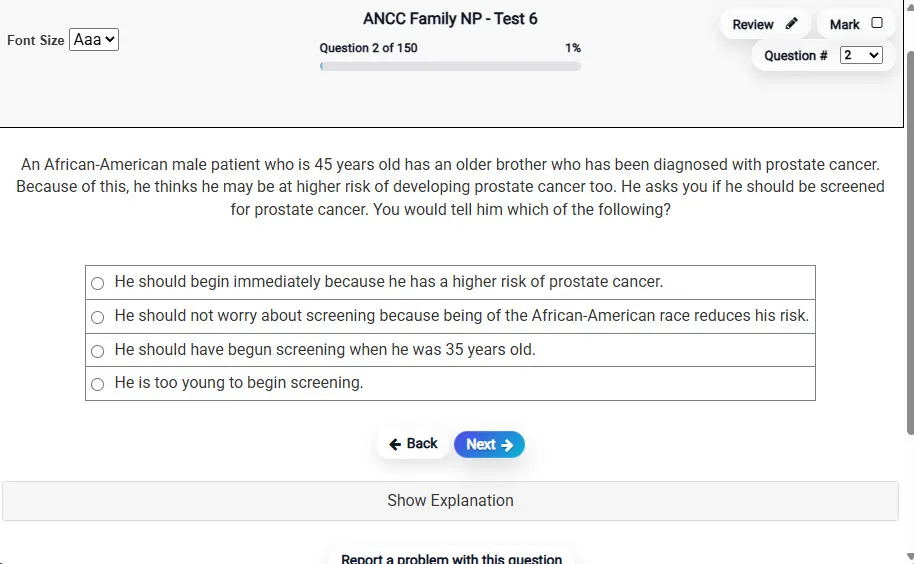
Answering a Question screen – Multiple-choice item view with navigation controls and progress tracker.
Answering a Question Multiple-choice item view with navigation controls and progress tracker.

                           Detailed Explanation screen – 
                         Review mode showing chosen answer and rationale and references.
Detailed Explanation Review mode showing chosen answer and rationale and references.

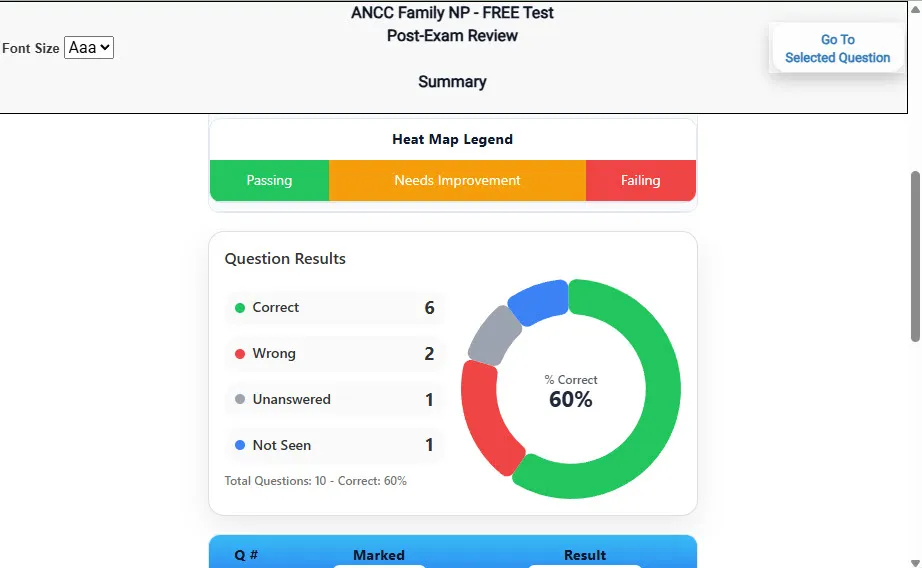
                           Review Summary 1 screen – 
                         Summary with counts for correct/wrong/unanswered and not seen items.
Review Summary 1 Summary with counts for correct/wrong/unanswered and not seen items.

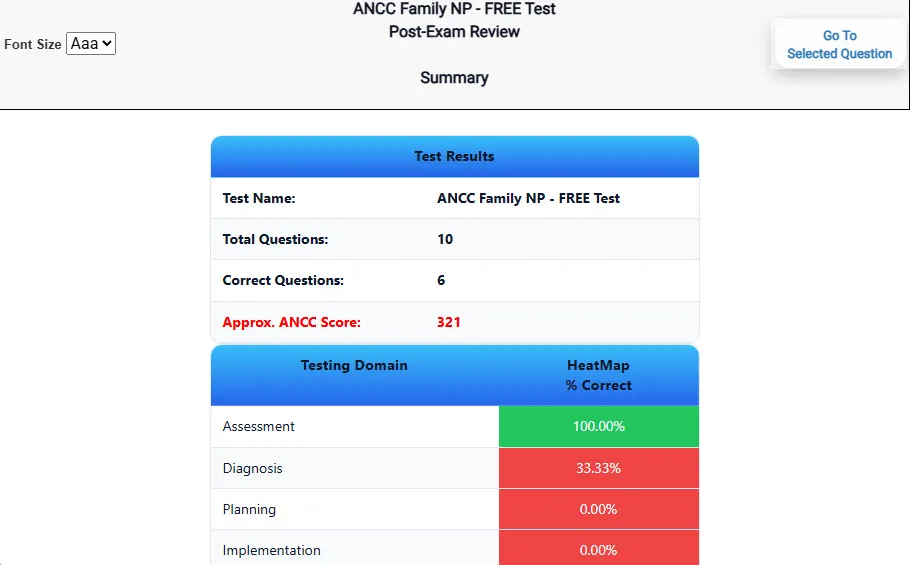
                           Review Summary 2 screen – 
                         Advanced summary with category/domain breakdown and performance insights.
Review Summary 2 Advanced summary with category/domain breakdown and performance insights.

What Each Screen Shows

Answer Question Screen

  • Clean multiple-choice interface with progress bar.
  • Mark for review feature.
  • Matches real test pacing.

Detailed Explanation

  • Correct answer plus rationale.
  • Key concepts and guidelines highlighted.
  • Move between questions to fill knowledge gaps.

Review Summary 1

  • Overall results with total questions and scaled score.
  • Domain heatmap shows strengths and weaknesses.
  • Quick visual feedback on study priorities.

Review Summary 2

  • Chart of correct, wrong, unanswered, not seen.
  • Color-coded results for easy review.
  • Links back to missed items.

Top 10 Reasons to Use Exam Edge for your VCLA Virginia Communication and Literacy Assessment Combined Exam Prep

  1. Focused on the VCLA Virginia Communication and Literacy Assessment Combined Exam

    Our practice tests are built specifically for the VCLA Combined exam — every question mirrors the real topics, format, and difficulty so you're studying exactly what matters.

  2. Real Exam Simulation

    We match the per-question time limits and pressure of the actual VCLA exam, so test day feels familiar and stress-free.

  3. 10 Full Practice Tests & 810 Unique Questions

    You'll have more than enough material to master every VCLA Combined concept — no repeats, no fluff.

  4. Lower Cost Than a Retake

    Ordering 5 practice exams costs less than retaking the VCLA Virginia Communication and Literacy Assessment Combined exam after a failure. One low fee could save you both time and money.

  5. Flexible Testing

    Need to step away mid-exam? Pick up right where you left off — with your remaining time intact.

  6. Instant Scoring & Feedback

    See your raw score and an estimated VCLA Virginia Communication and Literacy Assessment Combined score immediately after finishing each practice test.

  7. Detailed Explanations for Every Question

    Review correct and incorrect answers with clear, step-by-step explanations so you truly understand each topic.

  8. Trusted & Accredited

    We're fully accredited by the Better Business Bureau and uphold the highest standards of trust and transparency.

  9. Web-Based & Always Available

    No software to install. Access your VCLA Combined practice exams 24/7 from any computer or mobile device.

  10. Expert Support When You Need It

    Need extra help? Our specialized tutors are highly qualified and ready to support your VCLA exam prep.


Pass the VCLA Virginia Communication and Literacy Assessment Combined Exam with Realistic Practice Tests from Exam Edge

Preparing for your upcoming VCLA Virginia Communication and Literacy Assessment Combined (VCLA) Certification Exam can feel overwhelming — but the right practice makes all the difference. Exam Edge gives you the tools, structure, and confidence to pass on your first try. Our online practice exams are built to match the real VCLA Combined exam in content, format, and difficulty.

  • 📝 10 VCLA Virginia Communication and Literacy Assessment Combined Practice Tests: Access 10 full-length exams with 81 questions each, covering every major VCLA Virginia Communication and Literacy Assessment Combined topic in depth.
  • Instant Online Access: Start practicing right away — no software, no waiting.
  • 🧠 Step-by-Step Explanations: Understand the reasoning behind every correct answer so you can master VCLA Combined exam concepts.
  • 🔄 Retake Each Exam Up to 4 Times: Build knowledge through repetition and track your improvement over time.
  • 🌐 Web-Based & Available 24/7: Study anywhere, anytime, on any device.
  • 🧘 Boost Your Test-Day Confidence: Familiarity with the VCLA format reduces anxiety and helps you perform under pressure.

These VCLA Virginia Communication and Literacy Assessment Combined practice exams are designed to simulate the real testing experience by matching question types, timing, and difficulty level. This approach helps you get comfortable not just with the exam content, but also with the testing environment, so you walk into your exam day focused and confident.

Exam Edge VCLA Reviews


VCLA Virginia Communication and Literacy Assessment Combined Aliases Test Name

Here is a list of alternative names used for this exam.

  • VCLA Virginia Communication and Literacy Assessment Combined
  • VCLA Virginia Communication and Literacy Assessment Combined test
  • VCLA Virginia Communication and Literacy Assessment Combined Certification Test
  • VCLA Combined test
  • VCLA
  • VCLA VCLA
  • VCLA test
  • VCLA Virginia Communication and Literacy Assessment Combined (VCLA)
  • Virginia Communication and Literacy Assessment Combined certification