This is the content of the pop-over!

TExMaT Master Science Teacher 4-8 (091) Practice Tests & Test Prep by Exam Edge


TExMaT Master Science Teacher 4-8  product image
(4.8)
Based on 34 Reviews

  • Real Exam Simulation: Timed questions and matching content build comfort for your TExMaT Master Science Teacher 4-8 test day.
  • Instant, 24/7 Access: Web-based TExMaT Master Science Teacher 4-8 practice exams with no software needed.
  • Clear Explanations: Step-by-step answers and explanations for your TExMaT exam to strengthen understanding.
  • Boosted Confidence: Reduces anxiety and improves test-taking skills to ace your TExMaT Master Science Teacher 4-8 (091).

Featured on

TExMaT Master Science Teacher 4-8 Online Practice Test Bundles

BEST VALUE
20 practice tests

$174.00

$799.00

SAVE $625

Only $8.70 per test!

  • 100% Pass Guarantee
  • 20 online practice tests
  • 95 questions per test
  • Bonus: 100 Flash Cards + Study Guide
  • Instant access
  • Detailed Explanations
  • Practice tests never expire
  • Timed, untimed, or study guide mode
MOST POPULAR
10 practice tests

$99.50

$399.50

SAVE $300

Only $9.95 per test!

  • 10 online practice tests
  • 95 questions per test
  • Bonus: 100 Flash Cards + Study Guide
  • Instant access
  • Detailed Explanations
  • Practice tests never expire
  • Timed, untimed, or study guide mode
5 practice tests

$69.75

$199.75

SAVE $130

Only $13.95 per test!

  • 5 online practice tests
  • 95 questions per test
  • Bonus: 100 Flash Cards
  • Instant access
  • Detailed Explanations
  • Practice tests never expire
  • Timed, untimed, or study guide mode
1 practice test

$39.95

  • 1 online practice test
  • 95 questions per test
  • Instant access
  • Detailed Explanations
  • Practice tests never expire
  • Timed, untimed, or study guide mode
Quick Select
Tap to choose a bundle

** All Prices are in US Dollars (USD) **


TExMaT Master Science Teacher 4-8 (091) Resources

Jump to the section you need most.

Understanding the exact breakdown of the TExMaT Master Science Teacher 4-8 test will help you know what to expect and how to most effectively prepare. The TExMaT Master Science Teacher 4-8 has 95 multiple-choice questions and 1 essay questions. The exam will be broken down into the sections below:

TExMaT Master Science Teacher 4-8 Exam Blueprint
Domain Name % Number of
Questions
Physical Science 18% 17
Life Science 18% 17
Earth and Space Science 18% 17
The History - Nature and Context of Science;
Scientific Inquiry; and Safety
18% 17
Alignment and Integration - Instruction and Assessment 14% 13
The Learning and Teaching Environment - Mentoring and Shared
Leadership
14% 13

TExMaT Master Science Teacher 4-8 Study Tips by Domain

  • Use conservation laws first: in closed systems, total momentum (and total energy when no nonconservative work) is constant; red flag—treating an explosion or collision as having “lost momentum.”
  • Apply Newton’s laws with clean free-body diagrams and consistent sign conventions; common trap—including internal forces when analyzing a system or forgetting that normal force is not always mg.
  • Distinguish heat, temperature, and thermal energy and use Q = mcΔT and phase-change Q = mL appropriately; priority rule—during melting/boiling, ΔT = 0 even though energy is added.
  • For waves, connect speed, frequency, and wavelength (v = fλ) and interpret amplitude vs energy; red flag—assuming changing frequency in a medium changes wave speed rather than wavelength.
  • In electricity and magnetism, use Ohm’s law and series/parallel rules (R_series adds, 1/R_parallel adds); common trap—thinking current “gets used up” or mixing up voltage drops and current splits.
  • For atomic/nuclear concepts, use balanced nuclear equations and distinguish fission vs fusion and ionizing radiation types; contraindication—confusing isotope notation (A, Z) or claiming beta decay changes mass number.
  • Explain how structure relates to function across levels (organelle → cell → tissue → organ → system); red flag: students often confuse diffusion/osmosis with active transport when interpreting membrane diagrams.
  • Analyze photosynthesis and cellular respiration as coupled processes of matter cycling and energy flow; common trap: saying “plants don’t respire” or claiming energy “cycles” rather than flows.
  • Use genetics models (Punnett squares, pedigrees, meiosis/mitosis) to predict inheritance and variation; priority rule: distinguish genotype vs. phenotype and don’t treat dominant alleles as “more common” by default.
  • Interpret natural selection using evidence (variation, heritability, differential survival/reproduction) and avoid teleology; red flag: phrases like “organisms evolve because they need to” indicate a misconception.
  • Evaluate ecosystem dynamics (food webs, trophic levels, biogeochemical cycles, limiting factors, succession) with quantitative reasoning; threshold cue: ~10% energy transfer between trophic levels should constrain biomass/energy pyramid claims.
  • Compare infectious vs. noninfectious disease and immune responses (innate vs. adaptive, vaccines) using data; contraindication cue: antibiotics treat bacteria, not viruses—misuse is a common testable error.
  • Use relative dating (superposition, cross-cutting, inclusions) before absolute dating; red flag: assuming radiometric ages are valid without checking whether the system remained “closed.”
  • Track Earth’s energy balance (albedo, greenhouse effect, convection) and interpret climate graphs; common trap: confusing ozone depletion with greenhouse warming.
  • Explain plate tectonics with multiple evidence lines (paleomagnetism, seafloor spreading, hotspot tracks, seismic patterns); priority rule: “plates move” is insufficient without a mechanism (mantle convection/slab pull).
  • Relate rock cycle processes to tectonic settings (e.g., subduction ? metamorphism/volcanism, rifting ? basaltic volcanism); red flag: treating the rock cycle as a fixed sequence rather than pathways driven by heat, pressure, and fluids.
  • Use celestial mechanics to predict seasons, lunar phases, eclipses, and tides; common trap: attributing seasons to Earth–Sun distance instead of axial tilt (≈23.5°).
  • Analyze stars and the universe using H–R diagrams, spectra, and redshift; red flag: claiming higher temperature stars are redder or that Doppler shift changes a star’s intrinsic luminosity.
  • Distinguish observation vs inference vs theory vs law; red flag: treating a “theory” as a guess rather than an evidence-based explanatory framework.
  • Use the history of science to show how models change with new evidence (e.g., atomic, plate tectonic, heliocentric models); common trap: presenting scientific knowledge as fixed “facts” instead of revisable explanations.
  • Design investigations with operational definitions, controls, and adequate sample size/replication; priority rule: one variable manipulated at a time in controlled experiments to support causal claims.
  • Evaluate data quality and uncertainty (measurement error, outliers, validity, reliability) and choose appropriate graphs; red flag: claiming causation from correlation or from non-controlled observational data.
  • Apply ethical and safe inquiry practices (proper handling/disposal, humane treatment of organisms, academic integrity); contraindication: allowing open-toed shoes, loose hair, or eating/drinking in lab settings.
  • Follow safety planning and response protocols (SDS use, PPE selection, emergency equipment location, incident reporting); common trap: using chemicals or heat sources without a documented risk assessment and teacher verification.
  • Start with TEKS-aligned, measurable objectives and success criteria; red flag: activities that are “fun” but lack a stated target standard or evidence of mastery.
  • Use a 5E/phenomena-driven sequence (engage–explore–explain–elaborate–evaluate) to integrate content and practices; common trap: giving vocabulary/notes before students investigate the phenomenon.
  • Plan assessments with an explicit evidence chain (claim–evidence–reasoning) tied to the objective; priority rule: if you can’t name what student work proves learning, the assessment isn’t aligned.
  • Differentiate by readiness, language, and IEP/504 needs using multiple entry points and supports (sentence stems, visuals, scaffolds); red flag: reducing rigor by substituting unrelated “easier” tasks instead of scaffolding the same standard.
  • Embed frequent formative checks (hinge questions, exit tickets, quick models) and pre-plan what you’ll do with results; common trap: collecting data but not adjusting grouping, reteach, or next-day instruction.
  • Integrate crosscutting concepts, math/graphing, and literacy (CER writing, data tables) within the same lesson goal; contraindication: adding integration pieces that create extra workload without assessing them or connecting them to the objective.
  • Use mentoring cycles (pre-conference → observation → feedback → follow-up) with evidence from student work or classroom data; red flag: feedback that is purely evaluative rather than coaching toward specific next steps.
  • Prioritize shared leadership by distributing roles (e.g., PLC facilitator, data lead, lab safety lead) aligned to strengths; common trap: “voluntelling” without time, resources, or clear decision rights.
  • In PLCs, keep meetings anchored to measurable student outcomes (TEKS-aligned targets, common assessments, and re-teach plans); priority rule: if no action item with owner and date is produced, the meeting wasn’t effective.
  • Model and coach culturally responsive and equitable participation structures (wait time, grouping, and discourse norms); red flag: advanced labs and enrichment opportunities informally tracking to the same students.
  • Support novice teachers with classroom systems (routines, transitions, and management) before pushing complex instructional shifts; common trap: introducing too many new strategies at once, causing implementation failure.
  • Maintain professional and legal/ethical boundaries in mentoring (confidentiality, documentation, and appropriate communication); red flag: sharing identifiable student or teacher performance information outside legitimate educational interest.


Built to Fit Into Your Busy Life

Everything you need to prepare with confidence—without wasting a minute.

Three Study Modes

Timed, No Time Limit, or Explanation mode.

Actionable Analytics

Heatmaps and scaled scores highlight weak areas.

High-Yield Rationales

Concise explanations emphasize key concepts.

Realistic Interface

Matches the feel of the actual exam environment.

Accessible by Design

Clean layout reduces cognitive load.

Anytime, Anywhere

Web-based access 24/7 on any device.
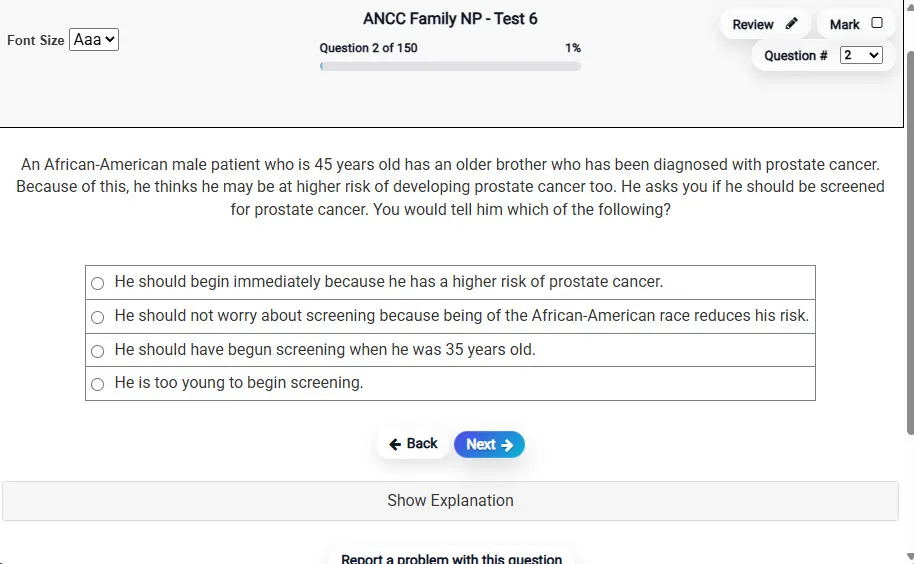
Answering a Question screen – Multiple-choice item view with navigation controls and progress tracker.
Answering a Question Multiple-choice item view with navigation controls and progress tracker.

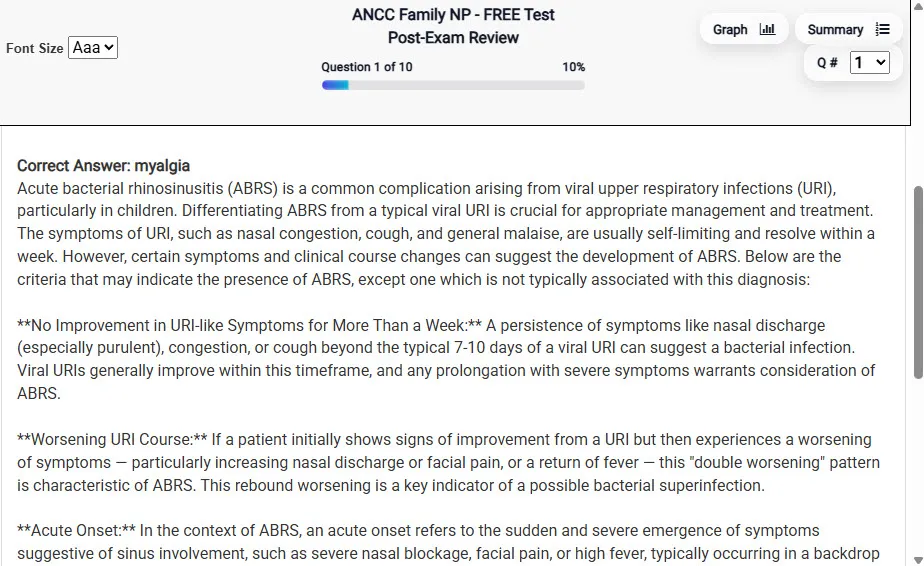
                           Detailed Explanation screen – 
                         Review mode showing chosen answer and rationale and references.
Detailed Explanation Review mode showing chosen answer and rationale and references.

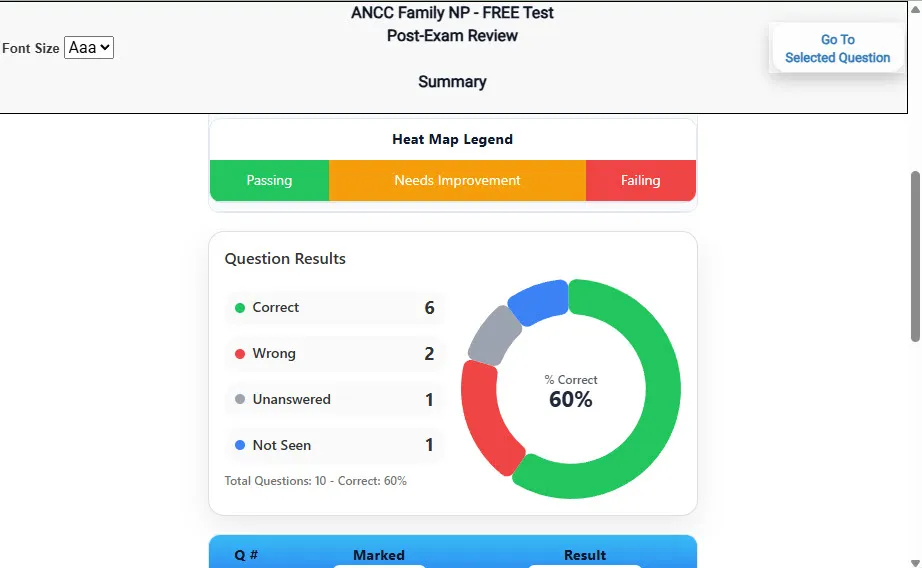
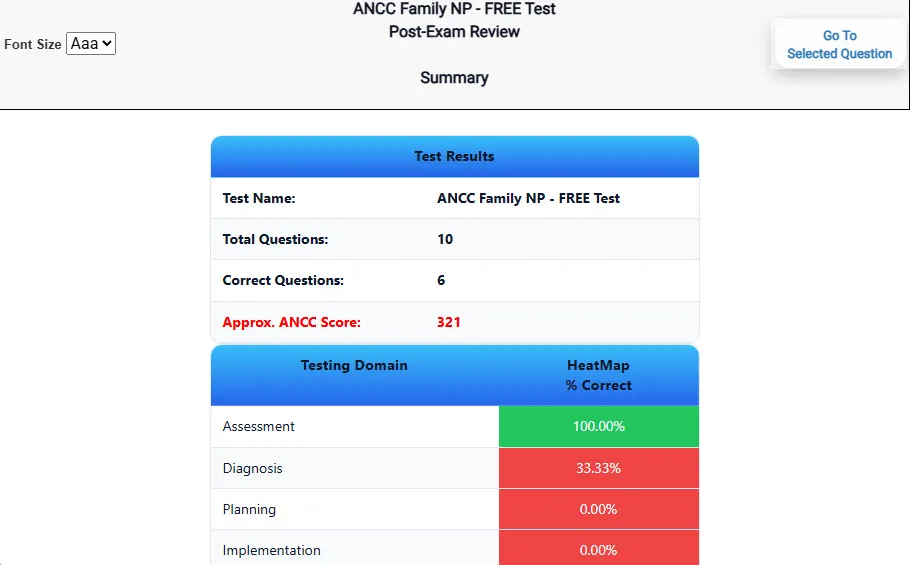
                           Review Summary 1 screen – 
                         Summary with counts for correct/wrong/unanswered and not seen items.
Review Summary 1 Summary with counts for correct/wrong/unanswered and not seen items.

                           Review Summary 2 screen – 
                         Advanced summary with category/domain breakdown and performance insights.
Review Summary 2 Advanced summary with category/domain breakdown and performance insights.

What Each Screen Shows

Answer Question Screen

  • Clean multiple-choice interface with progress bar.
  • Mark for review feature.
  • Matches real test pacing.

Detailed Explanation

  • Correct answer plus rationale.
  • Key concepts and guidelines highlighted.
  • Move between questions to fill knowledge gaps.

Review Summary 1

  • Overall results with total questions and scaled score.
  • Domain heatmap shows strengths and weaknesses.
  • Quick visual feedback on study priorities.

Review Summary 2

  • Chart of correct, wrong, unanswered, not seen.
  • Color-coded results for easy review.
  • Links back to missed items.

Top 10 Reasons to Use Exam Edge for your TExMaT Master Science Teacher 4-8 Exam Prep

  1. Focused on the TExMaT Master Science Teacher 4-8 Exam

    Our practice tests are built specifically for the TExMaT Master Science Teacher 4-8 exam — every question mirrors the real topics, format, and difficulty so you're studying exactly what matters.

  2. Real Exam Simulation

    We match the per-question time limits and pressure of the actual TExMaT exam, so test day feels familiar and stress-free.

  3. 20 Full Practice Tests & 1,900 Unique Questions

    You'll have more than enough material to master every TExMaT Master Science Teacher 4-8 concept — no repeats, no fluff.

  4. Lower Cost Than a Retake

    Ordering 5 practice exams costs less than retaking the TExMaT Master Science Teacher 4-8 exam after a failure. One low fee could save you both time and money.

  5. Flexible Testing

    Need to step away mid-exam? Pick up right where you left off — with your remaining time intact.

  6. Instant Scoring & Feedback

    See your raw score and an estimated TExMaT Master Science Teacher 4-8 score immediately after finishing each practice test.

  7. Detailed Explanations for Every Question

    Review correct and incorrect answers with clear, step-by-step explanations so you truly understand each topic.

  8. Trusted & Accredited

    We're fully accredited by the Better Business Bureau and uphold the highest standards of trust and transparency.

  9. Web-Based & Always Available

    No software to install. Access your TExMaT Master Science Teacher 4-8 practice exams 24/7 from any computer or mobile device.

  10. Expert Support When You Need It

    Need extra help? Our specialized tutors are highly qualified and ready to support your TExMaT exam prep.


Pass the TExMaT Master Science Teacher 4-8 Exam with Realistic Practice Tests from Exam Edge

Preparing for your upcoming TExMaT Master Science Teacher 4-8 (091) Certification Exam can feel overwhelming — but the right practice makes all the difference. Exam Edge gives you the tools, structure, and confidence to pass on your first try. Our online practice exams are built to match the real TExMaT Master Science Teacher 4-8 exam in content, format, and difficulty.

  • 📝 20 TExMaT Master Science Teacher 4-8 Practice Tests: Access 20 full-length exams with 95 questions each, covering every major TExMaT Master Science Teacher 4-8 topic in depth.
  • Instant Online Access: Start practicing right away — no software, no waiting.
  • 🧠 Step-by-Step Explanations: Understand the reasoning behind every correct answer so you can master TExMaT Master Science Teacher 4-8 exam concepts.
  • 🔄 Retake Each Exam Up to 4 Times: Build knowledge through repetition and track your improvement over time.
  • 🌐 Web-Based & Available 24/7: Study anywhere, anytime, on any device.
  • 🧘 Boost Your Test-Day Confidence: Familiarity with the TExMaT format reduces anxiety and helps you perform under pressure.

These TExMaT Master Science Teacher 4-8 practice exams are designed to simulate the real testing experience by matching question types, timing, and difficulty level. This approach helps you get comfortable not just with the exam content, but also with the testing environment, so you walk into your exam day focused and confident.


Exam Edge TEXES Reviews


Pleased with using Exam Edge. I have learned many other terms and related information using Exam Edge. I started with one examination to ready myself for the state examination and ended up purchasing all 10. Exam Edge also gave me some additional information after purchasing 10 exams.

Barb N, TX

Excellent experience!

Agnes , San Antonio, Texas

Just wanted to tell you how helpful your site and tests were. I have taught HS English for 16 years and challenged this test to make myself more marketable. I ended up buying three tests, studying all the answer reasons, and using the info to make notes to study. I passed on the first try. Actually, ...
Read More
Wendy, Texes

The practice tests allowed me to practice with questions that were of similar content and construction as the real test. I took several practice tests and was able to focus my studying on what I missed. I felt the rigor of the questions matched the real test as well. After taking the real test and r ...
Read More
Lucy, Texes

Exam edge really prepared me for my exam. I passed!!! Thank you so much!

Mary, Houston, TX

Great exam site that helped me pass my tests.

June , Murphy, Texas


TExMaT Master Science Teacher 4-8 Aliases Test Name

Here is a list of alternative names used for this exam.

  • TExMaT Master Science Teacher 4-8
  • TExMaT Master Science Teacher 4-8 test
  • TExMaT Master Science Teacher 4-8 Certification Test
  • TEXES
  • TEXES 091
  • 091 test
  • TExMaT Master Science Teacher 4-8 (091)
  • TExMaT Master Science Teacher 4-8 certification