This is the content of the pop-over!

TExMaT Master Mathematics Teacher 8-12 (089) Practice Tests & Test Prep by Exam Edge


TExMaT Master Mathematics Teacher 8-12  product image
(4.8)
Based on 32 Reviews

  • Real Exam Simulation: Timed questions and matching content build comfort for your TExMaT Master Mathematics Teacher 8-12 test day.
  • Instant, 24/7 Access: Web-based TExMaT Master Mathematics Teacher 8-12 practice exams with no software needed.
  • Clear Explanations: Step-by-step answers and explanations for your TExMaT exam to strengthen understanding.
  • Boosted Confidence: Reduces anxiety and improves test-taking skills to ace your TExMaT Master Mathematics Teacher 8-12 (089).

Featured on

TExMaT Master Mathematics Teacher 8-12 Online Practice Test Bundles

BEST VALUE
15 practice tests

$149.25

$599.25

SAVE $450

Only $9.95 per test!

  • 100% Pass Guarantee
  • 15 online practice tests
  • 90 questions + 1 essay per test
  • Bonus: 100 Flash Cards + Study Guide
  • Instant access
  • Detailed Explanations
  • Practice tests never expire
  • Timed, untimed, or study guide mode
MOST POPULAR
10 practice tests

$99.50

$399.50

SAVE $300

Only $9.95 per test!

  • 10 online practice tests
  • 90 questions + 1 essay per test
  • Bonus: 100 Flash Cards + Study Guide
  • Instant access
  • Detailed Explanations
  • Practice tests never expire
  • Timed, untimed, or study guide mode
5 practice tests

$69.75

$199.75

SAVE $130

Only $13.95 per test!

  • 5 online practice tests
  • 90 questions + 1 essay per test
  • Bonus: 100 Flash Cards
  • Instant access
  • Detailed Explanations
  • Practice tests never expire
  • Timed, untimed, or study guide mode
1 practice test

$39.95

  • 1 online practice test
  • 90 questions + 1 essay per test
  • Instant access
  • Detailed Explanations
  • Practice tests never expire
  • Timed, untimed, or study guide mode
Quick Select
Tap to choose a bundle

** All Prices are in US Dollars (USD) **


TExMaT Master Mathematics Teacher 8-12 (089) Resources

Jump to the section you need most.

Understanding the exact breakdown of the TExMaT Master Mathematics Teacher 8-12 test will help you know what to expect and how to most effectively prepare. The TExMaT Master Mathematics Teacher 8-12 has 90 multiple-choice questions and 1 essay questions. The exam will be broken down into the sections below:

TExMaT Master Mathematics Teacher 8-12 Exam Blueprint
Domain Name % Number of
Questions
Number Concepts: Content - Instruction and Assessment 16% 15
Patterns and Algebra: Content - Instruction and Assessment 18% 17
Geometry and Measurement: Content - Instruction and Assessment 16% 15
Probability and Statistics: Content - Instruction and Assessment 14% 13
Mathematical Processes - Perspectives - Mentoring and Leadership 18% 17
Precalculus and Calculus Content - Instruction and Assessment 16% 15

TExMaT Master Mathematics Teacher 8-12 Study Tips by Domain

  • Emphasize multiple representations of number (place-value models, number lines, ratios, complex plane) and require students to justify equivalence; red flag: treating “equal” as “approximately the same” without defining tolerance.
  • Connect operations to structure (field properties, inverses, distributive law) and use counterexamples to test claims; common trap: canceling terms across addition (e.g., \(\frac{a+b}{b}=a\)).
  • Address rational/irrational and real/complex classifications with precise definitions and diagnostic tasks; priority rule: distinguish between “non-terminating decimal” and “non-terminating repeating” when identifying rationals.
  • Teach estimation and error analysis (rounding, truncation, relative vs. absolute error) and set explicit accuracy expectations; threshold cue: specify significant figures and propagate rounding only at the end unless instructed otherwise.
  • Develop proportional reasoning (rates, unit analysis, percent, dimensional consistency) using authentic contexts and quick checks; red flag: ignoring units or mixing additive and multiplicative comparisons (e.g., percent increase vs. percentage points).
  • Assess number sense with tasks that reveal misconceptions (ordering negatives, fractions vs. decimals, exponent rules) and plan targeted interventions; common trap: assuming \((-a)^2=-a^2\) or that larger denominator means larger fraction.
  • Emphasize structure of expressions (factoring, completing the square, rewriting exponentials/logs) to solve and interpret problems—red flag: students treating algebra as “steps” without justifying equivalence.
  • Connect multiple representations (symbolic, graphical, tabular, contextual) and require consistent parameter interpretation (e.g., transformations of \(f(x)\))—common trap: misreading shifts/scales when switching between forms.
  • Teach function families (linear, quadratic, polynomial, rational, exponential, logarithmic, piecewise) with domain/range and asymptotes as nonnegotiables—priority rule: always state domain restrictions before solving or graphing.
  • Use patterns and sequences (arithmetic, geometric, recursive vs. explicit) to generalize and prove conjectures—red flag: overgeneralizing from a few cases without a valid argument.
  • Stress solving and analyzing equations/inequalities (including absolute value, rational, radical, exponential/log) with solution checking—common trap: extraneous solutions from squaring, clearing denominators, or applying inverse operations.
  • In assessment and instruction, target reasoning with manipulatives/technology strategically (CAS/graphing) while requiring verification—red flag: accepting calculator output without explaining the method or constraints.
  • Use rigid motions and similarity to justify congruence/similarity (SSS, SAS, ASA, AA) rather than memorizing—red flag: students using AAA for congruence or confusing similarity scale factor with area scaling.
  • Connect coordinate and synthetic geometry (slope, distance, midpoint, equation of a circle) and require units/labels—common trap: applying the distance formula without squaring differences or mixing units on coordinate axes.
  • Prioritize reasoning about transformations (translations, rotations, reflections, dilations) with clear notation and invariants—contraindication: claiming angles change under dilation or that reflections preserve orientation.
  • Teach measurement as structure (dimensional analysis, unit conversions, precision/rounding) and attend to reasonableness—threshold cue: specify when to round (e.g., final step) and avoid compounding rounding error.
  • Emphasize area/volume/surface area relationships across solids (prisms, pyramids, cylinders, cones, spheres) using decompositions and nets—common trap: using lateral area in place of total surface area or confusing radius vs. diameter.
  • Assess geometric proof and argument quality (given/claim, diagram assumptions, logical sequencing) with multiple representations—red flag: students assuming what a diagram “looks like” (e.g., right angle, bisected segment) without stated information.
  • Choose and justify an appropriate probability model (binomial, geometric, normal, Poisson) and check conditions; red flag: using a normal approximation without verifying independence and np ≥ 10 and n(1−p) ≥ 10.
  • Distinguish correlation from causation and critique study design (random sampling vs. random assignment); common trap: treating an observational study as evidence of a causal effect.
  • Use sampling distributions and standard error to connect sample size to margin of error; priority rule: doubling n does not halve the margin of error—it shrinks by about 1/√2.
  • Select and interpret confidence intervals and hypothesis tests for means/proportions and compare two groups; red flag: declaring a result “significant” based on CI overlap without referencing the correct two-sample procedure and assumptions.
  • Interpret and teach regression with residuals, leverage, and outliers, including r vs. r2; common trap: claiming a high r implies predictive reliability when a single influential point drives the fit.
  • Assess and communicate distribution features (center, spread, shape) using appropriate summaries; contraindication: reporting mean and standard deviation for strongly skewed data or data with outliers where median and IQR are more robust.
  • Model the mathematical process cycle (analyze, conjecture, justify, communicate) and require students to defend claims with definitions/theorems; red flag: accepting “it works on my calculator” as proof.
  • Select and sequence tasks to move from concrete representations to formalization while preserving cognitive demand; common trap: over-scaffolding that turns problem solving into following steps.
  • Use multiple representations (symbolic, graphical, numeric, verbal) and press for connections across them; priority rule: every new procedure should be anchored to at least one representation-based explanation.
  • Design assessment with clear success criteria, exemplars, and error analysis opportunities; red flag: grading only final answers when the standard emphasizes reasoning and justification.
  • Mentor teachers by using evidence-based coaching (specific look-fors, short feedback cycles, and student-work protocols); common trap: giving general praise/critique without citing observable data.
  • Lead equitable discourse by planning talk moves (wait time, revoicing, accountable talk) and monitoring participation patterns; red flag: the same few students routinely carry the mathematical explanations.
  • Connect multiple representations of functions (graph, table, equation, verbal) to key features like intercepts, asymptotes, end behavior, and transformations; red flag: students confusing vertical vs. horizontal shifts in expressions such as f(x–h) vs. f(x)–h.
  • Justify domain/range restrictions and inverse existence using one-to-one criteria (e.g., horizontal line test) and context; common trap: treating every function as invertible without restricting the domain.
  • Use trigonometric unit-circle definitions to derive identities and solve equations with attention to radians and periodicity; priority rule: always check solutions against the original interval to avoid extraneous angles.
  • Develop limits conceptually (graphical/numerical/algebraic) and distinguish removable, jump, and infinite discontinuities; contraindication: canceling terms at points where the original function is undefined without stating the hole.
  • Apply derivative interpretations (rate of change, tangent slope) and compute using rules while analyzing where differentiability fails; red flag: assuming continuity implies differentiability at cusps/corners or vertical tangents.
  • Use the Fundamental Theorem of Calculus to link accumulation and area to antiderivatives and definite integrals, including basic substitution; common trap: omitting +C for indefinite integrals or losing bounds when changing variables.


Built to Fit Into Your Busy Life

Everything you need to prepare with confidence—without wasting a minute.

Three Study Modes

Timed, No Time Limit, or Explanation mode.

Actionable Analytics

Heatmaps and scaled scores highlight weak areas.

High-Yield Rationales

Concise explanations emphasize key concepts.

Realistic Interface

Matches the feel of the actual exam environment.

Accessible by Design

Clean layout reduces cognitive load.

Anytime, Anywhere

Web-based access 24/7 on any device.
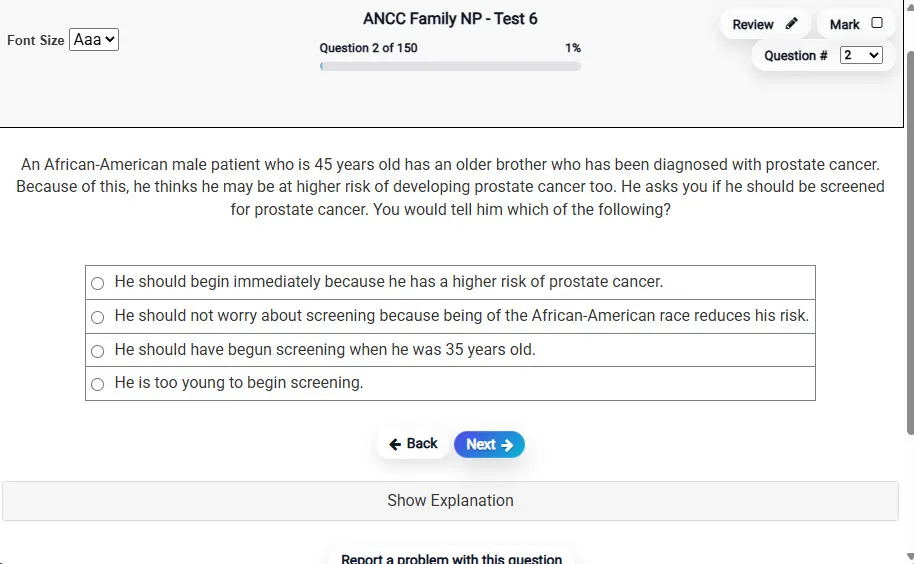
Answering a Question screen – Multiple-choice item view with navigation controls and progress tracker.
Answering a Question Multiple-choice item view with navigation controls and progress tracker.

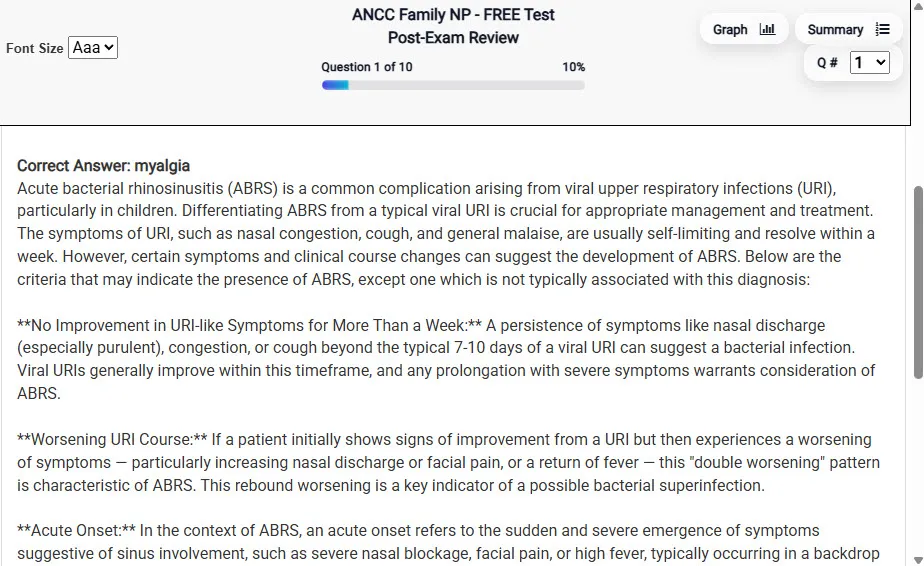
                           Detailed Explanation screen – 
                         Review mode showing chosen answer and rationale and references.
Detailed Explanation Review mode showing chosen answer and rationale and references.

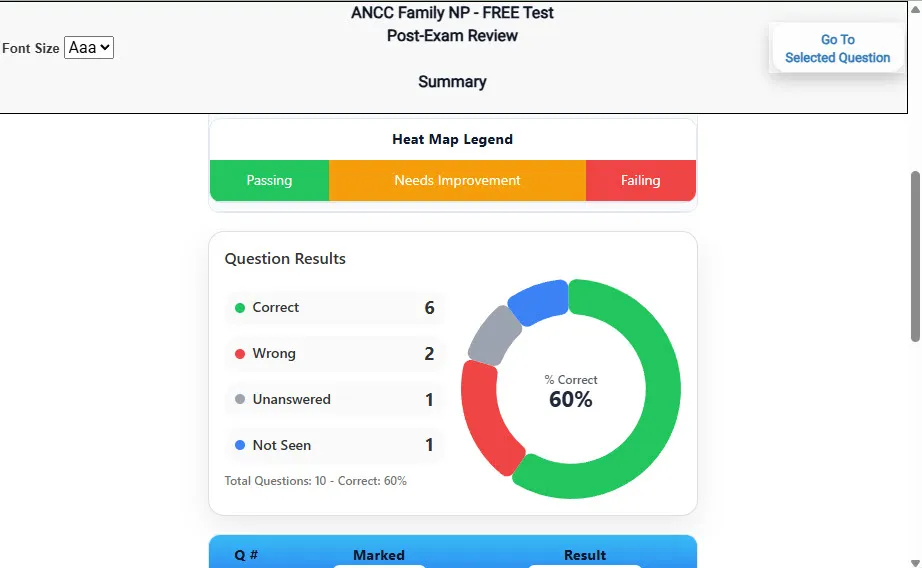
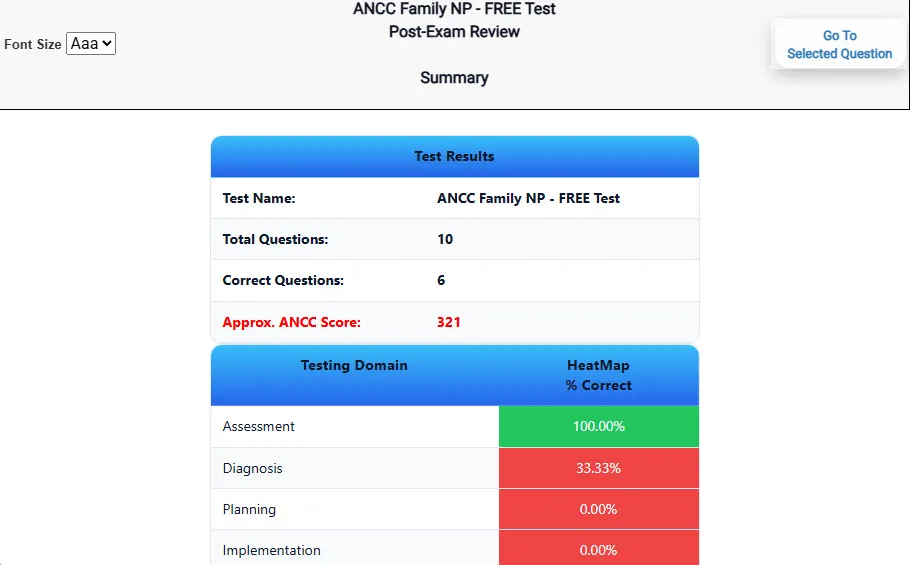
                           Review Summary 1 screen – 
                         Summary with counts for correct/wrong/unanswered and not seen items.
Review Summary 1 Summary with counts for correct/wrong/unanswered and not seen items.

                           Review Summary 2 screen – 
                         Advanced summary with category/domain breakdown and performance insights.
Review Summary 2 Advanced summary with category/domain breakdown and performance insights.

What Each Screen Shows

Answer Question Screen

  • Clean multiple-choice interface with progress bar.
  • Mark for review feature.
  • Matches real test pacing.

Detailed Explanation

  • Correct answer plus rationale.
  • Key concepts and guidelines highlighted.
  • Move between questions to fill knowledge gaps.

Review Summary 1

  • Overall results with total questions and scaled score.
  • Domain heatmap shows strengths and weaknesses.
  • Quick visual feedback on study priorities.

Review Summary 2

  • Chart of correct, wrong, unanswered, not seen.
  • Color-coded results for easy review.
  • Links back to missed items.

Top 10 Reasons to Use Exam Edge for your TExMaT Master Mathematics Teacher 8-12 Exam Prep

  1. Focused on the TExMaT Master Mathematics Teacher 8-12 Exam

    Our practice tests are built specifically for the TExMaT Master Mathematics Teacher 8-12 exam — every question mirrors the real topics, format, and difficulty so you're studying exactly what matters.

  2. Real Exam Simulation

    We match the per-question time limits and pressure of the actual TExMaT exam, so test day feels familiar and stress-free.

  3. 15 Full Practice Tests & 1,365 Unique Questions

    You'll have more than enough material to master every TExMaT Master Mathematics Teacher 8-12 concept — no repeats, no fluff.

  4. Lower Cost Than a Retake

    Ordering 5 practice exams costs less than retaking the TExMaT Master Mathematics Teacher 8-12 exam after a failure. One low fee could save you both time and money.

  5. Flexible Testing

    Need to step away mid-exam? Pick up right where you left off — with your remaining time intact.

  6. Instant Scoring & Feedback

    See your raw score and an estimated TExMaT Master Mathematics Teacher 8-12 score immediately after finishing each practice test.

  7. Detailed Explanations for Every Question

    Review correct and incorrect answers with clear, step-by-step explanations so you truly understand each topic.

  8. Trusted & Accredited

    We're fully accredited by the Better Business Bureau and uphold the highest standards of trust and transparency.

  9. Web-Based & Always Available

    No software to install. Access your TExMaT Master Mathematics Teacher 8-12 practice exams 24/7 from any computer or mobile device.

  10. Expert Support When You Need It

    Need extra help? Our specialized tutors are highly qualified and ready to support your TExMaT exam prep.


Pass the TExMaT Master Mathematics Teacher 8-12 Exam with Realistic Practice Tests from Exam Edge

Preparing for your upcoming TExMaT Master Mathematics Teacher 8-12 (089) Certification Exam can feel overwhelming — but the right practice makes all the difference. Exam Edge gives you the tools, structure, and confidence to pass on your first try. Our online practice exams are built to match the real TExMaT Master Mathematics Teacher 8-12 exam in content, format, and difficulty.

  • 📝 15 TExMaT Master Mathematics Teacher 8-12 Practice Tests: Access 15 full-length exams with 91 questions each, covering every major TExMaT Master Mathematics Teacher 8-12 topic in depth.
  • Instant Online Access: Start practicing right away — no software, no waiting.
  • 🧠 Step-by-Step Explanations: Understand the reasoning behind every correct answer so you can master TExMaT Master Mathematics Teacher 8-12 exam concepts.
  • 🔄 Retake Each Exam Up to 4 Times: Build knowledge through repetition and track your improvement over time.
  • 🌐 Web-Based & Available 24/7: Study anywhere, anytime, on any device.
  • 🧘 Boost Your Test-Day Confidence: Familiarity with the TExMaT format reduces anxiety and helps you perform under pressure.

These TExMaT Master Mathematics Teacher 8-12 practice exams are designed to simulate the real testing experience by matching question types, timing, and difficulty level. This approach helps you get comfortable not just with the exam content, but also with the testing environment, so you walk into your exam day focused and confident.

Exam Edge TEXES Reviews


Excellent experience!

Agnes , San Antonio, Texas

Pleased with using Exam Edge. I have learned many other terms and related information using Exam Edge. I started with one examination to ready myself for the state examination and ended up purchasing all 10. Exam Edge also gave me some additional information after purchasing 10 exams.

Barb N, TX

Just wanted to tell you how helpful your site and tests were. I have taught HS English for 16 years and challenged this test to make myself more marketable. I ended up buying three tests, studying all the answer reasons, and using the info to make notes to study. I passed on the first try. Actually, ...
Read More
Wendy, Texes

The practice tests allowed me to practice with questions that were of similar content and construction as the real test. I took several practice tests and was able to focus my studying on what I missed. I felt the rigor of the questions matched the real test as well. After taking the real test and r ...
Read More
Lucy, Texes

Exam edge really prepared me for my exam. I passed!!! Thank you so much!

Mary, Houston, TX

Great exam site that helped me pass my tests.

June , Murphy, Texas


TExMaT Master Mathematics Teacher 8-12 Aliases Test Name

Here is a list of alternative names used for this exam.

  • TExMaT Master Mathematics Teacher 8-12
  • TExMaT Master Mathematics Teacher 8-12 test
  • TExMaT Master Mathematics Teacher 8-12 Certification Test
  • TEXES
  • TEXES 089
  • 089 test
  • TExMaT Master Mathematics Teacher 8-12 (089)
  • TExMaT Master Mathematics Teacher 8-12 certification