This is the content of the pop-over!

TExES Core Subjects EC-6 - Science (904) Practice Tests & Test Prep by Exam Edge


TExES Core Subjects EC-6 - Science  product image
(4.6)
Based on 29 Reviews

  • Real Exam Simulation: Timed questions and matching content build comfort for your TExES Core Subjects EC-6 - Science test day.
  • Instant, 24/7 Access: Web-based TExES Core Subjects EC-6 - Science practice exams with no software needed.
  • Clear Explanations: Step-by-step answers and explanations for your TExES exam to strengthen understanding.
  • Boosted Confidence: Reduces anxiety and improves test-taking skills to ace your TExES Core Subjects EC-6 - Science (904).

Featured on

TExES Core Subjects EC-6 - Science Online Practice Test Bundles

BEST VALUE
20 practice tests

$174.00

$799.00

SAVE $625

Only $8.70 per test!

  • 100% Pass Guarantee
  • 20 online practice tests
  • 45 questions per test
  • Bonus: 100 Flash Cards + Study Guide
  • Instant access
  • Detailed Explanations
  • Practice tests never expire
  • Timed, untimed, or study guide mode
MOST POPULAR
10 practice tests

$99.50

$399.50

SAVE $300

Only $9.95 per test!

  • 10 online practice tests
  • 45 questions per test
  • Bonus: 100 Flash Cards + Study Guide
  • Instant access
  • Detailed Explanations
  • Practice tests never expire
  • Timed, untimed, or study guide mode
5 practice tests

$69.75

$199.75

SAVE $130

Only $13.95 per test!

  • 5 online practice tests
  • 45 questions per test
  • Bonus: 100 Flash Cards
  • Instant access
  • Detailed Explanations
  • Practice tests never expire
  • Timed, untimed, or study guide mode
1 practice test

$39.95

  • 1 online practice test
  • 45 questions per test
  • Instant access
  • Detailed Explanations
  • Practice tests never expire
  • Timed, untimed, or study guide mode
Quick Select
Tap to choose a bundle

** All Prices are in US Dollars (USD) **


TExES Core Subjects EC-6 - Science (904) Resources

Jump to the section you need most.

Understanding the exact breakdown of the TExES Core Subjects EC-6 - Science test will help you know what to expect and how to most effectively prepare. The TExES Core Subjects EC-6 - Science has 45 multiple-choice questions . The exam will be broken down into the sections below:

TExES Core Subjects EC-6 - Science Exam Blueprint
Domain Name
Lab Processes - Equipment and Safety  
History and Nature of Science  
Impact of Science  
Concepts and Processes  
Students as Learners and Science Instruction  
Science Assessment  
Forces and Motion  
Physical and Chemical Properties  
Energy and Interactions  
Energy Transformations and Conservation  
Structure and Function of Living Things  
Reproduction and the Mechanisms of Heredity  
Adaptations and Evolution  
Organisms and the Environment  
Structure and Function of Earth Systems  
Cycles in Earth Systems  
Energy in Weather and Climate  
Solar System and the Universe  

TExES Core Subjects EC-6 - Science Study Tips by Domain

  • Apply core lab safety rules: PPE (goggles/apron/gloves as needed), tie back hair, no food/drink, and keep aisles clear—red flag: students handling materials before you give explicit procedures and safety expectations.
  • Know emergency equipment locations and use: eyewash/safety shower (flush eyes/skin 15+ minutes), fire blanket/extinguisher (PASS), and cut/burn first aid—common trap: sending a student to the nurse before decontamination is complete.
  • Use correct measurement tools and units (graduated cylinder for volume, balance for mass, thermometer for temperature) and require recording units every time—priority rule: estimate one digit beyond the smallest marked increment.
  • Handle heat, glass, and electricity safely: check for cracks, use tongs/heat mitts, point test tubes away, and keep cords/dry hands away from water—red flag: “hot glass looks like cold glass,” so require cooling time and labeling.
  • Implement chemical and biological safety basics appropriate for EC–6: label all containers, never return unused chemicals to stock, and disinfect/handwash after handling organisms—contraindication: using unknown household mixtures or unlabeled solutions in student stations.
  • Maintain clean setup, storage, and disposal: close caps, store sharps and glass separately, and dispose of broken glass in a designated container (not regular trash)—common trap: students picking up broken glass with bare hands instead of using a brush/dustpan.
  • Distinguish observation from inference and claim from evidence; red flag: treating a conclusion as a direct observation (e.g., “the rock is old” vs measured traits/data).
  • Explain how scientific explanations are tentative yet durable and change with new evidence; common trap: saying “theories become laws” rather than noting theories explain and laws describe patterns.
  • Know characteristics of scientific investigations (testable questions, controlled variables, repeatability, peer review); priority rule: conclusions must align with data, not the hypothesis.
  • Connect major historical contributions to shifts in scientific understanding (e.g., heliocentrism, germ theory) and why evidence mattered; red flag: attributing changes to “belief” instead of improved methods/technology.
  • Recognize the role of models in science (useful, limited, revised) and when they fail; common trap: assuming a model is a literal copy of reality rather than an explanatory tool with assumptions.
  • Address bias and ethics in science (sampling bias, confirmation bias, responsible conduct) and how the scientific community reduces them; red flag: small, nonrandom samples used to generalize to all populations.
  • Evaluate trade-offs of scientific and technological solutions using constraints (cost, risk, benefits, feasibility) — red flag: claiming a solution is “best” without citing criteria and evidence.
  • Identify how science and engineering affect society and the environment (e.g., resource use, pollution, health) — priority rule: always link a human action to both intended benefits and unintended consequences.
  • Use risk analysis ideas (hazard vs. exposure, probability vs. severity) to compare choices — common trap: treating a dramatic hazard as high risk when exposure is minimal.
  • Interpret media/consumer claims about products (graphs, samples, controls, reproducibility) — red flag: conclusions drawn from anecdotes or a single small, biased sample.
  • Connect science to policy and ethics (public health, conservation, energy) while separating evidence from values — contraindication: presenting personal opinion as scientific conclusion.
  • Recognize that scientific advances can create new questions and new technologies (feedback loop) — common trap: assuming technology always improves outcomes without monitoring long-term impacts.
  • Distinguish observation vs. inference vs. prediction—red flag: a conclusion about an unmeasured cause (e.g., “it reacted because it was an acid”) is an inference, not an observation.
  • Use scientific models (physical, conceptual, mathematical) as tools with limits—common trap: treating a model as the real thing instead of a simplified representation that can be revised with new evidence.
  • Identify variables and fair tests (independent, dependent, controlled) in investigations—priority rule: change only one factor at a time or you can’t attribute cause-and-effect.
  • Choose appropriate measurement tools and units (SI, time, mass, volume, temperature) and read scales correctly—red flag: reporting measurements with more precision than the instrument allows.
  • Interpret data displays (tables, line graphs, bar graphs) and look for patterns, trends, and anomalies—common trap: using a bar graph for continuous data where a line graph is expected.
  • Evaluate claims using evidence and reasoning, including replicability and sample size—red flag: a one-time result or tiny sample is weak evidence, especially when variability is high.
  • Plan instruction around what students already think—use a quick diagnostic (KWL, concept map, predict-observe-explain) to surface misconceptions; red flag: moving on because students can recite vocabulary but can’t explain a phenomenon.
  • Differentiate for EC–6 by adjusting language load, time, and representations while keeping the same science goal; common trap: giving a simpler task that changes the TEKS-level expectation instead of providing supports.
  • Use the 5E/inquiry sequence with an explicit evidence step (claim–evidence–reasoning) so students justify ideas from data; priority rule: conclusions must be tied to observations/measurements, not opinions.
  • Build academic language through sentence stems, word banks, and structured talk while protecting conceptual meaning; red flag: teaching definitions in isolation without hands-on or model-based experiences.
  • Leverage formative assessment continuously (exit tickets, quick probes, notebooks) to adjust instruction; common trap: grading every lab/product rather than using checks to decide reteach, extend, or regroup.
  • Ensure equitable participation and access in science (roles, materials access, accountable talk norms); priority cue: if only a few students handle equipment or speak, redesign routines to prevent “hands-on for some” bias.
  • Align assessment items tightly to the TEKS and to the intended cognitive level (DOK/Bloom)—red flag: a question that can be answered by memorization when the objective requires explanation or use of evidence.
  • Use a balanced mix of selected-response, constructed-response, and performance tasks to measure skills like investigation and data interpretation—common trap: assessing lab skills only with a paper-and-pencil quiz.
  • Write prompts and rubrics that specify the scientific practice being scored (e.g., claim-evidence-reasoning, graphing, modeling)—priority rule: score evidence and reasoning, not handwriting or artistic drawing quality.
  • Build in formative checks (exit tickets, quick probes, notebook checks) and adjust instruction based on patterns—red flag: moving on when many students share the same misconception (e.g., heavier objects fall faster).
  • Ensure assessments are fair and accessible (clear language, appropriate supports, multiple ways to show learning)—common trap: vocabulary-heavy wording that measures reading level more than science understanding.
  • Maintain safety and integrity during performance assessments—contraindication: any task requiring unsafe handling of heat, chemicals, or live organisms without explicit procedures, supervision, and PPE.
  • Use net force to predict motion changes: if forces are balanced, velocity stays constant; red flag—students often think motion requires a continuous force to keep moving.
  • Distinguish mass vs weight (W = mg) and note g is about 9.8 m/s2 on Earth; common trap—using pounds (force) as if it were mass.
  • Apply Newton’s third law correctly: action–reaction forces are equal and opposite but act on different objects; red flag—pairing forces on the same object (e.g., friction vs push) as a 3rd-law pair.
  • Use free-body diagrams to identify forces (gravity, normal, friction, tension) and resolve components on inclines; priority rule—draw the diagram before doing any math to avoid missing a force.
  • Relate friction to normal force (Ff ≤ μsN; Fk = μkN) and know static friction adjusts up to a maximum; common trap—setting Ff = μsN every time.
  • Connect motion graphs and measurements: slope of position–time is velocity and slope of velocity–time is acceleration; red flag—confusing the graph’s height with its slope when interpreting acceleration.
  • Distinguish physical vs. chemical changes: phase change/dissolving are physical, while gas formation with a new substance or permanent color change can indicate chemical change—common trap: calling melting or crushing a “chemical reaction.”
  • Use density (D = m/V) to identify substances and predict floating/sinking—red flag: mixing up mass and weight or using inconsistent units (e.g., g and mL vs. kg and L).
  • Differentiate mixtures and solutions from pure substances: solutions are homogeneous, mixtures can be heterogeneous—common trap: assuming a clear liquid is always a pure substance.
  • Separate mixtures by properties: filtration for particle size, evaporation/distillation for boiling point, magnetism for iron—priority rule: choose a method tied to a specific differing property, not guesswork.
  • Interpret simple particle models: solids have fixed shape/volume, liquids fixed volume, gases compressible and fill container—common trap: saying gases have no mass or that particles stop moving in solids.
  • Recognize chemical reaction evidence vs. mere heating/mixing: temperature change without external heating, precipitate, or new odor can be clues—contraindication: bubbling from boiling or shaking (air release) is not proof of a reaction.
  • Differentiate contact vs. noncontact forces (gravity, magnetism, electric) and state that forces are interactions between objects—red flag: treating “force” as something an object “has” rather than an interaction.
  • Use free-body thinking: identify all forces acting on an object and note that balanced forces mean no change in motion—common trap: believing motion requires a net force to keep going.
  • Apply Newton’s third law qualitatively: interaction pairs are equal and opposite but act on different objects—red flag: pairing normal force with weight (they are not an action-reaction pair).
  • Interpret gravitational interactions with mass and distance (more mass → stronger; more distance → weaker)—priority rule: do not confuse mass with weight, especially when comparing objects in different gravitational fields.
  • Describe electric and magnetic interactions: like charges repel/unlike attract; magnets have poles and exert forces at a distance—common trap: assuming magnetic poles can be isolated like electric charges.
  • Connect interactions to energy transfer: forces can do work to transfer energy and change speed/direction—red flag: claiming energy is “used up” rather than transferred or transformed in an interaction.
  • Distinguish energy forms and pathways (radiant, thermal, chemical, electrical, mechanical) and track transfers with a clear start/end system boundary—red flag: treating an energy transfer (heat, work) as an energy form.
  • Apply conservation of energy qualitatively and with simple calculations (e.g., PE ↔ KE, elastic ↔ kinetic) and expect losses to thermal/sound—common trap: assuming 100% conversion in real devices.
  • Use temperature vs. thermal energy correctly (thermal energy depends on mass and particle motion, temperature is average kinetic energy)—priority rule: equal temperature does not mean equal thermal energy.
  • Compare conduction, convection, and radiation in everyday situations (metal spoon in soup, boiling water, Sun warming Earth)—red flag: saying “cold flows” instead of thermal energy moving from warmer to cooler.
  • Interpret energy transformations in circuits (chemical → electrical → light/heat in a battery-bulb system) and identify where energy is dissipated—common trap: confusing current/charge flow with energy itself.
  • Evaluate simple machines and efficiency (work input vs. output; mechanical advantage vs. energy savings) and note friction’s role—contraindication: claiming a machine reduces total work or creates energy.
  • Trace structure–function across levels (cell → tissue → organ → system) and require evidence for each link; red flag: stating a body part’s job without naming the key structure that enables it.
  • Differentiate plant vs. animal cell features (cell wall, chloroplasts, large central vacuole) and connect each to function; common trap: saying both plant and animal cells have chloroplasts.
  • Match major organ systems to primary functions (respiratory gas exchange, circulatory transport, digestive absorption, nervous coordination, skeletal/muscular support–movement); priority rule: when two systems are involved, identify the immediate function first (e.g., lungs exchange, blood transports).
  • Relate human body regulation to homeostasis (temperature, water balance, glucose) using simple feedback examples; red flag: treating homeostasis as a fixed state rather than ongoing adjustment.
  • Use basic model organisms/examples to test structure–function claims (stomata for gas exchange, roots for absorption/anchoring, gills vs. lungs for aquatic vs. terrestrial exchange); common trap: overgeneralizing one organism’s adaptation as universal.
  • Connect microscopic structures to processes (mitochondria — cellular respiration/energy release; nucleus — genetic control; cell membrane — selective transport) and be alert to scale errors; red flag: describing organ-level functions as if they occur in a single organelle.
  • Distinguish sexual vs. asexual reproduction: sexual increases variation via two parents and recombination, while asexual produces genetically similar offspring—red flag: students often think “asexual = no DNA” or “cloning is identical in all traits.”
  • Connect cells to heredity: body (somatic) cells use mitosis for growth/repair, while sex cells (gametes) form by meiosis with half the chromosomes—common trap: saying meiosis makes identical cells or that fertilization reduces chromosome number.
  • Use basic genetics language precisely: gene vs. chromosome vs. DNA, trait vs. allele, and genotype vs. phenotype—priority rule: a phenotype can skip generations if an allele is recessive.
  • Apply simple inheritance patterns: dominant/recessive and predict outcomes with Punnett squares for monohybrid crosses—threshold cue: use probability language (e.g., 1/4, 50%) rather than guarantees for individual offspring.
  • Explain sources of variation in sexual reproduction: crossing over and independent assortment in meiosis plus random fertilization—red flag: attributing variation primarily to “need” or acquired traits.
  • Recognize that environment can influence expression of inherited traits without changing DNA sequence—common trap: claiming organisms pass on changes from use/disuse (Lamarckian inheritance) as the main mechanism of heredity.
  • Distinguish structural vs. behavioral vs. physiological adaptations and tie each to survival/reproduction; red flag: calling a learned behavior (e.g., training) an inherited adaptation.
  • Explain natural selection as variation → differential survival/reproduction → change in population over generations; common trap: saying individuals evolve during their lifetime.
  • Use “fitness” correctly as reproductive success in a given environment; priority rule: any claim about “most fit” must reference the specific environmental conditions.
  • Interpret simple evidence for evolution (fossils, homologous structures, DNA similarities) and match evidence to the claim; red flag: confusing analogous structures with common ancestry.
  • Describe how environmental change and isolation can lead to new traits and speciation over long timescales; common trap: expecting a single new trait to instantly create a new species.
  • Model classroom-appropriate explanations that avoid teleology (no “organisms evolved because they needed to”); contraindication: implying purpose or intention as the mechanism of evolution.
  • Track energy flow with food chains/webs: producers → consumers → decomposers, with energy lost as heat at each transfer—red flag if a choice shows energy cycling like matter.
  • Distinguish roles in ecosystems: predators, prey, parasites, mutualists, commensals; common trap is calling parasitism “mutualism” because one organism benefits.
  • Interpret population changes using limiting factors (food, water, space, disease) and carrying capacity; priority rule: density-dependent factors intensify as population rises.
  • Use the water/carbon/nitrogen cycles to link organisms to the environment—key cue: nitrogen fixation makes atmospheric N2 usable; red flag if plants are said to “absorb” N2 directly.
  • Compare habitats and niches: habitat is where an organism lives, niche is its role and resource use; common trap is treating “niche” as just a location.
  • Evaluate human impacts (pollution, habitat fragmentation, invasive species) on biodiversity and ecosystem services; TEXES-style cue: invasive species often lack predators and can outcompete natives rapidly.
  • Differentiate Earth’s layers by composition and properties: crust (thin, solid), mantle (solid but plastic/convecting), core (mostly Fe/Ni; outer liquid, inner solid)—red flag: saying the mantle is liquid.
  • Connect plate tectonics to surface features: divergent ridges/rifts, convergent subduction zones (trenches, volcano arcs), and transform faults—common trap: expecting volcanoes at transform boundaries.
  • Use the rock cycle to explain how igneous, sedimentary, and metamorphic rocks form via cooling, weathering/erosion & deposition, heat/pressure—priority rule: focus on the process, not just the rock name.
  • Interpret earthquakes with plate boundaries and seismic waves: P-waves travel through solids/liquids, S-waves only through solids—red flag: claiming S-waves pass through the outer core.
  • Relate weathering and erosion to landforms and soil formation: chemical weathering is fastest in warm, wet climates; physical weathering dominates with freeze–thaw—common trap: mixing up weathering (breakdown) vs erosion (transport).
  • Explain geologic evidence and time: fossils in sedimentary layers, relative dating (superposition) vs absolute dating (radiometric)—threshold cue: older layers are generally below younger ones unless disturbed (faults/folding).
  • Trace the water cycle by process name (evaporation, condensation, precipitation, runoff, infiltration) and connect each to a phase change or movement of matter—red flag: saying plants “create” water instead of describing transpiration.
  • Explain rock cycle pathways (igneous, sedimentary, metamorphic) using heat/pressure and weathering/erosion/deposition—common trap: calling any heat-treated rock “igneous” when it may be metamorphic.
  • Link carbon cycle reservoirs (atmosphere, biosphere, hydrosphere, geosphere) to processes (photosynthesis, respiration, combustion, decomposition) and identify human-driven flux increases—priority rule: CO2 rises with fossil-fuel burning even if plants absorb some.
  • Describe nitrogen cycle steps (fixation, nitrification, assimilation, ammonification, denitrification) and who does them (bacteria, lightning, industry)—red flag: stating plants use atmospheric N2 directly.
  • Use sediment movement to model cycling on Earth’s surface (weathering → erosion → transport → deposition → lithification) and relate it to landform change—common trap: confusing erosion (movement) with weathering (breakdown).
  • Interpret simple diagrams/data (e.g., precipitation vs. runoff, CO2 graphs, soil nitrogen) by identifying the “cycle” as matter moving among reservoirs, not energy—red flag: describing cycles as energy loops rather than conserved matter.
  • Distinguish weather (short-term conditions) from climate (long-term patterns) and use the ~30-year climate normal rule—red flag: using a single storm, cold snap, or heat wave as evidence of climate change.
  • Explain differential heating (latitude, land vs. water, albedo, elevation) and how it drives winds and currents—common trap: saying seasons are caused by Earth being closer to the Sun rather than axial tilt and solar angle.
  • Track energy transfer in the atmosphere by radiation, conduction, and convection—priority rule: convection dominates vertical energy movement and is linked to cloud formation and storms.
  • Describe the greenhouse effect (incoming shortwave vs. outgoing longwave) and the role of greenhouse gases—red flag: confusing ozone depletion with the greenhouse effect or claiming greenhouse gases “trap sunlight” rather than infrared heat.
  • Link phase changes of water to latent heat (evaporation cools; condensation releases heat) and weather intensity—common trap: treating humidity as “heat” instead of stored energy in water vapor.
  • Relate global circulation (Hadley/Ferrel/Polar cells), jet streams, and ocean currents to regional climates—practical cue: warm currents raise coastal temperatures while cold currents often promote coastal fog and aridity.
  • Differentiate Earth’s rotation vs. revolution and relate them to day/night and seasons; red flag: attributing seasons to Earth being closer/farther from the Sun instead of axial tilt.
  • Model the Sun–Earth–Moon system for lunar phases and eclipses; common trap: thinking phases are caused by Earth’s shadow rather than the Moon’s changing illumination as it orbits Earth.
  • Compare inner (rocky) vs. outer (gas/ice) planets using observable properties (density, surface, rings, moons); priority rule: asteroid belt divides the terrestrial planets from the giants.
  • Use gravity as the unifying explanation for orbits, tides, and planetary motion; red flag: confusing mass with weight or assuming heavier objects fall faster in the absence of air resistance.
  • Apply the electromagnetic spectrum and light-year concept to astronomy observations; common trap: saying light-years measure time rather than distance.
  • Explain the cycle of star formation and life stages (nebula → main sequence → end state) based on mass; threshold cue: massive stars can end as supernovae, while Sun-like stars end as white dwarfs.


Built to Fit Into Your Busy Life

Everything you need to prepare with confidence—without wasting a minute.

Three Study Modes

Timed, No Time Limit, or Explanation mode.

Actionable Analytics

Heatmaps and scaled scores highlight weak areas.

High-Yield Rationales

Concise explanations emphasize key concepts.

Realistic Interface

Matches the feel of the actual exam environment.

Accessible by Design

Clean layout reduces cognitive load.

Anytime, Anywhere

Web-based access 24/7 on any device.
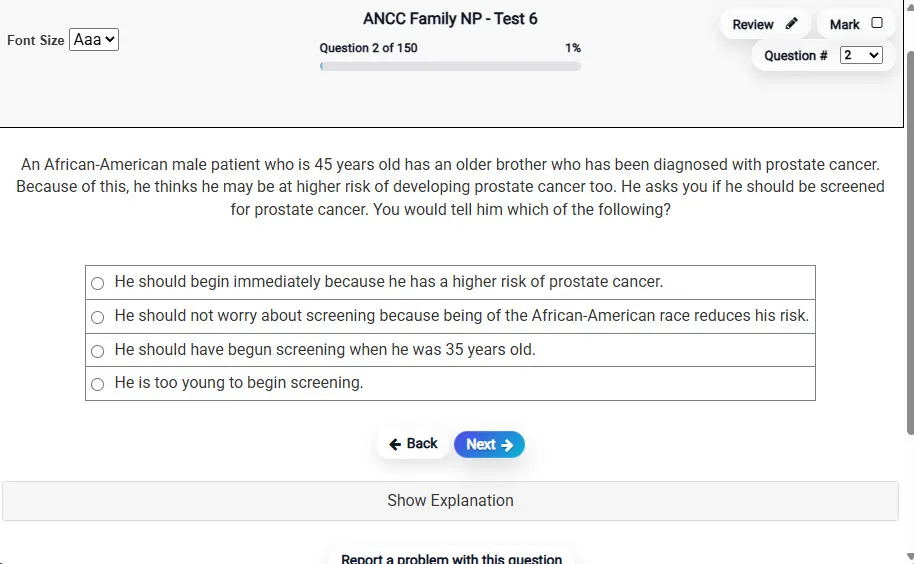
Answering a Question screen – Multiple-choice item view with navigation controls and progress tracker.
Answering a Question Multiple-choice item view with navigation controls and progress tracker.

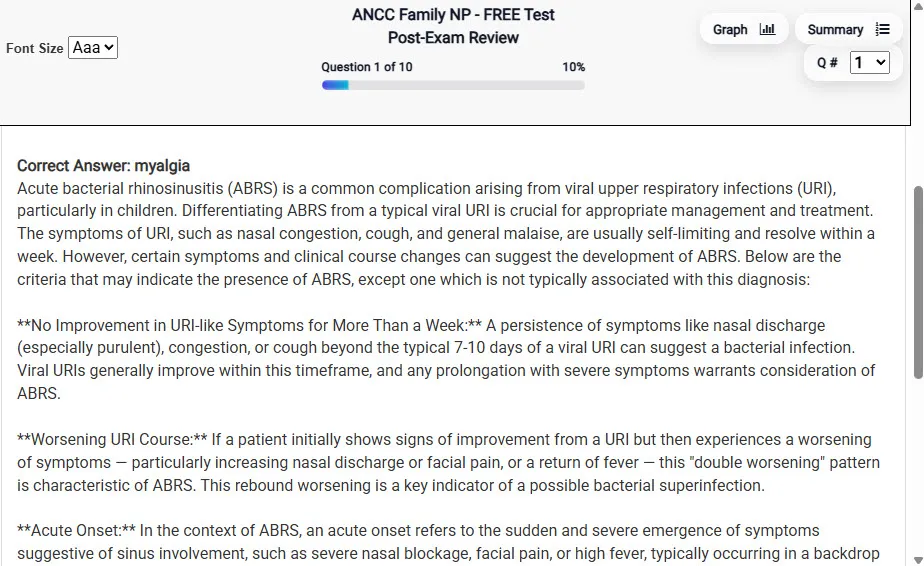
                           Detailed Explanation screen – 
                         Review mode showing chosen answer and rationale and references.
Detailed Explanation Review mode showing chosen answer and rationale and references.

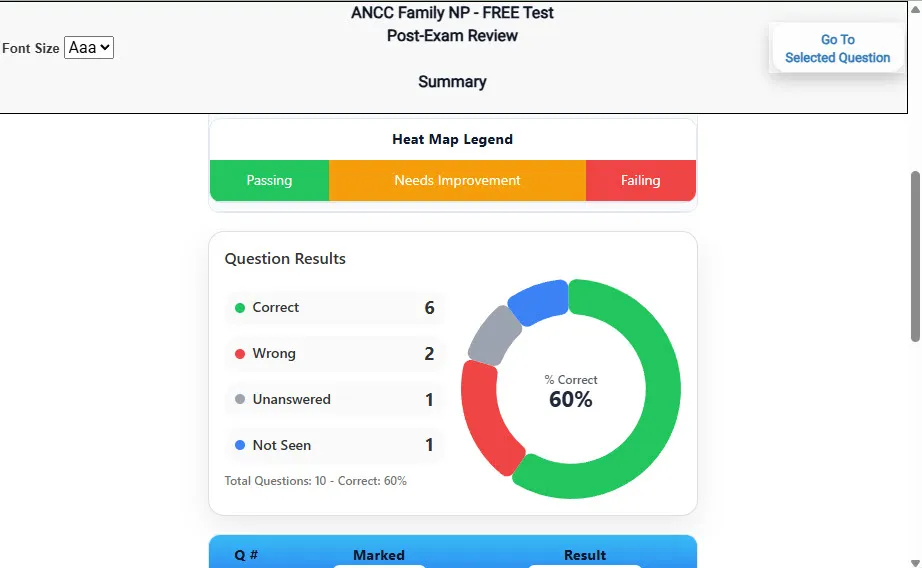
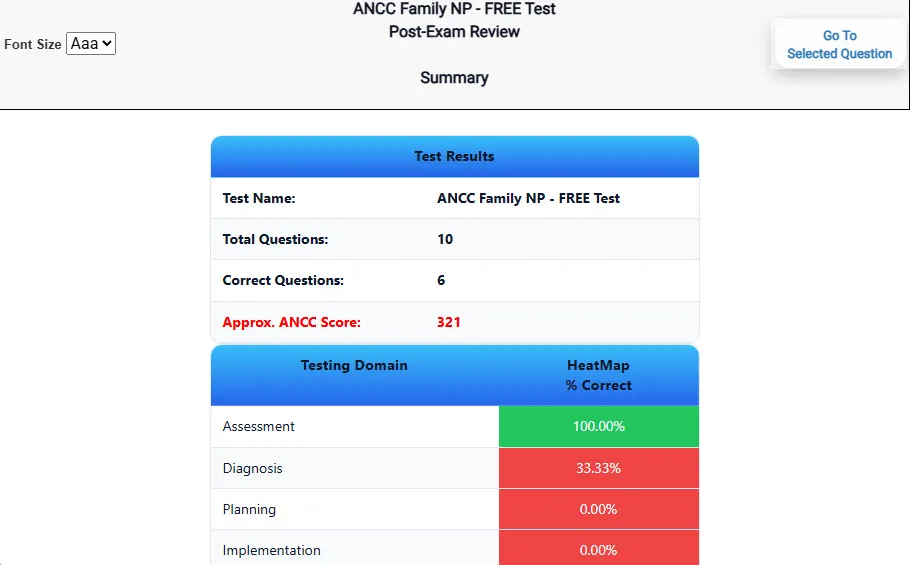
                           Review Summary 1 screen – 
                         Summary with counts for correct/wrong/unanswered and not seen items.
Review Summary 1 Summary with counts for correct/wrong/unanswered and not seen items.

                           Review Summary 2 screen – 
                         Advanced summary with category/domain breakdown and performance insights.
Review Summary 2 Advanced summary with category/domain breakdown and performance insights.

What Each Screen Shows

Answer Question Screen

  • Clean multiple-choice interface with progress bar.
  • Mark for review feature.
  • Matches real test pacing.

Detailed Explanation

  • Correct answer plus rationale.
  • Key concepts and guidelines highlighted.
  • Move between questions to fill knowledge gaps.

Review Summary 1

  • Overall results with total questions and scaled score.
  • Domain heatmap shows strengths and weaknesses.
  • Quick visual feedback on study priorities.

Review Summary 2

  • Chart of correct, wrong, unanswered, not seen.
  • Color-coded results for easy review.
  • Links back to missed items.

Top 10 Reasons to Use Exam Edge for your TExES Core Subjects EC-6 - Science Exam Prep

  1. Focused on the TExES Core Subjects EC-6 - Science Exam

    Our practice tests are built specifically for the TExES Core Subjects EC-6 - Science exam — every question mirrors the real topics, format, and difficulty so you're studying exactly what matters.

  2. Real Exam Simulation

    We match the per-question time limits and pressure of the actual TExES exam, so test day feels familiar and stress-free.

  3. 20 Full Practice Tests & 900 Unique Questions

    You'll have more than enough material to master every TExES Core Subjects EC-6 - Science concept — no repeats, no fluff.

  4. Lower Cost Than a Retake

    Ordering 5 practice exams costs less than retaking the TExES Core Subjects EC-6 - Science exam after a failure. One low fee could save you both time and money.

  5. Flexible Testing

    Need to step away mid-exam? Pick up right where you left off — with your remaining time intact.

  6. Instant Scoring & Feedback

    See your raw score and an estimated TExES Core Subjects EC-6 - Science score immediately after finishing each practice test.

  7. Detailed Explanations for Every Question

    Review correct and incorrect answers with clear, step-by-step explanations so you truly understand each topic.

  8. Trusted & Accredited

    We're fully accredited by the Better Business Bureau and uphold the highest standards of trust and transparency.

  9. Web-Based & Always Available

    No software to install. Access your TExES Core Subjects EC-6 - Science practice exams 24/7 from any computer or mobile device.

  10. Expert Support When You Need It

    Need extra help? Our specialized tutors are highly qualified and ready to support your TExES exam prep.


Pass the TExES Core Subjects EC-6 - Science Exam with Realistic Practice Tests from Exam Edge

Preparing for your upcoming TExES Core Subjects EC-6 - Science (904) Certification Exam can feel overwhelming — but the right practice makes all the difference. Exam Edge gives you the tools, structure, and confidence to pass on your first try. Our online practice exams are built to match the real TExES Core Subjects EC-6 - Science exam in content, format, and difficulty.

  • 📝 20 TExES Core Subjects EC-6 - Science Practice Tests: Access 20 full-length exams with 45 questions each, covering every major TExES Core Subjects EC-6 - Science topic in depth.
  • Instant Online Access: Start practicing right away — no software, no waiting.
  • 🧠 Step-by-Step Explanations: Understand the reasoning behind every correct answer so you can master TExES Core Subjects EC-6 - Science exam concepts.
  • 🔄 Retake Each Exam Up to 4 Times: Build knowledge through repetition and track your improvement over time.
  • 🌐 Web-Based & Available 24/7: Study anywhere, anytime, on any device.
  • 🧘 Boost Your Test-Day Confidence: Familiarity with the TExES format reduces anxiety and helps you perform under pressure.

These TExES Core Subjects EC-6 - Science practice exams are designed to simulate the real testing experience by matching question types, timing, and difficulty level. This approach helps you get comfortable not just with the exam content, but also with the testing environment, so you walk into your exam day focused and confident.


Exam Edge TEXES Reviews


This is a good cross sectional review for Educational Diagnosticians, Special Education and Mainstream teachers. The questions were very comprehensible and engaging. Thanks

Linda R, Texas

Very good! Shows a reality of the test

Ivelisse , KATY, Texas

Very good study resource.

Angie , Grapevine , Texas

Purchased the bundle of 5 practice tests for speech 7-12. Passed the state exam on the first try! Very happy with exam edge and the information it provided!

Juan G, Eagle Pass, TX

Exam Edge was exactly what I needed to pass my Technology 171 TEXES exam. The questions prepared me for the real test. I highly recommend their study guide.

Crystalyn , Texes

I am a teacher in Texas who recently passed my Technology Education 6-12 exam. I took five of the practice exams with Examedge, which prepared me well. In fact, on the last practice test I finished, I scored a 265, and on the actual exam, I scored a 262; that’s within one question, extremely a ...
Read More
Adam G, Texas


TExES Core Subjects EC-6 - Science Aliases Test Name

Here is a list of alternative names used for this exam.

  • TExES Core Subjects EC-6 - Science
  • TExES Core Subjects EC-6 - Science test
  • TExES Core Subjects EC-6 - Science Certification Test
  • TEXES
  • TEXES 904
  • 904 test
  • TExES Core Subjects EC-6 - Science (904)
  • TExES Core Subjects EC-6 - Science certification