This is the content of the pop-over!

TExES Core Subjects EC-6 - Social Studies (903) Practice Tests & Test Prep by Exam Edge


TExES Core Subjects EC-6 - Social Studies  product image
(4.6)
Based on 28 Reviews

  • Real Exam Simulation: Timed questions and matching content build comfort for your TExES Core Subjects EC-6 - Social Studies test day.
  • Instant, 24/7 Access: Web-based TExES Core Subjects EC-6 - Social Studies practice exams with no software needed.
  • Clear Explanations: Step-by-step answers and explanations for your TExES exam to strengthen understanding.
  • Boosted Confidence: Reduces anxiety and improves test-taking skills to ace your TExES Core Subjects EC-6 - Social Studies (903).

Featured on

TExES Core Subjects EC-6 - Social Studies Online Practice Test Bundles

BEST VALUE
20 practice tests

$174.00

$799.00

SAVE $625

Only $8.70 per test!

  • 100% Pass Guarantee
  • 20 online practice tests
  • 40 questions per test
  • Bonus: 100 Flash Cards + Study Guide
  • Instant access
  • Detailed Explanations
  • Practice tests never expire
  • Timed, untimed, or study guide mode
MOST POPULAR
10 practice tests

$99.50

$399.50

SAVE $300

Only $9.95 per test!

  • 10 online practice tests
  • 40 questions per test
  • Bonus: 100 Flash Cards + Study Guide
  • Instant access
  • Detailed Explanations
  • Practice tests never expire
  • Timed, untimed, or study guide mode
5 practice tests

$69.75

$199.75

SAVE $130

Only $13.95 per test!

  • 5 online practice tests
  • 40 questions per test
  • Bonus: 100 Flash Cards
  • Instant access
  • Detailed Explanations
  • Practice tests never expire
  • Timed, untimed, or study guide mode
1 practice test

$39.95

  • 1 online practice test
  • 40 questions per test
  • Instant access
  • Detailed Explanations
  • Practice tests never expire
  • Timed, untimed, or study guide mode
Quick Select
Tap to choose a bundle

** All Prices are in US Dollars (USD) **


TExES Core Subjects EC-6 - Social Studies (903) Resources

Jump to the section you need most.

Understanding the exact breakdown of the TExES Core Subjects EC-6 - Social Studies test will help you know what to expect and how to most effectively prepare. The TExES Core Subjects EC-6 - Social Studies has 40 multiple-choice questions . The exam will be broken down into the sections below:

TExES Core Subjects EC-6 - Social Studies Exam Blueprint
Domain Name
Social Science Instruction  
History  
Geography and Culture  
Economics  
Government and Citizenship  

TExES Core Subjects EC-6 - Social Studies Study Tips by Domain

  • Plan instruction with clear, measurable objectives aligned to the TEKS and grade-level expectations—red flag: lessons that are activity-driven but lack an explicit content/skill target and a way to assess it.
  • Use multiple sources (primary/secondary, maps, graphs, artifacts) and teach sourcing/corroboration explicitly—common trap: treating a single textbook passage as “the answer” instead of evidence to analyze.
  • Build and spiral core social studies vocabulary (e.g., citizen, economy, region, chronology) with student-friendly definitions and examples—priority rule: vocabulary must be taught in context, not as isolated word lists.
  • Teach disciplinary skills (compare/contrast, cause-and-effect, timelines, map skills, data interpretation) using brief, frequent practice—red flag: students can recall facts but cannot use them to explain or justify a claim.
  • Differentiate with scaffolds for emergent bilinguals and students with disabilities (sentence stems, visuals, chunked texts, graphic organizers) while keeping the cognitive demand—common trap: simplifying tasks so much that students only copy or match.
  • Assess continuously with quick checks (exit tickets, sorting, short constructed responses) tied to objectives and use results to reteach—threshold: if most students miss a key concept, adjust instruction before moving on.
  • Build timelines that distinguish sequence from duration and identify multiple causation; red flag: assuming one “main cause” without linking economic, political, and social factors.
  • Use primary vs. secondary sources with sourcing questions (author, purpose, audience, context); common trap: treating a textbook excerpt as a primary source for the historical event.
  • Compare perspectives across groups (e.g., Indigenous peoples, immigrants, women, enslaved people) and note continuity/change; priority rule: always ask “who benefits/who is harmed” when analyzing policies and conflicts.
  • Connect major eras and turning points in U.S. and Texas history (exploration/colonization, Revolution, Civil War/Reconstruction, industrialization, 20th-century reform/conflict); red flag: mixing Texas-specific events with national events without clear geographic context.
  • Interpret historical maps, graphs, and political cartoons as evidence; common trap: describing the image without stating the claim it supports and the evidence inside it.
  • Apply historical inquiry to civic and cultural impacts (laws, rights, migration, technology) and evaluate significance; threshold cue: be able to justify why an event is a turning point using at least two concrete outcomes.
  • Use the five themes of geography (location, place, human-environment interaction, movement, region) to frame questions; red flag: confusing absolute location (latitude/longitude) with relative location (near, between, distance/time).
  • Interpret maps with scale, direction, symbols, and legend accurately; common trap: reversing cardinal directions when a map is rotated or misreading scale units (miles vs. kilometers).
  • Differentiate physical processes (weathering, erosion, deposition) from sudden hazards (floods, hurricanes, earthquakes); priority rule: match the landform to the process (e.g., delta — deposition) rather than the event name.
  • Connect climate, vegetation, and human settlement/economic activity; red flag: assuming climate zones are defined by temperature alone and ignoring precipitation patterns.
  • Analyze cultural patterns (language, religion, customs) and diffusion; common trap: labeling all diffusion as “forced” when the scenario indicates voluntary movement, trade, or media.
  • Evaluate how humans adapt to and modify environments (dams, irrigation, urbanization) and the costs/benefits; contraindication: treating any human modification as automatically negative without considering intended purpose and trade-offs.
  • Apply the basic economic problem (scarcity) by naming what is given up in any choice—red flag: confusing “trade-off” (all options forgone) with “opportunity cost” (next best alternative).
  • Distinguish needs vs. wants and have students justify with evidence from a scenario—common trap: labeling something a “need” because it is popular or culturally valued.
  • Use supply-and-demand graphs to predict price/quantity changes when a factor shifts—priority rule: change ONE curve at a time and state the cause (e.g., income, input costs) before the effect.
  • Compare market, command, traditional, and mixed economies through who answers “what, how, for whom”—red flag: assuming the U.S. is a pure market economy or that government involvement automatically means “command.”
  • Explain roles of consumers, producers, government, banks, and entrepreneurship in a local community economy—common trap: treating “profit” as unethical rather than as an incentive signal.
  • Teach personal finance basics (income, budgeting, saving, credit) using real-world examples—threshold cue: distinguish gross vs. net pay and warn that using credit without understanding interest increases total cost over time.
  • Differentiate levels of government: federal powers are enumerated and supreme, while states retain reserved powers (10th Amendment)—red flag if an answer claims the federal government has a general “police power.”
  • Know how a bill becomes law and where checks occur (veto, override, judicial review)—common trap: thinking courts “veto” bills instead of ruling laws unconstitutional after enactment.
  • Match constitutional principles to examples: separation of powers, checks and balances, popular sovereignty, federalism, and limited government—priority rule: look for the branch-to-branch action to identify the correct concept.
  • Identify key civil liberties and rights (speech, religion, due process, equal protection) and the role of amendments—red flag: assuming the Bill of Rights originally applied to state governments without incorporation via the 14th Amendment.
  • Understand citizenship and civic participation: voting requirements, voter registration, jury duty, and ways to engage (contacting officials, petitions, volunteering)—common trap: mixing up responsibilities (expected) with rights (protected).
  • Recognize the structure and roles of Texas government (legislative, executive, judicial) and local governments (county, city, school district)—priority rule: if the scenario is about schools, elections, zoning, or services, it’s usually local or state rather than federal.


Built to Fit Into Your Busy Life

Everything you need to prepare with confidence—without wasting a minute.

Three Study Modes

Timed, No Time Limit, or Explanation mode.

Actionable Analytics

Heatmaps and scaled scores highlight weak areas.

High-Yield Rationales

Concise explanations emphasize key concepts.

Realistic Interface

Matches the feel of the actual exam environment.

Accessible by Design

Clean layout reduces cognitive load.

Anytime, Anywhere

Web-based access 24/7 on any device.
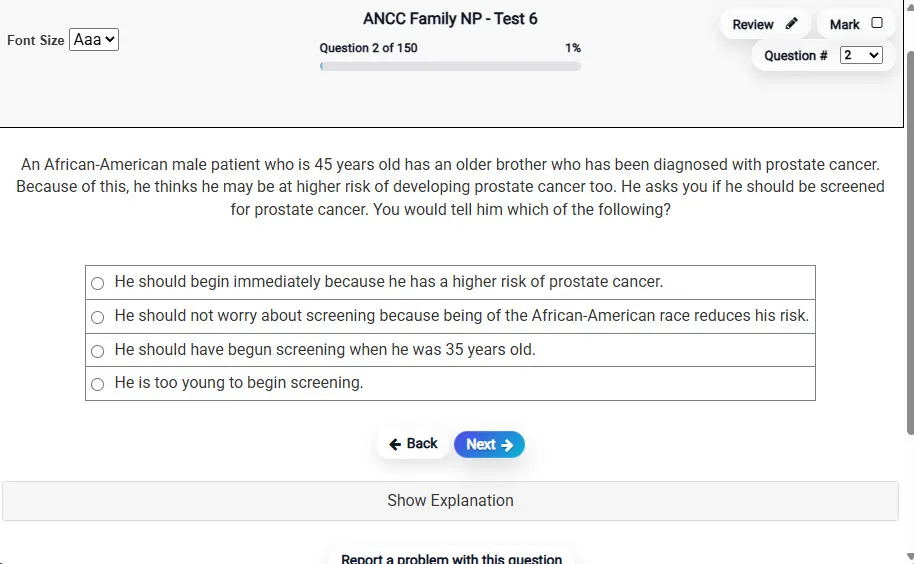
Answering a Question screen – Multiple-choice item view with navigation controls and progress tracker.
Answering a Question Multiple-choice item view with navigation controls and progress tracker.

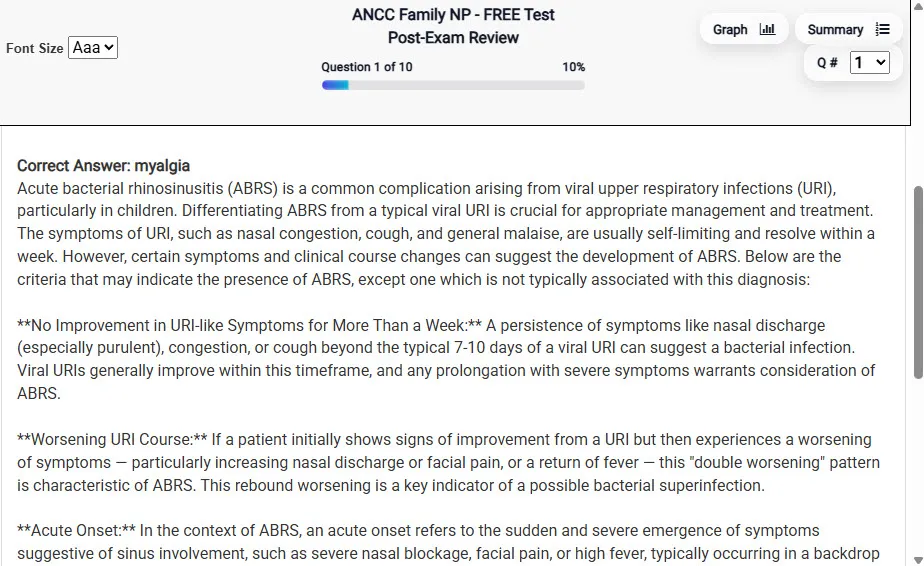
                           Detailed Explanation screen – 
                         Review mode showing chosen answer and rationale and references.
Detailed Explanation Review mode showing chosen answer and rationale and references.

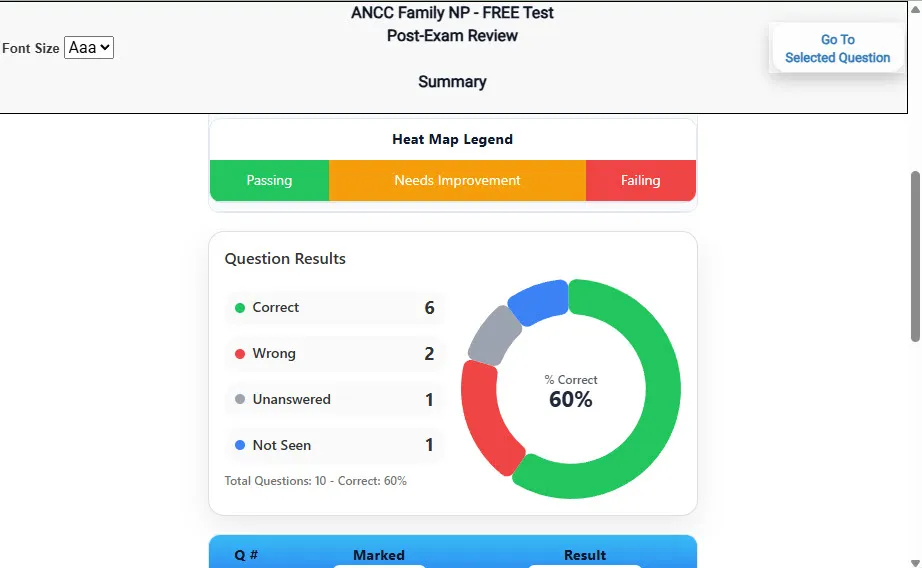
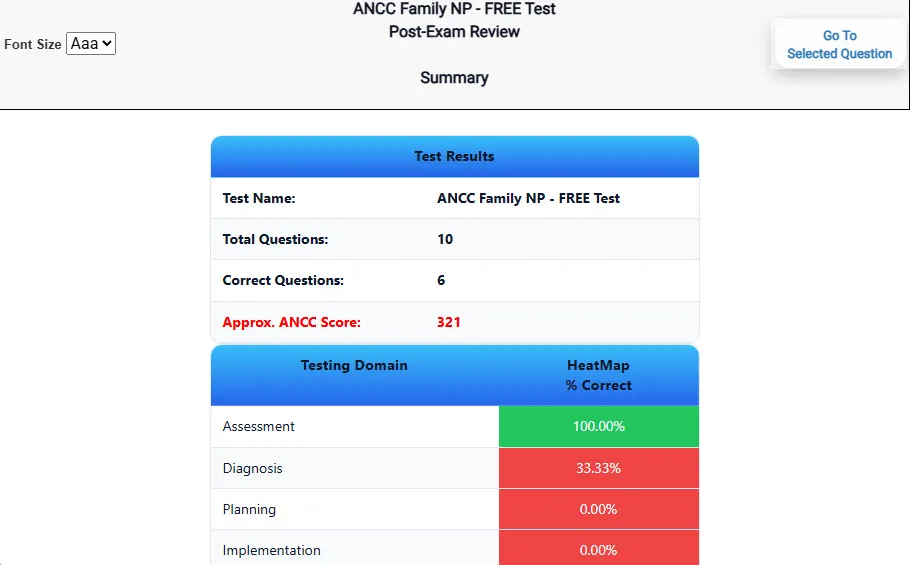
                           Review Summary 1 screen – 
                         Summary with counts for correct/wrong/unanswered and not seen items.
Review Summary 1 Summary with counts for correct/wrong/unanswered and not seen items.

                           Review Summary 2 screen – 
                         Advanced summary with category/domain breakdown and performance insights.
Review Summary 2 Advanced summary with category/domain breakdown and performance insights.

What Each Screen Shows

Answer Question Screen

  • Clean multiple-choice interface with progress bar.
  • Mark for review feature.
  • Matches real test pacing.

Detailed Explanation

  • Correct answer plus rationale.
  • Key concepts and guidelines highlighted.
  • Move between questions to fill knowledge gaps.

Review Summary 1

  • Overall results with total questions and scaled score.
  • Domain heatmap shows strengths and weaknesses.
  • Quick visual feedback on study priorities.

Review Summary 2

  • Chart of correct, wrong, unanswered, not seen.
  • Color-coded results for easy review.
  • Links back to missed items.

Top 10 Reasons to Use Exam Edge for your TExES Core Subjects EC-6 - Social Studies Exam Prep

  1. Focused on the TExES Core Subjects EC-6 - Social Studies Exam

    Our practice tests are built specifically for the TExES Core Subjects EC-6 - Social Studies exam — every question mirrors the real topics, format, and difficulty so you're studying exactly what matters.

  2. Real Exam Simulation

    We match the per-question time limits and pressure of the actual TExES exam, so test day feels familiar and stress-free.

  3. 20 Full Practice Tests & 800 Unique Questions

    You'll have more than enough material to master every TExES Core Subjects EC-6 - Social Studies concept — no repeats, no fluff.

  4. Lower Cost Than a Retake

    Ordering 5 practice exams costs less than retaking the TExES Core Subjects EC-6 - Social Studies exam after a failure. One low fee could save you both time and money.

  5. Flexible Testing

    Need to step away mid-exam? Pick up right where you left off — with your remaining time intact.

  6. Instant Scoring & Feedback

    See your raw score and an estimated TExES Core Subjects EC-6 - Social Studies score immediately after finishing each practice test.

  7. Detailed Explanations for Every Question

    Review correct and incorrect answers with clear, step-by-step explanations so you truly understand each topic.

  8. Trusted & Accredited

    We're fully accredited by the Better Business Bureau and uphold the highest standards of trust and transparency.

  9. Web-Based & Always Available

    No software to install. Access your TExES Core Subjects EC-6 - Social Studies practice exams 24/7 from any computer or mobile device.

  10. Expert Support When You Need It

    Need extra help? Our specialized tutors are highly qualified and ready to support your TExES exam prep.


Pass the TExES Core Subjects EC-6 - Social Studies Exam with Realistic Practice Tests from Exam Edge

Preparing for your upcoming TExES Core Subjects EC-6 - Social Studies (903) Certification Exam can feel overwhelming — but the right practice makes all the difference. Exam Edge gives you the tools, structure, and confidence to pass on your first try. Our online practice exams are built to match the real TExES Core Subjects EC-6 - Social Studies exam in content, format, and difficulty.

  • 📝 20 TExES Core Subjects EC-6 - Social Studies Practice Tests: Access 20 full-length exams with 40 questions each, covering every major TExES Core Subjects EC-6 - Social Studies topic in depth.
  • Instant Online Access: Start practicing right away — no software, no waiting.
  • 🧠 Step-by-Step Explanations: Understand the reasoning behind every correct answer so you can master TExES Core Subjects EC-6 - Social Studies exam concepts.
  • 🔄 Retake Each Exam Up to 4 Times: Build knowledge through repetition and track your improvement over time.
  • 🌐 Web-Based & Available 24/7: Study anywhere, anytime, on any device.
  • 🧘 Boost Your Test-Day Confidence: Familiarity with the TExES format reduces anxiety and helps you perform under pressure.

These TExES Core Subjects EC-6 - Social Studies practice exams are designed to simulate the real testing experience by matching question types, timing, and difficulty level. This approach helps you get comfortable not just with the exam content, but also with the testing environment, so you walk into your exam day focused and confident.


Exam Edge TEXES Reviews


This is a good cross sectional review for Educational Diagnosticians, Special Education and Mainstream teachers. The questions were very comprehensible and engaging. Thanks

Linda R, Texas

Very good! Shows a reality of the test

Ivelisse , KATY, Texas

Very good study resource.

Angie , Grapevine , Texas

Purchased the bundle of 5 practice tests for speech 7-12. Passed the state exam on the first try! Very happy with exam edge and the information it provided!

Juan G, Eagle Pass, TX

Exam Edge was exactly what I needed to pass my Technology 171 TEXES exam. The questions prepared me for the real test. I highly recommend their study guide.

Crystalyn , Texes

I am a teacher in Texas who recently passed my Technology Education 6-12 exam. I took five of the practice exams with Examedge, which prepared me well. In fact, on the last practice test I finished, I scored a 265, and on the actual exam, I scored a 262; that’s within one question, extremely a ...
Read More
Adam G, Texas


TExES Core Subjects EC-6 - Social Studies Aliases Test Name

Here is a list of alternative names used for this exam.

  • TExES Core Subjects EC-6 - Social Studies
  • TExES Core Subjects EC-6 - Social Studies test
  • TExES Core Subjects EC-6 - Social Studies Certification Test
  • TEXES
  • TEXES 903
  • 903 test
  • TExES Core Subjects EC-6 - Social Studies (903)
  • TExES Core Subjects EC-6 - Social Studies certification