This is the content of the pop-over!

Lightning Deal Alert – 12% Off Ends at Midnight!

Strike while the savings are hot! Use promo code FlashSale at checkout for 12% off any Exam Edge test or bundle. Hurry—the clock is ticking!

TExES Core Subjects EC-6 - ELAR (901) Practice Tests & Test Prep by Exam Edge


TExES Core Subjects EC-6 - English Language Arts and Reading   product image
(4.8)
Based on 22 Reviews

  • Real Exam Simulation: Timed questions and matching content build comfort for your TExES Core Subjects EC-6 - ELAR test day.
  • Instant, 24/7 Access: Web-based TExES Core Subjects EC-6 - English Language Arts and Reading practice exams with no software needed.
  • Clear Explanations: Step-by-step answers and explanations for your TExES exam to strengthen understanding.
  • Boosted Confidence: Reduces anxiety and improves test-taking skills to ace your TExES Core Subjects EC-6 - English Language Arts and Reading .

Featured on

TExES Core Subjects EC-6 - English Language Arts and Reading Online Practice Test Bundles

BEST VALUE
20 practice tests

$174.00

$799.00

SAVE $625

Only $8.70 per test!

  • 100% Pass Guarantee
  • 20 online practice tests
  • 45 questions per test
  • Bonus: 100 Flash Cards + Study Guide
  • Instant access
  • Detailed Explanations
  • Practice tests never expire
  • Timed, untimed, or study guide mode
MOST POPULAR
10 practice tests

$99.50

$399.50

SAVE $300

Only $9.95 per test!

  • 10 online practice tests
  • 45 questions per test
  • Bonus: 100 Flash Cards + Study Guide
  • Instant access
  • Detailed Explanations
  • Practice tests never expire
  • Timed, untimed, or study guide mode
5 practice tests

$69.75

$199.75

SAVE $130

Only $13.95 per test!

  • 5 online practice tests
  • 45 questions per test
  • Bonus: 100 Flash Cards
  • Instant access
  • Detailed Explanations
  • Practice tests never expire
  • Timed, untimed, or study guide mode
1 practice test

$39.95

  • 1 online practice test
  • 45 questions per test
  • Instant access
  • Detailed Explanations
  • Practice tests never expire
  • Timed, untimed, or study guide mode
Quick Select
Tap to choose a bundle

** All Prices are in US Dollars (USD) **


TExES Core Subjects EC-6 - ELAR () Resources

Jump to the section you need most.

Understanding the exact breakdown of the TExES Core Subjects EC-6 - English Language Arts and Reading test will help you know what to expect and how to most effectively prepare. The TExES Core Subjects EC-6 - English Language Arts and Reading has 45 multiple-choice questions . The exam will be broken down into the sections below:

TExES Core Subjects EC-6 - English Language Arts and Reading Exam Blueprint
Domain Name
Oral Language  
Phonological and Phonemic Awareness  
Alphabetic Principle  
Literacy Development and Practice  
Word Analysis and Decoding  
Reading Fluency  
Reading Comprehension  
Development of Written Communication  
Writing Conventions  
Assessment and Instruction of Developing Literacy  
Research and Inquiry Skills  
Viewing and Representing:  

TExES Core Subjects EC-6 - English Language Arts and Reading Study Tips by Domain

  • Differentiate receptive vs. expressive language and plan instruction that grows both (e.g., listening tasks with accountable talk); red flag: evaluating oral language solely by written work or quiet behavior.
  • Use explicit vocabulary instruction (student-friendly definitions, multiple exposures, and usage in speaking) and track Tier 2 words; common trap: teaching only dictionary definitions without practice in oral sentences.
  • Teach and model academic discourse moves (ask for clarification, agree/disagree with evidence, build on ideas) with sentence stems; priority rule: assess both content and language function, not just participation.
  • Support English learners with scaffolds (visuals, gestures, cognates when appropriate, structured partner talk) while maintaining grade-level ideas; red flag: lowering cognitive demand instead of increasing linguistic support.
  • Attend to pragmatics (turn-taking, register, audience, and purpose) through role-play and discussion norms; common trap: treating dialect or cultural language patterns as errors rather than differences unless they impede clarity in the target context.
  • Monitor articulation/voice/fluency concerns and refer appropriately when patterns persist across settings; contraindication: diagnosing a disability based on second-language acquisition features or limited exposure to English.
  • Differentiate phonological awareness (words, syllables, onset-rime) from phonemic awareness (individual phonemes); common trap: treating letter-naming as evidence of phonemic skill.
  • Sequence instruction from larger to smaller units (rhyming → syllable segmentation → onset-rime → phoneme blending/segmenting); red flag: pushing phoneme manipulation before students can reliably blend and segment.
  • Target high-leverage phonemic tasks for decoding/spelling—phoneme blending and segmentation—and use deletion/substitution as advanced practice; priority rule: mastery of segmentation is a strong indicator for early reading success.
  • Keep tasks oral/aural (no print) when assessing phonological/phonemic awareness; contraindication: adding letters can mask whether a student is struggling with sounds versus symbols.
  • Use explicit articulation cues for continuous sounds (/m/, /s/, /f/) vs stop sounds (/p/, /t/, /k/) during phoneme isolation and blending; common trap: adding a schwa (e.g., saying “puh”) which distorts blending.
  • Progress-monitor with brief, specific measures (e.g., phoneme segmentation fluency) and adjust intensity promptly; red flag: persistent difficulty with phoneme segmentation despite practice warrants more explicit, smaller-step modeling and immediate corrective feedback.
  • Teach that letters and letter patterns represent sounds in spoken words; red flag: students can recite the alphabet but cannot connect letters to sounds in print.
  • Sequence instruction from common, consistent letter–sound correspondences to less predictable patterns; common trap: introducing many vowel patterns at once without enough guided practice.
  • Use explicit modeling and immediate corrective feedback when students confuse visually similar letters (b/d, p/q); priority rule: address letter formation and directionality before expecting accurate word reading.
  • Link phoneme segmentation to grapheme mapping (sound-by-sound to letter-by-letter) during encoding and decoding; red flag: students guess words from pictures instead of using print cues.
  • Apply the alphabetic principle across reading and spelling (e.g., students write sounds they hear, then refine to conventional spellings); common trap: correcting every spelling too early rather than focusing first on sound–symbol accuracy.
  • Monitor mastery with quick checks (identify letter names, letter sounds, and produce the sound for a given letter in isolation and in words); threshold cue: lack of automatic letter–sound retrieval signals need for intensified, systematic review.
  • Plan literacy instruction as an integrated block (read-aloud, shared/interactive reading, guided reading, independent practice) aligned to a clear objective—red flag: isolated worksheets that don’t connect to authentic reading/writing.
  • Select diverse, culturally relevant texts at appropriate complexity and purpose (literary vs. informational) and explicitly teach text features—common trap: choosing texts only by student interest without considering readability demands and background knowledge.
  • Build a print-rich environment (labels, charts, word walls used for reading/writing) and model how to use it—priority rule: displays must be instructionally referenced, not just decorative.
  • Use structured routines to promote independent literacy behaviors (choosing “just-right” books, stamina, retelling, response journals)—red flag: independent reading time without accountability or conferencing.
  • Differentiate practice using small-group instruction and targeted scaffolds (sentence stems, graphic organizers, re-reading, partner talk) based on evidence—common trap: grouping by “low/middle/high” without specific skill focus.
  • Include explicit academic vocabulary and language supports for emergent bilinguals (preview/review, visuals, cognates, oral rehearsal) while maintaining grade-level expectations—contraindication: reducing literacy tasks to below-grade-level work instead of scaffolding access.
  • Teach decoding explicitly and systematically (letter–sound correspondences → blending/segmenting → word reading), and treat guessing from pictures as a red flag in EC–2 instruction.
  • Use a cueing priority rule: analyze the word (graphemes/phonemes) first, then confirm with meaning/syntax; a common trap is prompting students to “look at the picture” instead of attending to print.
  • Target phonics patterns by developmental sequence (CVC → digraphs → blends → long-vowel patterns → r-controlled → vowel teams), and don’t move on when students can’t decode words with taught patterns in connected text.
  • Teach multisyllabic decoding (chunk by syllables/morphemes, locate vowels, apply syllable types), and watch for the red flag of students who read single-syllable words but stall on longer grade-level words.
  • Integrate morphology (inflectional endings, prefixes/suffixes, roots) to support decoding and spelling, with the caution that meaning cues should reinforce—not replace—accurate word reading.
  • Use running records/phonics inventories to pinpoint error patterns (e.g., confusing short vowels, omitting blends, misreading vowel teams), and avoid the trap of re-teaching “everything” instead of addressing the specific pattern causing miscues.
  • Reading fluency is accurate, automatic word recognition plus appropriate rate and prosody to support comprehension—red flag: students who read fast but cannot retell may have a comprehension, not fluency, problem.
  • Prioritize building accuracy before pushing speed; common trap: timing a student with high error rates and rewarding faster guessing.
  • Use repeated reading, echo/choral reading, and teacher modeling to develop automaticity and expression; cue: select short, decodable or controlled texts when decoding is still emerging.
  • Monitor with brief oral reading measures (e.g., words correct per minute plus error patterns and prosody notes); threshold cue: multiple miscues on high-frequency words signals a word-recognition/decoding issue undermining fluency.
  • Teach phrasing and prosody explicitly (pausing at punctuation, reading in meaningful word groups); red flag: word-by-word reading with little intonation often indicates weak automaticity or limited syntactic awareness.
  • Provide immediate, specific corrective feedback during oral reading (model the word/phrase, have the student reread it correctly); contraindication: interrupting after every minor slip can reduce comprehension and confidence.
  • Teach comprehension as an active process—before/during/after reading strategies (predict, question, summarize, clarify); red flag: lessons that only check answers after reading rather than coaching thinking while reading.
  • Explicitly build academic and domain-specific vocabulary (morphology, context, multiple-meaning words) because it drives meaning; common trap: treating vocabulary as a separate list instead of tying words to the text’s ideas.
  • Use text structure and features (cause/effect, compare/contrast, headings, captions, graphs) to support understanding across genres; priority rule: students should cite which structure/feature helped them locate or infer key information.
  • Differentiate between literal understanding, inference, and evaluation and require evidence for each; red flag: accepting personal opinions (“I think”) without a text-based reason or quotation/paraphrase.
  • Teach comprehension monitoring and fix-up strategies (reread, slow rate, chunk, annotate, use context/visuals) and check for breakdowns; common trap: assuming fluent oral reading means the student understood.
  • Align questions and tasks to the standard and the text’s complexity (including informational text and paired texts); red flag: over-reliance on low-level recall questions when the objective targets analysis or synthesis.
  • Plan writing instruction around the full process (prewrite, draft, revise, edit, publish) — red flag: grading only the final product with no evidence of revision.
  • Teach development by matching mode and purpose (narrative, informational, persuasive) to a clear focus and organized structure — trap: students include lots of details but no controlling idea or logical sequencing.
  • Use mentor texts and explicit modeling (think-alouds) to show how to elaborate with examples, reasons, and sensory details — priority rule: require evidence of elaboration beyond simple retelling.
  • Differentiate supports (sentence stems, graphic organizers, shared/interactive writing) while maintaining grade-level expectations — contraindication: over-scaffolding that produces teacher-written work.
  • Address voice and audience by teaching word choice and tone, including how to add or remove formal language — common trap: students write every piece in the same “school report” style regardless of purpose.
  • Give timely, specific feedback tied to a rubric and one or two targeted goals per draft — red flag: correcting everything at once, which overwhelms students and reduces transfer.
  • Teach conventions (capitalization, punctuation, grammar, usage) through authentic writing and targeted mini-lessons rather than isolated worksheets; red flag: “editing” instruction that never transfers to students’ drafts.
  • Differentiate between revising (ideas/organization) and editing (conventions); common trap: grading conventions heavily on first drafts when the task focus is composition, not correctness.
  • Use sentence combining/expansion to improve syntax and reduce run-ons/fragments; priority cue: if a student has many fragments, teach complete subject–predicate structures before fine-grained punctuation rules.
  • Apply punctuation for meaning (end marks, commas in series/after introductory elements, apostrophes for possession/contractions, quotation marks in dialogue); red flag: students using commas “by pause” instead of by structure.
  • Address common usage errors (subject–verb agreement, pronoun case/antecedent agreement, verb tense consistency, comparative forms, double negatives); threshold cue: if errors obscure meaning, prioritize instruction and feedback over stylistic preferences.
  • Teach spelling and capitalization conventions within patterns (morphology, prefixes/suffixes, homophones, proper nouns/titles); common trap: treating spelling as memorization only and ignoring morphological cues (e.g., keeping base-word spelling in inflected forms).
  • Use screening and diagnostic data to target instruction (e.g., phonological awareness vs. decoding vs. fluency)—red flag: prescribing the same phonics routine for every student despite error-pattern differences.
  • Progress-monitor frequently with brief measures aligned to the skill taught; common trap: using only a benchmark score (3x/year) to claim growth without instruction-linked data points.
  • Triangulate multiple sources (running records, spelling inventories, oral reading, work samples) before changing placement—priority rule: one low score should trigger verification, not immediate retention or wholesale program changes.
  • Plan explicit, systematic instruction with a gradual release model (I do/we do/you do) and cumulative review; red flag: moving on after “exposure” without confirming mastery at an appropriate accuracy threshold (e.g., ~90% in controlled practice).
  • Differentiate for English learners and students with reading difficulties by adjusting language supports and time/intensity; contraindication: treating limited English proficiency as a reading disability without evidence from first-language/linguistic considerations.
  • Ensure assessments are administered and scored reliably (standard directions, consistent prompting, accurate miscues); common trap: over-prompting during oral reading, which inflates accuracy and leads to under-identifying needed intervention.
  • Teach students to pose investigable questions and narrow topics by time, place, and purpose; red flag: a “topic” stated as a broad noun (e.g., “weather”) instead of a focused question.
  • Prioritize source evaluation using authority, accuracy, bias, currency, and relevance; common trap: treating the top search result or a .com site as automatically credible.
  • Model efficient information gathering with keywords, synonyms, and Boolean operators (AND/OR/NOT); cue: if searches return thousands of hits, require adding a limiter (grade level, date range, specific subtopic).
  • Explicitly teach note-taking that separates paraphrase, summary, and direct quotation; red flag: sentences copied with minor word swaps (patchwriting) — require citation even when paraphrasing.
  • Guide students to synthesize across multiple texts by comparing claims, evidence, and reasoning; priority rule: at least two sources should corroborate a key factual claim before it is treated as reliable.
  • Teach basic research ethics and product conventions (citations, bibliographies, and crediting images/media); common trap: assuming classroom projects don’t require attribution or that images found online are “free to use.”
  • Teach students to interpret how visual elements (e.g., color, camera angle, layout, font size) shape meaning—red flag: students retell content but cannot cite a specific visual feature as evidence.
  • Emphasize media literacy by identifying purpose and target audience (inform, entertain, persuade, sell)—common trap: assuming anything labeled “documentary” is unbiased.
  • Have students evaluate credibility by checking source, date, and evidence behind claims in images, charts, and videos—priority rule: treat graphs and infographics as arguments that must be verified, not as facts.
  • Teach students to distinguish fact, opinion, and persuasive techniques (emotional appeal, bandwagon, loaded language) in advertisements and digital media—red flag: students confuse a slogan with a supported claim.
  • When students create visual/digital products (posters, slides, videos), require alignment among message, visuals, and text with proper citation—common trap: copying images without attribution or using visuals that contradict the intended message.
  • Differentiate instruction by explicitly teaching vocabulary for visual analysis (e.g., symbol, perspective, exaggeration) and offering accessible formats—contraindication: grading the “art quality” instead of the communication of meaning.


Built to Fit Into Your Busy Life

Everything you need to prepare with confidence—without wasting a minute.

Three Study Modes

Timed, No Time Limit, or Explanation mode.

Actionable Analytics

Heatmaps and scaled scores highlight weak areas.

High-Yield Rationales

Concise explanations emphasize key concepts.

Realistic Interface

Matches the feel of the actual exam environment.

Accessible by Design

Clean layout reduces cognitive load.

Anytime, Anywhere

Web-based access 24/7 on any device.
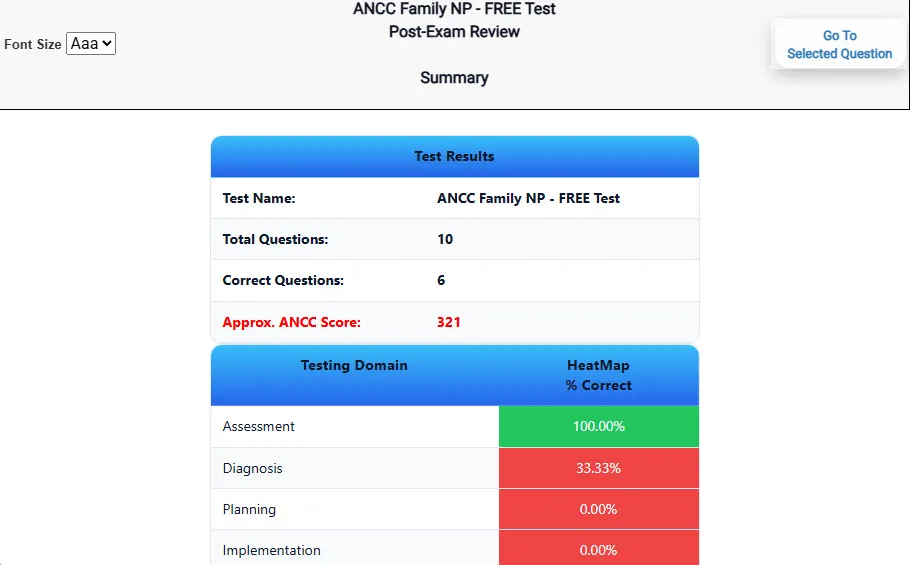
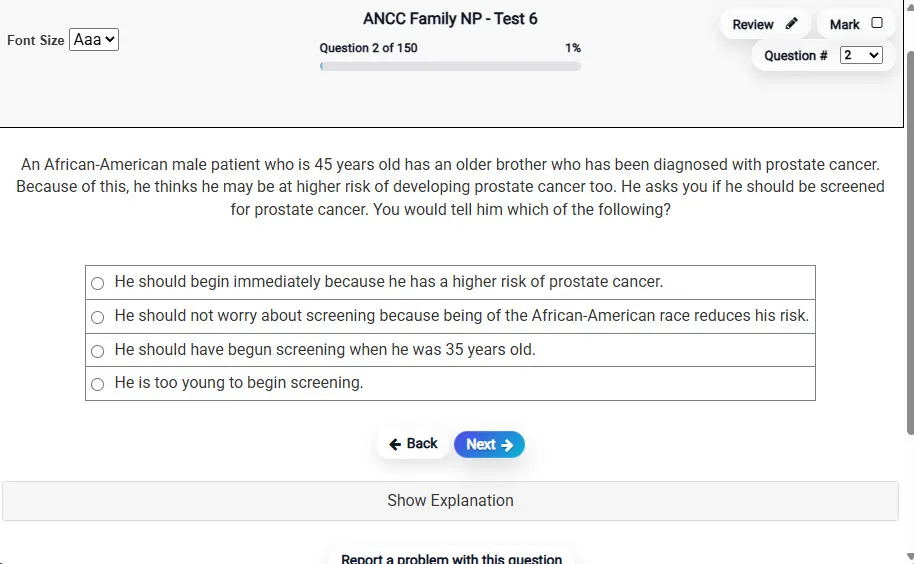
Answering a Question screen – Multiple-choice item view with navigation controls and progress tracker.
Answering a Question Multiple-choice item view with navigation controls and progress tracker.

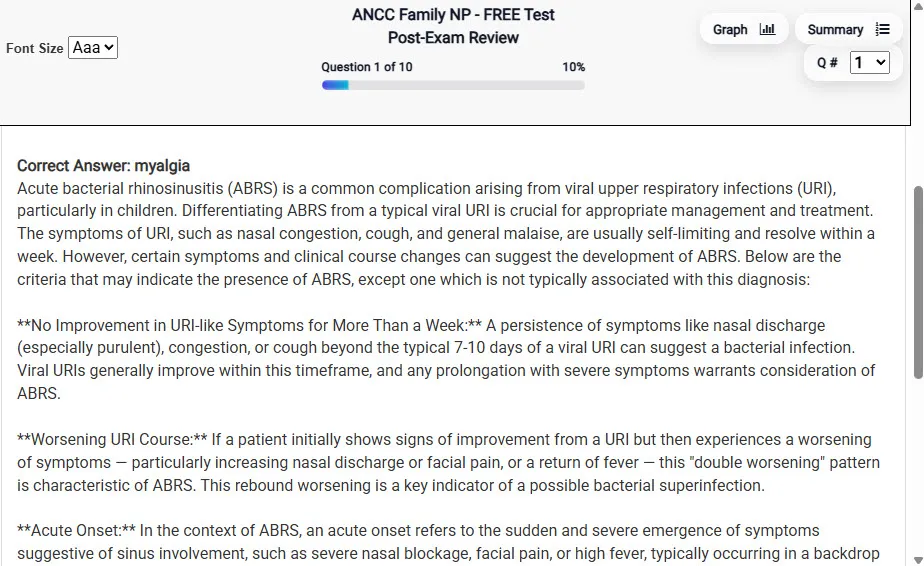
                           Detailed Explanation screen – 
                         Review mode showing chosen answer and rationale and references.
Detailed Explanation Review mode showing chosen answer and rationale and references.

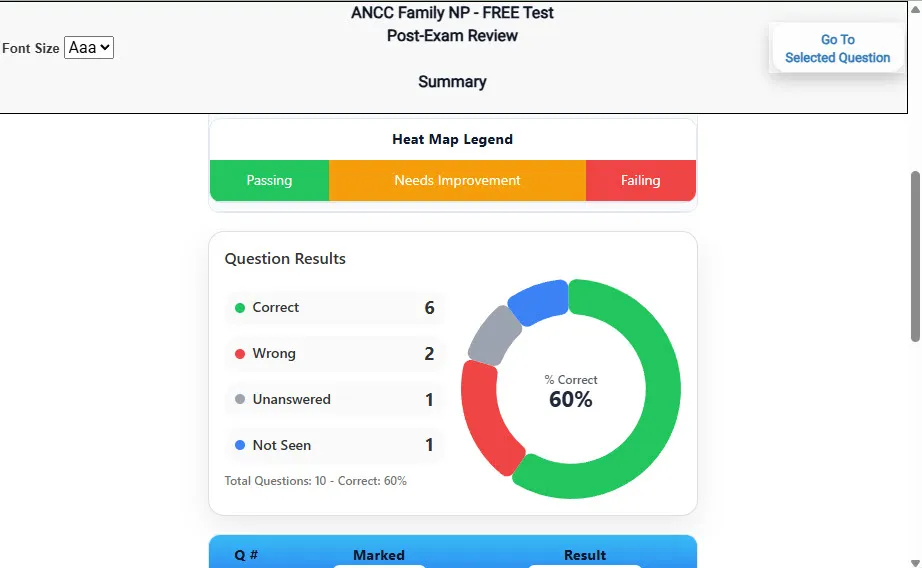
                           Review Summary 1 screen – 
                         Summary with counts for correct/wrong/unanswered and not seen items.
Review Summary 1 Summary with counts for correct/wrong/unanswered and not seen items.

                           Review Summary 2 screen – 
                         Advanced summary with category/domain breakdown and performance insights.
Review Summary 2 Advanced summary with category/domain breakdown and performance insights.

What Each Screen Shows

Answer Question Screen

  • Clean multiple-choice interface with progress bar.
  • Mark for review feature.
  • Matches real test pacing.

Detailed Explanation

  • Correct answer plus rationale.
  • Key concepts and guidelines highlighted.
  • Move between questions to fill knowledge gaps.

Review Summary 1

  • Overall results with total questions and scaled score.
  • Domain heatmap shows strengths and weaknesses.
  • Quick visual feedback on study priorities.

Review Summary 2

  • Chart of correct, wrong, unanswered, not seen.
  • Color-coded results for easy review.
  • Links back to missed items.

Top 10 Reasons to Use Exam Edge for your TExES Core Subjects EC-6 - English Language Arts and Reading Exam Prep

  1. Focused on the TExES Core Subjects EC-6 - English Language Arts and Reading Exam

    Our practice tests are built specifically for the TExES Core Subjects EC-6 - ELAR exam — every question mirrors the real topics, format, and difficulty so you're studying exactly what matters.

  2. Real Exam Simulation

    We match the per-question time limits and pressure of the actual TExES exam, so test day feels familiar and stress-free.

  3. 20 Full Practice Tests & 900 Unique Questions

    You'll have more than enough material to master every TExES Core Subjects EC-6 - ELAR concept — no repeats, no fluff.

  4. Lower Cost Than a Retake

    Ordering 5 practice exams costs less than retaking the TExES Core Subjects EC-6 - English Language Arts and Reading exam after a failure. One low fee could save you both time and money.

  5. Flexible Testing

    Need to step away mid-exam? Pick up right where you left off — with your remaining time intact.

  6. Instant Scoring & Feedback

    See your raw score and an estimated TExES Core Subjects EC-6 - English Language Arts and Reading score immediately after finishing each practice test.

  7. Detailed Explanations for Every Question

    Review correct and incorrect answers with clear, step-by-step explanations so you truly understand each topic.

  8. Trusted & Accredited

    We're fully accredited by the Better Business Bureau and uphold the highest standards of trust and transparency.

  9. Web-Based & Always Available

    No software to install. Access your TExES Core Subjects EC-6 - ELAR practice exams 24/7 from any computer or mobile device.

  10. Expert Support When You Need It

    Need extra help? Our specialized tutors are highly qualified and ready to support your TExES exam prep.


Pass the TExES Core Subjects EC-6 - English Language Arts and Reading Exam with Realistic Practice Tests from Exam Edge

Preparing for your upcoming TExES Core Subjects EC-6 - English Language Arts and Reading () Certification Exam can feel overwhelming — but the right practice makes all the difference. Exam Edge gives you the tools, structure, and confidence to pass on your first try. Our online practice exams are built to match the real TExES Core Subjects EC-6 - ELAR exam in content, format, and difficulty.

  • 📝 20 TExES Core Subjects EC-6 - English Language Arts and Reading Practice Tests: Access 20 full-length exams with 45 questions each, covering every major TExES Core Subjects EC-6 - English Language Arts and Reading topic in depth.
  • Instant Online Access: Start practicing right away — no software, no waiting.
  • 🧠 Step-by-Step Explanations: Understand the reasoning behind every correct answer so you can master TExES Core Subjects EC-6 - ELAR exam concepts.
  • 🔄 Retake Each Exam Up to 4 Times: Build knowledge through repetition and track your improvement over time.
  • 🌐 Web-Based & Available 24/7: Study anywhere, anytime, on any device.
  • 🧘 Boost Your Test-Day Confidence: Familiarity with the TExES format reduces anxiety and helps you perform under pressure.

These TExES Core Subjects EC-6 - English Language Arts and Reading practice exams are designed to simulate the real testing experience by matching question types, timing, and difficulty level. This approach helps you get comfortable not just with the exam content, but also with the testing environment, so you walk into your exam day focused and confident.


Exam Edge TEXES Reviews


I still can't believe I passed my TEXES exams on my first attempt. I always thought “Practice makes perfect” was a cliche, but after using your product, I now know that “Practice does make perfect.” Unlike several of my classmates, I walked into the tests feeling confident and prepared. Thank you fo ...
Read More
Hal, Huston

These practice tests were the key in my study preparation! I had been studying for months but continued to be on the borderline of passing. After taking a few of these tests I got a better idea of what I needed to learn and I excitedly can say that I just passed the TExES Science 8-12 test with a 90 ...
Read More
Meridith , TX

Thank you for making this program available to those of us who need to brush up on academics of past years. I passed on my first try:) I really appreciate the fact that I was able to retake the tests as many times as necessary. Thanks again for this service.

Angele , Texes

Just wanted to tell you how helpful your site and tests were. I have taught HS English for 16 years and challenged this test to make myself more marketable. I ended up buying three tests, studying all the answer reasons, and using the info to make notes to study. I passed on the first try. Actually, ...
Read More
Wendy, Texes

I am so glad that I found your website. It's been 25 years since I took most of the science courses that I had to review and become familiar with to pass the Texes Science 7-12 and I passed on the first try. I studied like crazy for two months, but your tests really helped to get me familiar with th ...
Read More
Caren, Texas

Just received my test scores. 273/ 300 on my Science Composite (236) exam first attempt. These practice exams were a huge help! 

Michael , Texes


TExES Core Subjects EC-6 - English Language Arts and Reading Aliases Test Name

Here is a list of alternative names used for this exam.

  • TExES Core Subjects EC-6 - English Language Arts and Reading
  • TExES Core Subjects EC-6 - English Language Arts and Reading test
  • TExES Core Subjects EC-6 - English Language Arts and Reading Certification Test
  • TExES Core Subjects EC-6 - ELAR test
  • TEXES
  • TEXES
  • test
  • TExES Core Subjects EC-6 - English Language Arts and Reading ()
  • TExES Core Subjects EC-6 - English Language Arts and Reading certification