This is the content of the pop-over!

TExES Early Childhood PK–3 (292) Practice Tests & Test Prep by Exam Edge


TExES Early Childhood PK-3 product image
(4.7)
Based on 37 Reviews

  • Real Exam Simulation: Timed questions and matching content build comfort for your TExES Early Childhood PK-3 test day.
  • Instant, 24/7 Access: Web-based TExES Early Childhood PK-3 practice exams with no software needed.
  • Clear Explanations: Step-by-step answers and explanations for your TExES exam to strengthen understanding.
  • Boosted Confidence: Reduces anxiety and improves test-taking skills to ace your TExES Early Childhood PK-3 (292).

Featured on

TExES Early Childhood PK-3 Online Practice Test Bundles

BEST VALUE
15 practice tests

$149.25

$599.25

SAVE $450

Only $9.95 per test!

  • 100% Pass Guarantee
  • 15 online practice tests
  • 90 questions + 1 essay per test
  • Bonus: 100 Flash Cards + Study Guide
  • Instant access
  • Detailed Explanations
  • Practice tests never expire
  • Timed, untimed, or study guide mode
MOST POPULAR
10 practice tests

$99.50

$399.50

SAVE $300

Only $9.95 per test!

  • 10 online practice tests
  • 90 questions + 1 essay per test
  • Bonus: 100 Flash Cards + Study Guide
  • Instant access
  • Detailed Explanations
  • Practice tests never expire
  • Timed, untimed, or study guide mode
5 practice tests

$69.75

$199.75

SAVE $130

Only $13.95 per test!

  • 5 online practice tests
  • 90 questions + 1 essay per test
  • Bonus: 100 Flash Cards
  • Instant access
  • Detailed Explanations
  • Practice tests never expire
  • Timed, untimed, or study guide mode
1 practice test

$39.95

  • 1 online practice test
  • 90 questions + 1 essay per test
  • Instant access
  • Detailed Explanations
  • Practice tests never expire
  • Timed, untimed, or study guide mode
Quick Select
Tap to choose a bundle

** All Prices are in US Dollars (USD) **


TExES Early Childhood PK-3 (292) Resources

Jump to the section you need most.

Understanding the exact breakdown of the TExES Early Childhood PK-3 test will help you know what to expect and how to most effectively prepare. The TExES Early Childhood PK-3 has 90 multiple-choice questions and 1 essay questions. The exam will be broken down into the sections below:

TExES Early Childhood PK-3 Exam Blueprint
Domain Name % Number of
Questions
Child Development 19% 17
The Instructional Setting 12% 11
Educating All Learners 12% 11
Data-Driven Practice and Formal/Informal Assessment 12% 11
Learning Across the Curriculum 25% 23
Analysis and Response 20% 18

TExES Early Childhood PK-3 Study Tips by Domain

  • Use developmental sequences (physical, cognitive, language, social-emotional) to set realistic expectations, but treat them as ranges—red flag: labeling a child as “behind” based on one observation or a single skill.
  • Plan for self-regulation growth (attention, impulse control, coping) with explicit co-regulation supports; common trap: expecting PK/K children to “use their words” without modeling, visuals, or calm-down routines.
  • Recognize typical language development milestones (phonology, vocabulary, syntax, pragmatics) and distinguish difference vs. disorder; priority rule: evaluate impact across settings before assuming a speech-language impairment.
  • Support executive function through predictable routines, choice within limits, and scaffolded transitions; red flag: escalating behavior plans that ignore triggers like fatigue, hunger, sensory overload, or abrupt schedule changes.
  • Apply play-based learning principles (symbolic play, peer interaction, problem-solving) aligned to developmental goals; common trap: replacing play with only worksheet-style tasks that reduce engagement and fine-motor readiness.
  • Interpret behavior through developmental and environmental lenses (attachment, temperament, stress/trauma) and respond with supportive strategies; contraindication: using punitive measures for age-typical behaviors (e.g., short attention span, toileting accidents) without teaching replacement skills.
  • Prioritize a safe, predictable environment with clear routines and visual schedules; red flag: frequent transitions without warnings that trigger challenging behavior.
  • Arrange the classroom into defined learning centers with labeled materials and traffic-flow paths; common trap: cluttered or overcrowded centers that increase off-task behavior and conflicts.
  • Use proactive behavior supports (explicit expectations, specific praise, pre-correction) before consequences; priority rule: address the function of behavior rather than escalating punishment.
  • Plan small-group and whole-group instruction with active engagement (manipulatives, movement, talk) and brief pacing; red flag: extended teacher talk that exceeds young children’s attention span.
  • Integrate culturally responsive, language-rich interactions (open-ended questions, modeling, recasting) throughout the day; common trap: correcting language errors without affirming meaning, which reduces participation.
  • Maintain health, safety, and legal compliance (supervision, sanitation, allergies, mandated reporting); threshold cue: never leave children unsupervised—line-of-sight and sound supervision is nonnegotiable.
  • Use UDL (multiple means of engagement, representation, and action/expression) when planning so access is built in from the start—red flag: offering only a single way to learn (e.g., lecture-only or worksheet-only).
  • Differentiate by adjusting content/process/product based on readiness, interests, and language needs—common trap: confusing differentiation with giving the same task to all students but “letting them work at their own pace.”
  • Provide language supports for emergent bilingual learners (visuals, gestures, sentence stems, modeled talk) while maintaining grade-level cognitive demand—priority rule: don’t lower rigor just because English proficiency is developing.
  • Follow IEP/IFSP requirements (accommodations, modifications, related services) and document implementation—red flag: changing a student’s supports informally without ARD/IEP team input or required documentation.
  • Implement behavior supports with proactive routines, explicit teaching of expectations, and reinforcement—common trap: relying on punitive responses without identifying the function of behavior or teaching a replacement skill.
  • Create culturally responsive, trauma-informed classrooms by building relationships, predictable structure, and respectful family partnerships—red flag: interpreting differences in communication, play, or behavior as deficits rather than as cultural/experiential variation.
  • Use multiple data sources (observations, work samples, screeners, family input) and look for patterns over time; red flag: making high-stakes decisions from a single data point or one “bad day.”
  • Match assessment type to purpose—screening for risk, diagnostic for specific needs, formative to adjust instruction, summative to evaluate outcomes; common trap: using a screener to plan detailed instruction without follow-up diagnostics.
  • Collect observational data with clear, behavior-based criteria (e.g., frequency, duration, anecdotal notes tied to standards) and document context; priority rule: record what the child did/said, not interpretations like “unmotivated.”
  • Ensure assessments are valid and reliable for the age and skill targeted; contraindication: tasks requiring fine-motor output (writing/cutting) to measure content knowledge when motor skills may be the barrier.
  • Interpret data with equity and language considerations (home language, culture, disability) and use appropriate accommodations; red flag: treating limited English proficiency as a developmental delay without language-informed evidence.
  • Translate data into action—set measurable goals, adjust instruction, monitor progress at planned intervals, and communicate findings to families; common trap: collecting data without a timeline for reteach, regroup, or intervention changes.
  • Plan integrated lessons that intentionally connect literacy, math, science, social studies, and fine arts around a shared concept—red flag: “cute theme” activities with no clear learning target or evidence of standards alignment.
  • Build oral language and vocabulary across content (e.g., science observations, social studies discussions) using explicit word instruction and repeated use—common trap: asking only yes/no questions that limit language production.
  • Use read-alouds, shared writing, and content-rich texts to support comprehension and knowledge building—priority rule: choose texts with accurate content and opportunities for students to use domain vocabulary in speaking/writing.
  • Embed math reasoning in daily routines (counting, measurement, patterns, data talks) and require students to explain thinking—red flag: worksheets focused solely on numeral tracing without conceptual understanding.
  • Support science inquiry and engineering habits through hands-on investigations, predicting, observing, recording, and reflecting—common trap: teacher demonstrations that don’t let students collect evidence or revise ideas.
  • Promote social studies understanding through classroom community, maps, symbols, and civic routines (rules, roles, fairness) with culturally responsive examples—red flag: treating holidays as the only social studies content.
  • When given an observation or student work sample, separate objective facts from inference before choosing an action—red flag: decisions based on “seems lazy” or other subjective labels rather than specific behaviors.
  • Prioritize immediate health/safety and legal/ethical obligations first (e.g., suspected abuse/neglect, self-harm risk, severe allergic reaction)—common trap: trying to “handle it in class” instead of following required reporting and nurse/administrator protocols.
  • For behavior scenarios, identify the function (attention, escape, sensory, tangible) and respond with prevention and replacement skills—red flag: relying on punishment without adjusting antecedents or teaching what to do instead.
  • Match the response to the least intrusive, instructionally focused support (e.g., prompt, model, reteach, adjust task, visual supports) before escalation—priority rule: keep the student in the learning environment when safely possible.
  • When families are involved, communicate with specific evidence and a shared goal, and use interpreters/translated materials as needed—common trap: blaming language or culture, or discussing other students’ information (confidentiality breach).
  • In planning next steps, choose actions that are developmentally appropriate and measurable (what you will teach, how you will practice, how you will check)—red flag: vague plans like “review” or “work harder” with no observable outcome.


Built to Fit Into Your Busy Life

Everything you need to prepare with confidence—without wasting a minute.

Three Study Modes

Timed, No Time Limit, or Explanation mode.

Actionable Analytics

Heatmaps and scaled scores highlight weak areas.

High-Yield Rationales

Concise explanations emphasize key concepts.

Realistic Interface

Matches the feel of the actual exam environment.

Accessible by Design

Clean layout reduces cognitive load.

Anytime, Anywhere

Web-based access 24/7 on any device.
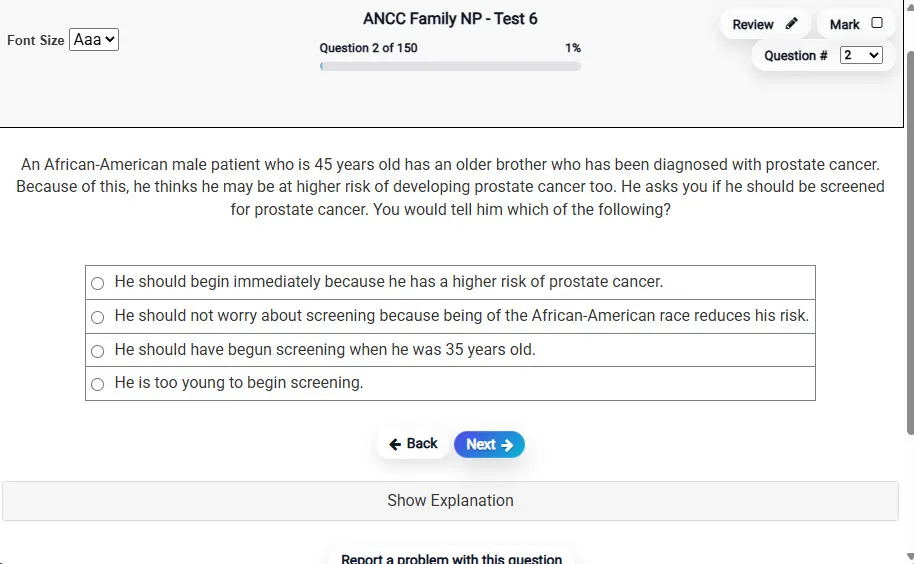
Answering a Question screen – Multiple-choice item view with navigation controls and progress tracker.
Answering a Question Multiple-choice item view with navigation controls and progress tracker.

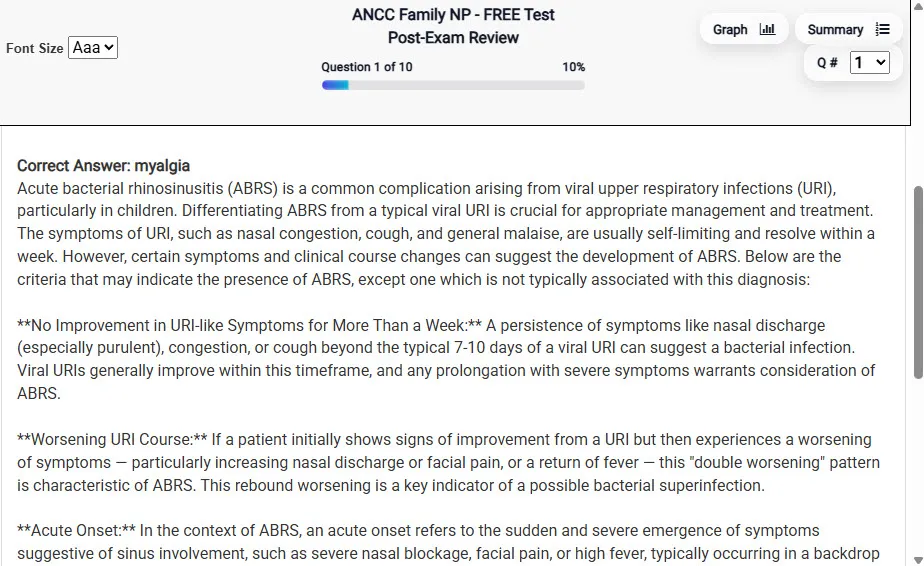
                           Detailed Explanation screen – 
                         Review mode showing chosen answer and rationale and references.
Detailed Explanation Review mode showing chosen answer and rationale and references.

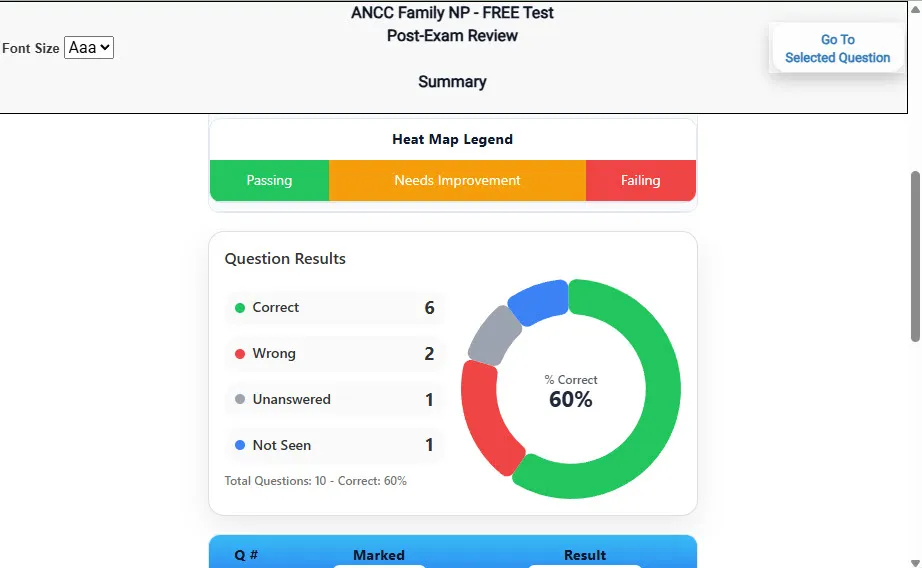
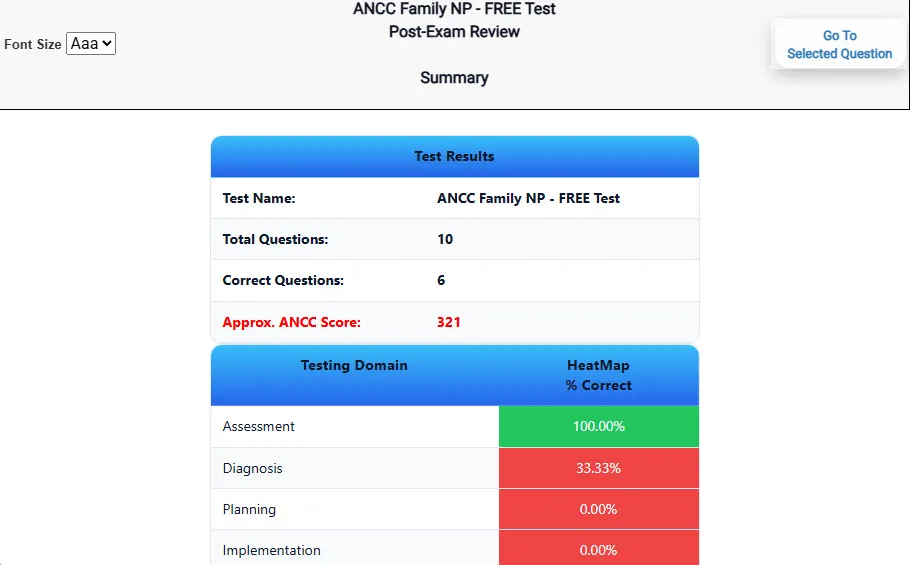
                           Review Summary 1 screen – 
                         Summary with counts for correct/wrong/unanswered and not seen items.
Review Summary 1 Summary with counts for correct/wrong/unanswered and not seen items.

                           Review Summary 2 screen – 
                         Advanced summary with category/domain breakdown and performance insights.
Review Summary 2 Advanced summary with category/domain breakdown and performance insights.

What Each Screen Shows

Answer Question Screen

  • Clean multiple-choice interface with progress bar.
  • Mark for review feature.
  • Matches real test pacing.

Detailed Explanation

  • Correct answer plus rationale.
  • Key concepts and guidelines highlighted.
  • Move between questions to fill knowledge gaps.

Review Summary 1

  • Overall results with total questions and scaled score.
  • Domain heatmap shows strengths and weaknesses.
  • Quick visual feedback on study priorities.

Review Summary 2

  • Chart of correct, wrong, unanswered, not seen.
  • Color-coded results for easy review.
  • Links back to missed items.

Top 10 Reasons to Use Exam Edge for your TExES Early Childhood PK-3 Exam Prep

  1. Focused on the TExES Early Childhood PK-3 Exam

    Our practice tests are built specifically for the TExES Early Childhood PK-3 exam — every question mirrors the real topics, format, and difficulty so you're studying exactly what matters.

  2. Real Exam Simulation

    We match the per-question time limits and pressure of the actual TExES exam, so test day feels familiar and stress-free.

  3. 15 Full Practice Tests & 1,365 Unique Questions

    You'll have more than enough material to master every TExES Early Childhood PK-3 concept — no repeats, no fluff.

  4. Lower Cost Than a Retake

    Ordering 5 practice exams costs less than retaking the TExES Early Childhood PK-3 exam after a failure. One low fee could save you both time and money.

  5. Flexible Testing

    Need to step away mid-exam? Pick up right where you left off — with your remaining time intact.

  6. Instant Scoring & Feedback

    See your raw score and an estimated TExES Early Childhood PK-3 score immediately after finishing each practice test.

  7. Detailed Explanations for Every Question

    Review correct and incorrect answers with clear, step-by-step explanations so you truly understand each topic.

  8. Trusted & Accredited

    We're fully accredited by the Better Business Bureau and uphold the highest standards of trust and transparency.

  9. Web-Based & Always Available

    No software to install. Access your TExES Early Childhood PK-3 practice exams 24/7 from any computer or mobile device.

  10. Expert Support When You Need It

    Need extra help? Our specialized tutors are highly qualified and ready to support your TExES exam prep.


Pass the TExES Early Childhood PK-3 Exam with Realistic Practice Tests from Exam Edge

Preparing for your upcoming TExES Early Childhood PK-3 (292) Certification Exam can feel overwhelming — but the right practice makes all the difference. Exam Edge gives you the tools, structure, and confidence to pass on your first try. Our online practice exams are built to match the real TExES Early Childhood PK-3 exam in content, format, and difficulty.

  • 📝 15 TExES Early Childhood PK-3 Practice Tests: Access 15 full-length exams with 91 questions each, covering every major TExES Early Childhood PK-3 topic in depth.
  • Instant Online Access: Start practicing right away — no software, no waiting.
  • 🧠 Step-by-Step Explanations: Understand the reasoning behind every correct answer so you can master TExES Early Childhood PK-3 exam concepts.
  • 🔄 Retake Each Exam Up to 4 Times: Build knowledge through repetition and track your improvement over time.
  • 🌐 Web-Based & Available 24/7: Study anywhere, anytime, on any device.
  • 🧘 Boost Your Test-Day Confidence: Familiarity with the TExES format reduces anxiety and helps you perform under pressure.

These TExES Early Childhood PK-3 practice exams are designed to simulate the real testing experience by matching question types, timing, and difficulty level. This approach helps you get comfortable not just with the exam content, but also with the testing environment, so you walk into your exam day focused and confident.


Exam Edge TEXES Reviews


This is a good cross sectional review for Educational Diagnosticians, Special Education and Mainstream teachers. The questions were very comprehensible and engaging. Thanks

Linda R, Texas

Very good! Shows a reality of the test

Ivelisse , KATY, Texas

Very good study resource.

Angie , Grapevine , Texas

Purchased the bundle of 5 practice tests for speech 7-12. Passed the state exam on the first try! Very happy with exam edge and the information it provided!

Juan G, Eagle Pass, TX

Exam Edge was exactly what I needed to pass my Technology 171 TEXES exam. The questions prepared me for the real test. I highly recommend their study guide.

Crystalyn , Texes

I am a teacher in Texas who recently passed my Technology Education 6-12 exam. I took five of the practice exams with Examedge, which prepared me well. In fact, on the last practice test I finished, I scored a 265, and on the actual exam, I scored a 262; that’s within one question, extremely a ...
Read More
Adam G, Texas


TExES Early Childhood PK-3 Aliases Test Name

Here is a list of alternative names used for this exam.

  • TExES Early Childhood PK-3
  • TExES Early Childhood PK-3 test
  • TExES Early Childhood PK-3 Certification Test
  • TEXES
  • TEXES 292
  • 292 test
  • TExES Early Childhood PK-3 (292)
  • TExES Early Childhood PK-3 certification