This is the content of the pop-over!

Lightning Deal Alert – 12% Off Ends at Midnight!

Strike while the savings are hot! Use promo code FlashSale at checkout for 12% off any Exam Edge test or bundle. Hurry—the clock is ticking!

TExES English Lang Arts and Reading 4-8 (217) (217) Practice Tests & Test Prep by Exam Edge


TExES English Language Arts and Reading 4-8  (217) product image
(4.7)
Based on 32 Reviews

  • Real Exam Simulation: Timed questions and matching content build comfort for your TExES English Lang Arts and Reading 4-8 (217) test day.
  • Instant, 24/7 Access: Web-based TExES English Language Arts and Reading 4-8 (217) practice exams with no software needed.
  • Clear Explanations: Step-by-step answers and explanations for your TExES exam to strengthen understanding.
  • Boosted Confidence: Reduces anxiety and improves test-taking skills to ace your TExES English Language Arts and Reading 4-8 (217) (217).

Featured on

TExES English Language Arts and Reading 4-8 (217) Online Practice Test Bundles

BEST VALUE
15 practice tests

$149.25

$599.25

SAVE $450

Only $9.95 per test!

  • 100% Pass Guarantee
  • 15 online practice tests
  • 90 questions + 1 essay per test
  • Bonus: 100 Flash Cards + Study Guide
  • Instant access
  • Detailed Explanations
  • Practice tests never expire
  • Timed, untimed, or study guide mode
MOST POPULAR
10 practice tests

$99.50

$399.50

SAVE $300

Only $9.95 per test!

  • 10 online practice tests
  • 90 questions + 1 essay per test
  • Bonus: 100 Flash Cards + Study Guide
  • Instant access
  • Detailed Explanations
  • Practice tests never expire
  • Timed, untimed, or study guide mode
5 practice tests

$69.75

$199.75

SAVE $130

Only $13.95 per test!

  • 5 online practice tests
  • 90 questions + 1 essay per test
  • Bonus: 100 Flash Cards
  • Instant access
  • Detailed Explanations
  • Practice tests never expire
  • Timed, untimed, or study guide mode
1 practice test

$39.95

  • 1 online practice test
  • 90 questions + 1 essay per test
  • Instant access
  • Detailed Explanations
  • Practice tests never expire
  • Timed, untimed, or study guide mode
Quick Select
Tap to choose a bundle

** All Prices are in US Dollars (USD) **


TExES English Lang Arts and Reading 4-8 (217) (217) Resources

Jump to the section you need most.

Understanding the exact breakdown of the TExES English Language Arts and Reading 4-8 (217) test will help you know what to expect and how to most effectively prepare. The TExES English Language Arts and Reading 4-8 (217) has 90 multiple-choice questions and 1 essay questions. The exam will be broken down into the sections below:

TExES English Language Arts and Reading 4-8 (217) Exam Blueprint
Domain Name % Number of
Questions
Foundations of Reading 27% 24
Text Comprehension and Analysis 20% 18
Oral and Written Communication 20% 18
Educating All Learners and Professional Practice 13% 12
Constructed Response 20% 18

TExES English Language Arts and Reading 4-8 (217) Study Tips by Domain

  • Teach and assess phonological awareness in a clear progression (rhyme → syllables → onset-rime → phonemes); red flag: students who can decode but can’t segment/blend phonemes often need PA, not more sight-word drills.
  • Use systematic, explicit phonics and word analysis (sound-spelling patterns, syllable types, morphology) tied to decoding and encoding; common trap: assigning “find the vowel team” worksheets without transferring the pattern to reading and spelling real words.
  • Prioritize fluency as accurate, automatic decoding plus prosody with grade-level text and repeated reading; threshold cue: if accuracy is below about 95% in connected text, focus on decoding and phrase-cued practice before rate goals.
  • Build vocabulary through morphology (roots, prefixes, suffixes) and context with multiple exposures; red flag: relying on dictionary-copying instead of teaching how affixes change meaning and part of speech (e.g., create → creative → creativity).
  • Teach academic language structures (syntax, cohesive devices, figurative language) that support comprehension; common trap: treating comprehension as only “answering questions” instead of explicitly modeling how complex sentences and pronoun reference work.
  • Align intervention to the source of difficulty using quick diagnostic data (PA, phonics/decoding, fluency, vocabulary); priority rule: don’t move to higher-level strategies (e.g., summarizing) when foundational decoding is still the primary barrier.
  • Teach students to cite the strongest textual evidence (direct quotes or precise paraphrase) and explain how it supports a claim; red flag: responses that summarize the plot but never connect evidence to the interpretation.
  • Target inference by requiring students to combine what the text says with background knowledge and then verify against the text; common trap: treating an inference as a guess without pointing to specific textual clues.
  • Analyze how author’s purpose, audience, and craft choices (e.g., diction, imagery, structure) shape meaning; priority rule: always tie a craft move to its effect on tone, theme, or reader understanding.
  • Distinguish literary and informational text structures (e.g., plot elements vs. cause/effect, compare/contrast) and use them to summarize accurately; red flag: a “summary” that includes opinions or minor details instead of the central ideas.
  • Evaluate claims and supporting evidence for relevance and sufficiency, including recognizing bias and faulty reasoning; common trap: accepting statistics or examples at face value without asking whether they actually support the claim.
  • Use academic vocabulary and context clues (morphology, syntax, figurative language) to derive meaning and interpret nuance; threshold cue: if a word has multiple meanings, confirm the intended meaning by checking the surrounding sentence and paragraph context.
  • Teach explicit speaking/listening norms (turn-taking, accountable talk stems, paraphrasing) and grade with a simple rubric; red flag: scoring “participation” without observable criteria.
  • Match purpose, audience, and mode (inform, argue, narrate) to a clear product and success criteria; common trap: assigning a “presentation” without specifying a claim, evidence, and organization expectations.
  • Build vocabulary and language conventions through sentence combining, mentor sentences, and targeted mini-lessons; priority rule: correct errors that impede meaning before surface-level mechanics.
  • Use structured discussion protocols (Socratic seminar, fishbowl, think-pair-share) with text-dependent prompts; red flag: discussions that drift to opinions without requiring evidence from the text.
  • Teach writing as a process (plan → draft → revise → edit) with focused feedback cycles; common trap: asking for “revise” when you only mean “edit for punctuation.”
  • Differentiate oral and written language supports (frames, word banks, rehearsal time) while maintaining grade-level communicative demands; contraindication: reducing rigor by substituting simplified tasks for students who need scaffolds.
  • Make instruction accessible via UDL and explicit language supports (e.g., sentence frames, visuals, chunking) while keeping grade-level text central; red flag: lowering text complexity instead of scaffolding access.
  • Use data cycles (screeners, formative checks, running records, writing samples) to plan targeted reteach/enrichment; common trap: relying on a single benchmark score and ignoring error patterns.
  • Implement IEP/504 accommodations with documented fidelity (e.g., read-aloud where allowed, extended time, preferential seating) and monitor impact; priority rule: accommodations change access, not the learning target or grading expectations.
  • Support multilingual learners with both language and literacy goals (explicit vocabulary/morphology, oral rehearsal, structured discussion) aligned to content; red flag: confusing conversational fluency with academic language proficiency.
  • Maintain a safe, culturally sustaining classroom community (norms for discussion, anti-bias text selection, restorative responses) to maximize participation; common trap: using “one-size-fits-all” management that escalates minor behaviors.
  • Meet ethical and legal responsibilities (confidentiality, mandated reporting, appropriate assessment practices, family communication) within school policy; threshold cue: when a student discloses harm or suspected abuse, report promptly rather than investigating yourself.
  • Answer the prompt first by stating a clear claim and purpose; red flag: summarizing the passage or lesson without taking an evaluative stance tied to the task.
  • Use specific, accurate evidence (quoted/paraphrased) and explain how it supports your claim; common trap: dropping text details with no commentary (“quote-and-go”).
  • Address all parts of the question (e.g., analysis + instructional move + justification); priority rule: if the prompt has multiple verbs, create a brief plan to hit each one.
  • When recommending instruction, name the skill and a concrete teacher move (model, think-aloud, guided practice) plus what students will produce; red flag: vague strategies like “do a graphic organizer” with no alignment to the stated need.
  • Include an equity/accessibility adjustment when relevant (ELLs, dyslexia, IEP/504) without lowering rigor; common trap: providing accommodations that change the construct (e.g., replacing complex text instead of scaffolding it).
  • Keep organization tight (claim → evidence → reasoning → implication) and maintain formal, error-controlled writing; threshold: repeated grammar/usage errors that obscure meaning can reduce scores even with strong ideas.


Built to Fit Into Your Busy Life

Everything you need to prepare with confidence—without wasting a minute.

Three Study Modes

Timed, No Time Limit, or Explanation mode.

Actionable Analytics

Heatmaps and scaled scores highlight weak areas.

High-Yield Rationales

Concise explanations emphasize key concepts.

Realistic Interface

Matches the feel of the actual exam environment.

Accessible by Design

Clean layout reduces cognitive load.

Anytime, Anywhere

Web-based access 24/7 on any device.
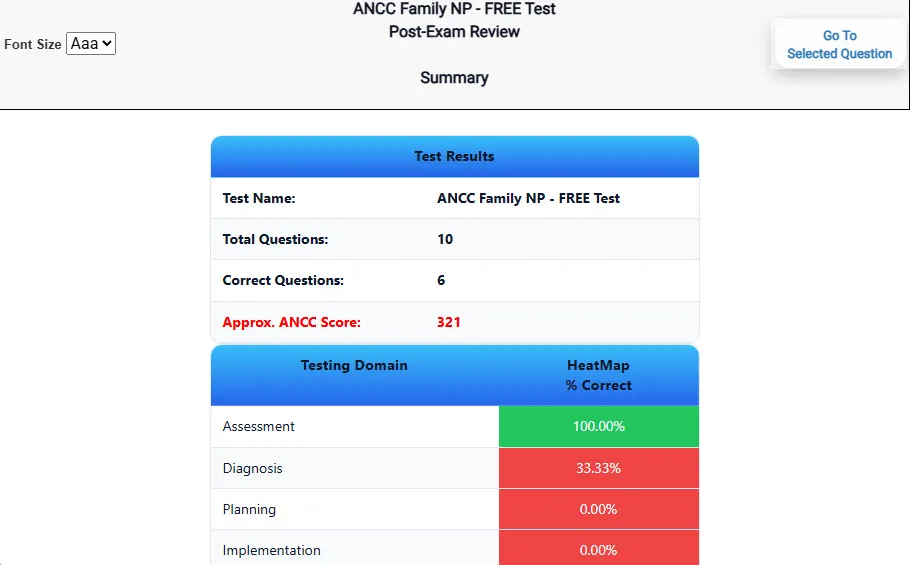
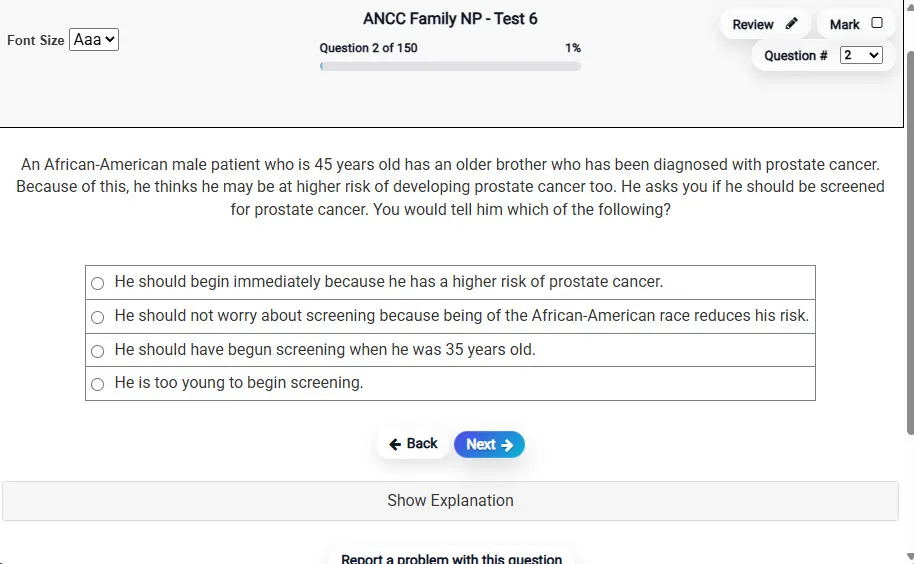
Answering a Question screen – Multiple-choice item view with navigation controls and progress tracker.
Answering a Question Multiple-choice item view with navigation controls and progress tracker.

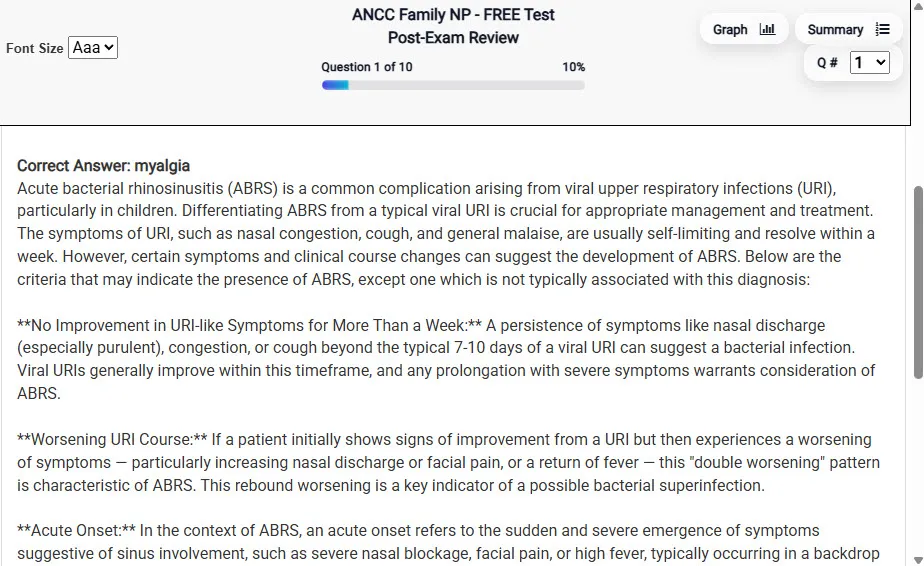
                           Detailed Explanation screen – 
                         Review mode showing chosen answer and rationale and references.
Detailed Explanation Review mode showing chosen answer and rationale and references.

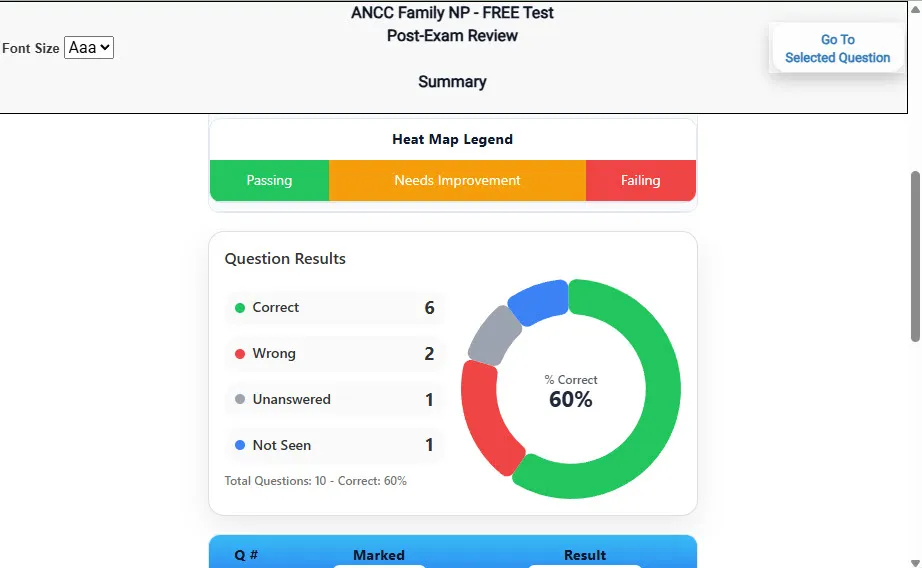
                           Review Summary 1 screen – 
                         Summary with counts for correct/wrong/unanswered and not seen items.
Review Summary 1 Summary with counts for correct/wrong/unanswered and not seen items.

                           Review Summary 2 screen – 
                         Advanced summary with category/domain breakdown and performance insights.
Review Summary 2 Advanced summary with category/domain breakdown and performance insights.

What Each Screen Shows

Answer Question Screen

  • Clean multiple-choice interface with progress bar.
  • Mark for review feature.
  • Matches real test pacing.

Detailed Explanation

  • Correct answer plus rationale.
  • Key concepts and guidelines highlighted.
  • Move between questions to fill knowledge gaps.

Review Summary 1

  • Overall results with total questions and scaled score.
  • Domain heatmap shows strengths and weaknesses.
  • Quick visual feedback on study priorities.

Review Summary 2

  • Chart of correct, wrong, unanswered, not seen.
  • Color-coded results for easy review.
  • Links back to missed items.

Top 10 Reasons to Use Exam Edge for your TExES English Language Arts and Reading 4-8 (217) Exam Prep

  1. Focused on the TExES English Language Arts and Reading 4-8 (217) Exam

    Our practice tests are built specifically for the TExES English Lang Arts and Reading 4-8 (217) exam — every question mirrors the real topics, format, and difficulty so you're studying exactly what matters.

  2. Real Exam Simulation

    We match the per-question time limits and pressure of the actual TExES exam, so test day feels familiar and stress-free.

  3. 15 Full Practice Tests & 1,365 Unique Questions

    You'll have more than enough material to master every TExES English Lang Arts and Reading 4-8 (217) concept — no repeats, no fluff.

  4. Lower Cost Than a Retake

    Ordering 5 practice exams costs less than retaking the TExES English Language Arts and Reading 4-8 (217) exam after a failure. One low fee could save you both time and money.

  5. Flexible Testing

    Need to step away mid-exam? Pick up right where you left off — with your remaining time intact.

  6. Instant Scoring & Feedback

    See your raw score and an estimated TExES English Language Arts and Reading 4-8 (217) score immediately after finishing each practice test.

  7. Detailed Explanations for Every Question

    Review correct and incorrect answers with clear, step-by-step explanations so you truly understand each topic.

  8. Trusted & Accredited

    We're fully accredited by the Better Business Bureau and uphold the highest standards of trust and transparency.

  9. Web-Based & Always Available

    No software to install. Access your TExES English Lang Arts and Reading 4-8 (217) practice exams 24/7 from any computer or mobile device.

  10. Expert Support When You Need It

    Need extra help? Our specialized tutors are highly qualified and ready to support your TExES exam prep.


Pass the TExES English Language Arts and Reading 4-8 (217) Exam with Realistic Practice Tests from Exam Edge

Preparing for your upcoming TExES English Language Arts and Reading 4-8 (217) (217) Certification Exam can feel overwhelming — but the right practice makes all the difference. Exam Edge gives you the tools, structure, and confidence to pass on your first try. Our online practice exams are built to match the real TExES English Lang Arts and Reading 4-8 (217) exam in content, format, and difficulty.

  • 📝 15 TExES English Language Arts and Reading 4-8 (217) Practice Tests: Access 15 full-length exams with 91 questions each, covering every major TExES English Language Arts and Reading 4-8 (217) topic in depth.
  • Instant Online Access: Start practicing right away — no software, no waiting.
  • 🧠 Step-by-Step Explanations: Understand the reasoning behind every correct answer so you can master TExES English Lang Arts and Reading 4-8 (217) exam concepts.
  • 🔄 Retake Each Exam Up to 4 Times: Build knowledge through repetition and track your improvement over time.
  • 🌐 Web-Based & Available 24/7: Study anywhere, anytime, on any device.
  • 🧘 Boost Your Test-Day Confidence: Familiarity with the TExES format reduces anxiety and helps you perform under pressure.

These TExES English Language Arts and Reading 4-8 (217) practice exams are designed to simulate the real testing experience by matching question types, timing, and difficulty level. This approach helps you get comfortable not just with the exam content, but also with the testing environment, so you walk into your exam day focused and confident.


Exam Edge TEXES Reviews


I still can't believe I passed my TEXES exams on my first attempt. I always thought “Practice makes perfect” was a cliche, but after using your product, I now know that “Practice does make perfect.” Unlike several of my classmates, I walked into the tests feeling confident and prepared. Thank you fo ...
Read More
Hal, Huston

These practice tests were the key in my study preparation! I had been studying for months but continued to be on the borderline of passing. After taking a few of these tests I got a better idea of what I needed to learn and I excitedly can say that I just passed the TExES Science 8-12 test with a 90 ...
Read More
Meridith , TX

Thank you for making this program available to those of us who need to brush up on academics of past years. I passed on my first try:) I really appreciate the fact that I was able to retake the tests as many times as necessary. Thanks again for this service.

Angele , Texes

Just wanted to tell you how helpful your site and tests were. I have taught HS English for 16 years and challenged this test to make myself more marketable. I ended up buying three tests, studying all the answer reasons, and using the info to make notes to study. I passed on the first try. Actually, ...
Read More
Wendy, Texes

I am so glad that I found your website. It's been 25 years since I took most of the science courses that I had to review and become familiar with to pass the Texes Science 7-12 and I passed on the first try. I studied like crazy for two months, but your tests really helped to get me familiar with th ...
Read More
Caren, Texas

Just received my test scores. 273/ 300 on my Science Composite (236) exam first attempt. These practice exams were a huge help! 

Michael , Texes


TExES English Language Arts and Reading 4-8 (217) Aliases Test Name

Here is a list of alternative names used for this exam.

  • TExES English Language Arts and Reading 4-8 (217)
  • TExES English Language Arts and Reading 4-8 (217) test
  • TExES English Language Arts and Reading 4-8 (217) Certification Test
  • TExES English Lang Arts and Reading 4-8 (217) test
  • TEXES
  • TEXES 217
  • 217 test
  • TExES English Language Arts and Reading 4-8 (217) (217)
  • TExES English Language Arts and Reading 4-8 (217) certification