This is the content of the pop-over!

TExES Spanish (613) Practice Tests & Test Prep by Exam Edge


TExES Languages Other Than English (LOTE) - Spanish  product image
(4.8)
Based on 28 Reviews

  • Real Exam Simulation: Timed questions and matching content build comfort for your TExES Spanish test day.
  • Instant, 24/7 Access: Web-based TExES Languages Other Than English (LOTE) - Spanish practice exams with no software needed.
  • Clear Explanations: Step-by-step answers and explanations for your TExES exam to strengthen understanding.
  • Boosted Confidence: Reduces anxiety and improves test-taking skills to ace your TExES Languages Other Than English (LOTE) - Spanish (613).

Featured on

TExES Languages Other Than English (LOTE) - Spanish Online Practice Test Bundles

BEST VALUE
15 practice tests

$149.25

$599.25

SAVE $450

Only $9.95 per test!

  • 100% Pass Guarantee
  • 15 online practice tests
  • 120 questions per test
  • Bonus: 100 Flash Cards + Study Guide
  • Instant access
  • Detailed Explanations
  • Practice tests never expire
  • Timed, untimed, or study guide mode
MOST POPULAR
10 practice tests

$99.50

$399.50

SAVE $300

Only $9.95 per test!

  • 10 online practice tests
  • 120 questions per test
  • Bonus: 100 Flash Cards + Study Guide
  • Instant access
  • Detailed Explanations
  • Practice tests never expire
  • Timed, untimed, or study guide mode
5 practice tests

$69.75

$199.75

SAVE $130

Only $13.95 per test!

  • 5 online practice tests
  • 120 questions per test
  • Bonus: 100 Flash Cards
  • Instant access
  • Detailed Explanations
  • Practice tests never expire
  • Timed, untimed, or study guide mode
1 practice test

$39.95

  • 1 online practice test
  • 120 questions per test
  • Instant access
  • Detailed Explanations
  • Practice tests never expire
  • Timed, untimed, or study guide mode
Quick Select
Tap to choose a bundle

** All Prices are in US Dollars (USD) **


TExES Spanish (613) Resources

Jump to the section you need most.

Understanding the exact breakdown of the TExES Languages Other Than English (LOTE) - Spanish test will help you know what to expect and how to most effectively prepare. The TExES Languages Other Than English (LOTE) - Spanish has 120 multiple-choice questions and 5 essay questions. The exam will be broken down into the sections below:

TExES Languages Other Than English (LOTE) - Spanish Exam Blueprint
Domain Name
Instruction and Assessment  
Cultural Understanding  
Interpretive Listening  
Interpretive Reading  
(speaking and writing sections are not covered)  

TExES Languages Other Than English (LOTE) - Spanish Study Tips by Domain

  • Plan instruction around ACTFL-style performance targets (Novice–Advanced) with clear evidence of what students can do; red flag: lessons that only list grammar points without an interpretive/interpersonal/presentational outcome.
  • Use comprehensible input with intentional scaffolds (visuals, cognates, sentence frames) while maintaining Spanish as the main classroom language; common trap: translating everything to English, which reduces students’ need to process Spanish.
  • Design proficiency-aligned assessments that mirror instruction (e.g., interpretive listening/reading tasks with rubrics); priority rule: assess what was practiced in context, not isolated verb charts.
  • Differentiate by adjusting task complexity (text type, speed, supports) rather than changing the language target; red flag: giving struggling students only fill-in-the-blank worksheets while others do meaning-based tasks.
  • Teach form in service of meaning using feedback that targets high-leverage errors that impede comprehension; contraindication: correcting every minor error in early proficiency levels, which can shut down communication.
  • Use data from quick checks (exit tickets, comprehension checks, item analysis) to reteach or extend within 24–48 hours; common trap: recording grades without acting on patterns of misunderstanding.
  • Compare products, practices, and perspectives across Spanish-speaking cultures; red flag: listing “facts” (food, holidays) without explaining the underlying value or worldview.
  • Use culturally appropriate language choices (tú/usted, greetings, leave-takings, and titles) based on relationship and setting; common trap: applying one country’s norms (e.g., universal tuteo) to all contexts.
  • Interpret how geography, history, and migration shape regional variation (accent, vocabulary, traditions); priority rule: treat variation as systematic and meaningful, not “incorrect Spanish.”
  • Analyze cultural norms for time, personal space, and interaction styles; red flag: judging behaviors with a U.S.-centric lens instead of describing them neutrally and contextually.
  • Recognize contributions of diverse communities (Indigenous, Afro-Latino, immigrant, and regional groups) to the Spanish-speaking world; common trap: centering Spain or one Latin American country as the default reference point.
  • Identify stereotypes and overgeneralizations in texts, media, or classroom materials and counter them with specific evidence; threshold cue: if a claim starts with “Los hispanos/los latinos son…” it likely needs qualification and context.
  • Listen first for the communicative purpose (e.g., request, complaint, invitation) before details—common trap: choosing an answer based on a familiar word rather than the speaker’s intent.
  • Use register cues (tú/usted, greetings, titles, verb forms) to infer relationship and setting—red flag: informal vocabulary paired with formal address can signal irony or a different speaker.
  • Track time and sequencing with discourse markers (ayer, antes de, luego, mientras, al final) and verb tenses—trap: mixing up preterite vs. imperfect can flip what actually happened.
  • Infer meaning from context when accents, speed, or unknown words occur—priority rule: keep listening for gist instead of mentally translating every word.
  • Identify who is speaking and why by noting transitions (por cierto, en cambio, o sea) and pronoun reference—red flag: losing the antecedent of lo/la/le often leads to wrong conclusions about the topic.
  • Distinguish main idea from supporting details by listening for emphasis and repetition—common trap: selecting a choice that mentions a specific detail that is true but not the best summary.
  • Prioritize global meaning first (main idea, purpose, audience) before details; red flag: choosing an option that is a true detail but doesn’t answer what the question asks.
  • Use context to resolve false cognates and polysemy (e.g., “actual” = current); common trap: defaulting to English-looking meanings without checking surrounding clues.
  • Track cohesive devices and referents (pronouns, demonstratives, connectors like “sin embargo”, “por lo tanto”); red flag: losing the antecedent and misattributing who did what.
  • Infer meaning of unfamiliar words from morphology and context (prefixes/suffixes, word family, contrast examples); priority rule: eliminate choices that contradict the sentence’s tone or logical relation.
  • Distinguish fact vs. opinion and recognize author stance (evaluative adjectives, hedging like “quizá”, “es posible”); common trap: treating a claim or generalization as a stated fact.
  • Adjust strategy by text type (news, ad, email, literary excerpt) and interpret implied information; red flag: ignoring genre cues and selecting an inference that requires outside knowledge not supported by the text.
  • Focus your study on interpretive skills only—if a prep source emphasizes oral proficiency interview (OPI) tactics or essay structures, it’s off-domain and a time trap.
  • Do not over-prepare for presentational tasks (e.g., persuasive letters, speeches); red flag: prompts requiring you to “argue” or “present” are not part of this domain.
  • Skip speaking-specific strategies like circumlocution drills and conversation fillers; priority rule: allocate that time to comprehension accuracy and evidence-based selection.
  • Avoid writing-mechanics deep dives (accent rules, essay organization) unless they directly support reading comprehension; common trap: spending hours on grammar worksheets unrelated to meaning-making.
  • Be cautious with test simulations that include recorded responses or written submissions; if scoring includes fluency, pronunciation, or composition, it’s not aligned to this exam scope.
  • Use practice that measures understanding, not production—threshold cue: you should be choosing or matching meanings/inferences rather than generating Spanish output beyond single-word recognition.


Built to Fit Into Your Busy Life

Everything you need to prepare with confidence—without wasting a minute.

Three Study Modes

Timed, No Time Limit, or Explanation mode.

Actionable Analytics

Heatmaps and scaled scores highlight weak areas.

High-Yield Rationales

Concise explanations emphasize key concepts.

Realistic Interface

Matches the feel of the actual exam environment.

Accessible by Design

Clean layout reduces cognitive load.

Anytime, Anywhere

Web-based access 24/7 on any device.
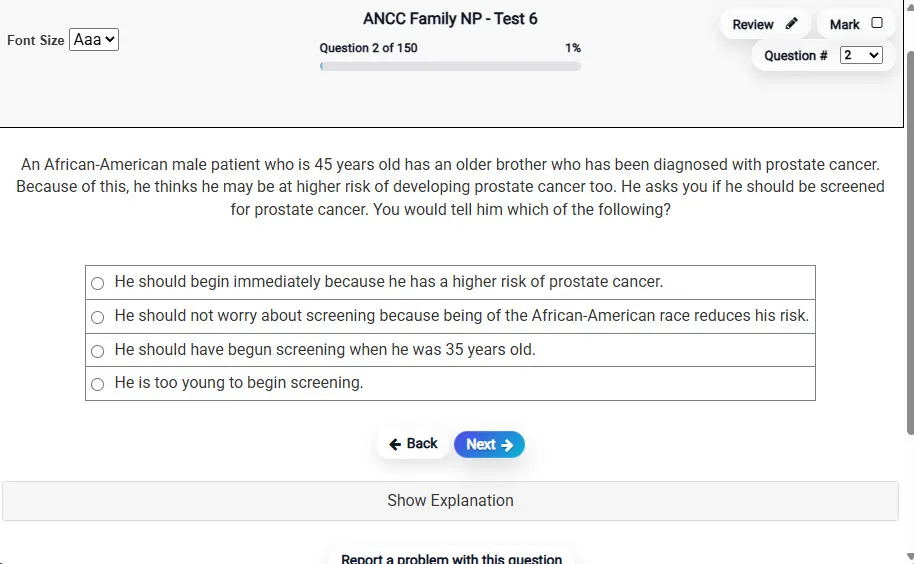
Answering a Question screen – Multiple-choice item view with navigation controls and progress tracker.
Answering a Question Multiple-choice item view with navigation controls and progress tracker.

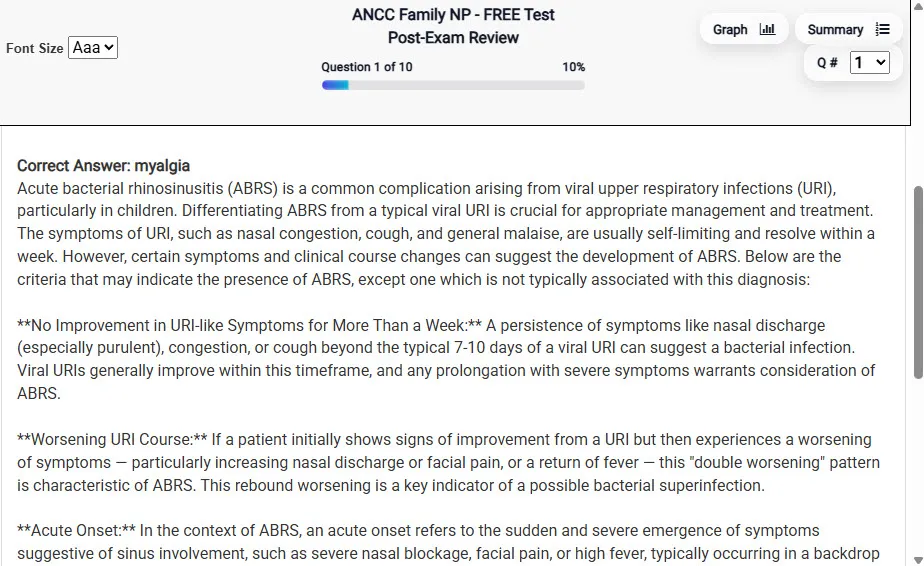
                           Detailed Explanation screen – 
                         Review mode showing chosen answer and rationale and references.
Detailed Explanation Review mode showing chosen answer and rationale and references.

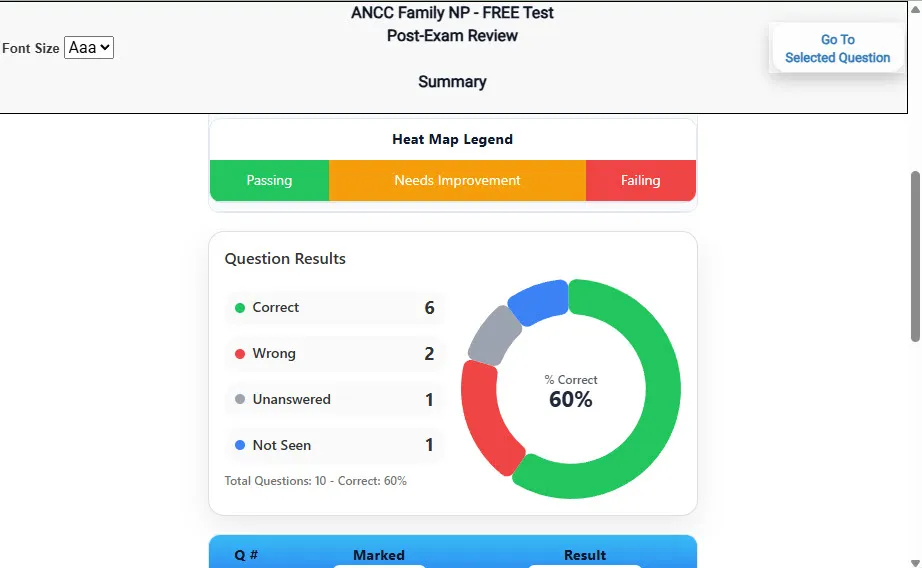
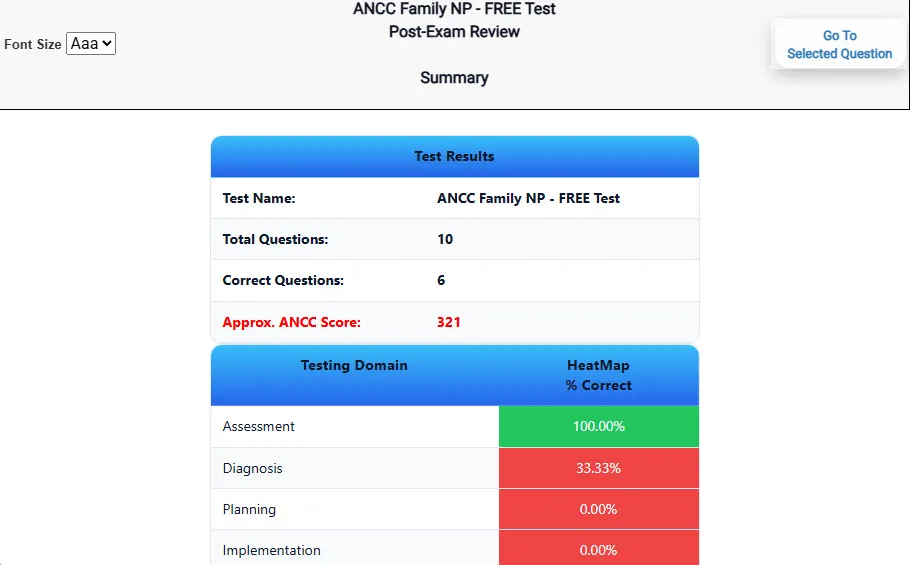
                           Review Summary 1 screen – 
                         Summary with counts for correct/wrong/unanswered and not seen items.
Review Summary 1 Summary with counts for correct/wrong/unanswered and not seen items.

                           Review Summary 2 screen – 
                         Advanced summary with category/domain breakdown and performance insights.
Review Summary 2 Advanced summary with category/domain breakdown and performance insights.

What Each Screen Shows

Answer Question Screen

  • Clean multiple-choice interface with progress bar.
  • Mark for review feature.
  • Matches real test pacing.

Detailed Explanation

  • Correct answer plus rationale.
  • Key concepts and guidelines highlighted.
  • Move between questions to fill knowledge gaps.

Review Summary 1

  • Overall results with total questions and scaled score.
  • Domain heatmap shows strengths and weaknesses.
  • Quick visual feedback on study priorities.

Review Summary 2

  • Chart of correct, wrong, unanswered, not seen.
  • Color-coded results for easy review.
  • Links back to missed items.

Top 10 Reasons to Use Exam Edge for your TExES Languages Other Than English (LOTE) - Spanish Exam Prep

  1. Focused on the TExES Languages Other Than English (LOTE) - Spanish Exam

    Our practice tests are built specifically for the TExES Spanish exam — every question mirrors the real topics, format, and difficulty so you're studying exactly what matters.

  2. Real Exam Simulation

    We match the per-question time limits and pressure of the actual TExES exam, so test day feels familiar and stress-free.

  3. 15 Full Practice Tests & 1,800 Unique Questions

    You'll have more than enough material to master every TExES Spanish concept — no repeats, no fluff.

  4. Lower Cost Than a Retake

    Ordering 5 practice exams costs less than retaking the TExES Languages Other Than English (LOTE) - Spanish exam after a failure. One low fee could save you both time and money.

  5. Flexible Testing

    Need to step away mid-exam? Pick up right where you left off — with your remaining time intact.

  6. Instant Scoring & Feedback

    See your raw score and an estimated TExES Languages Other Than English (LOTE) - Spanish score immediately after finishing each practice test.

  7. Detailed Explanations for Every Question

    Review correct and incorrect answers with clear, step-by-step explanations so you truly understand each topic.

  8. Trusted & Accredited

    We're fully accredited by the Better Business Bureau and uphold the highest standards of trust and transparency.

  9. Web-Based & Always Available

    No software to install. Access your TExES Spanish practice exams 24/7 from any computer or mobile device.

  10. Expert Support When You Need It

    Need extra help? Our specialized tutors are highly qualified and ready to support your TExES exam prep.


Pass the TExES Languages Other Than English (LOTE) - Spanish Exam with Realistic Practice Tests from Exam Edge

Preparing for your upcoming TExES Languages Other Than English (LOTE) - Spanish (613) Certification Exam can feel overwhelming — but the right practice makes all the difference. Exam Edge gives you the tools, structure, and confidence to pass on your first try. Our online practice exams are built to match the real TExES Spanish exam in content, format, and difficulty.

  • 📝 15 TExES Languages Other Than English (LOTE) - Spanish Practice Tests: Access 15 full-length exams with 120 questions each, covering every major TExES Languages Other Than English (LOTE) - Spanish topic in depth.
  • Instant Online Access: Start practicing right away — no software, no waiting.
  • 🧠 Step-by-Step Explanations: Understand the reasoning behind every correct answer so you can master TExES Spanish exam concepts.
  • 🔄 Retake Each Exam Up to 4 Times: Build knowledge through repetition and track your improvement over time.
  • 🌐 Web-Based & Available 24/7: Study anywhere, anytime, on any device.
  • 🧘 Boost Your Test-Day Confidence: Familiarity with the TExES format reduces anxiety and helps you perform under pressure.

These TExES Languages Other Than English (LOTE) - Spanish practice exams are designed to simulate the real testing experience by matching question types, timing, and difficulty level. This approach helps you get comfortable not just with the exam content, but also with the testing environment, so you walk into your exam day focused and confident.

Exam Edge TEXES Reviews


Thank you for making this program available to those of us who need to brush up on academics of past years. I passed on my first try:) I really appreciate the fact that I was able to retake the tests as many times as necessary. Thanks again for this service.

Angele , Texes

Great exam site that helped me pass my tests.

June , Murphy, Texas

Dear Exam Edge, I passed my exam on the first attempt with a score of 271/300 (exactly what the practice tests showed). Your practice tests were excellent and very representative of the exam. They helped my preparation and focus my study. Without question of all the test aids yours was head and shou ...
Read More
Donald , Beaumont Texas

Just wanted to say thanks for your helpful product. I purchased and took 5 practice exams to help prepare for the TEXES Math 7-12 235 exam, and am happy to say I passed the certification exam last week on the first try. Practice with your tests definitely was a big factor in preparing successfully. ...
Read More
Mobi , Dallas

I just passed my TEXES Math 4-8 certification and I want to thank you for the quality of your practice tests that was a key to my preparation. Your tests were very rigorous, even a little beyond and above the level of the test I would say, but definitely it was better to be over prepared than have t ...
Read More
Miguel , Huston

Some of the questions did not go along with the grade levels of the exam. For example, the exams were supposed to be Social Studies 4-8, and multiple questions asked about grades specifically outside of that range. The questions were also very very detailed, to where none of the study material I h ...
Read More
Jennifer , DeKalb, Illinois


TExES Languages Other Than English (LOTE) - Spanish Aliases Test Name

Here is a list of alternative names used for this exam.

  • TExES Languages Other Than English (LOTE) - Spanish
  • TExES Languages Other Than English (LOTE) - Spanish test
  • TExES Languages Other Than English (LOTE) - Spanish Certification Test
  • TExES Spanish test
  • TEXES
  • TEXES 613
  • 613 test
  • TExES Languages Other Than English (LOTE) - Spanish (613)
  • TExES Languages Other Than English (LOTE) - Spanish certification