This is the content of the pop-over!

TExES Science 7-12 (236) Practice Tests & Test Prep by Exam Edge


TExES Science 7-12  product image
(4.8)
Based on 28 Reviews

  • Real Exam Simulation: Timed questions and matching content build comfort for your TExES Science 7-12 test day.
  • Instant, 24/7 Access: Web-based TExES Science 7-12 practice exams with no software needed.
  • Clear Explanations: Step-by-step answers and explanations for your TExES exam to strengthen understanding.
  • Boosted Confidence: Reduces anxiety and improves test-taking skills to ace your TExES Science 7-12 (236).

Featured on

TExES Science 7-12 Online Practice Test Bundles

BEST VALUE
25 practice tests

$218.75

$998.75

SAVE $780

Only $8.75 per test!

  • 100% Pass Guarantee
  • 25 online practice tests
  • 140 questions per test
  • Bonus: 100 Flash Cards + Study Guide
  • Instant access
  • Detailed Explanations
  • Practice tests never expire
  • Timed, untimed, or study guide mode
MOST POPULAR
10 practice tests

$99.50

$399.50

SAVE $300

Only $9.95 per test!

  • 10 online practice tests
  • 140 questions per test
  • Bonus: 100 Flash Cards + Study Guide
  • Instant access
  • Detailed Explanations
  • Practice tests never expire
  • Timed, untimed, or study guide mode
5 practice tests

$69.75

$199.75

SAVE $130

Only $13.95 per test!

  • 5 online practice tests
  • 140 questions per test
  • Bonus: 100 Flash Cards
  • Instant access
  • Detailed Explanations
  • Practice tests never expire
  • Timed, untimed, or study guide mode
1 practice test

$39.95

  • 1 online practice test
  • 140 questions per test
  • Instant access
  • Detailed Explanations
  • Practice tests never expire
  • Timed, untimed, or study guide mode
Quick Select
Tap to choose a bundle

** All Prices are in US Dollars (USD) **


TExES Science 7-12 (236) Resources

Jump to the section you need most.

Understanding the exact breakdown of the TExES Science 7-12 test will help you know what to expect and how to most effectively prepare. The TExES Science 7-12 has 140 multiple-choice questions . The exam will be broken down into the sections below:

TExES Science 7-12 Exam Blueprint
Domain Name % Number of
Questions
Scientific Inquiry and Processes 10% 14
Physics 20% 28
Chemistry 20% 28
Cell Structure and Processes 8% 11
Heredity and Evolution of Life 8% 11
Diversity of Life 8% 11
Interdependence of Life and Environmental Systems 6% 8
Earth's History and the Structure and Function of Earth Systems 9% 13
Components and Properties of the Solar System and the Universe 6% 8
Science Learning - Instruction Assessment 5% 7

TExES Science 7-12 Study Tips by Domain

  • Distinguish observation vs. inference and hypothesis vs. theory—red flag: statements that smuggle explanations into “data” (e.g., calling an observation a “cause”).
  • Identify independent, dependent, and controlled variables and the role of a control group—common trap: changing more than one variable or using “control” to mean “constant.”
  • Evaluate experimental design for validity, reliability, and bias—priority rule: adequate sample size, repeated trials, and random assignment/selection when possible reduce error and confounds.
  • Interpret data representations (tables, graphs, units, significant figures) and distinguish correlation from causation—red flag: extrapolating beyond the data range or ignoring measurement uncertainty/error bars.
  • Apply basic statistics and error concepts (mean/median, range, percent error, precision vs. accuracy)—common trap: “precise” measurements can still be inaccurate if a systematic error is present.
  • Use scientific reasoning and communication: claims supported by evidence and logical justification, with appropriate safety/ethics—contraindication: conclusions that contradict the data or ignore anomalous results without explanation.
  • Apply Newton’s laws with correct free-body diagrams—red flag: treating action–reaction forces as acting on the same object or forgetting components on an incline.
  • Use conservation of energy and work–energy to relate forces, distance, and speed—common trap: assuming mechanical energy is conserved when friction or air resistance does nonconservative work.
  • Analyze momentum and impulse in collisions—priority rule: momentum is conserved only for an isolated system; red flag: confusing conservation of momentum with conservation of kinetic energy (elastic vs. inelastic).
  • Master wave behaviors (reflection, refraction, diffraction, interference) and key relationships—threshold cue: wave speed is set by the medium, so changing frequency changes wavelength, not speed.
  • Handle electricity and magnetism with circuit laws and field concepts—common trap: series vs. parallel rules (series: same current; parallel: same voltage) and mixing up conventional current direction with electron flow.
  • Connect thermal physics and gas laws to particle models—red flag: using Celsius in gas-law calculations; use Kelvin for PV = nRT and interpret temperature as proportional to average kinetic energy.
  • Balance chemical equations by conserving atoms (and charge for ionic/net ionic equations)—red flag: changing subscripts instead of using coefficients.
  • Use mole relationships (molar mass, Avogadro’s number, and limiting reactant logic)—common trap: using the excess reactant or forgetting to identify the limiting reactant before computing yield.
  • Classify bonding and intermolecular forces to predict properties (e.g., ionic vs. covalent, H-bonding, polarity)—priority rule: molecular shape (VSEPR) determines polarity, not just electronegativity differences.
  • Apply gas laws and stoichiometry (PV=nRT, Dalton’s law, partial pressures)—threshold cue: use Kelvin for temperature or the relationship fails.
  • Interpret reaction types and energetics (acid-base, redox, precipitation, exo/endo; enthalpy from bond energies)—common trap: oxidation number errors (O is usually −2, H usually +1) and confusing heat released vs. absorbed.
  • Analyze solutions and equilibrium ideas (concentration, solubility, pH/pOH, Le Châtelier)—red flag: mixing up strong vs. weak acids/bases (strength is dissociation, not concentration) and forgetting pH+pOH=14 at 25°C.
  • Differentiate prokaryotic vs. eukaryotic cells using “no nucleus/no membrane-bound organelles” as a priority rule; red flag: calling ribosomes or a plasma membrane “organelles” that make a cell eukaryotic.
  • Link organelles to function (e.g., rough ER → proteins for export/membranes, Golgi → modify/package, mitochondria/chloroplast → ATP capture); common trap: saying chloroplasts “make energy” rather than converting light energy to chemical energy stored in sugars.
  • Compare transport mechanisms with a threshold cue: passive transport follows the concentration gradient and needs no ATP, while active transport moves against the gradient and uses ATP; red flag: treating osmosis as movement of solute instead of water across a selectively permeable membrane.
  • Connect enzymes to homeostasis with the cue “optimal pH/temperature”; common trap: claiming enzymes are used up in reactions or that increasing temperature always increases reaction rate without denaturation risk.
  • Relate cellular respiration and photosynthesis by tracking matter and energy (glucose/CO2/O2) as a balancing check; red flag: stating respiration occurs only in animals or that photosynthesis’s main product is “energy” rather than glucose.
  • Use cell cycle checkpoints as the priority rule for growth/repair vs. cancer risk; common trap: mixing up mitosis (somatic, identical diploid cells) with meiosis (gametes, haploid, increases genetic variation via crossing over/independent assortment).
  • Track allele frequencies with Hardy–Weinberg (p + q = 1; p2 + 2pq + q2 = 1) and treat any violated assumption (small population, migration, mutation, nonrandom mating, selection) as a red flag that evolution is occurring.
  • Link meiosis to genetic variation—crossing over and independent assortment increase diversity; a common trap is confusing homologous chromosome separation in meiosis I with sister chromatid separation in meiosis II.
  • Predict inheritance patterns (autosomal vs sex-linked; dominant vs recessive) using pedigrees, and use the cue that X-linked recessive traits often appear more in males and skip generations.
  • Use central dogma mechanics to explain mutations (DNA → RNA → protein) and note the practical cue that frameshift mutations (insertions/deletions not in multiples of 3) are typically more disruptive than point substitutions.
  • Interpret evidence for evolution (fossils, homologous structures, embryology, molecular data) and treat “individual organisms evolve” as a misconception—populations evolve via changes in allele frequencies over generations.
  • Distinguish mechanisms of evolution—natural selection, genetic drift (bottleneck/founder effects), and gene flow—and use the priority rule that drift dominates in small populations while selection is tied to differential reproductive success (fitness), not physical strength.
  • Classify organisms using domain/kingdom and hierarchical ranks; a common trap is confusing prokaryotes (Bacteria/Archaea, no nucleus) with eukaryotes (Eukarya, nucleus).
  • Distinguish major animal phyla and key traits (symmetry, body cavity, segmentation); red flag: mixing up protostome vs deuterostome development (blastopore becomes mouth vs anus).
  • Compare plant groups by vascular tissue, seeds, and flowers (bryophytes, ferns, gymnosperms, angiosperms); priority rule: “flowers/fruits” indicates angiosperm, not gymnosperm.
  • Differentiate fungi, plants, and animals by nutrition and cell walls; common trap: calling fungi “plants”—fungi are heterotrophs with chitin cell walls and absorb nutrients.
  • Use diagnostic features of protists (autotroph/heterotroph, unicellular/multicellular, motility structures); red flag: assuming all protists are single-celled or all are harmless.
  • Interpret and build simple cladograms using shared derived characteristics (synapomorphies); common trap: ranking by overall similarity rather than identifying the most recent common ancestor.
  • Track energy flow with the 10% rule between trophic levels; red flag: claiming energy “cycles” like matter instead of flowing and being lost as heat.
  • Model matter cycling (carbon, nitrogen, water) through reservoirs and processes (e.g., fixation, nitrification, denitrification); common trap: mixing up nitrogen fixation (N2 → NH3) with assimilation (uptake into biomass).
  • Predict population changes using limiting factors and carrying capacity (K); priority cue: density-dependent controls (disease, competition) typically intensify as population size rises.
  • Interpret community dynamics (succession, disturbance, keystone species) using cause-and-effect; red flag: assuming succession is always linear toward a single “climax” endpoint regardless of disturbance regime.
  • Evaluate human impacts (eutrophication, habitat fragmentation, invasive species, biomagnification) with a specific mechanism; common trap: confusing bioaccumulation within one organism with biomagnification across trophic levels.
  • Use abiotic drivers (temperature, salinity, pH, dissolved oxygen, light) to predict ecosystem distribution and productivity; threshold cue: hypoxia risk rises when warm water and nutrient loading reduce dissolved O2.
  • Use relative dating rules consistently: superposition, original horizontality, cross-cutting relationships, and inclusions—red flag: calling an intrusion older than the rocks it cuts.
  • Connect absolute dating to half-life and isotopes (e.g., U-Pb for very old rocks, C-14 for recent organics)—common trap: using carbon-14 to date igneous rocks or anything beyond its effective range (~50,000 years).
  • Explain plate tectonics evidence (seafloor spreading, paleomagnetism stripes, earthquake/volcano belts) and boundary types—priority rule: convergent boundaries produce the deepest earthquakes and major mountain building.
  • Relate Earth’s internal structure to physical behavior: lithosphere/asthenosphere vs. crust/mantle/core—red flag: mixing compositional layers (crust/mantle/core) with mechanical layers (lithosphere/asthenosphere).
  • Describe the rock cycle pathways and what drives them (heat, pressure, uplift, weathering/erosion)—common trap: assuming metamorphic rocks form only from sedimentary rocks rather than any preexisting rock type.
  • Link atmosphere-hydrosphere-geosphere-biosphere interactions to major cycles (water, carbon) and climate feedbacks—red flag: treating greenhouse effect as ozone depletion or ignoring that water vapor is a major greenhouse gas.
  • Use Kepler’s laws to compare planetary motion—eccentric orbits sweep equal areas in equal times, so planets move fastest at perihelion (common trap: assuming constant orbital speed).
  • Apply Newton’s law of gravitation and orbital mechanics: increasing orbital radius increases period and decreases orbital speed; weight changes with distance but mass does not (red flag: confusing mass vs. weight).
  • Interpret electromagnetic spectra for astronomical evidence—absorption/emission lines identify composition and temperature; Doppler shifts indicate radial motion (priority rule: redshift = moving away).
  • Use the H–R diagram and stellar evolution: main-sequence position relates to mass and luminosity; massive stars live shorter and can end as supernovae (common trap: thinking bigger stars live longer).
  • Differentiate solar system components by formation and properties: terrestrial vs. Jovian planets, Kuiper Belt vs. Oort Cloud, asteroids vs. comets (red flag: mixing up Kuiper Belt with Oort Cloud locations).
  • Apply cosmology evidence appropriately: Hubble’s law links greater distance with higher recessional velocity and supports an expanding universe (common trap: treating “Big Bang” as an explosion into existing space rather than expansion of space).
  • Align lessons to TEKS and clearly stated, measurable objectives; red flag: activities that are “hands-on” but not tied to a specific content expectation or skill.
  • Use the 5E model strategically (Engage/Explore before Explain) to surface misconceptions; common trap: lecturing first and calling it inquiry afterward.
  • Plan safety and legal compliance for labs (SDS access, PPE, supervision, proper disposal) with explicit student training; priority rule: stop the lab if safety procedures are not being followed.
  • Differentiation should match need (ELL supports, IEP/504 accommodations, extension for advanced learners) while keeping rigor constant; red flag: “accommodation” that changes what is being assessed rather than how students access it.
  • Use formative assessment cycles (probe → evidence → feedback → adjust instruction) with specific criteria; common trap: using grades as feedback instead of actionable comments tied to a rubric.
  • Design valid, reliable assessments with aligned items (e.g., CER for explanations, data/graph interpretation, lab reports) and balanced cognitive demand; red flag: tests that overemphasize vocabulary recall when objectives require analysis or application.


Built to Fit Into Your Busy Life

Everything you need to prepare with confidence—without wasting a minute.

Three Study Modes

Timed, No Time Limit, or Explanation mode.

Actionable Analytics

Heatmaps and scaled scores highlight weak areas.

High-Yield Rationales

Concise explanations emphasize key concepts.

Realistic Interface

Matches the feel of the actual exam environment.

Accessible by Design

Clean layout reduces cognitive load.

Anytime, Anywhere

Web-based access 24/7 on any device.
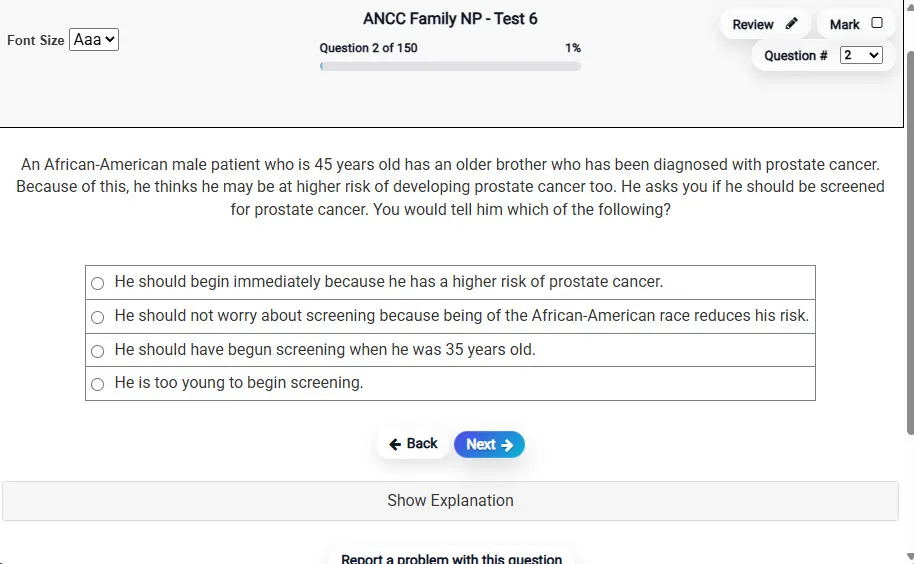
Answering a Question screen – Multiple-choice item view with navigation controls and progress tracker.
Answering a Question Multiple-choice item view with navigation controls and progress tracker.

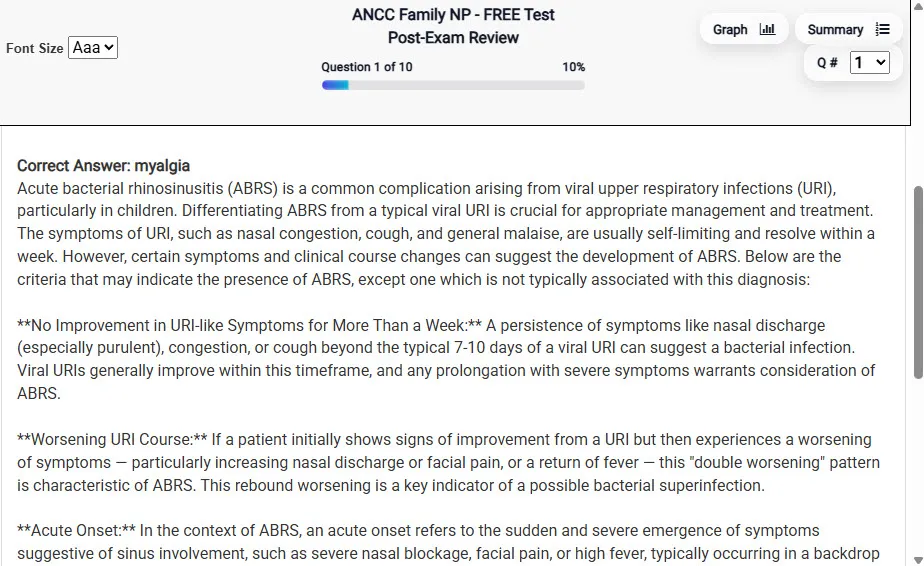
                           Detailed Explanation screen – 
                         Review mode showing chosen answer and rationale and references.
Detailed Explanation Review mode showing chosen answer and rationale and references.

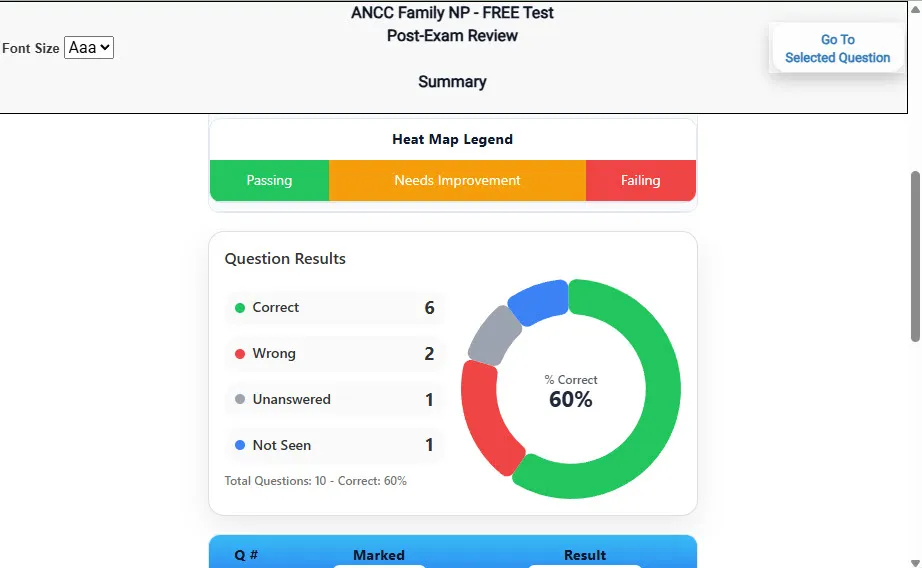
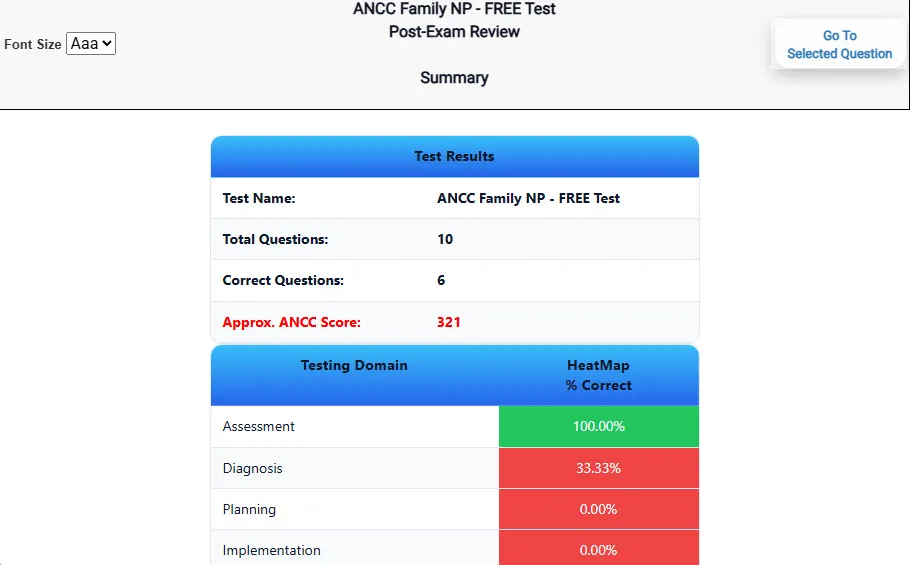
                           Review Summary 1 screen – 
                         Summary with counts for correct/wrong/unanswered and not seen items.
Review Summary 1 Summary with counts for correct/wrong/unanswered and not seen items.

                           Review Summary 2 screen – 
                         Advanced summary with category/domain breakdown and performance insights.
Review Summary 2 Advanced summary with category/domain breakdown and performance insights.

What Each Screen Shows

Answer Question Screen

  • Clean multiple-choice interface with progress bar.
  • Mark for review feature.
  • Matches real test pacing.

Detailed Explanation

  • Correct answer plus rationale.
  • Key concepts and guidelines highlighted.
  • Move between questions to fill knowledge gaps.

Review Summary 1

  • Overall results with total questions and scaled score.
  • Domain heatmap shows strengths and weaknesses.
  • Quick visual feedback on study priorities.

Review Summary 2

  • Chart of correct, wrong, unanswered, not seen.
  • Color-coded results for easy review.
  • Links back to missed items.

Top 10 Reasons to Use Exam Edge for your TExES Science 7-12 Exam Prep

  1. Focused on the TExES Science 7-12 Exam

    Our practice tests are built specifically for the TExES Science 7-12 exam — every question mirrors the real topics, format, and difficulty so you're studying exactly what matters.

  2. Real Exam Simulation

    We match the per-question time limits and pressure of the actual TExES exam, so test day feels familiar and stress-free.

  3. 25 Full Practice Tests & 3,500 Unique Questions

    You'll have more than enough material to master every TExES Science 7-12 concept — no repeats, no fluff.

  4. Lower Cost Than a Retake

    Ordering 5 practice exams costs less than retaking the TExES Science 7-12 exam after a failure. One low fee could save you both time and money.

  5. Flexible Testing

    Need to step away mid-exam? Pick up right where you left off — with your remaining time intact.

  6. Instant Scoring & Feedback

    See your raw score and an estimated TExES Science 7-12 score immediately after finishing each practice test.

  7. Detailed Explanations for Every Question

    Review correct and incorrect answers with clear, step-by-step explanations so you truly understand each topic.

  8. Trusted & Accredited

    We're fully accredited by the Better Business Bureau and uphold the highest standards of trust and transparency.

  9. Web-Based & Always Available

    No software to install. Access your TExES Science 7-12 practice exams 24/7 from any computer or mobile device.

  10. Expert Support When You Need It

    Need extra help? Our specialized tutors are highly qualified and ready to support your TExES exam prep.


Pass the TExES Science 7-12 Exam with Realistic Practice Tests from Exam Edge

Preparing for your upcoming TExES Science 7-12 (236) Certification Exam can feel overwhelming — but the right practice makes all the difference. Exam Edge gives you the tools, structure, and confidence to pass on your first try. Our online practice exams are built to match the real TExES Science 7-12 exam in content, format, and difficulty.

  • 📝 25 TExES Science 7-12 Practice Tests: Access 25 full-length exams with 140 questions each, covering every major TExES Science 7-12 topic in depth.
  • Instant Online Access: Start practicing right away — no software, no waiting.
  • 🧠 Step-by-Step Explanations: Understand the reasoning behind every correct answer so you can master TExES Science 7-12 exam concepts.
  • 🔄 Retake Each Exam Up to 4 Times: Build knowledge through repetition and track your improvement over time.
  • 🌐 Web-Based & Available 24/7: Study anywhere, anytime, on any device.
  • 🧘 Boost Your Test-Day Confidence: Familiarity with the TExES format reduces anxiety and helps you perform under pressure.

These TExES Science 7-12 practice exams are designed to simulate the real testing experience by matching question types, timing, and difficulty level. This approach helps you get comfortable not just with the exam content, but also with the testing environment, so you walk into your exam day focused and confident.


Exam Edge TEXES Reviews


These practice tests were the key in my study preparation! I had been studying for months but continued to be on the borderline of passing. After taking a few of these tests I got a better idea of what I needed to learn and I excitedly can say that I just passed the TExES Science 8-12 test with a 90 ...
Read More
Meridith , TX

I am so glad that I found your website. It's been 25 years since I took most of the science courses that I had to review and become familiar with to pass the Texes Science 7-12 and I passed on the first try. I studied like crazy for two months, but your tests really helped to get me familiar with th ...
Read More
Caren, Texas

I purchased 10 tests to prepare for the TEXES Science 7-12 certification exam. I had earned a science education degree in 1997, but worked in law enforcement for 20 years. Your exams were an excellent source for study prep. On the first few tests, I scored in the high 230's. Using the results to gui ...
Read More
Jeffery, Arlington, TX

Just received my test scores. 273/ 300 on my Science Composite (236) exam first attempt. These practice exams were a huge help! 

Michael , Texes

Helped me to pass my test

Jordan , Bedford, Texas

I just wanted to praise this company for creating helpful practice tests. The first time I took the librarian certification test I scored a 233 and you have to have a 240 to pass. I was so sad and discouraged. I had hoped my college courses would have prepared me for the test. I didn't know what ...
Read More
Jennifer , Dallas


TExES Science 7-12 Aliases Test Name

Here is a list of alternative names used for this exam.

  • TExES Science 7-12
  • TExES Science 7-12 test
  • TExES Science 7-12 Certification Test
  • TEXES
  • TEXES 236
  • 236 test
  • TExES Science 7-12 (236)
  • TExES Science 7-12 certification