This is the content of the pop-over!

TExES Reading Specialist (151) Practice Tests & Test Prep by Exam Edge


TExES Reading Specialist  product image
(4.8)
Based on 28 Reviews

  • Real Exam Simulation: Timed questions and matching content build comfort for your TExES Reading Specialist test day.
  • Instant, 24/7 Access: Web-based TExES Reading Specialist practice exams with no software needed.
  • Clear Explanations: Step-by-step answers and explanations for your TExES exam to strengthen understanding.
  • Boosted Confidence: Reduces anxiety and improves test-taking skills to ace your TExES Reading Specialist (151).

Featured on

TExES Reading Specialist Online Practice Test Bundles

BEST VALUE
20 practice tests

$174.00

$799.00

SAVE $625

Only $8.70 per test!

  • 100% Pass Guarantee
  • 20 online practice tests
  • 100 questions per test
  • Bonus: 100 Flash Cards + Study Guide
  • Instant access
  • Detailed Explanations
  • Practice tests never expire
  • Timed, untimed, or study guide mode
MOST POPULAR
10 practice tests

$99.50

$399.50

SAVE $300

Only $9.95 per test!

  • 10 online practice tests
  • 100 questions per test
  • Bonus: 100 Flash Cards + Study Guide
  • Instant access
  • Detailed Explanations
  • Practice tests never expire
  • Timed, untimed, or study guide mode
5 practice tests

$69.75

$199.75

SAVE $130

Only $13.95 per test!

  • 5 online practice tests
  • 100 questions per test
  • Bonus: 100 Flash Cards
  • Instant access
  • Detailed Explanations
  • Practice tests never expire
  • Timed, untimed, or study guide mode
1 practice test

$39.95

  • 1 online practice test
  • 100 questions per test
  • Instant access
  • Detailed Explanations
  • Practice tests never expire
  • Timed, untimed, or study guide mode
Quick Select
Tap to choose a bundle

** All Prices are in US Dollars (USD) **


TExES Reading Specialist (151) Resources

Jump to the section you need most.

Understanding the exact breakdown of the TExES Reading Specialist test will help you know what to expect and how to most effectively prepare. The TExES Reading Specialist has 100 multiple-choice questions . The exam will be broken down into the sections below:

TExES Reading Specialist Exam Blueprint
Domain Name % Number of
Questions
Instruction and Assessment: Components of Literacy 57% 58
Instruction and Assessment: Resources and Procedures 14% 14
Meeting the Needs of Individual Students 14% 14
Professional Knowledge and Leadership 14% 14

TExES Reading Specialist Study Tips by Domain

  • Plan explicit, systematic phonological awareness and phonics instruction that progresses from sound manipulation to decoding/encoding; red flag: students who can “sound out” but can’t read connected text fluently need work beyond phonics drills.
  • Teach morphology (roots, prefixes, suffixes) and orthographic patterns to build word recognition and spelling; common trap: focusing only on syllable types without connecting to meaning-based morphemes in grades 3+.
  • Build fluency through accurate decoding plus prosody and rate with repeated reading using appropriately leveled text; priority rule: measure words-correct-per-minute only after accuracy is at least 95% on the passage.
  • Develop vocabulary with both breadth and depth (multiple meanings, relationships, academic language) using direct instruction and wide reading; red flag: relying on copying definitions instead of requiring students to use words in context.
  • Strengthen comprehension by teaching text structures, inference, monitoring, and evidence-based responses across narrative and informational texts; common trap: treating “strategy instruction” as worksheets rather than modeling, guided practice, and gradual release.
  • Integrate writing, spelling, and oral language to reinforce reading (e.g., sentence combining, summarizing, note-taking) with clear language objectives; contraindication: asking for extended written responses when transcription (handwriting/spelling) is the main barrier without accommodations.
  • Select and evaluate literacy resources (core, supplemental, digital) by checking alignment to TEKS/ELPS and evidence of effectiveness; red flag: adopting materials based on popularity without screening for research base and cultural/linguistic responsiveness.
  • Use a structured assessment system (universal screening, diagnostics, progress monitoring, outcome) with clear decision rules; common trap: using a single benchmark score to place students without confirming with diagnostic data.
  • Plan data-driven instruction by linking specific skill deficits (e.g., phonemic awareness vs. decoding vs. language comprehension) to targeted routines; priority rule: address foundational skills first when they are below grade-level expectations.
  • Implement progress monitoring with appropriate measures and frequency (more often for higher-risk students) and adjust instruction when growth is inadequate; red flag: changing programs too quickly without enough data points to show a trend.
  • Ensure assessment and intervention procedures meet accommodations and accessibility requirements for multilingual learners and students with disabilities; common trap: providing an accommodation that changes the construct being measured (e.g., reading a decoding test aloud).
  • Coordinate literacy procedures across tiers (MTSS/RTI) with documentation of interventions, fidelity, and family communication; red flag: missing fidelity checks, making it impossible to interpret whether lack of progress is due to the student or inconsistent implementation.
  • Use multiple data points (universal screeners, diagnostics, progress monitoring, classroom work) to identify a student’s specific skill deficit; red flag: placing a student in intervention based on a single score or an overall reading level only.
  • Match intervention to the need (e.g., phonemic awareness/phonics for decoding, morphology/vocabulary for word meaning, syntax/background knowledge for comprehension) and set a measurable goal; common trap: choosing a packaged program without verifying it targets the diagnosed component.
  • Plan intensification intentionally (increase time, reduce group size, raise explicitness and opportunities to respond) when growth is inadequate; threshold cue: if progress-monitoring trend is flat across several data points, adjust rather than “wait and see.”
  • Differentiate for multilingual learners with language objectives and scaffolded access to complex text while maintaining grade-level expectations; red flag: mistaking limited English proficiency for a decoding disability without appropriate assessment in the student’s language profile.
  • Address factors that interfere with reading (attention, behavior, vision/hearing, attendance, trauma) through coordinated supports; priority rule: remove access barriers first (e.g., provide audio support/assistive tech) while continuing explicit literacy instruction.
  • Use collaborative problem-solving with families and campus teams (MTSS/RTI, special education, 504, dyslexia services) and document interventions with fidelity; common trap: referring for evaluation without evidence of matched instruction and monitored response.
  • Use the Texas Essential Knowledge and Skills (TEKS) and state assessment data to set measurable literacy goals; red flag: interventions that aren’t tied to a documented need (e.g., no baseline or progress data).
  • Maintain confidentiality and ethical practice when handling student records and assessment results (e.g., FERPA expectations); common trap: discussing identifiable student data in public spaces or unsecured digital tools.
  • Lead campus literacy improvement by aligning core instruction, intervention, and assessment schedules; priority rule: protect Tier 1 instructional time before adding pull-outs or test-prep blocks.
  • Coach teachers using evidence-based feedback cycles (observe → model → co-teach → reflect) grounded in student work and observation data; red flag: advice based on preference rather than observable behaviors and outcomes.
  • Facilitate collaboration with families and multidisciplinary teams (e.g., MTSS/RTI, special education, dyslexia services, bilingual/ESL) to coordinate supports; common trap: starting formal referrals without documented, high-fidelity interventions and progress monitoring.
  • Evaluate and select literacy programs and materials using research evidence, cultural/linguistic responsiveness, and fidelity requirements; contraindication: adopting a “one-size-fits-all” program that cannot be differentiated for ELs, students with dyslexia, or students with disabilities.


Built to Fit Into Your Busy Life

Everything you need to prepare with confidence—without wasting a minute.

Three Study Modes

Timed, No Time Limit, or Explanation mode.

Actionable Analytics

Heatmaps and scaled scores highlight weak areas.

High-Yield Rationales

Concise explanations emphasize key concepts.

Realistic Interface

Matches the feel of the actual exam environment.

Accessible by Design

Clean layout reduces cognitive load.

Anytime, Anywhere

Web-based access 24/7 on any device.
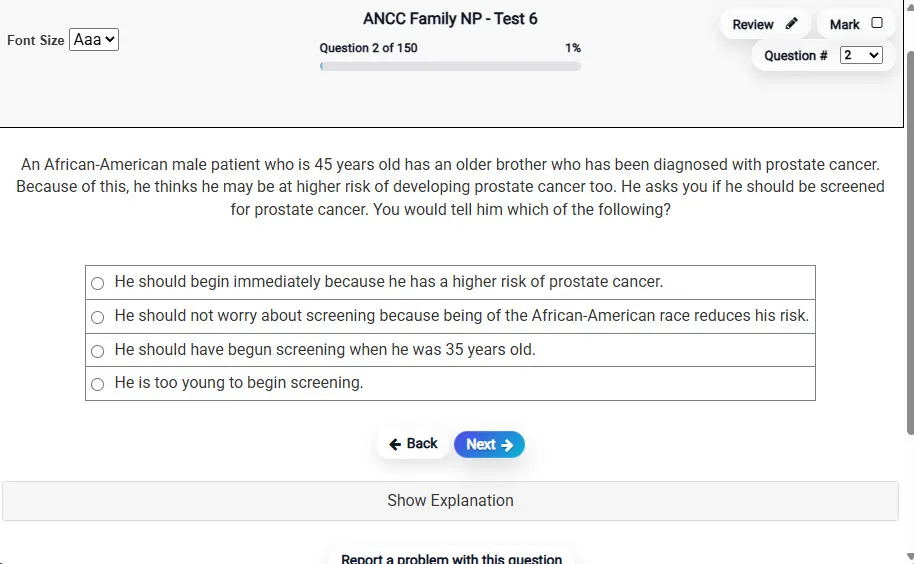
Answering a Question screen – Multiple-choice item view with navigation controls and progress tracker.
Answering a Question Multiple-choice item view with navigation controls and progress tracker.

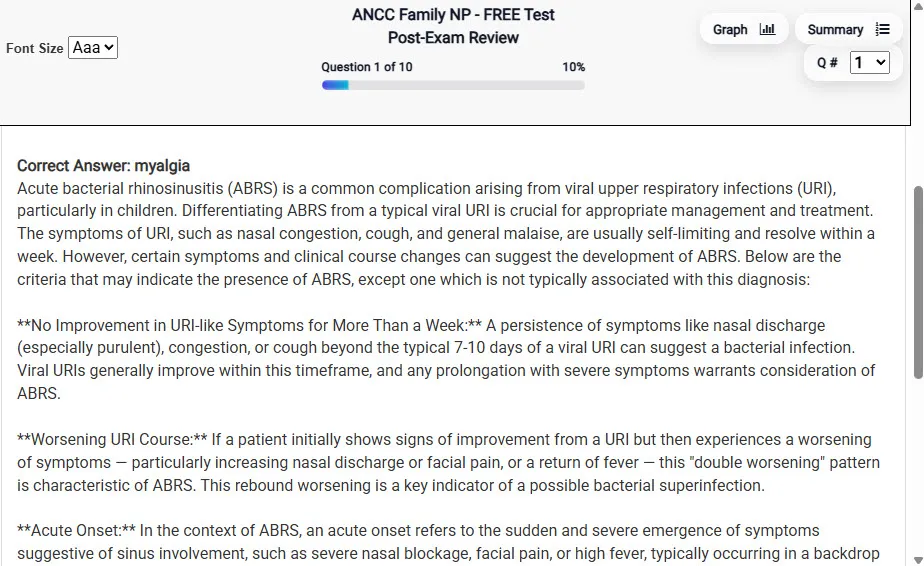
                           Detailed Explanation screen – 
                         Review mode showing chosen answer and rationale and references.
Detailed Explanation Review mode showing chosen answer and rationale and references.

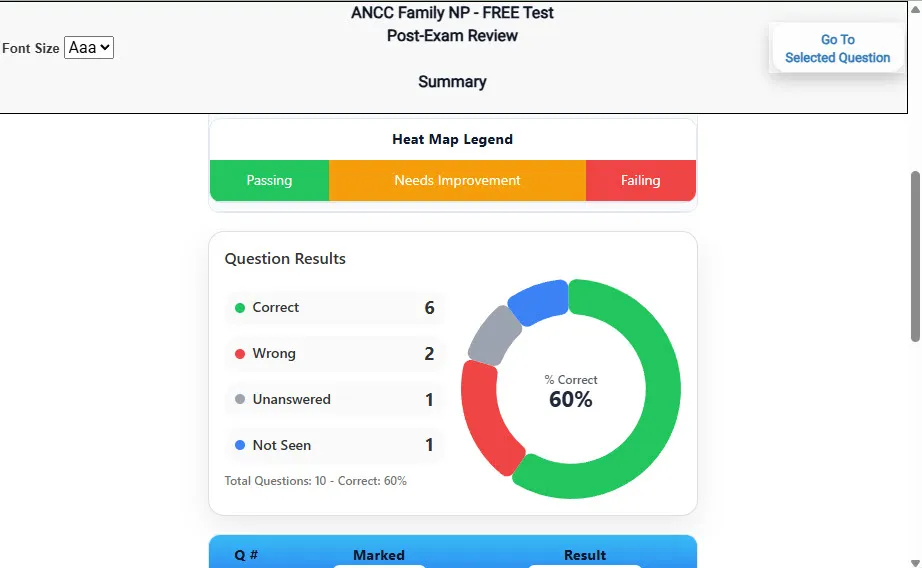
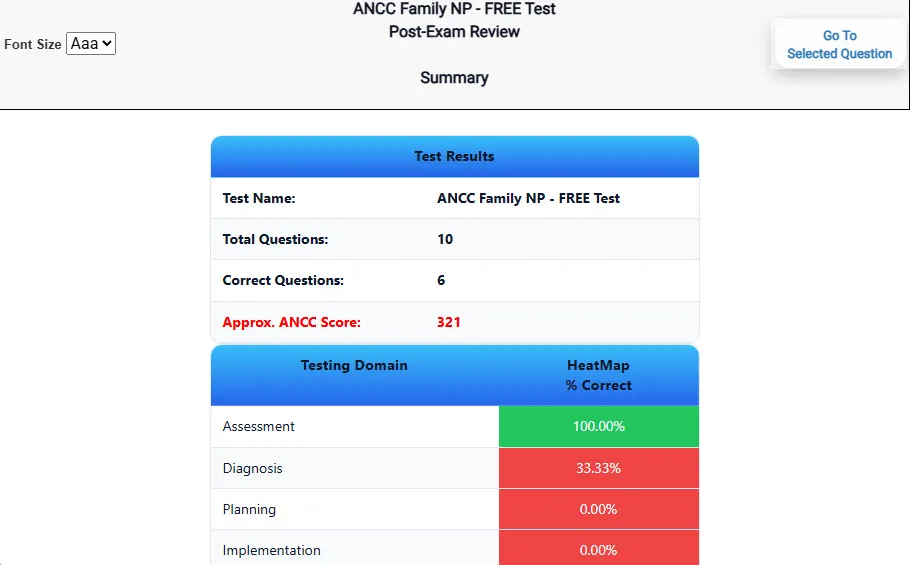
                           Review Summary 1 screen – 
                         Summary with counts for correct/wrong/unanswered and not seen items.
Review Summary 1 Summary with counts for correct/wrong/unanswered and not seen items.

                           Review Summary 2 screen – 
                         Advanced summary with category/domain breakdown and performance insights.
Review Summary 2 Advanced summary with category/domain breakdown and performance insights.

What Each Screen Shows

Answer Question Screen

  • Clean multiple-choice interface with progress bar.
  • Mark for review feature.
  • Matches real test pacing.

Detailed Explanation

  • Correct answer plus rationale.
  • Key concepts and guidelines highlighted.
  • Move between questions to fill knowledge gaps.

Review Summary 1

  • Overall results with total questions and scaled score.
  • Domain heatmap shows strengths and weaknesses.
  • Quick visual feedback on study priorities.

Review Summary 2

  • Chart of correct, wrong, unanswered, not seen.
  • Color-coded results for easy review.
  • Links back to missed items.

Top 10 Reasons to Use Exam Edge for your TExES Reading Specialist Exam Prep

  1. Focused on the TExES Reading Specialist Exam

    Our practice tests are built specifically for the TExES Reading Specialist exam — every question mirrors the real topics, format, and difficulty so you're studying exactly what matters.

  2. Real Exam Simulation

    We match the per-question time limits and pressure of the actual TExES exam, so test day feels familiar and stress-free.

  3. 20 Full Practice Tests & 2,000 Unique Questions

    You'll have more than enough material to master every TExES Reading Specialist concept — no repeats, no fluff.

  4. Lower Cost Than a Retake

    Ordering 5 practice exams costs less than retaking the TExES Reading Specialist exam after a failure. One low fee could save you both time and money.

  5. Flexible Testing

    Need to step away mid-exam? Pick up right where you left off — with your remaining time intact.

  6. Instant Scoring & Feedback

    See your raw score and an estimated TExES Reading Specialist score immediately after finishing each practice test.

  7. Detailed Explanations for Every Question

    Review correct and incorrect answers with clear, step-by-step explanations so you truly understand each topic.

  8. Trusted & Accredited

    We're fully accredited by the Better Business Bureau and uphold the highest standards of trust and transparency.

  9. Web-Based & Always Available

    No software to install. Access your TExES Reading Specialist practice exams 24/7 from any computer or mobile device.

  10. Expert Support When You Need It

    Need extra help? Our specialized tutors are highly qualified and ready to support your TExES exam prep.


Pass the TExES Reading Specialist Exam with Realistic Practice Tests from Exam Edge

Preparing for your upcoming TExES Reading Specialist (151) Certification Exam can feel overwhelming — but the right practice makes all the difference. Exam Edge gives you the tools, structure, and confidence to pass on your first try. Our online practice exams are built to match the real TExES Reading Specialist exam in content, format, and difficulty.

  • 📝 20 TExES Reading Specialist Practice Tests: Access 20 full-length exams with 100 questions each, covering every major TExES Reading Specialist topic in depth.
  • Instant Online Access: Start practicing right away — no software, no waiting.
  • 🧠 Step-by-Step Explanations: Understand the reasoning behind every correct answer so you can master TExES Reading Specialist exam concepts.
  • 🔄 Retake Each Exam Up to 4 Times: Build knowledge through repetition and track your improvement over time.
  • 🌐 Web-Based & Available 24/7: Study anywhere, anytime, on any device.
  • 🧘 Boost Your Test-Day Confidence: Familiarity with the TExES format reduces anxiety and helps you perform under pressure.

These TExES Reading Specialist practice exams are designed to simulate the real testing experience by matching question types, timing, and difficulty level. This approach helps you get comfortable not just with the exam content, but also with the testing environment, so you walk into your exam day focused and confident.

Exam Edge TEXES Reviews


I usually do not have trouble passing the Texes test, but I was very nervous about the principal's exam. I was very pleased with the testing materials I found on this site. The scoring made it very easy for me to ensure I was growing. I was able to see what I missed and learned new material. Also, b ...
Read More
Michelle , Texes

Hey Exam Edge, just a big thanks to you! Only having 48 hours to prepare I was totally freaking! I graduated from college in 1983 so I needed a basic refresher and you guys did just that. I passed with flying colors...

Susan, Texes

I had tried two other types of tests and would come within 15 points or so from passing using other software to study. I decided to try this site for a new exam I was preparing for. (BAM), I passed it on the first try and now can hold a probationary certificate in the State of Texas.

Patricia , San Antonio

I just want to take a second and thank Exam Edge for providing me with the content needed to pass a test! I took 3 of your practice tests, passed my Texes exam on my first try! You provided me with all the information needed to carry on my career! I've already referred other teachers! Thank you agai ...
Read More
Brett , Texas

Great exam site that helped me pass my tests.

June , Murphy, Texas

Dear Exam Edge, I passed my exam on the first attempt with a score of 271/300 (exactly what the practice tests showed). Your practice tests were excellent and very representative of the exam. They helped my preparation and focus my study. Without question of all the test aids yours was head and shou ...
Read More
Donald , Beaumont Texas


TExES Reading Specialist Aliases Test Name

Here is a list of alternative names used for this exam.

  • TExES Reading Specialist
  • TExES Reading Specialist test
  • TExES Reading Specialist Certification Test
  • TEXES
  • TEXES 151
  • 151 test
  • TExES Reading Specialist (151)
  • TExES Reading Specialist certification