This is the content of the pop-over!

TExES Science 4-8 (116) Practice Tests & Test Prep by Exam Edge


TExES Science 4-8  product image
(4.8)
Based on 29 Reviews

  • Real Exam Simulation: Timed questions and matching content build comfort for your TExES Science 4-8 test day.
  • Instant, 24/7 Access: Web-based TExES Science 4-8 practice exams with no software needed.
  • Clear Explanations: Step-by-step answers and explanations for your TExES exam to strengthen understanding.
  • Boosted Confidence: Reduces anxiety and improves test-taking skills to ace your TExES Science 4-8 (116).

Featured on

TExES Science 4-8 Online Practice Test Bundles

BEST VALUE
15 practice tests

$149.25

$599.25

SAVE $450

Only $9.95 per test!

  • 100% Pass Guarantee
  • 15 online practice tests
  • 100 questions per test
  • Bonus: 100 Flash Cards + Study Guide
  • Instant access
  • Detailed Explanations
  • Practice tests never expire
  • Timed, untimed, or study guide mode
MOST POPULAR
10 practice tests

$99.50

$399.50

SAVE $300

Only $9.95 per test!

  • 10 online practice tests
  • 100 questions per test
  • Bonus: 100 Flash Cards + Study Guide
  • Instant access
  • Detailed Explanations
  • Practice tests never expire
  • Timed, untimed, or study guide mode
5 practice tests

$69.75

$199.75

SAVE $130

Only $13.95 per test!

  • 5 online practice tests
  • 100 questions per test
  • Bonus: 100 Flash Cards
  • Instant access
  • Detailed Explanations
  • Practice tests never expire
  • Timed, untimed, or study guide mode
1 practice test

$39.95

  • 1 online practice test
  • 100 questions per test
  • Instant access
  • Detailed Explanations
  • Practice tests never expire
  • Timed, untimed, or study guide mode
Quick Select
Tap to choose a bundle

** All Prices are in US Dollars (USD) **


TExES Science 4-8 (116) Resources

Jump to the section you need most.

Understanding the exact breakdown of the TExES Science 4-8 test will help you know what to expect and how to most effectively prepare. The TExES Science 4-8 has 100 multiple-choice questions . The exam will be broken down into the sections below:

TExES Science 4-8 Exam Blueprint
Domain Name % Number of
Questions
Scientific Inquiry and Processes 22% 22
Physical Science 22% 22
Life Science 22% 22
Earth and Space Science 22% 22
Science Learning - Instruction Assessment 13% 13

TExES Science 4-8 Study Tips by Domain

  • Identify dependent/independent variables and controlled variables before interpreting data; red flag: changing more than one factor means you can’t claim causation.
  • Use a testable, falsifiable hypothesis framed as an “if–then” relationship tied to measurable variables; common trap: writing predictions or opinions that can’t be tested.
  • Judge data quality by sample size, repeated trials, and measurement precision; priority rule: conclusions should match the strength of the evidence, not a single trial or outlier.
  • Distinguish observations (directly sensed/measured) from inferences (interpretations) and models; red flag: treating a model or diagram as the phenomenon itself.
  • Select appropriate tools/units (SI where applicable) and attend to significant figures and error; common trap: mixing units or over-reporting precision beyond the instrument’s resolution.
  • Apply lab safety and ethical practices (PPE, proper disposal, humane treatment of organisms) during investigations; contraindication: any procedure that creates unnecessary risk or violates district safety protocols.
  • Use particle models to explain phase changes and physical vs. chemical changes; red flag: claiming matter is “lost” when it dissolves or changes state—mass is conserved in a closed system.
  • Apply conservation of mass and energy in simple systems (e.g., heating/cooling, mixing); common trap: confusing heat with temperature—temperature measures average kinetic energy, while heat is energy transfer.
  • Predict motion with balanced/unbalanced forces and relate force, mass, and acceleration; priority rule: always draw a free-body diagram first or you’ll miss normal/friction forces.
  • Work with speed, velocity, and acceleration using graphs and units; red flag: mixing up slope and area—slope of a position-time graph is velocity, and area under a velocity-time graph is displacement.
  • Describe energy forms and transfers (conduction, convection, radiation) and interpret simple circuits; common trap: treating “current used up” in a circuit—charge is conserved and current is the same in series.
  • Use wave properties (amplitude, frequency, wavelength) to compare sound and light; threshold cue: if frequency increases and wave speed is constant, wavelength must decrease (v = fλ).
  • Distinguish prokaryotic vs. eukaryotic cells using evidence (nucleus/organelles, DNA location, cell wall composition)—red flag: calling mitochondria or chloroplasts “in prokaryotes.”
  • Relate structure to function across levels (cell → tissue → organ → organ system) and emphasize homeostasis—common trap: listing parts without explaining how feedback maintains stable internal conditions.
  • Use genetics to predict inheritance (Punnett squares for simple traits, dominant/recessive, sex-linked basics) and interpret pedigrees—priority rule: genotype ratios vs. phenotype ratios must be stated correctly.
  • Trace matter and energy in ecosystems (photosynthesis/respiration, food webs, trophic levels, cycles of carbon and nitrogen)—red flag: claiming energy cycles or that “energy increases” at higher trophic levels.
  • Explain evolution with multiple lines of evidence (natural selection, adaptation, fossil record, homologous structures, genetic similarity)—common trap: saying individuals evolve or that organisms “try to adapt” within a lifetime.
  • Compare reproduction and development (asexual vs. sexual, mitosis vs. meiosis, plant vs. animal life cycles) and link meiosis to variation—threshold cue: meiosis reduces chromosome number; mixing it up with mitosis is a frequent miss.
  • Apply the rock cycle and plate tectonics to explain landforms (mountain building, rifting, trenches) and geologic events; red flag: confusing weathering/erosion/deposition (surface) with metamorphism/melting (heat/pressure).
  • Interpret topographic and geologic maps (contours, profiles, strike/dip, fossils) to infer relative age and history; common trap: assuming the steepest slope is where contour lines are farthest apart (it’s where they’re closest).
  • Use the Law of Superposition, cross-cutting relationships, and index fossils for relative dating, and connect to absolute dating at a high level; priority rule: igneous intrusions/faults are younger than the rocks they cut.
  • Connect atmosphere, hydrosphere, geosphere, and biosphere interactions to weather patterns, ocean currents, and climate; red flag: mixing up weather (short-term conditions) versus climate (long-term patterns, typically 30+ years).
  • Model the Sun–Earth–Moon system for seasons, phases, eclipses, and tides; common trap: attributing seasons to Earth’s distance from the Sun rather than tilt and angle of sunlight.
  • Analyze resource use and Earth systems impacts (groundwater, soils, minerals, energy, natural hazards) with mitigation strategies; threshold cue: recognize that groundwater recharge is slow and overpumping can cause subsidence and reduced water quality.
  • Plan lessons around TEKS-aligned, measurable objectives (content + process) and match the assessment to the objective; red flag: activities that are “fun” but can’t be graded against a clear criterion.
  • Use the 5E/inquiry cycle to move from evidence to explanation and explicitly check for misconceptions; common trap: letting labs stop at “what happened” without requiring claims supported by data.
  • Differentiate with targeted supports (sentence stems, graphic organizers, multiple representations) while keeping the same science expectation; priority rule: modify access, not the core learning target.
  • Build academic language intentionally (Tier 2 and Tier 3) through reading, writing, and discussion routines; red flag: vocabulary taught as isolated definitions instead of used in explanations and arguments.
  • Use formative assessment frequently (exit tickets, hinge questions, quick probes) to adjust instruction immediately; common trap: relying on one end-of-unit test to diagnose gaps.
  • Design fair and valid assessments with clear rubrics for CER, models, and lab reports and check for bias or construct-irrelevant difficulty; red flag: grading on neatness/format rather than scientific reasoning and evidence.


Built to Fit Into Your Busy Life

Everything you need to prepare with confidence—without wasting a minute.

Three Study Modes

Timed, No Time Limit, or Explanation mode.

Actionable Analytics

Heatmaps and scaled scores highlight weak areas.

High-Yield Rationales

Concise explanations emphasize key concepts.

Realistic Interface

Matches the feel of the actual exam environment.

Accessible by Design

Clean layout reduces cognitive load.

Anytime, Anywhere

Web-based access 24/7 on any device.
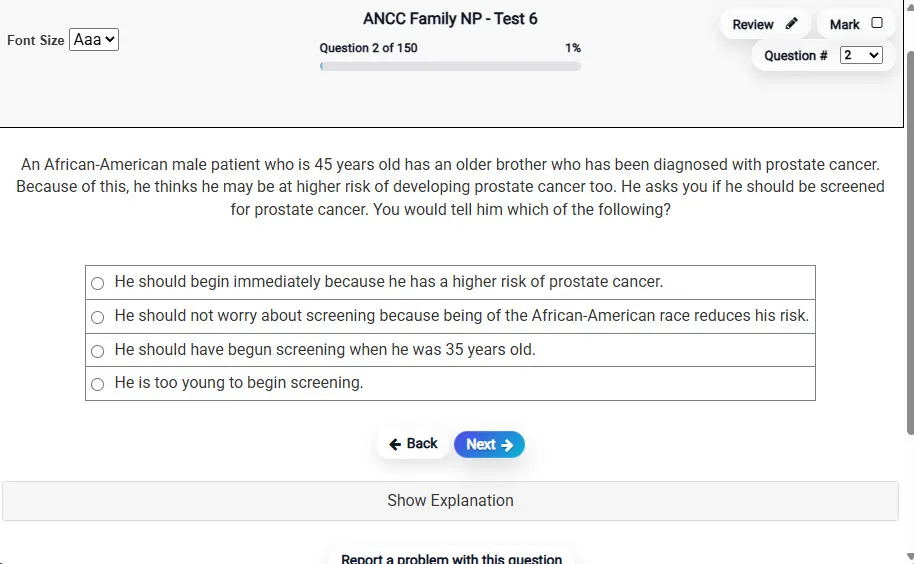
Answering a Question screen – Multiple-choice item view with navigation controls and progress tracker.
Answering a Question Multiple-choice item view with navigation controls and progress tracker.

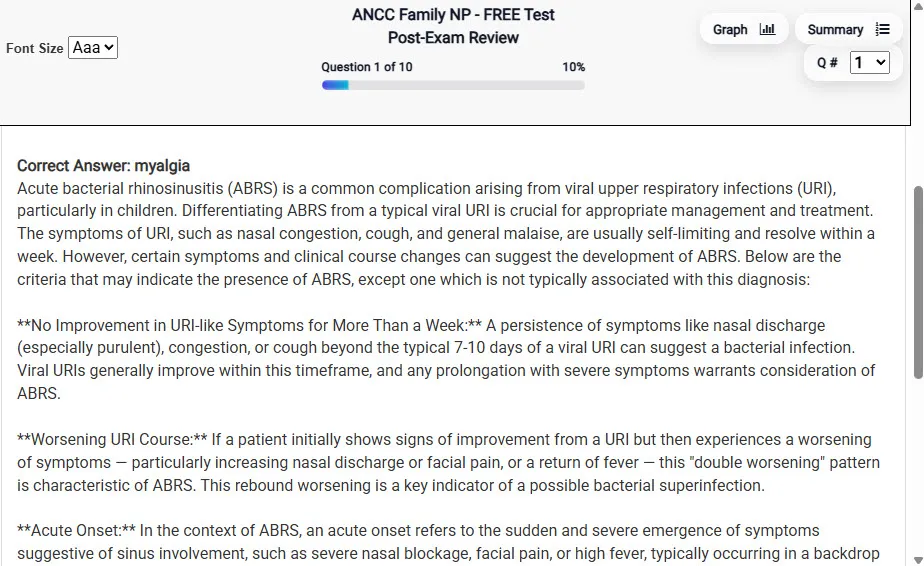
                           Detailed Explanation screen – 
                         Review mode showing chosen answer and rationale and references.
Detailed Explanation Review mode showing chosen answer and rationale and references.

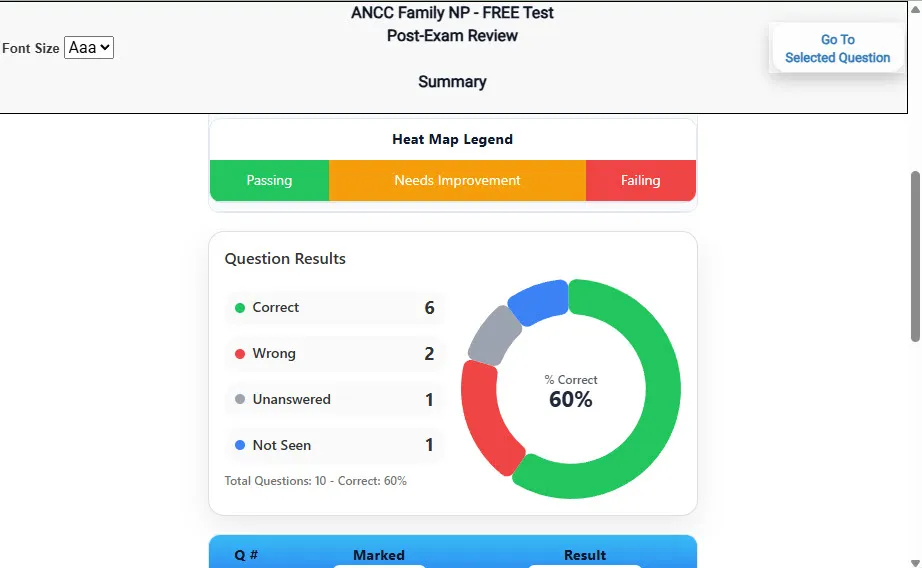
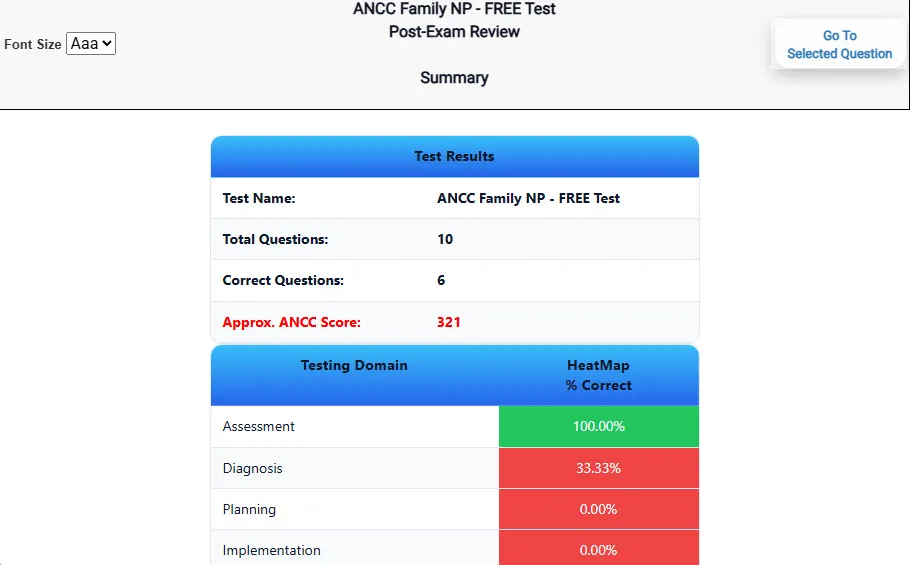
                           Review Summary 1 screen – 
                         Summary with counts for correct/wrong/unanswered and not seen items.
Review Summary 1 Summary with counts for correct/wrong/unanswered and not seen items.

                           Review Summary 2 screen – 
                         Advanced summary with category/domain breakdown and performance insights.
Review Summary 2 Advanced summary with category/domain breakdown and performance insights.

What Each Screen Shows

Answer Question Screen

  • Clean multiple-choice interface with progress bar.
  • Mark for review feature.
  • Matches real test pacing.

Detailed Explanation

  • Correct answer plus rationale.
  • Key concepts and guidelines highlighted.
  • Move between questions to fill knowledge gaps.

Review Summary 1

  • Overall results with total questions and scaled score.
  • Domain heatmap shows strengths and weaknesses.
  • Quick visual feedback on study priorities.

Review Summary 2

  • Chart of correct, wrong, unanswered, not seen.
  • Color-coded results for easy review.
  • Links back to missed items.

Top 10 Reasons to Use Exam Edge for your TExES Science 4-8 Exam Prep

  1. Focused on the TExES Science 4-8 Exam

    Our practice tests are built specifically for the TExES Science 4-8 exam — every question mirrors the real topics, format, and difficulty so you're studying exactly what matters.

  2. Real Exam Simulation

    We match the per-question time limits and pressure of the actual TExES exam, so test day feels familiar and stress-free.

  3. 15 Full Practice Tests & 1,500 Unique Questions

    You'll have more than enough material to master every TExES Science 4-8 concept — no repeats, no fluff.

  4. Lower Cost Than a Retake

    Ordering 5 practice exams costs less than retaking the TExES Science 4-8 exam after a failure. One low fee could save you both time and money.

  5. Flexible Testing

    Need to step away mid-exam? Pick up right where you left off — with your remaining time intact.

  6. Instant Scoring & Feedback

    See your raw score and an estimated TExES Science 4-8 score immediately after finishing each practice test.

  7. Detailed Explanations for Every Question

    Review correct and incorrect answers with clear, step-by-step explanations so you truly understand each topic.

  8. Trusted & Accredited

    We're fully accredited by the Better Business Bureau and uphold the highest standards of trust and transparency.

  9. Web-Based & Always Available

    No software to install. Access your TExES Science 4-8 practice exams 24/7 from any computer or mobile device.

  10. Expert Support When You Need It

    Need extra help? Our specialized tutors are highly qualified and ready to support your TExES exam prep.


Pass the TExES Science 4-8 Exam with Realistic Practice Tests from Exam Edge

Preparing for your upcoming TExES Science 4-8 (116) Certification Exam can feel overwhelming — but the right practice makes all the difference. Exam Edge gives you the tools, structure, and confidence to pass on your first try. Our online practice exams are built to match the real TExES Science 4-8 exam in content, format, and difficulty.

  • 📝 15 TExES Science 4-8 Practice Tests: Access 15 full-length exams with 100 questions each, covering every major TExES Science 4-8 topic in depth.
  • Instant Online Access: Start practicing right away — no software, no waiting.
  • 🧠 Step-by-Step Explanations: Understand the reasoning behind every correct answer so you can master TExES Science 4-8 exam concepts.
  • 🔄 Retake Each Exam Up to 4 Times: Build knowledge through repetition and track your improvement over time.
  • 🌐 Web-Based & Available 24/7: Study anywhere, anytime, on any device.
  • 🧘 Boost Your Test-Day Confidence: Familiarity with the TExES format reduces anxiety and helps you perform under pressure.

These TExES Science 4-8 practice exams are designed to simulate the real testing experience by matching question types, timing, and difficulty level. This approach helps you get comfortable not just with the exam content, but also with the testing environment, so you walk into your exam day focused and confident.


Exam Edge TEXES Reviews


Just received my test scores. 273/ 300 on my Science Composite (236) exam first attempt. These practice exams were a huge help! 

Michael , Texes

Helped me to pass my test

Jordan , Bedford, Texas

I just wanted to praise this company for creating helpful practice tests. The first time I took the librarian certification test I scored a 233 and you have to have a 240 to pass. I was so sad and discouraged. I had hoped my college courses would have prepared me for the test. I didn't know what ...
Read More
Jennifer , Dallas

Great exam site that helped me pass my tests.

June , Murphy, Texas

Dear Exam Edge, I passed my exam on the first attempt with a score of 271/300 (exactly what the practice tests showed). Your practice tests were excellent and very representative of the exam. They helped my preparation and focus my study. Without question of all the test aids yours was head and shou ...
Read More
Donald , Beaumont Texas

Just wanted to say thanks for your helpful product. I purchased and took 5 practice exams to help prepare for the TEXES Math 7-12 235 exam, and am happy to say I passed the certification exam last week on the first try. Practice with your tests definitely was a big factor in preparing successfully. ...
Read More
Mobi , Dallas


TExES Science 4-8 Aliases Test Name

Here is a list of alternative names used for this exam.

  • TExES Science 4-8
  • TExES Science 4-8 test
  • TExES Science 4-8 Certification Test
  • TEXES
  • TEXES 116
  • 116 test
  • TExES Science 4-8 (116)
  • TExES Science 4-8 certification