This is the content of the pop-over!

TExES Physics/Mathematics 7-12 (243) Practice Tests & Test Prep by Exam Edge


TExES Physics/Mathematics 7-12  product image
(4.8)
Based on 29 Reviews

  • Real Exam Simulation: Timed questions and matching content build comfort for your TExES Physics/Mathematics 7-12 test day.
  • Instant, 24/7 Access: Web-based TExES Physics/Mathematics 7-12 practice exams with no software needed.
  • Clear Explanations: Step-by-step answers and explanations for your TExES exam to strengthen understanding.
  • Boosted Confidence: Reduces anxiety and improves test-taking skills to ace your TExES Physics/Mathematics 7-12 (243).

Featured on

TExES Physics/Mathematics 7-12 Online Practice Test Bundles

BEST VALUE
10 practice tests

$99.50

$399.50

SAVE $300

Only $9.95 per test!

  • 100% Pass Guarantee
  • 10 online practice tests
  • 120 questions per test
  • Bonus: 100 Flash Cards + Study Guide
  • Instant access
  • Detailed Explanations
  • Practice tests never expire
  • Timed, untimed, or study guide mode
5 practice tests

$69.75

$199.75

SAVE $130

Only $13.95 per test!

  • 5 online practice tests
  • 120 questions per test
  • Bonus: 100 Flash Cards + Study Guide
  • Instant access
  • Detailed Explanations
  • Practice tests never expire
  • Timed, untimed, or study guide mode
1 practice test

$39.95

  • 1 online practice test
  • 120 questions per test
  • Instant access
  • Detailed Explanations
  • Practice tests never expire
  • Timed, untimed, or study guide mode
Quick Select
Tap to choose a bundle

** All Prices are in US Dollars (USD) **


TExES Physics/Mathematics 7-12 (243) Resources

Jump to the section you need most.

Understanding the exact breakdown of the TExES Physics/Mathematics 7-12 test will help you know what to expect and how to most effectively prepare. The TExES Physics/Mathematics 7-12 has 120 multiple-choice questions . The exam will be broken down into the sections below:

TExES Physics/Mathematics 7-12 Exam Blueprint
Domain Name % Number of
Questions
Number Concepts 7% 8
Patterns and Algebra 16% 19
Geometry and Measurement 10% 12
Probability and Statistics 7% 8
Mathematical Processes and Perspectives 5% 6
Mathematical Learning - Instruction Assessment 5% 6
Scientific Inquiry and Processes 7% 8
Physics 39% 47
Science Learning - Instruction Assessment 4% 5

TExES Physics/Mathematics 7-12 Study Tips by Domain

  • Convert fluently among fractions, decimals, and percents, and justify equivalence; red flag: treating repeating decimals as “rounded” rather than exact rational numbers.
  • Apply number properties (commutative, associative, distributive, identity, inverse) to simplify or rewrite expressions; common trap: misusing distribution over exponents (e.g., (a+b)2 ≠ a2+b2).
  • Reason with integer operations and absolute value in context (distance vs. direction); priority rule: keep track of sign conventions before computing to avoid “double negative” errors.
  • Work with rational and irrational numbers on the number line, including approximations and interval notation; threshold cue: specify an error bound (e.g., within 0.01) when approximating √2 or π.
  • Use exponents and radicals correctly, including scientific notation and order of operations; red flag: incorrect handling of negative exponents or confusing (10-3) with −103.
  • Analyze proportional reasoning and rates (unit rate, scale factors, dimensional analysis); common trap: canceling units incorrectly or mixing additive and multiplicative comparisons (e.g., “twice as much” vs. “2 more”).
  • Translate between representations (equation, table, graph, verbal) for linear, quadratic, polynomial, rational, exponential, logarithmic, and trigonometric models; red flag: mismatching domain restrictions when moving from context to equation.
  • Solve equations and inequalities (including systems) using algebraic and graphical methods and verify solutions; common trap: introducing extraneous solutions when squaring both sides or clearing denominators.
  • Analyze function behavior using transformations, intercepts, end behavior, and key features (e.g., vertex, asymptotes, periodicity); priority rule: state domain and range explicitly when shifting/scaling functions.
  • Use factoring, completing the square, and polynomial/rational simplification strategically; red flag: canceling factors across a sum (e.g., treating (x+1)/(x+1)+1 as cancelable) rather than factoring first.
  • Apply sequences and series (arithmetic, geometric) and recursive definitions to model patterns; threshold cue: check whether a geometric series is finite or infinite before using a sum formula (requires |r|<1 for convergence).
  • Justify algebraic reasoning with properties (distributive, inverse, exponent/log rules) and communicate constraints; common trap: applying log(a+b)=log a+log b or exponent rules without verifying positivity and base conditions.
  • Use the Pythagorean Theorem and distance formula fluently in coordinate problems; red flag: forgetting to square root at the end when a length (not a squared length) is asked.
  • Apply similarity and congruence criteria (SSS, SAS, ASA, AAS, HL; AA similarity) to justify results; common trap: assuming triangles are similar from one equal angle without a second condition.
  • Compute area and volume with correct unit reasoning (e.g., square vs. cubic units); priority rule: always convert units before applying formulas to avoid scale-factor errors.
  • Use angle relationships (parallel lines, transversals, interior/exterior angles, polygon angle sums); red flag: mixing up corresponding vs. alternate interior angles when identifying congruent angles.
  • Model transformations (translations, rotations, reflections, dilations) and their effects on orientation and scale; common trap: treating a dilation as preserving distances instead of multiplying by the scale factor.
  • Work with circles (arc length, sector area, chords, tangents, radian measure); threshold cue: ensure radian measure is used in s = rθ and A = ½r2θ — degrees require conversion.
  • Choose and justify the appropriate model (binomial vs. geometric vs. Poisson vs. normal approximation) based on conditions like independence and fixed n; red flag: using a normal approximation when np or n(1-p) is too small.
  • Compute and interpret conditional probability and independence using tables, trees, or Bayes’ theorem; common trap: confusing “independent” with “mutually exclusive” (they are rarely both true unless a probability is 0).
  • Distinguish and calculate measures of center and spread (mean/median, variance/standard deviation, IQR) and match them to distribution shape; priority rule: use median and IQR for skewed data or outliers.
  • Analyze data displays (histograms, boxplots, scatterplots) for shape, clusters, gaps, and outliers; red flag: inferring causation from correlation in a scatterplot.
  • Apply counting principles (permutations/combinations) and interpret results in context; common trap: forgetting whether order matters or double-counting when events overlap.
  • Make and critique statistical inferences (confidence intervals, hypothesis tests) with attention to assumptions and sampling; threshold cue: interpret significance via the given α (e.g., reject H0 only if p-value ≤ α).
  • Model real situations with appropriate representations (graph, table, equation, diagram) and state assumptions explicitly; red flag: jumping to a formula without defining variables, units, or constraints.
  • Use logical reasoning to justify conclusions (deductive and inductive) and connect steps with clear warrants; common trap: treating one example or a pattern as a proof.
  • Communicate mathematics precisely using correct notation and vocabulary, and interpret others’ reasoning accurately; cue: if the problem asks for “explain” or “justify,” a numeric answer alone is insufficient.
  • Apply multiple strategies and check for reasonableness (estimate, mental math, inverse operations, or alternate method); priority rule: always perform a quick sanity check to catch sign, scale, or domain errors.
  • Analyze and compare solution methods for efficiency and validity, including use of technology when appropriate; red flag: calculator output that violates constraints (e.g., extraneous solutions, wrong quadrant, non-integer when required).
  • Attend to structure and generalize results (identify invariants, symmetry, or functional relationships) to solve unfamiliar problems; common trap: over-generalizing from a special case (e.g., assuming linearity when data are merely increasing).
  • Plan instruction around clear, measurable objectives aligned to the TEKS and the TExES emphasis on conceptual understanding over rote procedures; red flag: lessons that only practice algorithms without requiring explanation or justification.
  • Use multiple representations (symbolic, graphical, numerical, verbal, manipulatives/technology) and explicitly connect them; common trap: treating a graphing-calculator output as “the answer” without interpretation or reasonableness checks.
  • Differentiate with targeted scaffolds (sentence stems for reasoning, worked examples fading to independence, strategic grouping) while maintaining grade-level rigor; priority rule: adjust access supports, not the mathematical demand.
  • Embed formative assessment (hinge questions, exit tickets, error analysis) to diagnose misconceptions in real time; red flag: moving on because “most got it” without evidence from all students.
  • Use assessment tasks that require reasoning and communication (justify, critique, model, compare methods) with transparent rubrics; common trap: items that can be answered by guessing or plugging numbers with no explanation.
  • Address common student misconceptions intentionally (e.g., equals sign as a process, slope as “rise/run” without context, area vs. perimeter confusion) and plan corrective feedback; contraindication: correcting only the final answer rather than the faulty reasoning step.
  • Design investigations with controlled variables, clear operational definitions, and repeatable procedures; red flag: changing more than one independent variable at a time undermines causal claims.
  • Use SI units, dimensional analysis, and significant figures consistently across calculations and reporting; common trap: mixing prefixes (e.g., m, cm, mm) or over-reporting digits beyond instrument precision.
  • Evaluate data quality using accuracy vs. precision, calibration checks, and uncertainty estimates; priority rule: report results with uncertainty (absolute or percent) and match precision to the least-precise measurement.
  • Interpret graphs and models by identifying slope, intercepts, and linearization (e.g., log-log, semi-log) when appropriate; red flag: extrapolating beyond the measured range without justification.
  • Apply statistical reasoning to experimental results (mean, spread, outliers, and trendlines) to support or refute hypotheses; common trap: treating correlation as causation or ignoring systematic error when data are consistent but wrong.
  • Follow laboratory safety and ethical practices for materials, equipment, and data reporting; contraindication: bypassing PPE, ignoring MSDS/SDS guidance, or altering data to “fit” expected outcomes.
  • Use conservation laws strategically: if no external net force/torque acts on a system, linear/angular momentum is conserved; red flag—including external friction/normal forces from the environment in the “system” by accident.
  • Apply kinematics only under stated assumptions (e.g., constant acceleration) and choose a sign convention first; common trap—mixing displacement with distance or letting “up” switch signs mid-problem.
  • For circuits, check series/parallel logic and units: V in volts, I in amps, R in ohms; red flag—treating current as “used up” or forgetting that parallel branches share the same voltage.
  • In waves/optics, use v = fλ and remember frequency stays constant across media while speed and wavelength change; common trap—changing f during refraction or confusing real vs. virtual images with sign conventions.
  • In thermodynamics, track work/heat sign and state vs. path functions: internal energy depends only on state, while Q and W are path-dependent; red flag—using PV = nRT for non-ideal situations without being told.
  • For modern/atomic topics, use threshold rules: photoelectric effect requires hf ≥ Φ and increasing intensity raises electron count not max kinetic energy; common trap—claiming brighter light increases stopping potential at fixed frequency.
  • Align instruction to TEKS and the specific learning objective before choosing an activity; red flag: a “fun lab” with no explicit content target or measurable outcome.
  • Use formative checks (e.g., hinge questions, quick error analysis) to adjust instruction in real time; common trap: waiting until the unit test to discover misconceptions.
  • Design assessments that match the cognitive demand of instruction (conceptual, procedural, application); priority rule: don’t assess calculation-only if instruction emphasized models and explanations.
  • Plan accommodations and accessibility (ELL supports, IEP/504, lab safety constraints) without lowering the standard; red flag: modifying the task so it no longer measures the intended construct.
  • Provide feedback that is specific and actionable (what to fix and how) rather than grades alone; common trap: praising effort without identifying the science idea or skill that needs revision.
  • Use data from item analysis to reteach targeted misconceptions (e.g., confusing independent vs. dependent variables); threshold cue: if a large subset misses the same distractor, reteach that concept before moving on.


Built to Fit Into Your Busy Life

Everything you need to prepare with confidence—without wasting a minute.

Three Study Modes

Timed, No Time Limit, or Explanation mode.

Actionable Analytics

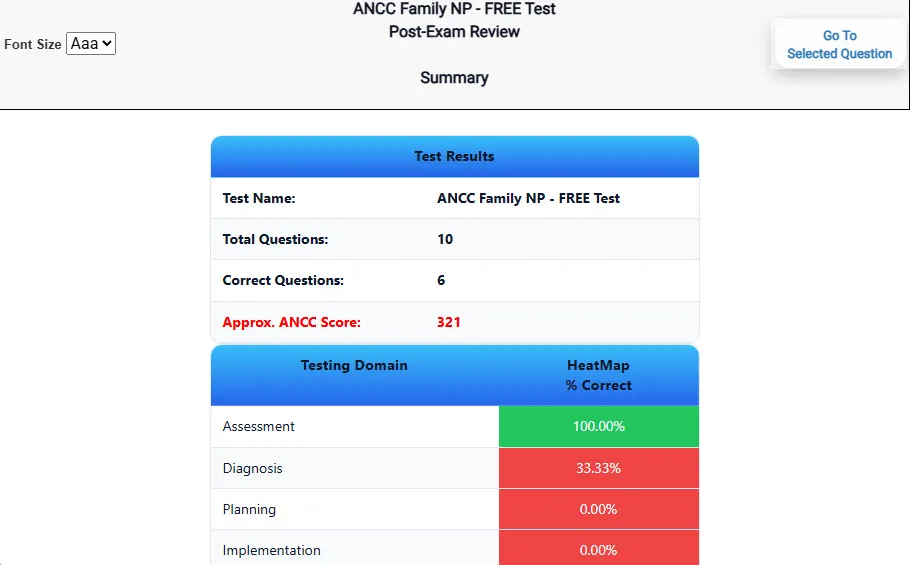
Heatmaps and scaled scores highlight weak areas.

High-Yield Rationales

Concise explanations emphasize key concepts.

Realistic Interface

Matches the feel of the actual exam environment.

Accessible by Design

Clean layout reduces cognitive load.

Anytime, Anywhere

Web-based access 24/7 on any device.
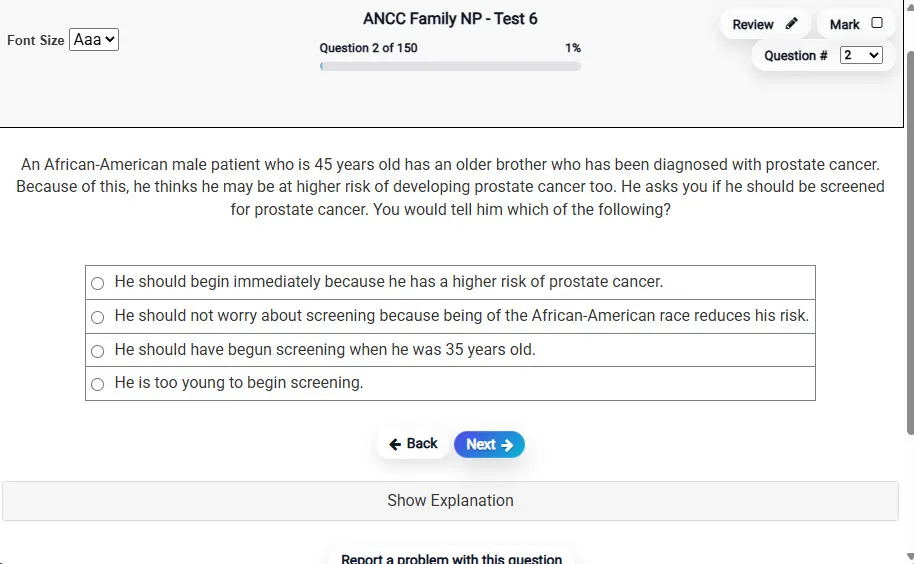
Answering a Question screen – Multiple-choice item view with navigation controls and progress tracker.
Answering a Question Multiple-choice item view with navigation controls and progress tracker.

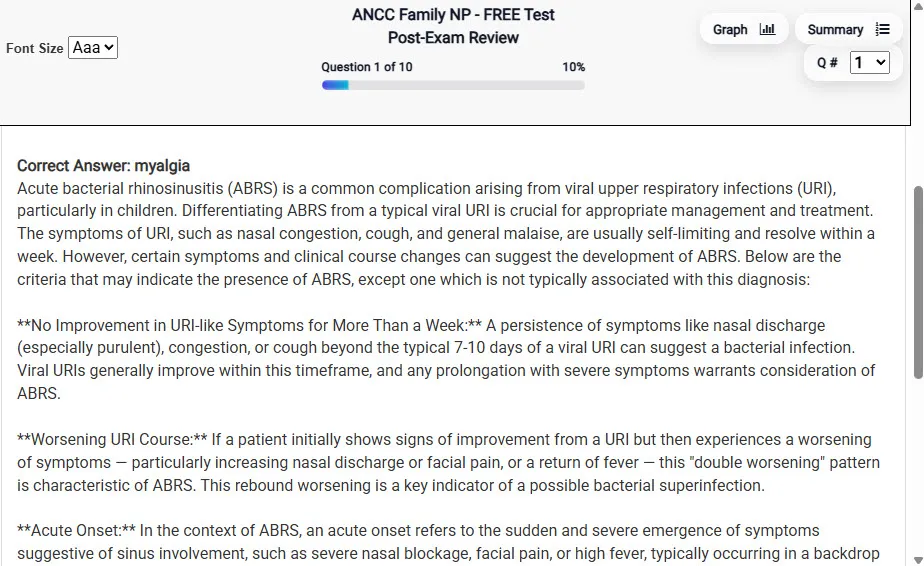
                           Detailed Explanation screen – 
                         Review mode showing chosen answer and rationale and references.
Detailed Explanation Review mode showing chosen answer and rationale and references.

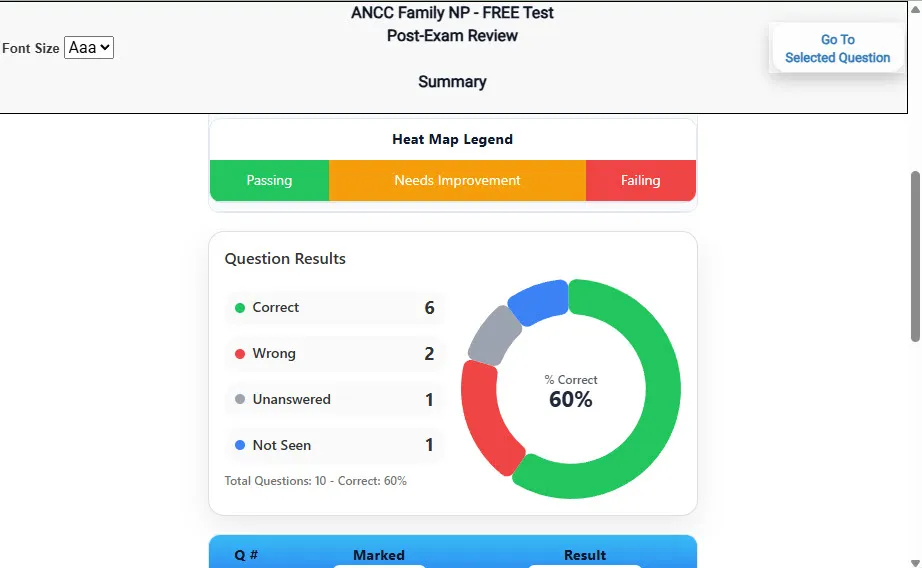
                           Review Summary 1 screen – 
                         Summary with counts for correct/wrong/unanswered and not seen items.
Review Summary 1 Summary with counts for correct/wrong/unanswered and not seen items.

                           Review Summary 2 screen – 
                         Advanced summary with category/domain breakdown and performance insights.
Review Summary 2 Advanced summary with category/domain breakdown and performance insights.

What Each Screen Shows

Answer Question Screen

  • Clean multiple-choice interface with progress bar.
  • Mark for review feature.
  • Matches real test pacing.

Detailed Explanation

  • Correct answer plus rationale.
  • Key concepts and guidelines highlighted.
  • Move between questions to fill knowledge gaps.

Review Summary 1

  • Overall results with total questions and scaled score.
  • Domain heatmap shows strengths and weaknesses.
  • Quick visual feedback on study priorities.

Review Summary 2

  • Chart of correct, wrong, unanswered, not seen.
  • Color-coded results for easy review.
  • Links back to missed items.

Top 10 Reasons to Use Exam Edge for your TExES Physics/Mathematics 7-12 Exam Prep

  1. Focused on the TExES Physics/Mathematics 7-12 Exam

    Our practice tests are built specifically for the TExES Physics/Mathematics 7-12 exam — every question mirrors the real topics, format, and difficulty so you're studying exactly what matters.

  2. Real Exam Simulation

    We match the per-question time limits and pressure of the actual TExES exam, so test day feels familiar and stress-free.

  3. 10 Full Practice Tests & 1,200 Unique Questions

    You'll have more than enough material to master every TExES Physics/Mathematics 7-12 concept — no repeats, no fluff.

  4. Lower Cost Than a Retake

    Ordering 5 practice exams costs less than retaking the TExES Physics/Mathematics 7-12 exam after a failure. One low fee could save you both time and money.

  5. Flexible Testing

    Need to step away mid-exam? Pick up right where you left off — with your remaining time intact.

  6. Instant Scoring & Feedback

    See your raw score and an estimated TExES Physics/Mathematics 7-12 score immediately after finishing each practice test.

  7. Detailed Explanations for Every Question

    Review correct and incorrect answers with clear, step-by-step explanations so you truly understand each topic.

  8. Trusted & Accredited

    We're fully accredited by the Better Business Bureau and uphold the highest standards of trust and transparency.

  9. Web-Based & Always Available

    No software to install. Access your TExES Physics/Mathematics 7-12 practice exams 24/7 from any computer or mobile device.

  10. Expert Support When You Need It

    Need extra help? Our specialized tutors are highly qualified and ready to support your TExES exam prep.


Pass the TExES Physics/Mathematics 7-12 Exam with Realistic Practice Tests from Exam Edge

Preparing for your upcoming TExES Physics/Mathematics 7-12 (243) Certification Exam can feel overwhelming — but the right practice makes all the difference. Exam Edge gives you the tools, structure, and confidence to pass on your first try. Our online practice exams are built to match the real TExES Physics/Mathematics 7-12 exam in content, format, and difficulty.

  • 📝 10 TExES Physics/Mathematics 7-12 Practice Tests: Access 10 full-length exams with 120 questions each, covering every major TExES Physics/Mathematics 7-12 topic in depth.
  • Instant Online Access: Start practicing right away — no software, no waiting.
  • 🧠 Step-by-Step Explanations: Understand the reasoning behind every correct answer so you can master TExES Physics/Mathematics 7-12 exam concepts.
  • 🔄 Retake Each Exam Up to 4 Times: Build knowledge through repetition and track your improvement over time.
  • 🌐 Web-Based & Available 24/7: Study anywhere, anytime, on any device.
  • 🧘 Boost Your Test-Day Confidence: Familiarity with the TExES format reduces anxiety and helps you perform under pressure.

These TExES Physics/Mathematics 7-12 practice exams are designed to simulate the real testing experience by matching question types, timing, and difficulty level. This approach helps you get comfortable not just with the exam content, but also with the testing environment, so you walk into your exam day focused and confident.

Exam Edge TEXES Reviews


I just wanted to praise this company for creating helpful practice tests. The first time I took the librarian certification test I scored a 233 and you have to have a 240 to pass. I was so sad and discouraged. I had hoped my college courses would have prepared me for the test. I didn't know what ...
Read More
Jennifer , Dallas

These practice tests were the key in my study preparation! I had been studying for months but continued to be on the borderline of passing. After taking a few of these tests I got a better idea of what I needed to learn and I excitedly can say that I just passed the TExES Science 8-12 test with a 90 ...
Read More
Meridith , TX

I am so glad that I found your website. It's been 25 years since I took most of the science courses that I had to review and become familiar with to pass the Texes Science 7-12 and I passed on the first try. I studied like crazy for two months, but your tests really helped to get me familiar with th ...
Read More
Caren, Texas

I purchased 10 tests to prepare for the TEXES Science 7-12 certification exam. I had earned a science education degree in 1997, but worked in law enforcement for 20 years. Your exams were an excellent source for study prep. On the first few tests, I scored in the high 230's. Using the results to gui ...
Read More
Jeffery, Arlington, TX

Just received my test scores. 273/ 300 on my Science Composite (236) exam first attempt. These practice exams were a huge help! 

Michael , Texes

Helped me to pass my test

Jordan , Bedford, Texas


TExES Physics/Mathematics 7-12 Aliases Test Name

Here is a list of alternative names used for this exam.

  • TExES Physics/Mathematics 7-12
  • TExES Physics/Mathematics 7-12 test
  • TExES Physics/Mathematics 7-12 Certification Test
  • TEXES
  • TEXES 243
  • 243 test
  • TExES Physics/Mathematics 7-12 (243)
  • TExES Physics/Mathematics 7-12 certification